
Certificate Fraud Prevention in 2026: Stopping AI Forgeries with Blockchain Verification
Published on May 6, 2026

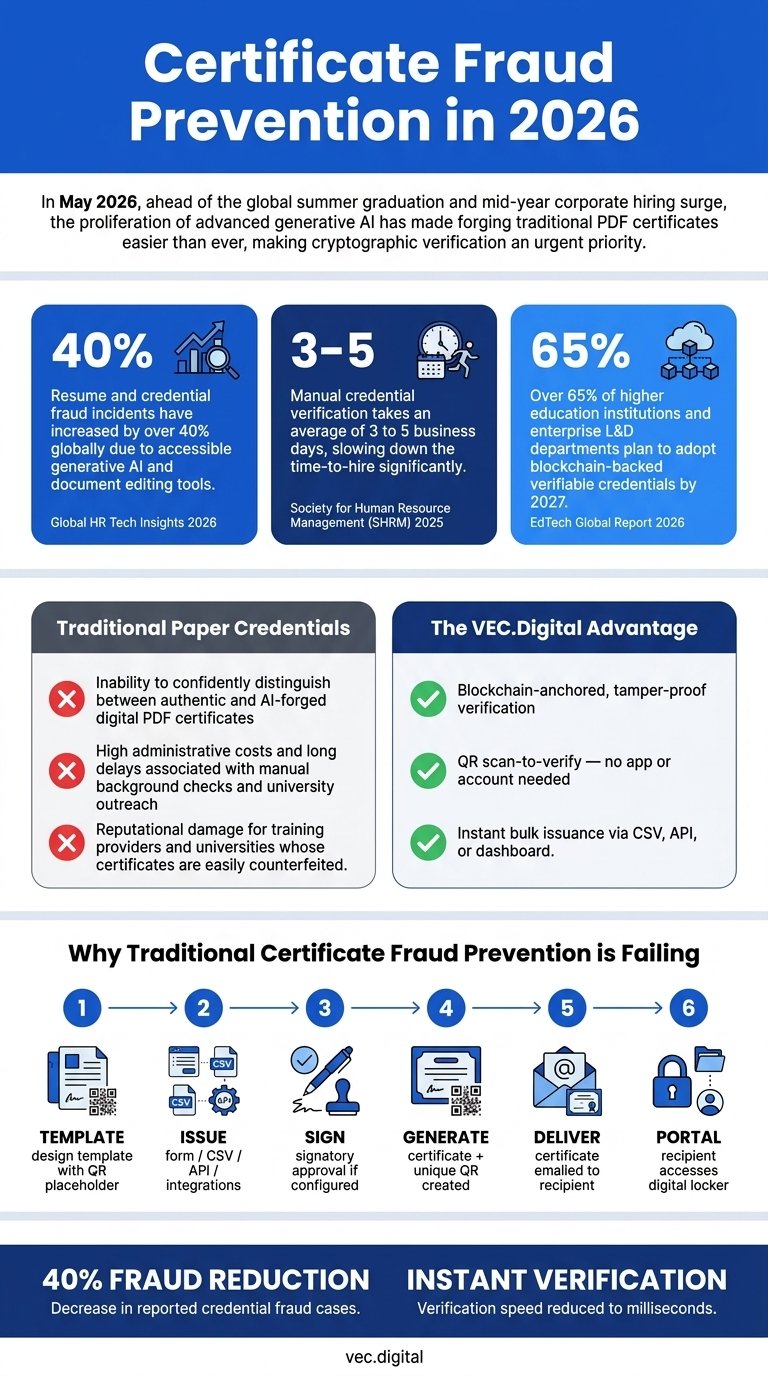
With the rapid advancement of generative artificial intelligence, resume and credential fraud incidents have increased by over 40% globally, leaving organizations vulnerable to highly sophisticated counterfeits (Global HR Tech Insights, 2026). For higher education institutions and enterprise recruitment teams, traditional certificate fraud prevention is no longer sufficient to combat these pixel-perfect AI forgeries. As we approach the global summer graduation and mid-year corporate hiring surge, implementing immutable, cryptographic verification has shifted from a technological luxury to an urgent operational necessity.
In this comprehensive guide, we will explore how your organization can transition from vulnerable legacy systems to secure, blockchain-anchored digital credentials. By leveraging the expertise of VEC.Digital in decentralized credentialing, you will learn how to eliminate credential fraud, issue secure bulk certificates in minutes, and provide learners globally with instantly verifiable digital assets. Whether you are managing university admissions, corporate training pipelines, or compliance tracking, this article provides the strategic framework needed to modernize your issuance workflow and guarantee absolute trust.
Key Takeaways
- Certificate fraud prevention requires moving beyond visual inspections of PDFs to cryptographic, blockchain-anchored verification.
- AI fake certificates are nearly impossible to detect manually, necessitating automated, scan-to-verify solutions that eliminate human error.
- Implementing blockchain credential verification reduces manual background check times from days to milliseconds, drastically improving global time-to-hire metrics.
- QR code certificate verification provides borderless, instant proof of achievement without requiring third-party apps, logins, or proprietary software.
- Adopting digital verifiable credentials directly supports global sustainability initiatives by eliminating paper waste and reducing the carbon footprint of physical mail.
The Escalating Crisis of AI Fake Certificates Globally
The landscape of professional and academic credentialing has undergone a seismic shift. As remote work and cross-border hiring continue to dominate the global economy, the volume of digital documents exchanged daily has skyrocketed. Unfortunately, this digital transformation has been mirrored by an equally sophisticated rise in credential forgery. The proliferation of accessible generative AI and advanced document editing tools has democratized the ability to create highly convincing, fake documentation.
For organizations operating in tech hubs like the UAE, the UK, and the US, this presents a critical challenge. Hiring managers and university admissions officers are increasingly inundated with digital credentials that look perfectly legitimate to the naked eye. To understand how to implement effective certificate fraud prevention, we must first examine the nature of this escalating global crisis and its profound impact on institutional integrity and corporate compliance.
How Generative AI Has Changed Credential Forgery
Historically, forging a university degree or a corporate training certificate required specialized graphic design skills, expensive software, and access to specific paper stock or foil seals. Today, AI fake certificates can be generated in seconds using simple text prompts. Generative AI models can perfectly replicate the typography, layout, signature styles, and institutional branding of almost any global university or training provider.
This technological leap has created a massive informational gap in the market. Most existing industry articles focus heavily on the rise of AI document fraud but fail to explain how organizations can actually implement automated, cryptographic proof to counter it. When a forged PDF is virtually indistinguishable from an authentic one, visual inspection becomes entirely obsolete. The inability to confidently distinguish between authentic and AI-forged digital PDF certificates is now a primary pain point for HR departments worldwide.
The Hidden Costs of Poor Verification in Remote Hiring
The financial and operational consequences of failing to detect forged credentials are staggering. According to the Corporate Compliance Alliance (2025), organizations lose billions annually to compliance fines and poor hiring decisions stemming from unverified or falsified professional credentials. In regulated industries such as healthcare, aviation, engineering, and finance, hiring an unverified candidate is not merely an administrative oversight—it is a severe compliance and safety risk that can lead to catastrophic legal liabilities.
When organizations ask, "How to prevent credential fraud in remote hiring?" the answer must address the complexities of international jurisdictions. Traditional verification across different international borders is legally complex, expensive, and frustratingly slow. Decentralized, globally verifiable blockchain credentials provide a universal standard of truth that transcends these borders, ensuring that a certificate issued in Dubai is instantly recognized and verifiable in London or New York.
Reputational Damage for Educational Institutions
It is not only hiring corporations that suffer from credential fraud; the issuers themselves face severe reputational damage. When training providers and universities have their certificates easily counterfeited, the intrinsic value of their legitimate credentials diminishes. Alumni who worked tirelessly to earn their qualifications find themselves competing in a saturated market against individuals holding fraudulent versions of the exact same degree.
To protect their brand equity and the investment of their learners, institutions must adopt issuance pipelines that make forgery mathematically impossible. By anchoring credentials to an immutable ledger, universities can assure their students—and the global employers hiring them—that their achievements are protected by state-of-the-art cryptographic security.
Why Traditional Certificate Fraud Prevention is Failing
Despite the rapid evolution of digital threats, many organizations still rely on outdated verification workflows. These legacy systems are fundamentally unsuited to the realities of the modern, AI-driven digital economy. Effective certificate fraud prevention cannot be achieved by merely digitizing broken paper-based processes; it requires a fundamental reimagining of how trust is established and verified online.
To fully grasp the necessity of modern cryptographic solutions, we must critically evaluate the shortcomings of the methods currently employed by many HR and admissions departments. The reliance on manual checks and unsecured digital formats is creating bottlenecks that stifle organizational growth and compromise security.
The Inefficiency of Manual Background Checks
The most common response to the threat of credential fraud is to increase the rigor of manual background checks. However, this approach is highly inefficient. Manual credential verification takes an average of 3 to 5 business days, slowing down the time-to-hire significantly (Society for Human Resource Management, 2025). This delay can result in losing top-tier candidates to faster-moving competitors.
Furthermore, manual verification involves high administrative costs. HR professionals are forced to spend hours tracking down university registrars across different time zones, navigating complex privacy laws, and waiting for email confirmations. This tedious task diverts valuable human resources away from strategic talent acquisition and organizational development.
The Limitations of Standard PDF Certificates
Many organizations mistakenly believe that issuing a certificate as a standard PDF constitutes a digital transformation. However, a standard PDF is merely a digital photograph of a physical document. It contains no inherent security mechanisms to prove its authenticity or origin. Even when secured with a basic password, PDFs can be easily unlocked, edited, and redistributed by malicious actors.
This brings us to a frequently asked question: "How do you detect fake digital certificates?" If the certificate is a standard PDF, detection is incredibly difficult, often requiring forensic digital analysis that is beyond the capabilities of a standard HR department. True digital certificates must move beyond static imagery and incorporate embedded, cryptographic proof of issuance that cannot be altered.
The Shift from Trust to Cryptographic Proof
The fundamental flaw in traditional verification is that it relies on human trust—trusting that the document looks right, trusting that the signature is genuine, and trusting that the reference check is accurate. In a world of sophisticated AI forgeries, human trust must be replaced by cryptographic proof.
This is where the concept of verifiable credentials becomes essential. Instead of relying on a human to manually cross-reference a document with an issuing institution, the document itself carries the mathematical proof of its authenticity. This shifts the burden of verification away from tedious HR tasks and transforms it into an instant, self-service process.
Blockchain Credential Verification: The New Global Standard
As the limitations of manual processes and static PDFs become painfully apparent, forward-thinking organizations are turning to decentralized technologies. Blockchain credential verification is rapidly emerging as the gold standard for securing academic and professional achievements globally. By leveraging the immutable nature of blockchain technology, organizations can create a permanent, tamper-proof record of every credential issued.
This technological shift is already well underway. Over 65% of higher education institutions and enterprise L&D departments plan to adopt blockchain-backed verifiable credentials by 2027 (EdTech Global Report, 2026). To remain competitive and secure, organizations must understand how this technology works and how to integrate it into their existing issuance workflows.
What is Blockchain Credential Verification?
A common question among administrators is, "What is blockchain credential verification?" In simple terms, it is the process of anchoring a digital certificate to a secure, decentralized ledger. When an organization issues a certificate through a platform like VEC.Digital, a unique cryptographic hash (a digital fingerprint) of that certificate is generated and recorded on the blockchain.
Because blockchains are immutable—meaning data cannot be altered or deleted once recorded—this hash serves as a permanent, unforgeable proof of issuance. When an employer or verification agency wants to verify digital certificates, the system automatically checks the document's hash against the record on the blockchain. If even a single pixel or character of the certificate has been altered, the hashes will not match, and the verification will instantly fail.
How Verifiable Credentials Work for Universities and Enterprises
Another frequent inquiry is, "How do verifiable credentials work for universities?" The process is designed to be seamless for both the issuer and the recipient. For the university or enterprise, the workflow is entirely automated. Using a platform like VEC.Digital, administrators can design their certificates using a robust template editor featuring over 1,400 Google Fonts, drag-and-drop functionality, and Canva integration for stunning backgrounds.
Once the design is finalized, the institution can issue the credentials using one of four streamlined methods: a dashboard form for individual issuance, a CSV upload for bulk processing, a REST API for programmatic automation, or via third-party integrations. Behind the scenes, the platform automatically anchors each credential to the blockchain. The recipient then receives a secure link to their permanent digital locker, where they can access, manage, and share their verified credentials anytime, from anywhere in the world.
The "Blockchain Verified" Badge of Trust
To provide immediate visual assurance to employers, certificates issued through advanced platforms feature a distinct "blockchain verified" badge on the public certificate verification page. This badge serves as a universal symbol of trust, signaling to anyone viewing the document that its authenticity is cryptographically guaranteed.
By adopting this standard, organizations align themselves with global best practices for data integrity. Institutions can learn more about the technical foundations of verifiable credentials through authoritative bodies like the W3C Verifiable Credentials Data Model, which outlines the international standards for expressing secure, machine-verifiable data on the web.
QR Code Certificate Verification: Instant and Tamper-Proof
While the underlying blockchain technology provides the security, the user experience of verification must be frictionless. This is where QR code certificate verification becomes the crucial bridge between complex cryptography and everyday usability. By embedding a unique, scannable code directly onto the certificate, organizations empower anyone—from a hiring manager to a border control agent—to verify the document's authenticity in milliseconds.
This approach completely democratizes the verification process. It removes the need for proprietary software, expensive verification subscriptions, or lengthy email chains with university registrars. With a simple scan from any standard smartphone camera, the truth of the credential is instantly revealed.
Can QR Code Certificates Be Faked?
A highly relevant question in today's security-conscious environment is, "Can QR code certificates be faked?" If a QR code merely points to a static image hosted on an unsecure server, it is highly vulnerable to spoofing. However, in a robust verifiable credential ecosystem, the QR code is inherently secure.
Every certificate issued via VEC.Digital features a unique QR code that links directly to a highly secure, dynamically generated URL (e.g., /certificate/[uuid]). When scanned, this link directs the user to a dedicated verification portal. No app, no account, and no login are required to verify the credential. The portal instantly queries the blockchain, confirms the cryptographic hash, and displays the authentic certificate data alongside the "blockchain verified" badge. Because the underlying blockchain record cannot be altered, a forged certificate will never successfully resolve to a verified status, making fake QR codes entirely useless.
Empowering Candidates with Digital Lockers
Modern credentialing is not just about security; it is also about empowering the learner. In the past, graduates and trainees were responsible for physically securing paper certificates or managing disparate PDF files on personal hard drives. If a document was lost, requesting a replacement was a costly and time-consuming administrative nightmare.
Today, recipients are provided with a permanent digital locker. This secure portal grants them lifetime access to all their earned certificates. Whether they are applying for a job in Tokyo, enrolling in a postgraduate program in London, or submitting compliance documentation in Dubai, their verified credentials are instantly accessible and shareable. This global accessibility is a massive value-add for training providers looking to enhance their alumni experience.
Streamlining the Time-to-Hire Process
For HR managers and recruitment directors, the integration of QR code verification directly impacts the bottom line. By shifting from a manual process that takes 3 to 5 days to an instant, self-service scan, organizations can drastically reduce their time-to-hire. This agility is a significant competitive advantage in a tight global labor market.
Furthermore, instant verification allows recruitment teams to confidently extend offers to international candidates without the lingering fear of credential fraud. The cryptographic proof provided by the blockchain ensures that the candidate possesses the exact qualifications they claim, mitigating the compliance risks associated with unverified hires.
Implementing a Secure Credential Workflow with VEC.Digital
Recognizing the need for modern certificate fraud prevention is the first step; executing a seamless transition is the next. Implementing a blockchain-anchored issuance pipeline does not require your organization to hire specialized blockchain developers or disrupt your existing administrative processes. VEC.Digital provides a comprehensive, user-friendly platform designed specifically for global HR teams, university administrators, and training providers.
Our platform is engineered to handle the complexities of digital credentialing at scale, ensuring that every certificate issued is secure, verifiable, and beautifully designed. Let's explore how your organization can leverage these advanced features to protect its reputation and streamline its operations.
Multi-Signatory and Bulk Issuance Workflows
In many academic and corporate environments, issuing a certificate requires approval from multiple stakeholders, such as a department head and a university dean. VEC.Digital accommodates this reality with a robust multi-signatory workflow. Up to two signatories can be assigned per certificate template. The system intelligently holds the certificate in a pending state until all required signatories have independently reviewed and signed off, ensuring strict internal compliance before the credential is ever anchored to the blockchain.
When it comes to high-volume issuance—such as graduating an entire university cohort or certifying thousands of employees globally after a compliance training rollout—efficiency is paramount. Our platform supports seamless CSV uploads for bulk issuance, allowing administrators to generate and distribute thousands of unique, blockchain-verified certificates in a matter of minutes. For organizations with complex IT infrastructures, our REST API allows for deep, programmatic integration directly into your existing Learning Management Systems (LMS) or HR software.
What is the Best Software to Verify Employee Qualifications?
When HR managers ask, "What is the best software to verify employee qualifications?" they are looking for a solution that balances rigorous security with effortless usability. VEC.Digital stands out by providing a holistic ecosystem that manages the entire lifecycle of a credential—from design and issuance to storage and instant verification.
By utilizing our intuitive credential workflows, organizations can eliminate the administrative bloat associated with manual verification. The inclusion of a comprehensive template editor, complete with over 1,400 Google Fonts and diverse sizing options (A2–A5, portrait/landscape), ensures that security does not come at the expense of brand aesthetics.
Promoting Sustainability Through Digital Credentials
Beyond security and efficiency, transitioning to digital verifiable credentials aligns with vital global sustainability objectives. The traditional credentialing process is incredibly resource-intensive, relying on specialty paper, chemical inks, plastic seals, and international courier shipping. This physical supply chain generates significant carbon emissions and paper waste.
VEC.Digital is committed to supporting the UN Sustainable Development Goals. By eliminating paper waste and reducing the environmental impact of physical delivery, our digital certificates contribute to eco-friendly credential management globally. Organizations that adopt our platform not only secure their credentials against fraud but also demonstrate a tangible commitment to corporate social responsibility and environmental stewardship.
Secure Your Organization's Future with VEC.Digital
As we navigate the complexities of 2026, the threat of AI-generated credential fraud will only continue to grow. Relying on outdated manual background checks and easily forged PDF documents exposes your organization to severe compliance risks, financial losses, and reputational damage. The time to modernize your credentialing infrastructure is now.
By embracing blockchain-anchored verifiable credentials and instant QR code verification, you can completely eliminate the burden of manual background checks, accelerate your global hiring pipelines, and provide your learners with secure, universally recognized proof of their achievements. VEC.Digital is engineered to make this transition effortless, providing a secure, scalable, and beautifully designed platform for all your issuance needs.
We believe that security should be accessible to organizations of all sizes. That is why we offer a completely free plan to help you get started—no credit card required, and absolutely no setup fees. For scaling institutions and global enterprises, our comprehensive paid plans begin at just $29.99/month, while individual users can issue secure certificates for as little as $1.00 per credential. Transform your credentialing process today and guarantee absolute trust in every certificate you issue.
Ready to eliminate credential fraud and streamline your issuance workflow?
Explore our tailored solutions for Higher Education or Corporate Training today.
Contact VEC.Digital:
Website: vec.digital
Email: support@vec.digital
WhatsApp: +971521373078