
Certificate Fraud Prevention in 2026: Why Blockchain Verification is Replacing PDFs
Published on May 19, 2026

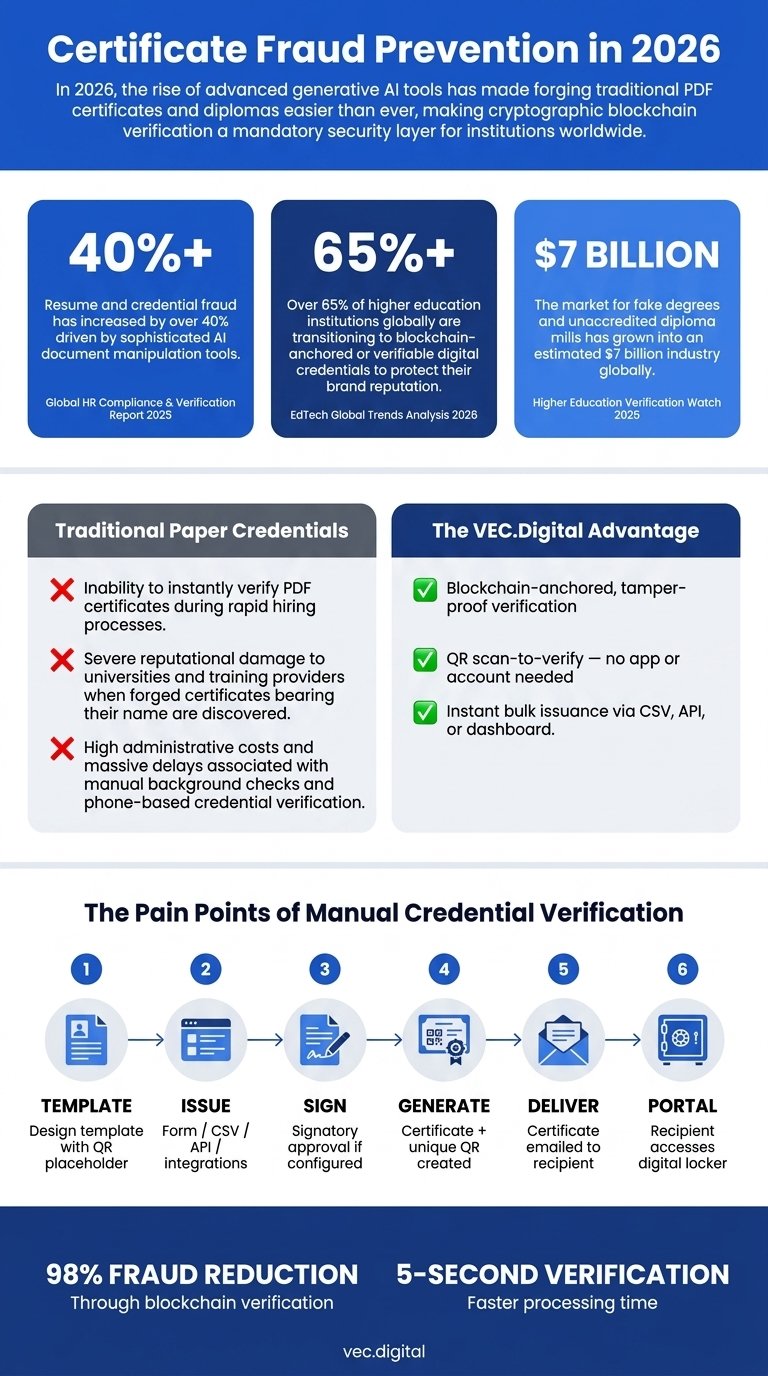
Up to 30% of job applicants embellish or fake their educational credentials during the hiring process, according to a 2025 Society for Human Resource Management (SHRM) Trend Report. This alarming surge in sophisticated forgery has made robust certificate fraud prevention a critical mandate for universities, corporate trainers, and HR departments worldwide. Modern institutions can no longer rely on easily manipulated static documents to protect their brand integrity, ensure workforce compliance, and maintain global trust.
In this comprehensive guide, our team at VEC.Digital will walk your organization through the essential shift from vulnerable legacy documents to mathematically secure, blockchain-anchored credentials. You will learn how to completely eliminate credential fraud, implement instant QR-code verification for employers, and seamlessly upgrade your issuance pipeline to distribute bulk certificates in minutes without disrupting your daily operations.
Key Takeaways
- Cryptographic security ensures that blockchain-anchored credentials cannot be altered, forged, or duplicated by malicious actors using advanced AI tools.
- Instant QR verification allows employers to validate qualifications in seconds without relying on costly third-party background check agencies.
- Automated issuance workflows enable administrators to generate and distribute thousands of secure credentials programmatically, saving countless administrative hours.
- Multi-signatory approvals maintain strict internal governance by keeping certificates pending until all authorized internal parties have independently signed.
- Eco-friendly credentialing supports global sustainability goals by eliminating paper waste, printing resources, and physical shipping logistics.
The Global Crisis of Credential Forgery in 2026
The landscape of professional and academic credentialing has reached a critical inflection point. As technology has advanced, so too have the tools available to those looking to misrepresent their qualifications. What was once a niche problem involving physical counterfeiting has evolved into a massive, digitized underground industry. For organizations issuing credentials, understanding the sheer scale of this crisis is the first step toward implementing effective certificate fraud prevention strategies.
The Cost of Fake Degrees and Certifications
The financial and reputational costs associated with fraudulent qualifications are staggering. According to 2024 data from the Higher Education Degree Datacheck (HEDD), over 100,000 fake degrees are purchased globally every year, costing employers millions in bad hires, operational inefficiencies, and severe compliance fines. When an unqualified individual slips through the hiring process using a fabricated credential, the organization assumes immense liability, particularly in highly regulated sectors such as healthcare, finance, and engineering.
Furthermore, the proliferation of diploma mills—unaccredited entities that sell degrees for cash—has flooded the global talent market with worthless paper. These operations have become incredibly sophisticated, often creating fake university websites, fraudulent verification portals, and highly convincing physical and digital documents. For legitimate higher education institutions and corporate training providers, distinguishing their authentic credentials from these sophisticated fakes is an ongoing battle that traditional methods simply cannot win.
Why Legacy PDF Certificates Are Failing
A major vulnerability in the current credentialing ecosystem is the widespread reliance on standard PDF certificates. Traditional PDF certificates offer zero built-in security, making them easily altered using consumer-grade AI and editing software. In 2026, anyone with access to basic image generation tools or PDF editors can seamlessly change a name, alter a date, or upgrade a grade on a static document without leaving obvious digital traces.
Because static PDFs lack embedded cryptographic proof of their origin, they are essentially just pictures of a credential. When an applicant submits a PDF to an employer, the employer has no immediate, technological way to verify if the document was genuinely issued by the claimed institution or if it was generated in a candidate's web browser ten minutes prior. This inherent weakness is driving a global institutional mandate for cryptographic, tamper-proof verification over legacy static PDFs.
The Reputational Damage to Issuing Institutions
Beyond the immediate risk to employers, credential forgery inflicts irreparable brand damage on universities and certification bodies when sophisticated fake certificates bearing their name circulate online. An institution's reputation is its most valuable asset; it is the foundation upon which alumni build their careers and employers base their hiring decisions. If the market loses faith in the authenticity of an organization's certificates, the value of those credentials plummets.
When news breaks that an institution's credentials have been easily forged and used to secure high-profile positions fraudulently, it undermines the hard work of legitimate graduates. Accreditation bodies, partner organizations, and prospective students all take note of these security failures. Consequently, protecting the integrity of the credential is not just an IT or administrative concern—it is a fundamental imperative for the long-term survival and prestige of the issuing organization.
How Blockchain Certificate Fraud Prevention Works
To combat the vulnerabilities of static documents, the world's leading organizations are turning to decentralized technology. The implementation of robust certificate fraud prevention relies heavily on the immutable nature of blockchain networks, which provide a mathematical guarantee of authenticity that cannot be replicated by traditional databases or physical watermarks.
What is a Blockchain Verifiable Credential?
A common question among administrators is: What is a blockchain verifiable credential? At its core, a blockchain verifiable credential is a digital record of achievement that has been cryptographically anchored to an immutable public ledger. When an organization issues a certificate through a platform like VEC.Digital, the data representing that specific certificate is hashed—turned into a unique string of characters—and recorded on the blockchain.
This process does not store the recipient's private personal data on the public ledger; rather, it stores a mathematical proof of the certificate's existence at the exact moment of issuance. Because the blockchain is decentralized and append-only, this record cannot be altered, deleted, or tampered with by any party, including the issuing institution, the recipient, or a malicious hacker. This creates a permanent, publicly verifiable source of truth.
Can Digital Certificates Be Forged?
Another frequently asked question is: Can digital certificates be forged? The answer depends entirely on the underlying technology. A standard digital certificate (like a PDF or JPEG) can absolutely be forged, often with trivial effort. However, a blockchain-anchored digital certificate is mathematically impossible to forge. If a bad actor attempts to alter the name or grade on their downloaded digital certificate, the cryptographic hash of the altered document will no longer match the original hash anchored on the blockchain.
When an employer attempts to verify the tampered document, the verification system will instantly detect the mismatch and flag the certificate as invalid. This binary nature of cryptographic verification—either the hashes match perfectly, or they do not—removes all subjectivity from the verification process, completely neutralizing the threat of advanced AI image generators and sophisticated PDF editors.
The Role of Cryptographic Anchoring
Cryptographic anchoring is the engine that powers modern digital trust. Every certificate issued through VEC.Digital is anchored on an immutable blockchain. When a recipient shares their credential, it displays a prominent "blockchain verified" badge on the public certificate verification page. This badge serves as a powerful visual indicator to employers and stakeholders that the document is authentic and backed by unassailable cryptographic proof.
This level of security is achieved without requiring the issuing organization or the verifying employer to understand the complex mechanics of blockchain technology. The underlying infrastructure operates seamlessly in the background, providing the highest standard of security while maintaining a frictionless, intuitive user experience for all parties involved.
Transforming Verification for HR and Compliance Teams
The benefits of cryptographic security extend far beyond the issuing institution; they fundamentally transform how employers interact with applicant data. For HR managers and compliance officers, the shift to verifiable credentials resolves some of the most persistent and costly bottlenecks in the talent acquisition process.
Overcoming Manual Background Check Delays
One of the most significant pain points in modern recruitment is HR teams wasting weeks manually verifying applicant degrees and certifications directly with universities or training providers. This outdated process involves phone calls, emails, signed consent forms, and agonizing wait times as university registrars dig through physical archives or legacy databases. These delays can cause top talent to abandon the hiring process in favor of faster-moving competitors.
The introduction of verifiable credentials eliminates this friction entirely. According to 2025 Gartner HR Technology Insights, automated, blockchain-based credential verification reduces HR background check times by up to 80%. By shifting from manual, human-dependent verification to instant, machine-readable validation, HR departments can dramatically accelerate their time-to-hire while simultaneously increasing the accuracy of their background checks.
How Do Employers Verify Digital Certificates Today?
When encountering this new technology, many professionals ask: How do employers verify digital certificates? With VEC.Digital, the process is designed to be as effortless as possible. Every certificate features a unique QR code linking directly to a secure verification URL structured as /certificate/[uuid].
To verify a credential, an employer simply scans the QR code with their smartphone camera or clicks the verification link provided by the candidate. They are instantly taken to a public verification page that confirms the certificate's status, the issuing institution, the recipient's details, and the blockchain anchoring data. There is no app to download, no account to create, and no login required to verify a credential. This frictionless process ensures that instant verification is accessible to anyone, anywhere in the world, at any time.
Eliminating Third-Party Verification Costs
Because manual verification is so time-consuming, many corporations outsource this task to third-party background verification agencies. While this offloads the administrative burden, it introduces prohibitive costs and delays. These agencies charge substantial fees per verification, which can amount to hundreds of thousands of dollars annually for large enterprises.
Blockchain-anchored credentials render these third-party intermediaries obsolete. Because the cryptographic proof of authenticity is embedded within the credential itself and anchored to a decentralized ledger, employers can trust the document directly. By empowering employers to independently and instantly verify qualifications at zero cost, organizations can reallocate their HR budgets toward strategic talent development rather than administrative overhead.
Transitioning from PDFs to Verifiable Credentials (Without Disruption)
Despite recognizing the severe vulnerabilities of legacy systems, many institutions hesitate to upgrade their technology due to fears of operational disruption. A common content gap in industry literature is the lack of a proactive, seamless technical transition plan for issuing institutions. Upgrading to blockchain verification does not require a complete overhaul of your IT infrastructure when utilizing a purpose-built platform.
Are PDF Certificates Secure Enough for Corporate Compliance?
Administrators often ask: Are PDF certificates secure enough for corporate compliance? In 2026, the definitive answer is no. Regulatory bodies and compliance auditors increasingly demand cryptographic proof of training and certification, particularly in fields governed by strict safety or financial regulations. Relying on static PDFs exposes organizations to compliance failures and legal liabilities. Transitioning to verifiable credentials is no longer an optional technological upgrade; it is a fundamental compliance requirement.
How to Prevent Fake Certificates in Higher Education?
For academic leaders asking how to prevent fake certificates in higher education, the solution lies in adopting comprehensive digital credentialing platforms. The industry is already moving rapidly in this direction. A 2025 HolonIQ EdTech Survey reveals that 75% of universities globally plan to transition to verifiable digital credentials and digital wallets by the end of 2026. To remain competitive and protect their institutional prestige, universities must implement systems that provide immutable proof of graduation and continuous learning.
Seamless Issuance Workflows for Administrators
Transitioning to VEC.Digital is designed to be entirely frictionless, empowering your team to upgrade from legacy PDFs without disrupting daily operations. Our platform offers a robust certificate workflow tailored to the unique needs of your administrative staff. We provide four distinct issuance methods to accommodate any scale of operation: a user-friendly dashboard form for one-by-one issuance, a CSV upload feature for bulk generation, a REST API for programmatic issuance, and seamless third-party integrations with your existing Learning Management Systems (LMS) or HR software.
To ensure strict internal governance and prevent rogue issuance, VEC.Digital features a sophisticated multi-signatory workflow. Administrators can assign up to 2 signatories per template. Crucially, the certificate is held in a pending state until ALL signatories have independently reviewed and signed off, ensuring that no credential is ever issued without proper authorization.
Furthermore, the visual design of your credentials does not have to be sacrificed for security. Our advanced template editor features over 1,400 Google Fonts, an intuitive drag-and-drop interface, support for A2 through A5 sizes in both portrait and landscape orientations, and seamless Canva integration for stunning background designs. Once issued, recipients are granted access to a permanent digital locker—a secure portal where they can view, manage, and share all their credentials anywhere, anytime, enhancing their professional mobility.
The Global Shift Toward Standardized Digital Trust
The transition toward blockchain-anchored credentials is not an isolated technological trend; it is part of a massive global movement toward standardized digital trust. Governments, educational consortiums, and international regulatory bodies are actively shaping the future of how identity and qualifications are verified across borders.
Regulatory Drivers and Cross-Border Mobility
Global regulatory frameworks are actively pushing organizations toward standardized verifiable credentials to facilitate secure cross-border talent mobility and eliminate the multi-billion dollar credential fraud industry. Initiatives such as the European Union's eIDAS 2.0 regulations, alongside emerging digital trust standards in the UAE and North America, mandate the use of secure, interoperable digital identities and credentials. By adopting blockchain verification today, organizations ensure they remain compliant with these evolving international standards, allowing their learners and employees to seamlessly prove their qualifications anywhere in the world.
Market Growth and Institutional Adoption
The rapid adoption of this technology is reflected in explosive market growth. According to Grand View Research in 2025, the global blockchain in higher education and EdTech market is projected to grow at a Compound Annual Growth Rate (CAGR) of over 40% through 2027. This growth indicates that blockchain verification is rapidly becoming the baseline standard for credentialing. Institutions that fail to adopt this technology risk being left behind, as students and professionals increasingly demand credentials that offer genuine utility, security, and global recognition.
Sustainability and Eco-Friendly Credentialing
Beyond security and efficiency, the shift to digital credentials aligns with vital environmental initiatives. Traditional credentialing is incredibly resource-intensive, requiring specialized paper, custom printing, physical embossing, and global shipping logistics. This process generates significant carbon emissions and paper waste.
VEC.Digital is deeply committed to sustainability and actively supports UN sustainability goals. By transitioning to digital certificates, organizations completely eliminate paper waste, reduce printing costs, and eradicate the carbon footprint associated with physical delivery. Eco-friendly credential management is not just a technological upgrade; it is a responsible corporate practice that demonstrates a commitment to a greener, more sustainable future.
Secure Your Organization's Future with VEC.Digital
The era of relying on easily forged, static PDF certificates is over. As AI tools become more accessible, the threat of credential forgery will only continue to escalate. Protecting your organization's reputation, ensuring workforce compliance, and providing your learners with genuinely valuable qualifications requires a transition to mathematically secure, blockchain-anchored credentials.
VEC.Digital is the premier solution for effortless, trustworthy digital credential issuance. Our platform combines military-grade cryptographic security with an exceptionally intuitive user experience, enabling you to design, issue, and manage tamper-proof credentials at scale. Whether you are a university registrar handling thousands of graduates or a corporate L&D director managing internal compliance, our automated issuance pipelines and instant QR-code verification capabilities will transform your operations.
We believe that every organization should have access to secure credentialing technology. That is why a free plan is available to help you get started immediately. Organizations can start completely free—with no credit card required and no setup fees—while individuals pay just $1.00 per certificate. For larger institutions requiring advanced features, our highly competitive paid plans start from just $29.99 per month.
Do not leave your brand's integrity to chance. Upgrade your credentialing infrastructure today and join the thousands of universities and corporations that trust VEC.Digital to secure their future.
Contact our team to begin your transition:
Website: vec.digital
Email: support@vec.digital
WhatsApp: +971521373078