
Certificate Fraud Prevention in 2026: Why Blockchain Verification is Replacing the PDF
Published on April 19, 2026

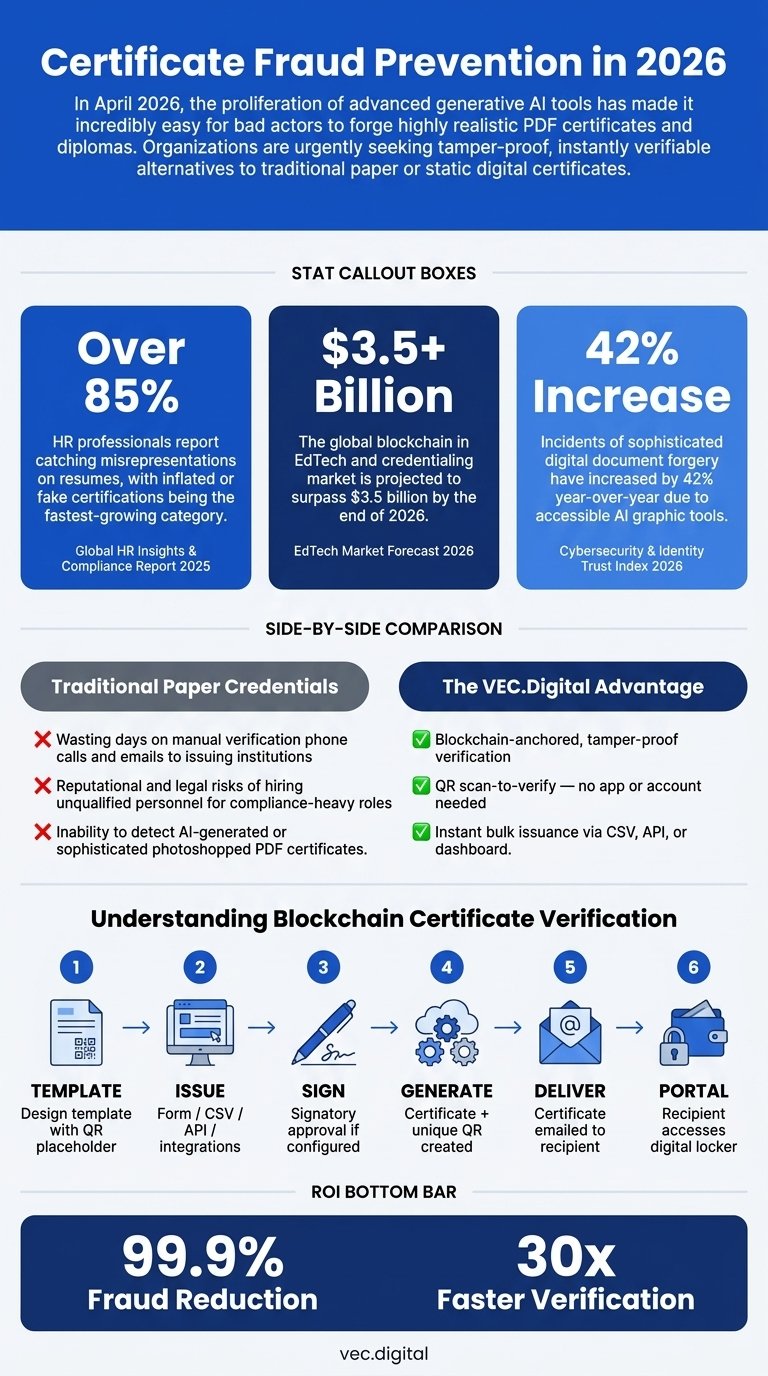
In 2026, incidents of sophisticated digital document forgery have increased by 42% year-over-year due to the widespread availability of advanced AI graphic tools, according to the Cybersecurity & Identity Trust Index (2026). As organizations worldwide grapple with the escalating costs and reputational damage caused by fraudulent diplomas and qualifications, the reliance on easily manipulated PDF documents has become a critical vulnerability. Implementing robust blockchain certificate verification is now an urgent necessity for institutions seeking to protect their integrity and ensure trust in a zero-trust digital landscape.
This comprehensive guide explores the vulnerabilities of traditional credentialing methods and outlines how your organization can transition to a tamper-proof, globally recognized digital credential ecosystem. By leveraging our deep expertise in secure digital credentialing at VEC.Digital, you will learn how to eliminate credential fraud, streamline verification from days to seconds, and issue bulk certificates with absolute cryptographic certainty. Ultimately, you will discover practical strategies to safeguard your institutional reputation while providing learners with instantly verifiable, universally accessible proof of their achievements.
Key Takeaways
- AI-driven document forgery has made static PDF certificates obsolete, requiring organizations to adopt cryptographic security measures.
- Blockchain certificate verification provides an immutable, tamper-proof record of achievement that anyone can verify instantly without technical expertise.
- QR code certificate verification reduces credential processing times from several days to under three seconds, drastically improving HR efficiency.
- Verifiable credentials for organizations protect against the severe legal and reputational risks associated with hiring unqualified personnel in compliance-heavy roles.
- Sustainable digital credentialing eliminates paper waste and physical shipping, aligning institutional practices with global United Nations sustainability goals.
The Rising Tide of AI-Assisted Certificate Fraud
How Generative AI Has Weaponized the Standard PDF
For decades, educational institutions and corporate training providers relied on physical paper certificates, which eventually evolved into static digital PDFs. While the PDF format offered convenience and reduced printing costs, it lacked inherent security. Today, the landscape of certificate fraud prevention has fundamentally shifted. Generative AI tools and advanced image manipulation software have democratized forgery, allowing malicious actors to create pixel-perfect replicas of official documents in a matter of minutes. These tools can seamlessly replicate institutional logos, authorized signatures, and specific typography, making visual detection nearly impossible for the untrained eye.
The core issue with standard PDFs is that they are merely visual representations of data, not mathematical proofs of authenticity. Even when organizations attempt to secure PDFs with basic passwords or digital watermarks, sophisticated AI tools can strip these layers of protection effortlessly. This technological shift has transformed credential fraud from a niche criminal enterprise into a widespread issue accessible to anyone with an internet connection. As a result, the foundational trust that employers and academic institutions place in standard digital documents has been severely compromised.
To combat this, organizations must move beyond visual verification. The focus must shift toward verifying the underlying data through cryptographic means. By anchoring the issuance data to an immutable ledger, institutions can ensure that the credential presented exactly matches the credential issued, regardless of any visual alterations attempted by bad actors.
The Hidden Costs of Fake Certificate Detection
The financial and operational toll of credential fraud is staggering. When organizations rely on manual background checks to verify qualifications, they incur significant labor costs and operational delays. Human resources departments are frequently forced to dedicate entire teams to the tedious process of contacting university registrars, professional associations, and past employers. This manual approach is not only inefficient but also highly prone to human error and miscommunication across different time zones and languages.
The scale of this problem is alarming. According to the Global HR Insights & Compliance Report (2025), over 85% of HR professionals report catching misrepresentations on resumes, with inflated or fake certifications being the fastest-growing category. When these fraudulent credentials slip through the cracks, the consequences extend far beyond a bad hire. Organizations face severe legal liabilities, regulatory fines, and catastrophic reputational damage, particularly when unqualified individuals are placed in compliance-heavy sectors such as healthcare, aviation, finance, and engineering.
Furthermore, the cost of fake certificate detection drains resources that could be better spent on strategic talent acquisition and employee development. By transitioning to automated, mathematically secure verification systems, organizations can reallocate these resources, ensuring that their hiring processes are both rigorous and highly efficient.
Can PDF Certificates Be Faked Easily?
A common question among administrators and HR professionals is: Can PDF certificates be faked easily? The unequivocal answer in 2026 is yes. Historically, forging a document required specialized software and graphic design expertise. Today, simple text prompts in generative AI platforms can yield high-resolution, convincing forgeries. Bad actors can modify names, dates, and grades on existing PDFs, or generate entirely new documents from scratch that mimic the exact layout of prestigious universities and global training providers.
Because a standard PDF does not contain an immutable, verifiable link back to the issuing authority, the burden of proof falls entirely on the verifier. When an HR manager receives a PDF, they have no intrinsic way of knowing if the document was genuinely issued by the institution or generated by an AI tool five minutes prior. This inherent vulnerability is exactly why global educational bodies and corporate enterprises are abandoning the static PDF in favor of dynamic, cryptographically secure digital credentials.
The transition away from PDFs is not merely a technological upgrade; it is a necessary evolution in risk management. By adopting credentials that carry their own proof of authenticity, organizations eliminate the guesswork and visual scrutiny previously required, replacing it with absolute mathematical certainty.
Understanding Blockchain Certificate Verification
What is Blockchain Credential Verification?
At its core, blockchain certificate verification is a method of using decentralized ledger technology to provide unforgeable proof that a specific credential was issued to a specific individual by a recognized authority, and that the credential has not been altered since its issuance. When an organization issues a certificate using this technology, the system generates a unique cryptographic hash—a digital fingerprint—of the certificate's data. This hash is then permanently recorded on a public blockchain.
Importantly, the blockchain does not store the learner's personal data or the visual certificate itself, ensuring complete compliance with global data privacy regulations such as GDPR. Instead, it stores the mathematical proof of the transaction. When a third party, such as an employer, wishes to verify the credential, the system recalculates the hash of the presented certificate and compares it to the hash anchored on the blockchain. If the hashes match perfectly, the certificate is authentic. If even a single pixel or character has been altered, the hashes will not match, and the verification will fail instantly.
This process completely abstracts the complexity of the underlying technology. For the end-user—whether that is an HR manager, a university admissions officer, or an event organizer—the experience is seamless. They do not need to understand cryptography or Web3 architecture; they simply receive a definitive "Valid" or "Invalid" result. The global blockchain in EdTech and credentialing market is projected to surpass $3.5 billion by the end of 2026, according to the EdTech Market Forecast (2026), reflecting the massive worldwide adoption of this secure methodology.
The Shift to Zero-Trust Credentialing
The concept of "zero-trust" originated in cybersecurity, operating on the principle of "never trust, always verify." This framework is now being rigorously applied to the world of academic and professional credentialing. In a zero-trust credentialing environment, an employer does not assume a certificate is valid simply because it features a realistic logo or was emailed from a candidate's personal account. Instead, the credential itself must continuously prove its own validity through independent, cryptographic means.
This paradigm shift is vital for global organizations managing international talent pools. When hiring candidates from different countries, verifying educational backgrounds traditionally involved navigating complex international bureaucracies, language barriers, and varying institutional standards. Zero-trust credentialing standardizes this process globally. A blockchain-anchored certificate issued by a university in Asia is verified using the exact same seamless, mathematical process as a corporate training certificate issued in Europe or the Americas.
By adopting a zero-trust approach, organizations protect themselves from the sophisticated social engineering and AI-driven fraud tactics that define the modern threat landscape. It ensures that hiring decisions, compliance reporting, and professional licensing are based on verified facts rather than assumptions.
Digital Badge vs. Verifiable Credential: What is the Difference?
As organizations explore digital credential security, a frequent question arises: What is the difference between a digital badge and a verifiable credential? While both are digital representations of an achievement, their underlying architecture and security levels differ significantly.
A standard digital badge is typically an image file embedded with metadata (such as the issuer's name, the recipient's name, and the criteria for the award). While useful for gamification and social media sharing, standard badges are often hosted on centralized servers. If the issuing platform ceases operations, or if the server is compromised, the badge and its verification link can disappear. Furthermore, the metadata within standard badges can sometimes be manipulated by sophisticated actors.
A verifiable credential, on the other hand, is anchored to an immutable blockchain. It adheres to strict, globally recognized data models, such as the W3C Verifiable Credentials standard. Because the proof of issuance is decentralized, the credential remains verifiable indefinitely, even if the original issuing software platform goes offline. Verifiable credentials provide a much higher level of assurance, making them the required standard for high-stakes use cases like university degrees, medical licenses, and corporate compliance certifications.
Overcoming Organizational Pain Points with Digital Credential Security
Eliminating Manual Verification Delays
One of the most significant bottlenecks in modern human resources and university admissions is the time required to authenticate candidate backgrounds. Wasting days on manual verification phone calls and emails to issuing institutions is a universal pain point. This slow process frustrates candidates, delays critical hiring decisions, and forces organizations to lose top talent to faster-moving competitors.
The implementation of digital credential security fundamentally solves this operational bottleneck. According to the HR Tech Optimization Survey (2025), automated verification reduces traditional credential background check processing time from an average of 4-7 days to under 3 seconds. This exponential increase in efficiency allows HR teams to process thousands of applications with absolute confidence, entirely eliminating the administrative burden of manual outreach.
With platforms like VEC.Digital, the verification process is entirely automated. When a candidate submits a blockchain-anchored certificate, the receiving organization can instantly validate its authenticity, the identity of the issuer, and the current status of the credential (ensuring it hasn't been revoked or expired). This real-time validation is a game-changer for high-volume hiring and global university admissions.
Mitigating Reputational and Legal Risks
The inability to detect AI-generated or sophisticated photoshopped PDF certificates exposes organizations to profound legal and reputational risks. In industries such as healthcare, finance, engineering, and aviation, regulatory compliance mandates that all personnel hold valid, up-to-date certifications. If an organization inadvertently hires an individual using forged credentials, the consequences can include severe regulatory fines, loss of operating licenses, and devastating public relations crises.
Furthermore, if an unqualified individual causes harm or financial loss while operating under the umbrella of your organization, the legal liabilities are immense. Courts and regulatory bodies increasingly expect organizations to employ state-of-the-art verification methods. Relying on outdated manual checks or visual inspections of PDFs is no longer considered adequate due diligence in the face of modern AI forgery.
By issuing and requiring blockchain-verified credentials, organizations create an immutable audit trail. This cryptographic proof demonstrates to auditors, regulators, and stakeholders that the organization has implemented the highest possible standard of compliance and risk management, effectively shielding the institution from liability.
Enhancing the Learner Experience Globally
Beyond the administrative benefits, traditional credentialing methods often result in a poor user experience for alumni and learners who need to prove their qualifications instantly. Graduates frequently lose physical paper certificates, and requesting replacements involves navigating slow, bureaucratic processes and paying administrative fees. Similarly, static PDFs get lost in email inboxes or are rejected by modern, security-conscious employers.
A robust digital credentialing platform provides recipients with a secure, permanent digital locker. This portal gives learners lifetime access to all their certificates, accessible anywhere in the world, at any time. They can seamlessly share their achievements on professional networks like LinkedIn, attach them to digital resumes, or send them directly to employers with a single click.
This enhanced experience significantly boosts learner motivation and strengthens the ongoing relationship between the issuing institution and the alumni. When an organization provides credentials that are instantly verifiable and globally respected, it elevates the perceived value of the training program or academic degree, driving higher enrollment and robust brand loyalty.
Practical Applications of Verifiable Credentials for Organizations
How Employers Verify Digital Certificates
Understanding how employers verify digital certificates is crucial for organizations looking to adopt this technology. In the past, verification required creating accounts on proprietary platforms, paying verification fees, or waiting days for an email response. Today, the process is frictionless and immediate.
When an employer receives a blockchain-anchored certificate, they simply click the unique verification link or scan the embedded QR code. They are instantly directed to a public, highly secure verification page. This page recalculates the cryptographic hash in real-time and queries the blockchain. Within milliseconds, the employer sees a definitive result.
For certificates issued through VEC.Digital, successfully authenticated documents prominently display a "blockchain verified" badge on the public verification page. This visual cue, backed by invisible mathematical proof, provides the employer with immediate peace of mind. There is no app to download, no account to create, and no login required to perform this verification, making it universally accessible to any HR professional worldwide.
How QR Codes on Digital Certificates Work
The integration of QR code certificate verification bridges the gap between physical and digital environments. Many organizations still host in-person graduation ceremonies or provide physical mementos of achievement. By embedding a unique, dynamically generated QR code onto the certificate design, institutions ensure that even a printed copy retains its digital security.
How do QR codes on digital certificates work? Every certificate generated is assigned a unique Universally Unique Identifier (UUID). The QR code is programmed to direct any standard smartphone camera to the specific secure URL associated with that UUID (e.g., /certificate/[uuid]). When scanned, the system automatically initiates the blockchain verification protocol described earlier.
This means that if a candidate brings a printed certificate to an in-person job interview, the hiring manager can simply point their smartphone at the document and instantly verify its authenticity. If the document was altered after printing—for example, if the candidate photoshopped a higher grade and reprinted it—the QR code will still link to the original, unaltered data on the blockchain, immediately exposing the discrepancy.
Global Regulatory Alignment and Sustainability
The transition to verifiable credentials is not happening in a vacuum; it is being driven by major global regulatory frameworks. For instance, the European Digital Identity Wallet framework and the continuous drive toward paperless, blockchain-powered government ecosystems in the UAE are establishing verifiable credentials as a global regulatory and corporate baseline, rather than just a tech novelty.
According to the University Digital Transformation Study (2026), nearly 60% of higher education institutions plan to implement verifiable digital credentials to protect their institutional reputation by 2027. This massive adoption curve indicates that organizations failing to modernize their credentialing processes will soon find themselves out of step with international standards.
Furthermore, digital credentialing strongly supports global sustainability initiatives. By eliminating the need for premium paper, physical printing, and international shipping, organizations drastically reduce their carbon footprint. Sustainable digital credentialing aligns perfectly with United Nations sustainability goals, allowing institutions to proudly demonstrate their commitment to eco-friendly practices while simultaneously upgrading their security infrastructure.
How Can Organizations Prevent Certificate Fraud Effectively?
Implementing a Multi-Signatory Workflow
To truly prevent certificate fraud, security must begin before the certificate is even issued. Internal fraud—where unauthorized staff members issue legitimate certificates to unqualified individuals—is a significant risk for large organizations. To combat this, institutions must implement robust internal governance mechanisms.
A highly effective method is the implementation of a multi-signatory workflow. In this setup, a certificate cannot be finalized or anchored to the blockchain until it has been independently reviewed and cryptographically signed by multiple authorized stakeholders. For example, a university diploma might require the digital signature of both the Department Head and the University Registrar.
Using advanced platforms, the certificate is held in a pending state until all required signatories have securely approved the issuance. This separation of duties ensures that no single individual has the unilateral power to issue a credential, drastically reducing the risk of internal manipulation and ensuring absolute data integrity prior to blockchain anchoring.
Scaling Issuance with Automated Pipelines
As organizations grow, the volume of certificates they need to issue increases exponentially. Manually generating and securing thousands of documents one by one is an impossible task for busy administrative teams. To prevent fraud at scale, organizations must leverage automated issuance methods that maintain cryptographic security without sacrificing speed.
Modern platforms offer versatile issuance methods tailored to different organizational needs. For continuous, individual certifications, a secure dashboard form allows for precise, one-by-one generation. For end-of-semester graduations or massive corporate training events, bulk CSV uploads enable administrators to issue thousands of unique, blockchain-anchored certificates in a matter of minutes.
For large-scale enterprises and universities with complex IT ecosystems, programmatic issuance via REST API is the gold standard. By integrating the credentialing engine directly into existing Learning Management Systems (LMS) or HR software, organizations can trigger secure certificate generation automatically upon course completion. This seamless integration ensures that security protocols are consistently applied to every single credential, eliminating human error entirely.
Adopting Sustainable, Eco-Friendly Practices
Preventing fraud and protecting the environment are no longer mutually exclusive goals. The traditional model of printing highly secure, watermarked paper certificates and shipping them globally is both expensive and environmentally destructive. The carbon footprint associated with international courier services for millions of documents annually is immense.
By transitioning to digital verifiable credentials, organizations immediately eliminate paper waste and the associated logistical emissions. This shift allows educational providers and corporate enterprises to contribute meaningfully to global sustainability targets. Learners receive their credentials instantly, securely, and with zero environmental impact.
This eco-friendly approach also resonates deeply with modern learners and corporate partners who prioritize environmental, social, and governance (ESG) criteria. By publicly committing to sustainable, blockchain-verified credentialing, organizations enhance their brand reputation, demonstrating that they are forward-thinking, secure, and environmentally responsible.
Secure Your Future with VEC.Digital's Blockchain Verification
The proliferation of AI-assisted forgery has permanently altered the landscape of document security. Relying on static PDFs and manual background checks is no longer viable for organizations that value their reputation, operational efficiency, and legal compliance. The future of credentialing demands cryptographic certainty, global accessibility, and seamless verification.
At VEC.Digital, we empower organizations worldwide to transition effortlessly to secure, blockchain-anchored digital certificates. Our comprehensive platform provides everything you need to design stunning credentials, implement rigorous multi-signatory approvals, and issue tamper-proof certificates at scale. Whether you are a university registrar managing thousands of graduates or a corporate HR director overseeing global compliance training, our solutions ensure that every credential you issue is instantly verifiable via QR code and permanently protected against fraud.
We believe that institutional security should be accessible to organizations of all sizes. That is why we offer a robust free plan to help you get started—requiring no credit card and no setup fees. As your needs grow, our paid organizational plans start at just $29.99 per month, delivering enterprise-grade security at a fraction of the cost of traditional paper credentialing. Individuals can also secure their achievements for just $1.00 per certificate.
Do not leave your institutional reputation vulnerable to AI-generated fraud. Upgrade your credentialing infrastructure today and join the thousands of universities and corporations that trust VEC.Digital for absolute cryptographic certainty.
Ready to eliminate credential fraud?
Visit our website: vec.digital
Explore our solutions: Corporate Training Solutions | Higher Education Solutions
Email our global team: support@vec.digital
Connect via WhatsApp: +971521373078