
Combating AI Certificate Fraud in 2026: Blockchain Verification
Published on April 13, 2026

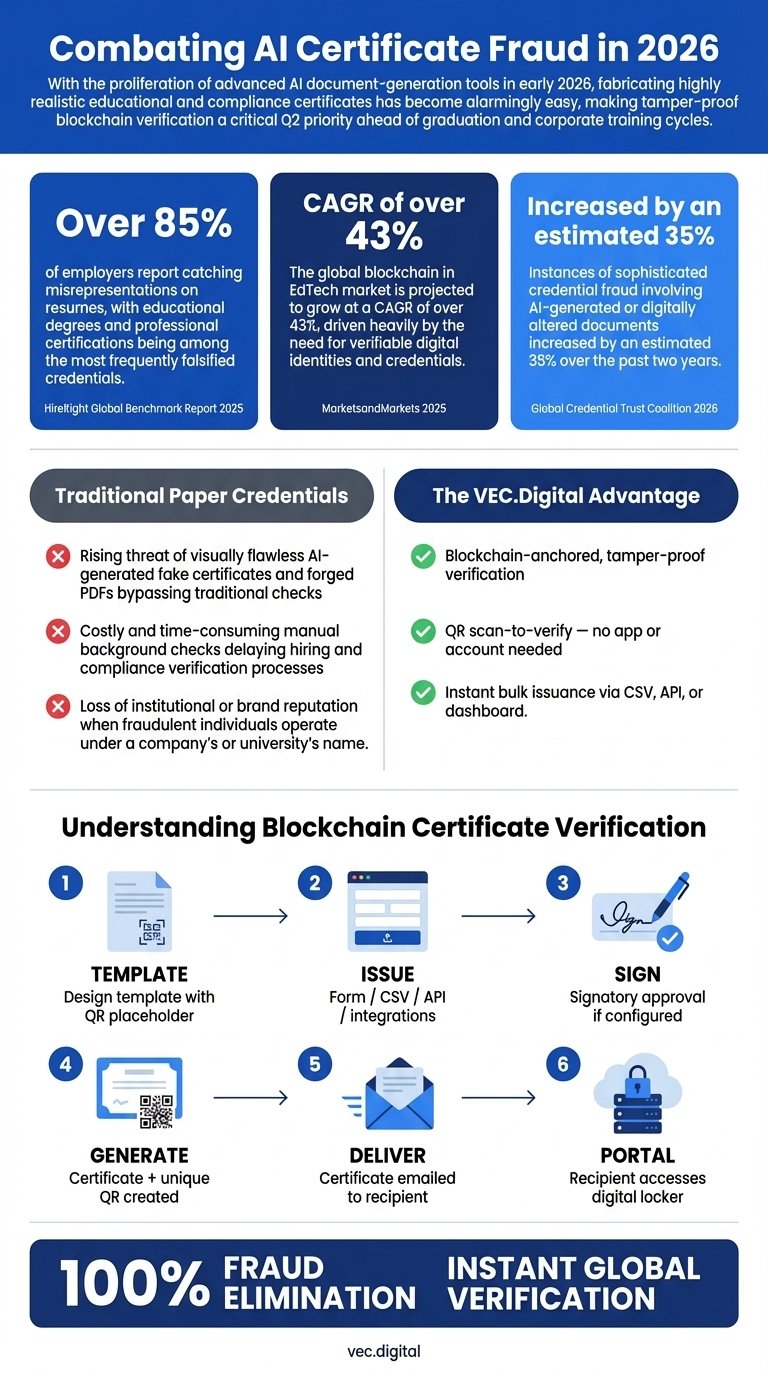
Over 85% of employers report catching misrepresentations on resumes, with educational degrees and professional certifications being among the most frequently falsified credentials (HireRight Global Benchmark Report, 2025). As advanced artificial intelligence makes forging visually flawless documents easier than ever, implementing robust blockchain certificate verification has become an urgent necessity for global institutions. Relying on outdated manual checks leaves organizations exposed to sophisticated fraud, severe reputational damage, and crippling operational bottlenecks.
In this comprehensive guide, our team at VEC.Digital will explore how modern organizations can eliminate credential fraud and streamline their issuance processes. You will learn how to transition from vulnerable PDFs to tamper-proof digital credentials, how to utilize instant QR-code scanning to empower employers worldwide, and how to deploy scalable issuance workflows that save time while supporting global sustainability goals.
Key Takeaways
- AI-generated credential fraud is rising rapidly, making traditional visual inspections of PDF certificates entirely obsolete.
- Blockchain certificate verification reduces credential background check times from several days to mere milliseconds.
- QR code scan-to-verify technology empowers employers to instantly validate credentials without downloading apps or creating accounts.
- Verifiable digital credentials protect institutional reputation by ensuring that every issued document is mathematically tamper-proof.
- Sustainable digital credentialing eliminates paper waste, aligning organizational operations with global UN sustainability goals.
The Escalating Threat of AI-Generated Credential Fraud
The landscape of professional and academic credentialing is undergoing a seismic shift. As we navigate through 2026, the proliferation of generative artificial intelligence has fundamentally altered the security paradigm for document issuance. Instances of sophisticated credential fraud involving AI-generated or digitally altered documents increased by an estimated 35% over the past two years (Global Credential Trust Coalition, 2026). This surge in fraudulent activity underscores the critical need for blockchain certificate verification across all sectors.
Historically, organizations relied on watermarks, specific paper stocks, or complex typography to secure their documents. Today, AI tools can replicate these physical and digital security measures with frightening accuracy, creating synthetic documents that easily deceive the human eye. This technological arms race demands a systemic upgrade in how we issue, manage, and verify professional achievements.
Why Traditional PDF Certificates Are No Longer Secure
For over a decade, standard PDF certificates were the default medium for digital credentialing. However, a fundamental question arises: why are traditional PDF certificates no longer secure? The answer lies in the mutability of standard digital files. A standard PDF is simply a visual representation of data. With modern PDF editing software and AI-driven image manipulation, bad actors can easily alter names, dates, grades, and institutional logos without leaving obvious digital footprints.
When a candidate submits a standard PDF as proof of qualification, the receiving organization has no mathematical guarantee that the document remains in its original, unaltered state. The visual layer of the document offers zero cryptographic proof of authenticity. This inherent vulnerability makes standard PDFs an unacceptable risk for high-stakes credentialing in healthcare, finance, engineering, and higher education.
The Cost of Manual Verification and Administrative Overhead
Because visual inspection of PDFs is unreliable, employers and compliance managers are forced to rely on manual verification. This process typically involves contacting the issuing university or training provider directly via email or phone. Traditional manual verification of academic and professional credentials takes an average of 3 to 5 business days, whereas blockchain verification occurs in milliseconds (World Economic Forum Digital Identity Report, 2025).
This delay has cascading negative effects. For employers, a 5-day delay in background checks can result in losing top-tier talent to competitors with faster hiring pipelines. For the issuing institutions, responding to thousands of manual verification requests creates an overwhelming administrative burden. University registrars and corporate HR teams spend countless hours digging through legacy databases to confirm alumni records, pulling valuable staff away from strategic initiatives.
Protecting Institutional Reputation on a Global Scale
Beyond the operational inefficiencies, credential fraud poses a severe threat to brand integrity. The loss of institutional reputation when fraudulent individuals operate under a company's or university's name can be devastating. If a medical professional or structural engineer causes harm while operating under a falsified credential from your institution, the resulting public relations crisis and potential legal liability are immense.
By adopting higher education solutions that utilize immutable ledgers, institutions can unequivocally disavow forged documents. When the public and corporate world know that an institution's authentic credentials can be instantly and mathematically verified, the incentive to forge those specific credentials plummets, thereby safeguarding the institution's global standing.
Understanding Blockchain Certificate Verification
To combat these evolving threats, more than 60% of higher education institutions are actively transitioning to or exploring verifiable digital credentials to safeguard institutional reputation (Educause Horizon Report, 2025). The global blockchain in EdTech market is projected to grow at a CAGR of over 43%, driven heavily by the need for verifiable digital identities and credentials (MarketsandMarkets, 2025). But what exactly does this technology entail, and how does it function in practice?
Blockchain certificate verification is the process of anchoring the cryptographic signature of a digital document to an immutable, decentralized ledger. Rather than storing sensitive personal data on the public ledger, the system generates a unique mathematical hash—a digital fingerprint—of the certificate. This hash is recorded permanently. When the certificate is presented for verification, the system recalculates the hash and compares it to the blockchain record. If they match perfectly, the document is authentic.
What Is a Verifiable Credential in Education and Corporate Training?
A verifiable credential is a digital record of an achievement or qualification that contains embedded, cryptographically secure proof of its origin and integrity. Unlike a static image or a standard text document, a verifiable credential carries its own verification mechanism within its metadata.
In the context of education and corporate training, this means that a diploma, a compliance certificate, or a professional license becomes a dynamic, self-authenticating asset. When an organization issues a verifiable credential, they are providing the learner with a portable digital asset that can be shared globally, while simultaneously providing any relying party (like an employer) with the mathematical certainty that the issuing body authorized it.
Can Blockchain Certificates Be Faked or Hacked?
A common concern among administrators is: can blockchain certificates be faked or hacked? The short answer is no, provided the underlying cryptographic anchoring is implemented correctly. Because the verification relies on cryptographic hashing, altering even a single pixel or a single character of text on the certificate will completely change its resulting hash.
If a fraudster attempts to change the name on a blockchain-anchored certificate and presents it to an employer, the verification system will instantly detect that the new hash does not match the original hash recorded on the immutable ledger. The verification will fail immediately, flagging the document as tampered with. Furthermore, because blockchains are decentralized and immutable, malicious actors cannot hack the ledger to alter the original record.
Moving Beyond Cryptography: The User-Friendly Verification Experience
A significant barrier to the widespread adoption of secure credentials has been the perceived technical complexity. Most existing literature heavily focuses on the complex cryptography behind decentralized ledgers, neglecting the practical, front-end user experience. At VEC.Digital, we bridge this informational gap by ensuring that the end-user experience requires zero technical expertise.
Administrators do not need to understand hash functions to issue secure documents, and employers do not need to understand consensus mechanisms to verify them. The technology operates entirely in the background. For the user, the experience is as simple as clicking a button or scanning a code, transforming complex cryptographic security into an effortless daily workflow.
How QR Code Scan-to-Verify Certificates Empower Employers
The true power of blockchain certificate verification is realized when it is placed in the hands of the people who need it most: hiring managers, compliance officers, and event organizers. To make verification universally accessible, VEC.Digital integrates seamless scanning technology directly into every issued document.
This approach eliminates the friction traditionally associated with background checks. By turning every credential into an interactive, self-verifying asset, organizations can accelerate global mobility and ensure that their alumni and certified professionals face no delays when proving their qualifications.
How Do QR Code Certificates Work for Employers?
The mechanism is elegant in its simplicity. Every certificate generated through the VEC platform features a unique, dynamically generated QR code. How do QR code certificates work for employers? When a hiring manager receives a resume or views a digital credential, they simply point their native smartphone camera at the embedded QR code.
The code instantly directs the user's browser to a secure, unique URL specific to that exact credential (e.g., /certificate/[uuid]). There is no need for the employer to download a proprietary verification app, create a user account, or log into a portal. The frictionless nature of this process ensures high adoption rates among relying parties globally.
How Do You Verify a Blockchain Certificate Instantly?
Once the QR code is scanned or the unique URL is clicked, the verifying party is taken to the public certificate verification page. So, how do you verify a blockchain certificate instantly? The VEC platform automatically performs the cryptographic check in milliseconds.
If the document is authentic and unaltered, the page prominently displays a "blockchain verified" badge. This visual indicator provides immediate peace of mind. The page also displays the verified metadata, including the recipient's name, the issuing organization, the date of issuance, and the specific qualifications achieved. This instant feedback loop completely bypasses the traditional 3-to-5-day manual verification waiting period.
How to Spot a Fake Digital Certificate in 2026
As we look at the threat landscape, knowing how to spot a fake digital certificate in 2026 relies entirely on technological validation rather than visual inspection. You can no longer trust your eyes when evaluating PDFs.
To spot a fake, an employer should look for the presence of a cryptographic verification link or QR code. If the certificate lacks these elements, it must be treated with high suspicion and subjected to manual checks. If it possesses a QR code, scanning it should lead to a secure verification portal hosted by a trusted provider like VEC.Digital. If the scan leads to an error, a mismatched name, or a page lacking a cryptographic verification badge, the document is a confirmed forgery.
Streamlining the Issuance Pipeline for Organizations
While the benefits of blockchain certificate verification for employers and recipients are clear, the system must also be highly efficient for the issuing organization. VEC.Digital provides a comprehensive, scalable suite of tools designed to reduce administrative overhead and streamline the entire credentialing lifecycle.
Our platform is built to accommodate the complex administrative hierarchies found in global universities, multinational corporations, and large-scale training providers, ensuring that security never comes at the expense of operational efficiency.
Multi-Signatory Workflows and Secure Template Editors
In many institutions, a single credential requires authorization from multiple department heads. VEC.Digital facilitates this through a robust multi-signatory workflow. Administrators can assign up to two signatories per template. Crucially, the certificate is held in a pending state until all designated signatories have independently reviewed and signed off on the issuance, ensuring strict internal compliance.
Furthermore, the platform features a powerful template editor that allows organizations to maintain their exact brand standards. With access to over 1,400 Google Fonts, an intuitive drag-and-drop interface, support for A2 through A5 sizes in both portrait and landscape orientations, and seamless Canva integration for background designs, creating visually stunning, highly secure documents has never been easier.
Four Issuance Methods for Scalable Global Operations
To accommodate diverse organizational needs, VEC.Digital offers four distinct issuance methods. For ad-hoc credentialing, administrators can use the dashboard form to issue certificates one-by-one. For graduating classes or massive corporate training cohorts, the CSV upload feature allows for bulk issuance in minutes.
For organizations looking for deep integration, our REST API allows for programmatic issuance directly from existing Learning Management Systems (LMS) or HR platforms. Finally, we support various third-party integrations to fit seamlessly into your existing tech stack, ensuring that your secure management processes remain uninterrupted.
Recipient Digital Lockers for Lifelong Access
The value of a credential is directly tied to its accessibility. VEC.Digital provides every recipient with a secure digital locker—a centralized portal where they gain permanent access to all their earned certificates. This empowers learners and professionals to manage their achievements from anywhere in the world, at any time.
By providing a digital locker, institutions eliminate the need to process "lost certificate" replacement requests. Alumni can easily retrieve, share, and prove their qualifications to prospective employers without ever needing to contact the university registrar, massively reducing ongoing administrative support costs.
Global Compliance and Sustainability in Credentialing
As digital transformation accelerates, organizations must ensure their credentialing practices align with international regulatory frameworks and broader corporate social responsibility initiatives. Blockchain certificate verification is not just a security measure; it is a strategic alignment with the future of global business operations.
Operating on a global scale requires an infrastructure that respects data privacy, ensures cross-border interoperability, and minimizes environmental impact.
Aligning with International Standards like eIDAS 2.0
Global regulatory pressures are compelling multinational organizations to adopt standardized, cross-border verifiable credentials. In Europe, the EU’s eIDAS 2.0 framework is setting strict standards for digital identity and trust services. Similarly, decentralized identity standards are rapidly rising across the APAC region.
VEC.Digital’s architecture prioritizes data privacy and instant verification, ensuring that credentials issued on our platform meet the rigorous demands of international compliance. By utilizing cryptographic hashing rather than storing personal data directly on public ledgers, organizations can issue globally verifiable documents while remaining fully compliant with privacy regulations like GDPR.
Supporting UN Sustainability Goals Through Paperless Operations
Beyond security and compliance, transitioning to digital credentials represents a significant step toward environmental sustainability. Traditional paper credentialing involves massive amounts of physical waste, from specialized parchment paper and printing inks to the carbon footprint associated with international physical shipping.
VEC.Digital is proud to support UN sustainability goals. By digitizing the entire credential lifecycle, organizations can completely eliminate paper waste, drastically reduce printing and delivery costs, and contribute to an eco-friendly credential management ecosystem globally. This commitment to sustainability is increasingly important to modern learners, corporate partners, and institutional stakeholders.
Secure Your Organization with VEC.Digital Today
The threat of AI-generated credential fraud is real, growing, and increasingly sophisticated. Organizations that continue to rely on manual verification and vulnerable PDF documents risk severe reputational damage and operational inefficiency. By adopting blockchain certificate verification, you can transform your credentialing process into a tamper-proof, globally accessible, and highly efficient system.
VEC.Digital provides the ultimate solution for effortless, trustworthy digital credential issuance. With our QR code scan-to-verify technology, multi-signatory workflows, and seamless digital lockers, we empower your organization to issue credentials with absolute confidence. Our platform is designed to scale with your needs, whether you are a boutique training provider or a massive global university.
Ready to modernize your credentialing process? You can start completely free today. Our flexible pricing requires no credit card and no setup fees to begin. Paid plans for organizations start at just $29.99/month, while individuals pay only $1.00 per certificate. Protect your reputation, save valuable administrative time, and join the future of secure digital credentials.
Contact our team to learn more:
Website: vec.digital
Email: support@vec.digital
WhatsApp: +971521373078