
Combating AI Credential Fraud in 2026: The Shift to Blockchain Verification
Published on April 19, 2026

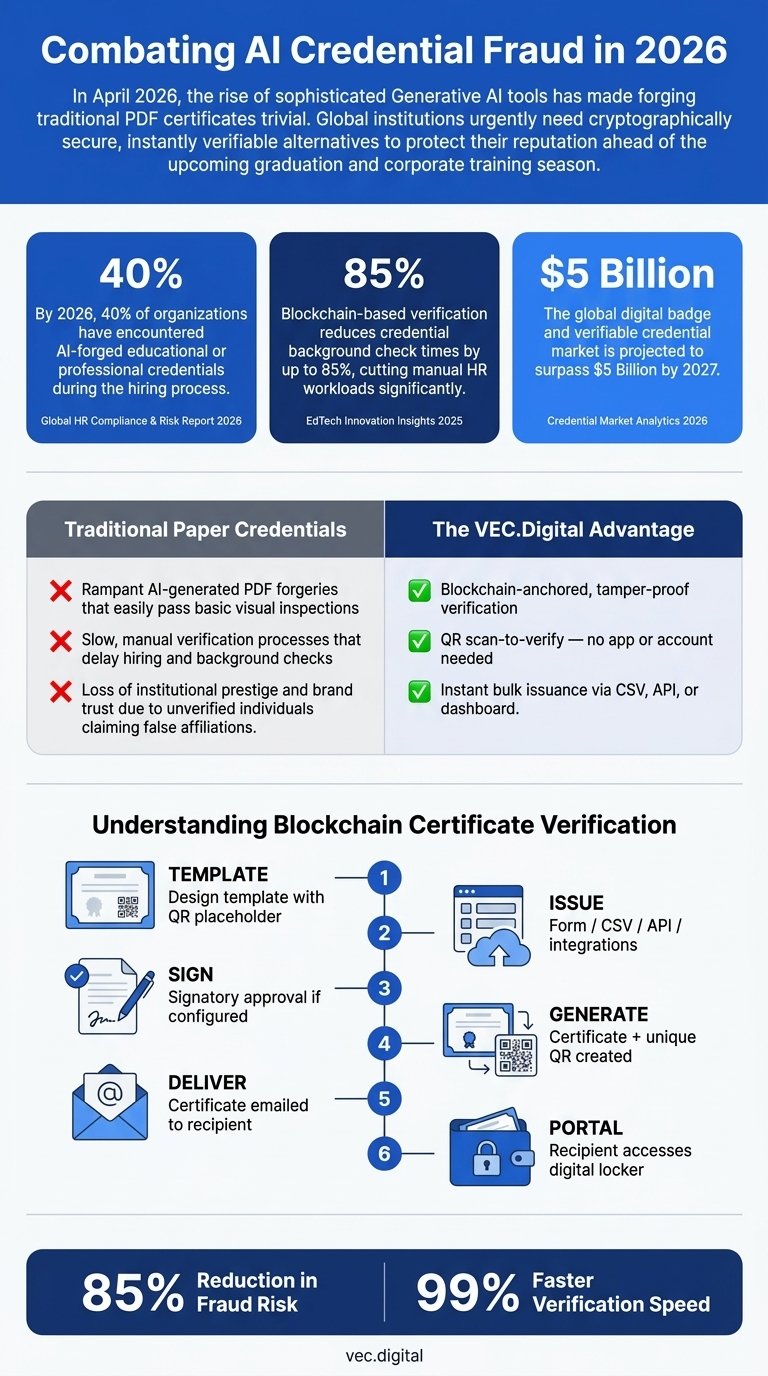
By 2026, a staggering 40% of organizations have encountered AI-forged educational or professional credentials during the hiring process, according to the Global HR Compliance & Risk Report (2026). As sophisticated generative artificial intelligence makes forging traditional PDF documents trivial, global institutions urgently require robust blockchain certificate verification to protect their brand reputations and operational integrity. The era of relying on easily manipulated static files and painstakingly slow manual background checks is officially over, demanding a decisive shift toward cryptographically secure, instantly verifiable digital alternatives.
In this comprehensive guide, your organization will learn how to transition seamlessly from vulnerable legacy formats to tamper-proof digital records without needing deep technical expertise. Our team at VEC.Digital will show you exactly how to eliminate credential fraud, issue bulk certificates in minutes using simple CSV uploads, and provide learners with globally accessible credentials. By modernizing your issuance pipeline, you will discover practical strategies to enforce multi-signatory workflows, reduce administrative overhead, and guarantee absolute trust for employers, universities, and training providers worldwide.
Key Takeaways
- AI certificate forgery has rendered traditional PDF documents obsolete, forcing a global shift in how qualifications are issued and verified.
- Blockchain certificate verification provides immutable, cryptographically secure proof of authenticity that cannot be altered or duplicated.
- QR code certificate verification enables instant, app-free background checks, drastically reducing HR workloads and hiring delays.
- Institutions can drastically reduce administrative overhead using bulk CSV uploads and automated multi-signatory workflows.
- Transitioning to verifiable digital credentials supports global sustainability goals by eliminating paper waste and physical shipping logistics.
The Rise of AI Certificate Forgery in 2026
Why Traditional PDF Certificates Are No Longer Secure in 2026
For over two decades, the portable document format (PDF) served as the global standard for digital document sharing, including academic diplomas and professional certifications. However, the landscape has fundamentally changed. When answering the question of why traditional PDF certificates are no longer secure in 2026, we must look at the accessibility of advanced generative AI tools. These platforms allow individuals with zero graphic design experience to clone institutional letterheads, replicate authorized signatures, and generate pixel-perfect forgeries in a matter of seconds. Visual inspection is no longer a reliable method for authenticating a document's origin.
Furthermore, legacy PDFs lack any inherent cryptographic linkage to the issuing authority. Even when digitally signed, these files can be stripped of their metadata, visually modified, and re-saved, rendering the original security measures useless. As a result, HR professionals and university admissions teams are increasingly skeptical of static documents submitted via email or uploaded to applicant tracking systems. The reliance on these outdated formats creates a significant vulnerability, necessitating a fundamental upgrade to blockchain certificate verification to restore trust in the credentialing ecosystem.
The Financial and Reputational Cost of Fraud
The consequences of accepting fraudulent credentials extend far beyond a mere administrative oversight; they carry severe financial and reputational penalties. According to the Talent Acquisition Risk Assessment (2026), companies lose an average of $30,000 per bad hire linked to resume or credential misrepresentation. This figure encompasses recruitment costs, onboarding expenses, lost productivity, and the eventual cost of replacing the unqualified employee. In highly regulated industries such as healthcare, finance, and engineering, the risks are compounded by potential legal liabilities and compliance violations.
For the issuing institutions—universities, corporate training providers, and certification bodies—the damage to brand prestige can be devastating. When unverified individuals successfully claim false affiliations, the perceived value of the institution's legitimate alumni network diminishes. If employers cannot trust the credentials bearing an organization's name, they will inevitably devalue those qualifications in the job market. Protecting the integrity of the credential is therefore not just an IT security issue, but a core strategic imperative for institutional survival.
The Global Shift Toward Verifiable Digital Credentials
Recognizing the vulnerabilities of legacy systems, regulatory bodies and governments worldwide are driving a rapid transition toward cryptographically secure frameworks. Initiatives such as the European Union's Digital Identity Wallets and the UAE's comprehensive push for paperless government ecosystems are setting new international standards. These initiatives mandate that digital records must be immutable, interoperable, and easily verifiable across borders, effectively forcing training providers worldwide to abandon easily manipulated static PDFs.
This global context highlights that the adoption of verifiable digital credentials is no longer an optional technological upgrade, but a compliance necessity. As international labor mobility increases, employers require a standardized method to verify cross-border qualifications instantly. Institutions that fail to adopt these modern credentialing standards risk isolating their graduates from global employment opportunities and falling behind in an increasingly digital-first educational landscape.
Understanding Blockchain Certificate Verification
What is a Verifiable Credential?
A verifiable credential is a tamper-evident digital record whose authorship and integrity can be cryptographically proven. Unlike a standard digital image or PDF, a verifiable credential contains embedded metadata that links the document directly to the decentralized identity of the issuing organization. When a learner presents this credential to a third party, the verifier can mathematically confirm who issued it, who it was issued to, and whether it has been altered or revoked since its creation, all without needing to contact the issuer directly.
The architecture behind these credentials often aligns with global data models, such as those established by the World Wide Web Consortium (W3C). By adhering to these internationally recognized standards, verifiable credentials ensure interoperability across different platforms and geographic regions. For universities and corporate training centers, this means their qualifications become universally recognized, portable assets that learners can securely store and share throughout their professional lives.
How Does Blockchain Prevent Certificate Fraud?
To understand how blockchain prevents certificate fraud, we must examine the concept of immutability. When an institution issues a certificate through a platform like VEC.Digital, the core data of that credential—its unique digital fingerprint, or "hash"—is anchored onto a decentralized blockchain network. This anchoring process creates a permanent, unalterable timestamp of the credential's issuance. Blockchain certificate verification works by comparing the hash of the presented certificate against the hash stored on the blockchain.
If a malicious actor attempts to alter even a single pixel of the certificate, change a grade, or modify the recipient's name, the digital fingerprint of the document changes completely. When an employer attempts to verify the altered document, the system will immediately detect a mismatch between the new hash and the original hash anchored on the blockchain, flagging the credential as invalid. Because the blockchain is decentralized and secured by complex consensus mechanisms, it is computationally impossible for a forger to hack the network and alter the original issuance record, thereby completely eradicating the possibility of undetected fraud.
Bridging the Gap: From Complex Theory to Operational Simplicity
A major barrier to the adoption of blockchain technology has been the assumption that it requires specialized technical knowledge to operate. Most existing literature focuses heavily on the underlying cryptography, web3 architecture, and smart contract development, which can alienate non-technical HR directors and education administrators. However, the reality of modern blockchain credential management is vastly different. The complexity of the decentralized ledger is entirely abstracted away from the user experience.
Today, issuing a blockchain-anchored credential is as simple as sending an email. Administrators do not need to manage cryptocurrency wallets, understand cryptographic hashing, or interact directly with blockchain nodes. Instead, they interact with intuitive, cloud-based dashboards where the heavy lifting is handled automatically in the background. By focusing on operational simplicity, platforms empower organizations to leverage military-grade security through familiar interfaces, ensuring that the transition to next-generation credentialing is frictionless and highly efficient.
Solving Administrative Pain Points with Modern Credentialing
Eliminating Slow Manual Verification Processes
One of the most significant bottlenecks in global hiring and academic admissions is the manual verification of qualifications. Historically, when an employer needed to authenticate a candidate's degree, they had to contact the university's registrar office via phone or email, pay a processing fee, and wait days or even weeks for a response. This archaic process not only delays critical hiring decisions but also places a massive administrative burden on the issuing institutions. Blockchain certificate verification entirely eliminates this friction.
According to EdTech Innovation Insights (2025), implementing blockchain-based verification reduces credential background check times by up to 85%, cutting manual HR workloads significantly. Because the cryptographic proof is permanently available on the public ledger, third-party verifiers can authenticate a credential instantly, 24/7, without requiring any human intervention from the issuing organization. This self-serve verification model accelerates talent acquisition, improves the candidate experience, and frees up institutional staff to focus on higher-value strategic initiatives rather than answering repetitive verification requests.
Reducing High Administrative Overhead
Beyond the verification process, managing the lifecycle of traditional certificates is inherently costly and inefficient. Physical certificates require expensive security paper, specialized printing equipment, manual signing sessions, and complex shipping logistics. Furthermore, when alumni inevitably lose their physical diplomas or require updated copies due to name changes, the administrative cycle must be repeated, generating continuous overhead for the institution.
Digital credentialing platforms solve this by digitizing the entire issuance pipeline. By moving to a centralized digital system, organizations can issue thousands of records simultaneously, instantly distribute them via email, and manage revocations or re-issuances with a single click. The global digital badge and verifiable credential market is projected to surpass $5 Billion by 2027 (Credential Market Analytics, 2026), driven largely by the massive cost savings institutions realize when they abandon legacy paper-based workflows in favor of streamlined digital infrastructure. To see how this applies to enterprise environments, explore our corporate training solutions.
The Sustainability Impact of Going Paperless
In addition to operational efficiency, the shift away from physical certificates aligns closely with global environmental priorities. The traditional credentialing industry consumes vast amounts of paper, water, and energy for printing, while the global shipping of diplomas contributes significantly to carbon emissions. For institutions committed to corporate social responsibility, this environmental footprint is no longer justifiable.
Transitioning to digital credentialing directly supports the United Nations Sustainable Development Goals (SDGs) by promoting responsible consumption and production. By eliminating paper waste and removing the need for physical delivery networks, organizations can drastically reduce their carbon footprint. VEC.Digital is deeply committed to this eco-friendly approach, enabling our partners to issue millions of credentials globally without cutting down a single tree, proving that advanced security and environmental stewardship can go hand in hand.
How Employers and Institutions Verify Digital Certificates Instantly
The Power of QR Code Certificate Verification
A common question among administrators is: "How can employers verify digital certificates instantly?" The answer lies in the seamless integration of quick response technology. Every certificate issued through the VEC.Digital platform features a unique, dynamically generated QR code. When an employer, admissions officer, or auditor scans this code using any standard smartphone camera, they are instantly directed to a secure, dedicated public verification page (hosted at /certificate/[uuid]).
This raises another frequent inquiry: "Are QR code certificates safe from tampering?" Yes, because the QR code itself is merely a routing mechanism. The security lies in the destination page, which pulls the cryptographic proof directly from the blockchain. There is no app to download, no account to create, and no login required for the verifier. This frictionless experience ensures that QR code certificate verification is not only mathematically secure but also universally accessible, providing immediate peace of mind to anyone reviewing the credential.
The "Blockchain Verified" Badge of Trust
To further enhance the verification experience, cryptographic platforms utilize visual indicators of authenticity. When a verifier accesses the unique URL associated with a VEC.Digital credential, the system performs a real-time cryptographic check against the blockchain. If the hash matches and the certificate is confirmed as authentic and unrevoked, the public verification page prominently displays a "blockchain verified" badge.
This badge serves as a universal symbol of trust. It communicates instantly to the reviewer that the document has not been tampered with and that the issuing authority's identity has been thoroughly authenticated. By combining the complex mathematical certainty of the blockchain with a clear, intuitive visual interface, institutions can provide absolute confidence to external stakeholders, effectively nullifying the threat of AI certificate forgery.
Empowering Learners with a Digital Locker
Modern credentialing is not just about serving the needs of the issuer and the verifier; it is equally about empowering the learner. In the past, graduates had to store physical diplomas in filing cabinets or manage disparate PDF files across various devices. Today, recipients of blockchain-anchored credentials are provided with a secure, permanent digital locker. This portal grants them centralized access to all their earned certificates in one convenient location.
The recipient digital locker is accessible anywhere, anytime, from any web-enabled device. Learners can easily share their verified credentials directly to professional networks like LinkedIn, email them to prospective employers, or download them for offline use. This persistent access not only improves the learner's professional mobility but also fosters a lifelong digital relationship between the issuing institution and the alumni. Learn more about the verification experience on our verification page.
Transitioning Your Organization to Blockchain Credential Management
How Universities Transition from Paper to Blockchain Certificates
Given the clear advantages, it is no surprise that over 60% of higher education institutions are currently transitioning from legacy PDFs to blockchain-anchored digital certificates (University Administration Tech Survey, 2025). However, many organizational leaders wonder how universities transition from paper to blockchain certificates without disrupting their existing operations. The key is adopting a platform designed specifically for institutional workflows, allowing for a phased, highly controlled rollout.
The transition begins with digitizing the certificate design, followed by mapping the organization's approval hierarchy into the digital system. Because modern platforms operate alongside existing Student Information Systems (SIS) and Learning Management Systems (LMS), institutions do not need to rip and replace their core infrastructure. They simply add a secure issuance layer at the very end of the student journey, seamlessly transforming graduation data into immutable digital assets.
Multi-Signatory Workflows for Secure Approvals
A critical component of institutional credentialing is the approval process. In a traditional setting, a physical diploma might require the wet signatures of both a university president and a department dean. Replicating this governance in a digital environment is essential for maintaining internal security and compliance. VEC.Digital addresses this through robust multi-signatory workflows.
Our platform allows organizations to configure up to two distinct signatories per certificate template. When a batch of certificates is generated, they do not immediately go live. Instead, the certificates are held in a secure "pending" status. Only after all designated signatories have independently reviewed and cryptographically signed the batch are the credentials anchored to the blockchain and released to the recipients. This strict signatory workflow ensures that no unauthorized personnel can issue credentials unilaterally, providing enterprise-grade internal controls.
4 Issuance Methods: From Bulk CSV to REST API
Flexibility in how data is ingested is crucial for global organizations of varying sizes. To accommodate everything from boutique training workshops to massive global universities, blockchain certificate verification platforms must offer multiple avenues for issuance. VEC.Digital provides four distinct issuance methods tailored to different operational needs.
First, administrators can use the dashboard form for issuing certificates one-by-one, ideal for ad-hoc awards. Second, for larger cohorts, the bulk CSV upload feature allows institutions to generate thousands of personalized certificates in minutes simply by uploading a spreadsheet. Third, for organizations seeking full automation, our robust REST API allows developers to trigger certificate issuance programmatically directly from their proprietary software. Finally, native third-party integrations connect the issuance pipeline directly to popular CRM and LMS platforms, ensuring that the credentialing process fits perfectly into any existing tech stack.
Designing Beautiful Credentials with Template Editors
Security and cryptographic anchoring should never come at the expense of visual branding. A certificate is a representation of an institution's prestige, and its design must reflect that quality. Modern platforms feature advanced template editors that empower administrators to create stunning, professional credentials without needing specialized graphic design software.
The VEC.Digital template editor offers unparalleled customization, featuring over 1,400 Google Fonts, intuitive drag-and-drop functionality, and support for various dimensions including A2 through A5, in both portrait and landscape orientations. Furthermore, seamless Canva integration allows design teams to import custom backgrounds and brand assets effortlessly. This ensures that every blockchain-anchored credential is not only mathematically tamper-proof but also visually breathtaking. Explore our design capabilities in the certificate maker.
Secure Your Institution's Future with VEC.Digital
As the threat of AI-generated fraud continues to escalate in 2026, the reliance on traditional PDF certificates poses an unacceptable risk to global organizations. The transition to blockchain certificate verification is no longer a futuristic concept; it is a current operational imperative. By adopting cryptographically secure, instantly verifiable digital credentials, your organization can protect its brand prestige, drastically reduce administrative overhead, and provide learners with the portable, trustworthy qualifications they need to succeed in a globalized workforce.
VEC.Digital is proud to lead this transformation, providing a platform that bridges military-grade blockchain security with intuitive, user-friendly operational workflows. Whether you need to issue a dozen certificates for a corporate workshop or tens of thousands for a university graduating class, our multi-signatory workflows, bulk CSV capabilities, and stunning template editors make the process effortless and secure.
Ready to eliminate credential fraud and streamline your issuance pipeline? Your organization can start completely free—no credit card required and no setup fees. As you scale, our flexible paid plans start from just $29.99/month for organizations, while individuals pay only $1.00 per certificate. Discover the future of trustworthy digital credentialing today. View our organization pricing to get started.
Contact our global team to learn more:
Website: vec.digital
Email: support@vec.digital
WhatsApp: +971521373078