
Combating Credential Fraud in 2026: The Guide to Digital Certificate Fraud Prevention
Published on April 28, 2026

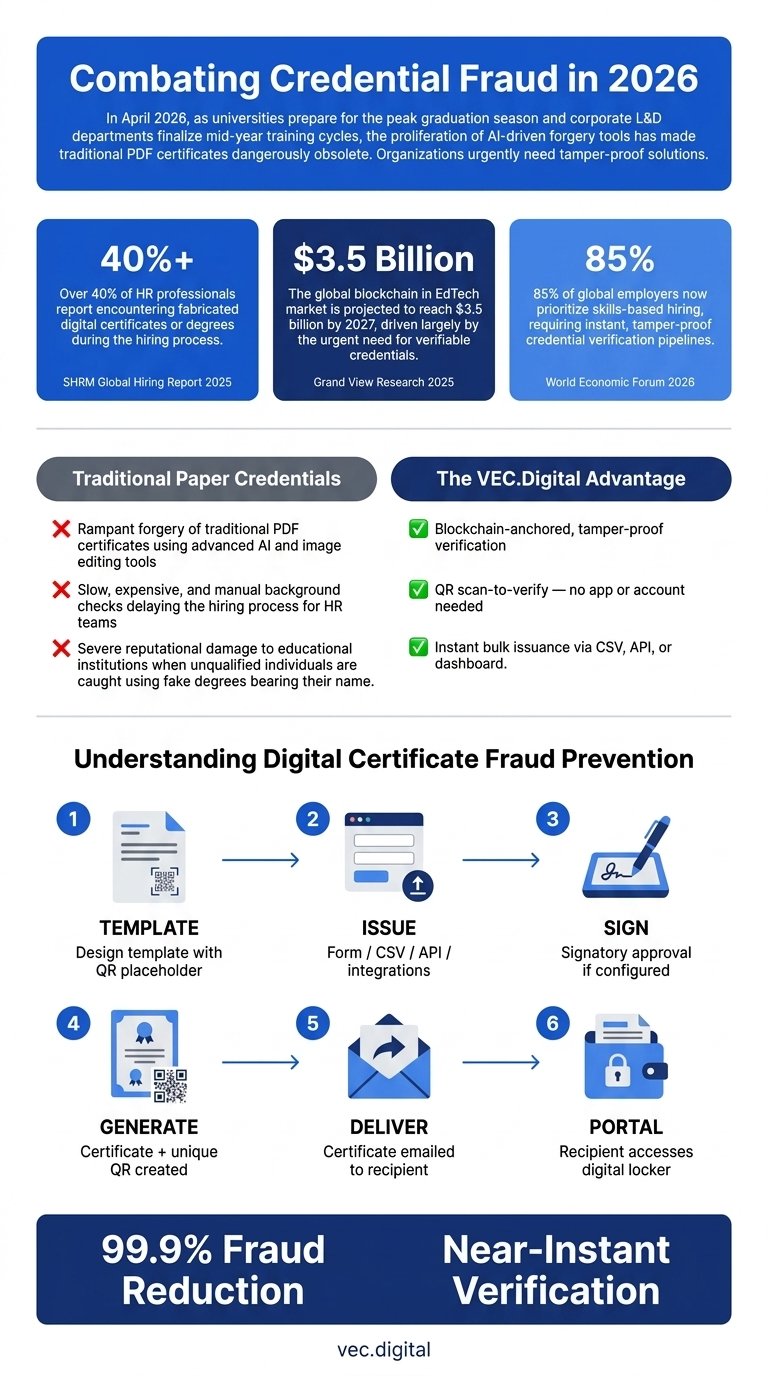
Over 40% of HR professionals report encountering fabricated digital certificates or degrees during the hiring process, according to the 2025 SHRM Global Hiring Report. As artificial intelligence and advanced image editing tools become universally accessible, traditional digital certificate fraud prevention is no longer just an IT concern—it is a critical imperative for maintaining organizational integrity. The reliance on easily altered PDF documents has created a massive vulnerability, costing global institutions millions in reputational damage and stalling hiring pipelines with painfully slow manual background checks.
In this comprehensive guide, our team at VEC.Digital will explore how forward-thinking organizations can transition from vulnerable legacy systems to robust, tamper-proof issuance pipelines. You will discover how to eliminate credential fraud entirely, how to issue bulk certificates securely in minutes, and how to provide learners with globally accessible, instantly verifiable credentials. By understanding the practical application of blockchain technology, your organization can protect its brand, save countless administrative hours, and support a more sustainable, paperless future.
Key Takeaways
- Digital certificate fraud prevention requires moving beyond static PDFs to cryptographically secure records anchored on immutable ledgers.
- Blockchain credential verification allows institutions to reduce third-party background check times by up to 70%, streamlining global hiring.
- QR code certificate verification enables instant, frictionless validation for employers and administrators without the need for apps or logins.
- Verifiable credentials 2026 are rapidly aligning with global trust frameworks, such as the European Union's eIDAS 2.0 regulations.
- Fake certificate detection is solved proactively when organizations adopt secure digital badges that offer public, tamper-proof verification pages.
The Escalating Threat of Credential Forgery in 2026
Why PDF Certificates Are No Longer Considered Secure
For over a decade, the standard for digital credentialing was the simple PDF document. However, as we navigate through 2026, the question frequently arises: why are PDF certificates no longer considered secure? The answer lies in the democratization of advanced artificial intelligence and sophisticated graphic editing software. What once required a skilled forger can now be accomplished by anyone with a web browser in a matter of seconds. Bad actors can effortlessly alter names, dates, institutional logos, and even replicate authorized signatures on static documents.
This rampant forgery of traditional PDF certificates represents a severe operational risk. When a document is merely a collection of pixels on a screen, it possesses no inherent verifiability. A hiring manager receiving a PDF attachment has no immediate way to cryptographically prove that the document was actually issued by the claimed university or training provider. Digital certificate fraud prevention must therefore evolve past the document itself and focus on the underlying data and its immutable proof of origin.
The global shift away from static files is accelerating. Organizations are recognizing that sending a PDF via email is equivalent to handing out unwatermarked currency. To truly secure the value of an achievement, the credential must be anchored to a system of trust that cannot be altered retroactively, regardless of how advanced forgery tools become.
The Cost of Reputational Damage for Institutions
When unqualified individuals successfully use fake degrees bearing an institution's name, the fallout extends far beyond a single bad hire. There is severe reputational damage to educational institutions and corporate training providers when their credentials are exposed as easily falsifiable. If employers cannot trust the certificates issued by a specific university, the intrinsic value of that university's genuine degrees plummets, ultimately harming honest alumni.
Maintaining a pristine reputation in the global education and training market requires proactive measures. Administrators can no longer afford a reactive stance, waiting for a scandal to prompt a security upgrade. By implementing robust issuance pipelines that guarantee authenticity, institutions signal to the global market that their standards are uncompromising. This builds enduring trust with corporate partners, accreditation bodies, and the learners themselves.
Furthermore, the financial implications of reputational damage are staggering. Declining enrollment rates, loss of corporate partnerships, and potential legal liabilities create a compelling business case for immediate technological intervention. Securing credentials is not merely an IT expense; it is a fundamental brand protection strategy.
Understanding Digital Certificate Fraud Prevention
What is a Blockchain Verifiable Credential?
To effectively combat forgery, organizations must understand the modern architecture of trust. A common question from administrators is: what is a blockchain verifiable credential? In simple terms, it is a digital record of achievement that is cryptographically anchored to an immutable ledger. When an organization issues a certificate, a unique digital fingerprint (or hash) of that certificate is generated and permanently recorded on the blockchain.
This means the actual certificate data remains private and secure, but the proof of its existence and authenticity is publicly verifiable. If a bad actor attempts to alter a single pixel or character on the certificate, the digital fingerprint changes entirely, instantly breaking the verification link. This binary state of trust—it is either 100% authentic or it is flagged as altered—is the cornerstone of modern digital certificate fraud prevention.
The market demand for this technology is surging. According to a 2025 report by Grand View Research, the global blockchain in EdTech market is projected to reach $3.5 billion by 2027, driven largely by the urgent need for verifiable credentials. This massive capital influx highlights a global consensus: cryptographic trust is the future of educational and professional certification.
Shifting from Manual Checks to Cryptographic Trust
The transition to blockchain-anchored credentials fundamentally changes how organizations handle verification. Historically, verifying a credential involved a cumbersome, multi-step process: contacting the issuing institution, waiting for the registrar's office to manually check their siloed databases, and paying a fee for the confirmation. This process is not only archaic but fundamentally unscalable in today's fast-paced global economy.
A 2026 report from the World Economic Forum highlights that 85% of global employers now prioritize skills-based hiring, requiring instant, tamper-proof credential verification pipelines. As employers shift their focus from broad degrees to specific, micro-credentialed skills, the sheer volume of certificates that need verifying has multiplied exponentially. Manual checks simply cannot keep up with this volume.
By adopting cryptographic trust mechanisms, the burden of verification is lifted from the issuing institution's administrative staff. The blockchain acts as a decentralized, always-on notary public. Anyone, anywhere in the world, can independently verify the authenticity of a claim in milliseconds, completely transforming the efficiency of the global labor market.
How Blockchain Credential Verification Solves HR Bottlenecks
Eliminating Slow and Expensive Background Checks
For HR managers and Talent Acquisition Directors, the hiring process is often delayed by slow, expensive, and manual background checks. When candidates submit traditional paper or PDF certificates, HR teams must rely on third-party verification services that can take days or even weeks to return a result. In a competitive talent market, these delays often result in losing top candidates to faster-moving competitors.
Blockchain credential verification completely eradicates this bottleneck. Gartner Technology Insights reported in 2025 that institutions utilizing blockchain-anchored verification reduce third-party background check times by up to 70%. This dramatic reduction in time-to-hire translates directly into reduced operational costs and a significantly better candidate experience.
Instead of sending emails to university registrars and waiting for replies, an HR professional can instantly validate a candidate's qualifications. This empowers talent acquisition teams to make faster, more confident hiring decisions, knowing with absolute certainty that the candidate possesses the skills they claim.
The Role of Global Standards like eIDAS 2.0
As organizations hire from a borderless, global talent pool, relying on localized, fragmented verification boards is no longer viable. The modern workforce requires standardized trust mechanisms that are recognized internationally. This is where global regulatory frameworks come into play, reshaping how digital identities and credentials are managed across borders.
With the European Union's eIDAS 2.0 regulations maturing in 2026 and standardizing digital identity wallets, globally operating companies require compliance-ready solutions. These regulations mandate secure, cross-border electronic identification, pushing organizations toward verifiable credentials that integrate seamlessly into these new digital wallet ecosystems.
Implementing a platform that aligns with these global standards ensures that your organization's credentials will remain relevant, verifiable, and legally recognized well into the future. It provides a future-proof foundation for global workforce mobility and cross-border academic recognition.
Implementing Fake Certificate Detection in Higher Education
How Can Universities Prevent Certificate Forgery?
University administrators are at the forefront of the battle against academic fraud. The question of how universities can prevent certificate forgery is best answered by adopting proactive, system-level defenses rather than reactive policing. Implementing a secure issuance pipeline is the most effective strategy. According to HolonIQ Education Trends in 2026, more than 50% of higher education institutions globally plan to issue cryptographically secure digital credentials by the end of the year.
To effectively implement fake certificate detection, universities must ensure that every credential issued is mathematically tied to the institution's verified identity. When a university uses a platform like VEC.Digital, they utilize a multi-signatory workflow. Up to two designated signatories per template must independently approve and sign the batch before the certificates are anchored to the blockchain and released. This internal control prevents unauthorized issuance from within the institution itself.
By moving to a secure digital infrastructure, universities not only prevent external forgery but also tighten their internal governance. Higher education solutions that utilize blockchain technology offer peace of mind to both the administrators issuing the documents and the alumni who rely on them for career advancement.
Protecting the Value of Academic Degrees Globally
An academic degree is a lifelong asset, but its value is entirely dependent on the trust placed in the issuing institution. When universities issue credentials that cannot be forged, they inherently protect and elevate the prestige of their brand. Alumni become proud ambassadors, carrying verifiable proof of their achievements that can be shared instantly with global employers.
Furthermore, this transition supports a more equitable global education landscape. Students from emerging markets often face heightened scrutiny when presenting degrees to international employers due to regional fraud concerns. By providing these students with blockchain-anchored credentials, universities equip them with undeniable proof of their hard work, leveling the playing field and facilitating global mobility.
The modernization of the registrar's office is no longer a futuristic concept; it is an immediate necessity. By embracing secure digital badges, universities ensure that their academic legacy remains untarnished in the face of evolving digital threats.
The Seamless User Experience of Modern Verification
How Do QR Code Certificates Work for Instant Verification?
A significant content gap in the industry is the overemphasis on complex technical architecture—ledgers, nodes, and cryptographic hashes—at the expense of explaining the practical user experience. Administrators and HR managers do not need to be blockchain developers to utilize this technology. The real power of modern platforms lies in their simplicity, specifically in how QR code certificates work for instant verification.
Every certificate issued through a modern, secure platform includes a unique, dynamically generated QR code. When an employer or third-party checker wants to verify the document, they simply open their smartphone camera and scan the code. This action instantly redirects them to a dedicated, secure verification page—for example, a unique URL like /certificate/[uuid]. There is no app to download, no account to create, and no login required.
This frictionless experience is what makes QR code certificate verification so powerful. It completely removes the cumbersome, multi-step verification processes that frustrate employers. The checker is immediately presented with the certificate details, the issuer's verified identity, and a prominent "blockchain verified" badge, providing absolute certainty in seconds.
How to Check if a Digital Certificate is Genuine in Seconds
For organizations receiving credentials, knowing how to check if a digital certificate is genuine is critical. With a platform like VEC.Digital, the process is intentionally designed to be effortless. Upon scanning the QR code or clicking the verification link, the system queries the blockchain in real-time to confirm the digital fingerprint matches the original issuance.
If the certificate is authentic, the verification page will display a green success indicator, confirming the recipient's name, the issuing organization, the date of issuance, and the specific skills or degree awarded. If the certificate has been revoked by the issuer or tampered with in any way, the verification will explicitly fail, alerting the checker immediately.
To see this process in action and understand the seamless interface, you can explore how verification works on our platform. This level of transparency not only deters fraudsters from even attempting to submit fake documents but also builds immense confidence among employers and academic institutions worldwide.
Choosing the Best Platform for Secure Digital Badges
What is the Best Platform to Issue Secure Digital Certificates?
When an organization decides to upgrade its credentialing process, the immediate question is: what is the best platform to issue secure digital certificates? The ideal solution must balance impenetrable security with intuitive design and flexible issuance capabilities. VEC.Digital was built precisely to meet these global enterprise and institutional demands.
A superior platform must offer flexibility in how credentials are generated. Our system provides four distinct issuance methods to suit any operational scale: a dashboard form for one-by-one creation, CSV upload for efficient bulk processing, a REST API for programmatic automation, and seamless third-party integrations. This ensures that whether you are a boutique training provider or a massive global university, the issuance pipeline adapts to your existing workflows.
Design flexibility is equally important. Organizations shouldn't have to sacrifice their brand identity for security. With a robust template editor featuring over 1,400 Google Fonts, drag-and-drop functionality, support for A2–A5 sizes in both portrait and landscape, and Canva integration for backgrounds, issuers can create stunning, on-brand credentials. Furthermore, recipients are provided with a permanent digital locker, granting them secure, anywhere-anytime access to their lifelong achievements.
Sustainability and the Paperless Future
Beyond security and efficiency, modern organizations must consider their environmental impact. The traditional method of printing, physically stamping, packaging, and internationally shipping paper certificates is highly resource-intensive and environmentally damaging. Transitioning to secure digital badges is a powerful step toward corporate sustainability.
VEC.Digital is deeply committed to supporting the United Nations' sustainability goals. By eliminating paper waste, reducing the carbon footprint associated with global courier deliveries, and minimizing the energy consumption of physical printing infrastructure, digital certificates offer a profoundly eco-friendly alternative. Organizations can proudly highlight their transition to paperless credentialing as part of their broader Environmental, Social, and Governance (ESG) initiatives.
Embracing digital credentials is not just an upgrade in security; it is a commitment to a smarter, greener, and more sustainable future for global education and corporate training.
Conclusion: Secure Your Organization’s Credentials Today
As we navigate 2026, the threat of AI-generated credential fraud is real, pervasive, and costly. Traditional PDFs and manual background checks are no longer sufficient to protect your organization's reputation or streamline your hiring processes. The shift toward blockchain-anchored, instantly verifiable credentials is the new global standard, ensuring that every certificate you issue is a tamper-proof testament to real achievement.
At VEC.Digital, we empower universities, HR departments, and training providers worldwide to issue trustworthy credentials effortlessly. Our platform combines military-grade cryptographic security with a seamless, intuitive user experience—from the multi-signatory issuance pipeline to the instant QR code verification. By adopting our technology, you not only eliminate fraud but also provide your learners with a modern, globally accessible digital locker for their achievements.
Transforming your credentialing process has never been easier or more accessible. We believe that every organization should have access to secure issuance, which is why we offer a completely free plan. There is no credit card required and no setup fees—you can start issuing verifiable credentials in minutes. For larger institutions, our scalable paid plans start at just $29.99/month, or individuals can pay a nominal $1.00 per certificate.
Protect your brand, empower your learners, and join the paperless revolution. Discover how our organization plans can be tailored to your specific needs, or explore our how it works page to dive deeper into the technology.
Ready to eliminate credential fraud? Contact us today:
Website: vec.digital
Email: support@vec.digital
WhatsApp: +971521373078