
Combating Credential Fraud in 2026: Why Universities Need Blockchain Certificate Verification
Published on May 19, 2026
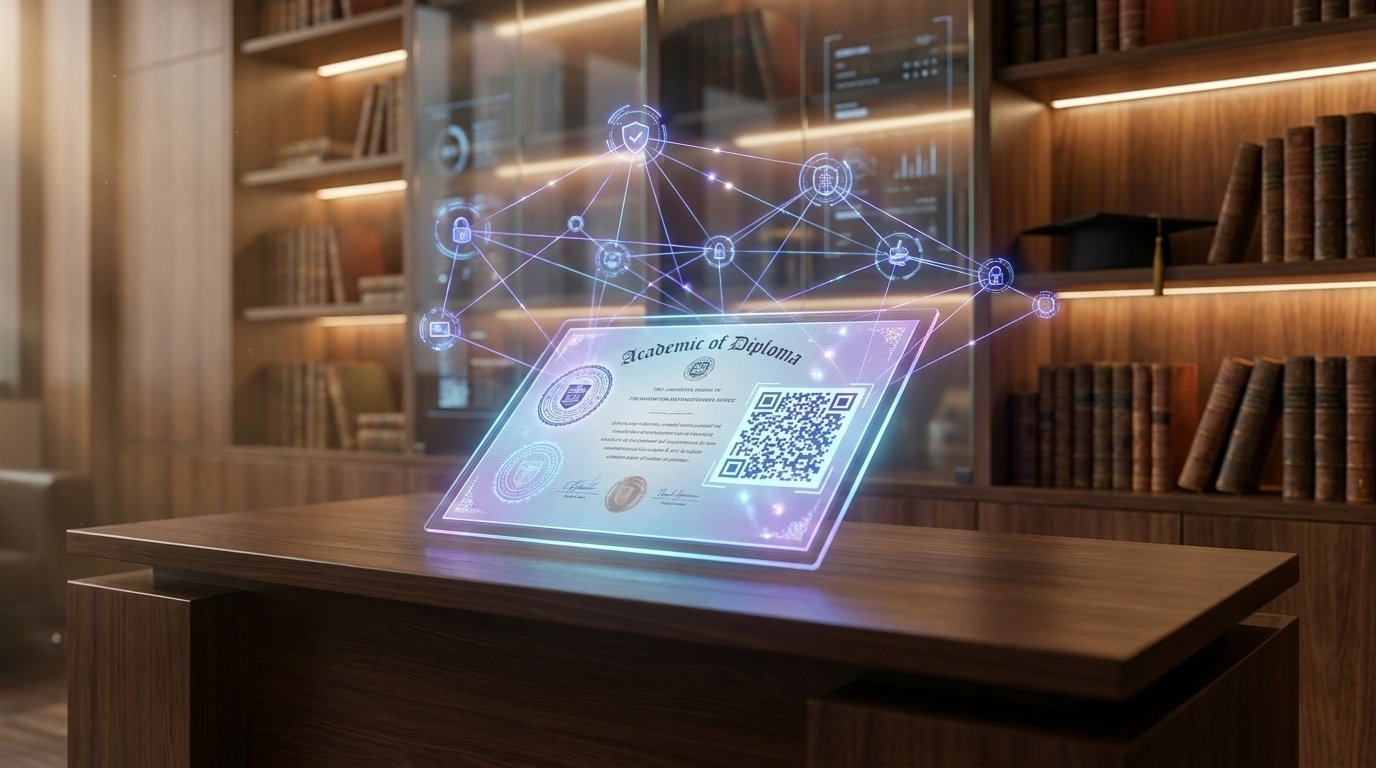
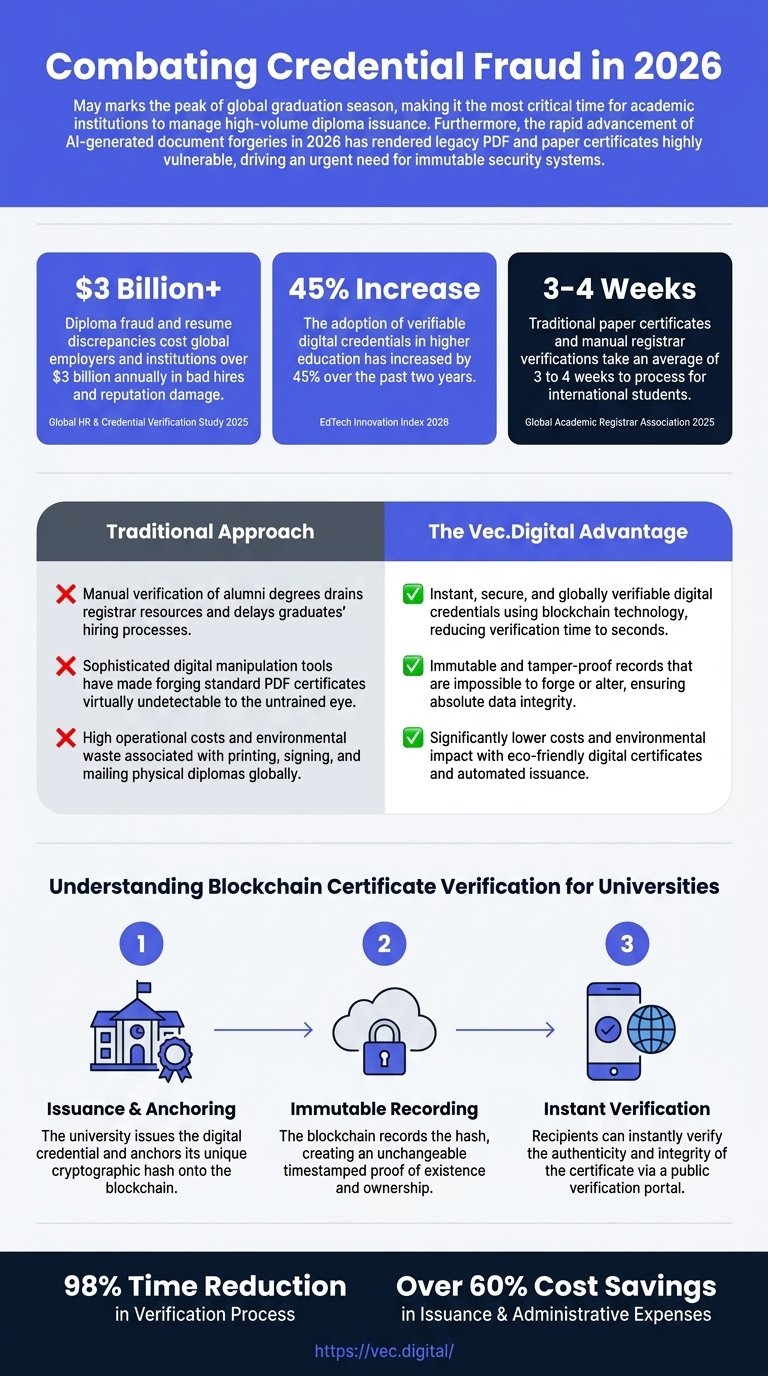
Diploma fraud and resume discrepancies cost global employers and institutions over $3 billion annually in bad hires and reputation damage, according to the Global HR & Credential Verification Study (2025). As AI-generated document forgeries become increasingly sophisticated in 2026, academic registrars and university deans are finding that traditional paper diplomas and legacy PDFs are no longer sufficient to protect their institution's legacy. The urgent need for immutable security has made blockchain certificate verification the definitive standard for modern higher education.
In this comprehensive guide, we will explore how universities can seamlessly transition to verifiable digital credentials, eliminating the administrative burden of manual background checks while eradicating credential fraud. Drawing on our expertise in Technology and digital credentialing at Vec.Digital, you will learn how to automate high-volume diploma issuance, implement instant QR-code authentication, and meet global sustainability goals—all without requiring a massive IT overhaul.
Key Takeaways
- Blockchain certificate verification provides an immutable, tamper-proof system that makes diploma fraud mathematically impossible.
- Institutions can replace weeks of manual background checks with instant authentication using QR code certificates.
- Adopting verifiable digital credentials aligns universities with UN sustainability goals by significantly reducing paper waste.
- A robust digital certificate maker enables academic registrars to retain full branding control while automating issuance.
- Using a bulk certificate generator allows universities to issue thousands of secure diplomas instantly via CSV or API integrations.
The Escalating Crisis of Credential Fraud in Higher Education
The landscape of higher education has fundamentally shifted, and with it, the methods used to verify academic achievements must evolve. In an era where global mobility and remote hiring are the norm, the traditional methods of proving one's educational background are under unprecedented attack. Blockchain certificate verification has emerged not just as a technological novelty, but as a critical infrastructure requirement for any institution that values its academic integrity and the future success of its alumni.
The Cost of Fake Degrees and Altered Transcripts
The financial and reputational toll of credential fraud is staggering. As noted earlier, the Global HR & Credential Verification Study (2025) reveals that diploma fraud and resume discrepancies cost global employers and institutions over $3 billion annually in bad hires and reputation damage. When an employer hires an individual based on a forged degree from a prestigious university, the subsequent fallout damages both the employer's operational efficiency and the university's brand equity. If a university's credentials cannot be trusted implicitly, the value of every legitimate degree issued by that institution is diluted.
Furthermore, the International Recruitment Security Report (2026) highlights that 75% of HR professionals report catching candidates misrepresenting their academic credentials during the hiring process. This high incidence rate underscores a systemic vulnerability in how credentials are currently shared and verified. Sophisticated digital manipulation tools have made forging standard PDF certificates virtually undetectable to the untrained eye. A simple PDF editor can alter a graduation date, change a major, or even fabricate a degree entirely, leaving HR departments struggling to separate fact from fiction.
Why Legacy PDFs and Paper Diplomas Are Failing
Beyond the immediate threat of fraud, legacy systems are failing institutions on an operational level. The administrative burden placed on university registrars is immense. The Global Academic Registrar Association (2025) reports that traditional paper certificates and manual registrar verifications take an average of 3 to 4 weeks to process for international students. This delay can cost a recent graduate a competitive job offer or a spot in a postgraduate program, directly impacting alumni success rates.
Additionally, there are high operational costs and environmental waste associated with printing, signing, and mailing physical diplomas globally. Universities spend millions annually on specialized paper, secure printing facilities, and international courier services. Worse still, alumni frequently lose physical diplomas and request costly, slow administrative reprints, trapping registrar staff in an endless cycle of manual document processing rather than focusing on strategic academic initiatives.
How Can Colleges Prevent Diploma Fraud and Fake Degrees?
To combat these systemic issues, colleges must move away from easily alterable formats and adopt cryptographically secure solutions. Preventing diploma fraud requires a fundamental shift from "trusting the document" to "trusting the mathematical proof" behind the document. By anchoring credentials to an immutable digital ledger, universities can ensure that once a degree is issued, it can never be altered, backdated, or forged by a third party.
This transition involves adopting systems that integrate deep cryptographic security with user-friendly issuance platforms. It requires moving toward an automated process where every credential generated is automatically stamped with a unique, verifiable digital signature that traces directly back to the issuing institution. This is where modern cryptographic technology steps in to solve a centuries-old problem.
Understanding Blockchain Certificate Verification for Universities
For many academic registrars and deans, the terminology surrounding decentralized technology can seem daunting. However, at its core, blockchain certificate verification is simply a highly advanced, automated digital notary system. It does not require your institution to manage complex servers or understand the intricacies of cryptographic hashing; it only requires utilizing the right platform to issue your documents.
What Are Verifiable Digital Credentials?
Verifiable digital credentials are electronic records of achievement that contain cryptographically secure proofs of their own authenticity. Unlike a standard PDF or a JPEG image of a diploma, a verifiable credential carries hidden metadata that mathematically proves who issued it, who received it, and that it has not been tampered with since the moment of issuance. According to the EdTech Innovation Index (2026), the adoption of verifiable digital credentials in higher education has increased by 45% over the past two years, signaling a massive shift in industry standards.
These credentials exist in a secure digital environment, allowing students to access them from anywhere in the world. They are designed to be machine-readable, meaning an employer's HR system can automatically verify them without human intervention, drastically speeding up the hiring process. By utilizing blockchain technology, these credentials become permanent, immutable records that survive independently of the university's internal server status.
How Does Blockchain Certificate Verification Work for Universities?
Instead of focusing on the dense cryptography behind the technology, let's look at how it practically solves administrative headaches for registrars. When your university issues a diploma using a specialized system, the platform takes all the data on that certificate (student name, degree, graduation date) and runs it through a mathematical algorithm to create a unique digital fingerprint, known as a hash. This fingerprint is then permanently recorded on a public blockchain.
If a student attempts to alter their digital diploma—for example, changing a "B.A." to a "B.S."—the mathematical fingerprint of the altered document will no longer match the fingerprint stored on the blockchain. When an employer checks the document, the system instantly flags it as invalid. This entire process happens in milliseconds in the background. For the university administrator, the experience is as simple as clicking "Issue"; the complex anchoring and security protocols are handled entirely by the underlying automated process.
Are Digital Academic Diplomas Legally Valid for Employment?
Yes, digital academic diplomas are highly valid and increasingly preferred by global employers. In 2026, cross-border remote hiring is the standard, making international credential verification a major bottleneck. Global data privacy regulations, such as GDPR, demand that academic data be stored securely while remaining easily verifiable by authorized third parties. Verifiable credentials meet these strict regulatory requirements because they allow the student to own and share their data securely, without the university having to constantly expose its central databases to third-party background check agencies.
Because these secure digital diplomas for universities provide irrefutable cryptographic proof of origin, major multinational corporations, government agencies, and international academic bodies accept them as primary source verification. They eliminate the need for notarized paper copies or expensive apostille services, facilitating a smoother, faster, and more legally sound global hiring ecosystem.
Bridging the Gap: From Cryptography to Instant QR Code Scanning
While the backend security of blockchain certificate verification is complex, the frontend user experience must be incredibly simple. The true power of modern credentialing lies in bridging the gap between advanced cryptographic immutability and the everyday actions of students and employers. This is achieved through the universal language of mobile technology.
How Do Employers Verify a Certificate Using a QR Code?
The most elegant solution to the verification bottleneck is the integration of QR code certificates. Every certificate issued through a modern platform features a unique, dynamically generated QR code. When an employer, auditor, or postgraduate admissions officer wants to verify a candidate's degree, they simply point their smartphone camera at the QR code on the digital or printed certificate.
This action instantly routes them to a dedicated, secure public verification page hosted by the issuing platform. There is no need to download a specialized app, create a registered account, or pay a verification fee. The page displays the issuer's details, the recipient's information, signatory data, and, crucially, a "verified badge" that confirms the document's cryptographic anchor matches the original issuance. This turns a process that used to take weeks of emailing and mailing into a frictionless, two-second interaction.
Eliminating Manual Registrar Verifications
For academic institutions, the transition to instant QR-code scanning represents a massive reduction in administrative overhead. The traditional pain point of manual verification drains registrar resources and delays graduates' hiring processes. When an employer requests verification of a paper degree, university staff must manually search through siloed databases or physical microfiche archives, draft a formal letter of confirmation, secure a physical signature, and mail it back.
With an automated verification system, the university empowers the employer to perform the verification themselves, instantly and securely. This self-service model drastically reduces the volume of verification requests hitting the registrar's inbox. Furthermore, because digital credentials cannot be permanently lost in a house fire or during a move, the endless requests for costly, slow administrative reprints are virtually eliminated. Alumni always have access to their secure digital locker, ensuring their credentials are safe and ready to deploy.
Meeting Modern Student Expectations
Today's students are digital natives who expect their academic achievements to integrate seamlessly with their digital lives. According to the Student Digital Experience Survey (2026), 82% of modern students prefer receiving a secure digital diploma alongside or instead of their physical one to easily share on professional networks. They want to be able to post their achievements on LinkedIn, attach them to digital portfolios, and email them directly to recruiters.
By providing verifiable digital credentials, universities not only secure their own reputation but also significantly enhance the student experience. It empowers graduates to instantly prove their worth in a competitive global job market, increasing the perceived value of the institution's educational offerings. A university that issues instant, verifiable, and highly shareable digital degrees is viewed as forward-thinking, student-centric, and technologically advanced.
Scaling Secure Issuance Without IT Overhauls
One of the primary concerns for university IT directors and academic deans is the complexity of implementing new technology. However, adopting blockchain certificate verification does not require tearing out existing Student Information Systems (SIS) or retraining entire departments. Modern platforms are designed to operate as frictionless layers on top of your current administrative operations.
Automating with a Bulk Certificate Generator
During the peak of global graduation season in May, academic institutions face the critical task of managing high-volume diploma issuance. Manually generating thousands of personalized certificates is an administrative nightmare prone to human error. This is where a bulk certificate generator becomes indispensable. Instead of typing out individual names and degrees, administrators can simply export a CSV file from their existing student database and upload it directly into the credentialing platform.
The system's automated process instantly maps the data columns—such as Recipient Name, Issue Date, Program Name, and Honors—to custom dynamic fields within the certificate template. Within minutes, thousands of highly secure, personalized, and cryptographically anchored certificates are generated and distributed to students via email. For enterprise-level universities, REST API access allows for an even deeper integration, enabling the automatic issuance of credentials the moment a student's final grades are approved in the university's LMS or CRM platform.
What is the Best Digital Certificate Maker for Higher Education?
The best digital certificate maker for higher education is one that balances uncompromising backend security with unparalleled frontend design flexibility. At Vec.Digital, our platform features a comprehensive drag-and-drop design editor equipped with hundreds of professional templates and over 1,400 Google Fonts. We understand that a university's diploma is a sacred piece of brand identity. Therefore, our system allows institutions to upload custom background designs, watermarks, and high-resolution logos up to 10MB, ensuring the final digital credential looks exactly like its prestigious paper counterpart.
Crucially, a top-tier platform must also include built-in signatory approval sequences. Before thousands of diplomas are published, specific team roles (such as the Academic Dean or University President) can be required to digitally sign off on the batch. The certificates are held securely in the system until all required signatories approve them, ensuring strict quality control and administrative oversight without slowing down the overall issuance speed. All of this operates on a cloud infrastructure boasting a 99.98% uptime SLA, guaranteeing reliability during crucial graduation periods.
Sustainable, Cloud-Based Document Security
Beyond security and efficiency, there is a pressing global imperative for sustainability. Universities are under immense pressure to align with the UN Sustainable Development Goals (SDGs) by reducing paper waste and minimizing their carbon footprint. The environmental impact of traditional graduation ceremonies—factoring in the paper, the chemical inks, the leather binders, and the global shipping logistics—is substantial.
Transitioning to cloud-based certification is a highly visible, impactful way for an institution to demonstrate its commitment to environmental stewardship. Going paperless with digital credentials eliminates the physical waste associated with diploma issuance while simultaneously upgrading the security and accessibility of the documents. It is a rare administrative upgrade that benefits the environment, the university budget, and the student experience all at once.
Secure Your Institution’s Legacy with Vec.Digital
The rapid advancement of digital forgery has made the transition to immutable document security an absolute necessity for higher education. Blockchain certificate verification is no longer a futuristic concept; it is the current global standard for protecting institutional reputation, streamlining administrative operations, and empowering alumni in a competitive, remote-first job market. By replacing easily forged PDFs and slow, manual background checks with instant, QR-code verifiable credentials, universities can eradicate fraud while saving thousands of hours in administrative labor.
At Vec.Digital, we have built trust as infrastructure. Our all-in-one platform provides everything your institution needs to design stunning, on-brand diplomas, automate high-volume issuance via CSV or API, and anchor every credential to an immutable ledger. We make credential fraud mathematically impossible, giving institutions the tools to issue with confidence, learners the power to own their achievements, and employers the certainty to hire without doubt.
Ready to modernize your university's credentialing system and eliminate diploma fraud forever? Start issuing verifiable certificates in minutes and secure your organization's legacy today.
Contact the Vec.Digital Team:
Website: https://vec.digital/
Email: support@vec.digital
WhatsApp/Phone: +971521373078