
Compliance Training Certificate Automation for Vendor Risk Management
Published on November 4, 2026

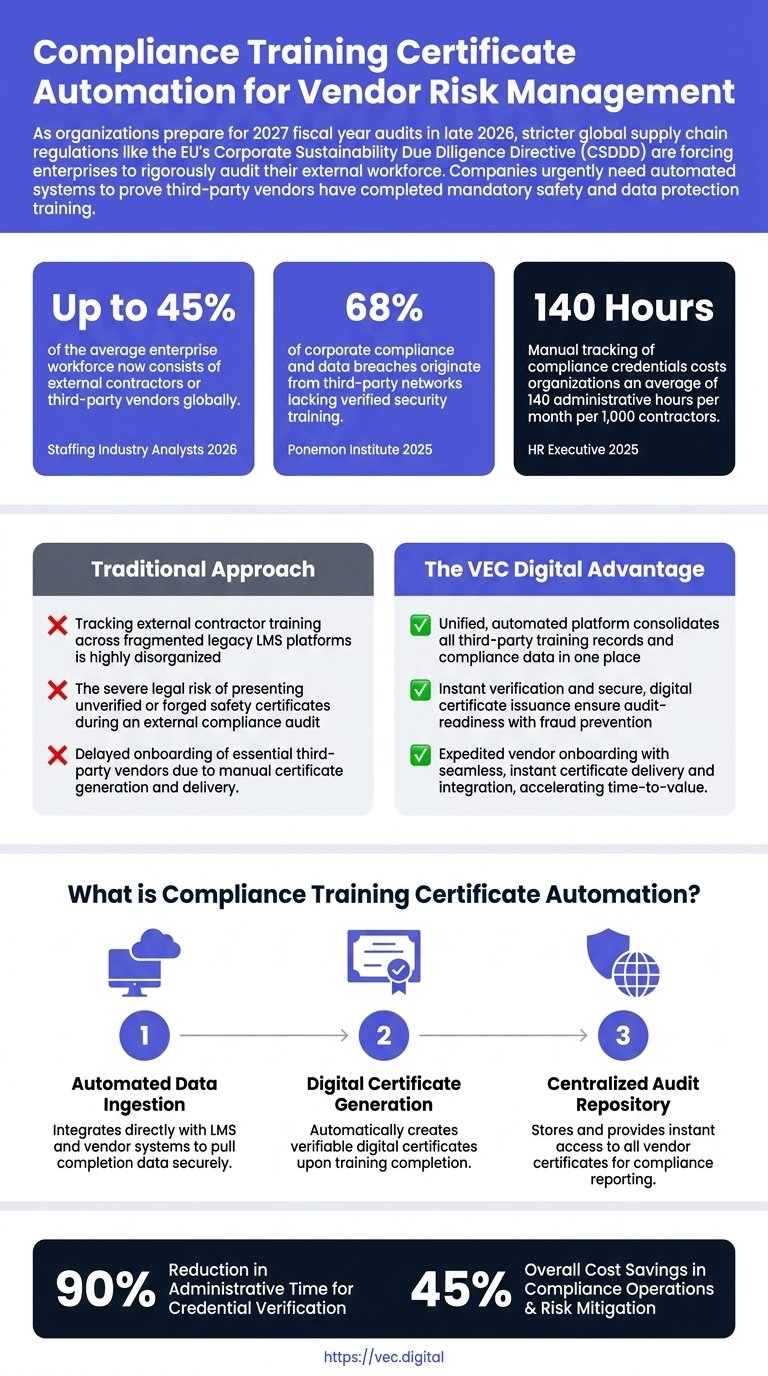
Up to 45% of the average enterprise workforce now consists of external contractors or third-party vendors globally, according to 2026 data from Staffing Industry Analysts. This massive reliance on external talent introduces severe operational vulnerabilities, making compliance training certificate automation an absolute necessity for modern corporate governance. Without an immutable system to track and verify mandatory safety and data protection training, organizations face catastrophic legal liabilities, compliance audit failures, and global supply chain disruptions.
In this comprehensive guide, we will explore how shifting from manual oversight to an API-driven automated credential engine eradicates third-party risk and secures your enterprise. Drawing on our deep expertise in credentialing technology at VEC Digital, we will demonstrate how to instantly issue tamper-proof digital records, eliminate onboarding bottlenecks, and guarantee absolute audit readiness. You will learn the exact strategies needed to connect fragmented legacy systems and deploy cryptographically secure credentials that protect your organizationâ's global operations.
Key Takeaways
- Compliance training certificate automation reduces enterprise audit preparation time by up to 75%.
- Integrating a bulk certificate generator eliminates the 140 administrative hours per month typically wasted on manual tracking.
- Verifiable digital credentials provide absolute proof of safety training, mitigating severe legal liabilities during corporate audits.
- API credential integration connects disparate LMS platforms to create a unified, zero-touch delivery system for third-party vendors.
- Blockchain certificate verification ensures that external contractor records are permanently tamper-proof and instantly accessible worldwide.
The Escalating Crisis of Third-Party Vendor Risk
As organizations prepare for stringent fiscal year audits, stricter global supply chain regulations are forcing enterprises to rigorously audit their external workforce. Historically, Human Resources and Learning & Development (L&D) departments focused primarily on internal employee compliance. However, the modern corporate ecosystem relies heavily on an interconnected web of independent contractors, freelance specialists, and outsourced agencies. This shift has created a massive informational gap in Third-party risk management (TPRM).
The failure to secure this external network has dire consequences. According to a 2025 report by the Ponemon Institute, a staggering 68% of corporate compliance and data breaches originate from third-party networks lacking verified security training. When an enterprise allows unverified personnel to access sensitive digital infrastructure or physical job sites, they absorb the entirety of the operational and legal risk.
The Hidden Costs of Disorganized Contractor Training
One of the most significant pain points for modern Compliance Officers is that tracking external contractor training across fragmented legacy Learning Management Systems (LMS) is highly disorganized. Unlike full-time employees who reside within a centralized Human Resources Information System (HRIS), contractors often complete training across various disconnected portals. This fragmentation makes it nearly impossible to maintain a unified dashboard of active compliance statuses.
When training records are scattered across spreadsheets, email threads, and outdated software, the administrative burden skyrockets. HR teams are forced to manually cross-reference completion data, track expiration dates, and chase down vendors for proof of certification. This disjointed process not only drains internal resources but also creates dangerous blind spots where uncertified contractors slip through the cracks and begin work without the mandatory safety or data privacy knowledge.
The Severe Legal Risks in External Compliance Audits
The severe legal risk of presenting unverified or forged safety certificates during an external compliance audit cannot be overstated. Regulatory bodies across the globe are no longer accepting administrative oversight as an excuse for supply chain failures. If an enterprise cannot definitively prove that a contractor was certified at the exact moment an incident occurred, the enterprise is held liable.
This liability carries a heavy financial toll. The Thomson Reuters Cost of Compliance report (2026) reveals that regulatory fines for unverified safety or data privacy compliance in supply chains have increased by 32% year-over-year globally. Relying on standard PDF documentsâ-which can be easily altered or fabricated using basic editing softwareâ-exposes the organization to catastrophic financial penalties and irreparable reputational damage.
Why Global Regulations Demand Immutable Proof
Global regulatory frameworks in 2026, such as the EU's Corporate Sustainability Due Diligence Directive (CSDDD), the NIS2 directive, and US SEC cybersecurity rules, have explicitly expanded corporate liability to include third-party vendors. Enterprises operating in major financial and industrial hubsâ-from London and New York to those seeking blockchain certificate solutions UAEâ-are now legally required to maintain immutable proof of compliance training.
These regulations demand more than just a checkbox; they require cryptographically secure, time-stamped evidence that training was completed and that the resulting credential has not been tampered with since its issuance. To meet these rigorous global standards, enterprises must abandon manual document generation and adopt automated, technologically advanced credentialing systems.
What is Compliance Training Certificate Automation?
To effectively manage the scale and complexity of a global external workforce, organizations must deploy robust technological solutions. But what exactly is compliance training certificate automation? At its core, it is the deployment of an intelligent, API-driven engine that instantly generates, secures, and delivers digital certificates the moment a learner completes a required training module, requiring zero manual human intervention.
This automated process fundamentally transforms how L&D and compliance teams operate. Instead of spending weeks preparing for audits by manually gathering documents, the automated system runs silently in the background. It listens for completion signals from your LMS, mints a secure credential, anchors it to a secure ledger, and emails it directly to the contractorâ-all within milliseconds.
Defining the Automated Credential Engine
An automated credential engine is a centralized platform designed to handle the entire lifecycle of a digital certificate. It begins with a visual, drag-and-drop template editor where organizations can design highly professional, branded certificates featuring dynamic text placeholders. Once the design is finalized, the engine uses these placeholders to automatically populate unique recipient data, such as the contractor's name, the specific compliance course, the date of completion, and a unique cryptographic ID.
This system completely eliminates the manual design work and data entry that traditionally bogs down HR departments. By utilizing dynamic variables, the engine ensures 100% accuracy, preventing the costly spelling errors and mismatched dates that frequently occur when issuing thousands of certificates manually.
Shifting from Internal Focus to Cross-Platform TPRM
Existing industry literature often focuses heavily on internal employee onboarding and basic LMS features, leaving a massive knowledge gap regarding cross-platform third-party risk management. An automated credential engine bridges this gap by acting as a universal translator between disparate systems. It does not matter if Vendor A uses one training portal and Vendor B uses another; the centralized engine ingests data from all sources and standardizes the output.
By shifting the focus to cross-platform integration, enterprises can finally achieve a holistic view of their entire supply chain's compliance status. This standardized approach ensures that every external worker, regardless of their origin or agency, is held to the exact same rigorous verification standards before they are permitted to interact with the enterprise's assets.
Are Digital Credentials Legally Binding for Enterprise Audits?
A common question among compliance officers is: Are digital credentials legally binding for enterprise audits? The answer is a resounding yes, provided they are built on a foundation of cryptographic security and immutability. Unlike traditional PDFs, modern verifiable digital credentials contain embedded metadata and cryptographic hashes that prove their origin and integrity.
When an auditor reviews these automated credentials, they do not have to take the enterprise's word for it. The digital signature embedded in the certificate mathematically proves that the document was issued by the authorized organization and has not been altered by a single pixel since the moment of issuance. This absolute mathematical certainty satisfies the strictest global regulatory requirements and provides an impenetrable defense during legal scrutiny.
Eradicating Manual Delays with a Bulk Certificate Generator
When dealing with thousands of external contractors, manual processes are not just inefficient; they are operationally paralyzing. The question of "How do organizations track compliance training for independent contractors?" is often answered with tales of endless spreadsheets and weekend overtime. To scale effectively, enterprises must leverage high-volume automation tools.
A bulk certificate generator is an essential component of this automation strategy. It allows organizations to process massive cohorts of vendors simultaneously, turning a process that used to take weeks into a task that takes mere minutes. This capability is critical for large-scale infrastructure projects, seasonal hiring spikes, and annual mandatory retraining periods.
Eliminating Onboarding Bottlenecks for Third-Party Vendors
Delayed onboarding of essential third-party vendors due to manual certificate generation and delivery is a critical operational bottleneck. When contractors cannot begin work because they are waiting for HR to manually process their safety certificates, projects stall, and costs overrun. According to HR Executive (2025), manual tracking of compliance credentials costs organizations an average of 140 administrative hours per month per 1,000 contractors.
By implementing a bulk generation system, these bottlenecks are instantly eradicated. As soon as a cohort finishes their training, their data is processed, and their credentials are dispatched. This rapid turnaround ensures that external talent can be deployed to the field or granted IT access immediately, maintaining project momentum and maximizing productivity.
Scaling Operations with CSV Uploads and Batch Processing
For organizations that have not yet implemented full API integrations, CSV upload capabilities provide a powerful and immediate operational upgrade. A smart CSV parsing system allows administrators to export a list of completed trainees from any legacy system, upload the file to the credential platform, and instantly trigger the batch generation of thousands of personalized certificates.
This batch processing capability is highly sought after globally, from European manufacturing sectors to organizations seeking a reliable bulk certificate generator Saudi Arabia to manage massive infrastructure workforces. The system automatically reads the data rows, maps them to the correct certificate template, and manages the email dispatch sequence, completely freeing the HR team from repetitive administrative labor.
Implementing Multi-Signatory Approval Pipelines
High-stakes compliance certificates often require strict internal governance before they can be issued. To ensure accountability, advanced automated systems feature multi-signatory approval pipelines. Certificates are generated and held in a secure draft status until designated organizational authoritiesâ-such as the Chief Compliance Officer and the Lead Safety Inspectorâ-securely log in and electronically sign them.
This digital governance process prevents accidental or rogue issuance and ensures that all external vendor credentials have passed the necessary internal reviews. It digitizes the traditionally slow process of gathering physical signatures, maintaining high compliance standards without sacrificing speed or efficiency.
API Credential Integration: Connecting Your LMS Seamlessly
While bulk uploads offer immense relief, the ultimate goal for any enterprise is zero-touch automation. When asked, "What is the best way to automate corporate compliance certificates?", the definitive answer is deep, programmatic integration. By connecting your existing software stack directly to a credentialing engine, you create a seamless, self-sustaining compliance ecosystem.
API credential integration represents the pinnacle of operational efficiency. It removes the human element entirely from the data transfer process, ensuring that certificates are issued in real-time, 24/7, without any administrative intervention. This is how global enterprises achieve true scalability in their TPRM programs.
How to Connect an LMS to a Bulk Certificate API
Connecting an LMS to a bulk certificate API is a straightforward process for modern development teams. A robust, developer-ready REST API allows your internal softwareâ-whether it is Canvas, Moodle, a proprietary corporate intranet, or an HRISâ-to communicate directly with the credentialing platform using secure OAuth 2.0 authentication.
The process involves configuring webhooks within your LMS that trigger specific endpoints on the credential API. For example, the moment a contractor scores 100% on a data privacy quiz, the LMS sends a structured data payload (containing the user's name, email, and course ID) to the API. The API receives this data, instantly generates the certificate, anchors it for security, and triggers the automated email delivery system. This real-time synchronization ensures that your compliance records are always perfectly up to date.
Achieving Zero-Touch Delivery Across Fragmented Systems
The beauty of a well-documented REST API is its platform agnosticism. Enterprises rarely use a single software solution; they operate a complex web of legacy systems, modern SaaS applications, and proprietary databases. An API-first credential engine acts as the central hub, capable of receiving automated issuance commands from any authorized system across the global network.
This zero-touch delivery model completely solves the pain point of disorganized tracking. Because every certificate is generated through the central API hub, the enterprise maintains a single, unified source of truth for all third-party credentials. When an auditor requests proof of training, the compliance officer simply pulls the centralized report, confident that every single credential was issued securely and automatically.
Securing the Supply Chain with Verifiable Digital Credentials
Automation solves the problem of issuance, but the true value of modern credentialing lies in its verification capabilities. The inability to instantly verify a contractor's active compliance status at a physical job site or before granting IT access is a massive security flaw. Traditional paper certificates or static PDFs require time-consuming phone calls to HR or manual database lookups to confirm authenticity.
By transitioning to a digital diploma platform model adapted for corporate compliance, enterprises empower their security personnel, site managers, and auditors to verify credentials independently and instantly. This frictionless verification process is the ultimate defense against credential fraud and unauthorized access.
How Do You Verify Third-Party Vendor Safety Training Instantly?
The solution to instant verification is the implementation of a QR code certificate maker. Every automated certificate generated by the system features a unique, embedded QR code. When a contractor arrives at a secure facility or logs into a restricted digital portal, they simply present their credential.
The site manager or security guard can scan the QR code using any standard smartphone camera. In less than two seconds, without requiring any app installations or account logins, the scanner is routed to a dedicated, secure verification URL. This page instantly displays the verified issuer, the recipient's details, the specific training completed, and the active validity status. This zero-friction process ensures that only fully certified personnel are granted access, neutralizing the risk of forged documents.
Blockchain Certificate Verification for Absolute Authenticity
To provide the highest possible level of security, industry-leading platforms utilize blockchain certificate verification. When a certificate is issued, the automated engine generates a unique cryptographic hash of the document and anchors it to an immutable, publicly verifiable blockchain ledger. This process makes the credential permanently tamper-proof and entirely independent of internal company servers.
If a bad actor attempts to alter the name or date on their digital certificate, the cryptographic hash will break. When scanned, the system will immediately flag the document as invalid. This technology completely eliminates the possibility of credential fraud, which is why organizations globallyâ-including those demanding academic degree fraud prevention Middle Eastâ-are adopting blockchain as the gold standard for corporate compliance and academic integrity.
Ensuring Audit Readiness with QR Code Certificate Makers
The combination of automated issuance, instant QR code scanning, and immutable blockchain anchoring creates an environment of absolute audit readiness. According to Deloitte Compliance Trends (2026), implementing an automated credentialing system reduces enterprise audit preparation time by up to 75%.
When external auditors arrive, they no longer need to sift through physical filing cabinets or fragmented digital folders. They can simply scan the QR codes of any randomly selected contractor cohort and instantly view the immutable blockchain records. This level of transparency and technological sophistication not only ensures passing grades on audits but also protects the issuing organizationâ's brand reputation on a global scale.
Secure Your Organizationâ's Credentials Today
The era of managing third-party vendor risk through manual spreadsheets and insecure PDF documents is over. As global regulatory requirements tighten and the external workforce continues to expand, enterprises must adopt modern, technologically advanced solutions to protect their operations. Compliance training certificate automation is no longer an optional upgrade; it is the foundational infrastructure required to ensure global supply chain integrity.
At VEC Digital, we provide the ultimate trust infrastructure for institutions and enterprises worldwide. Our platform combines frictionless API automation, bulk CSV capabilities, and unbreakable blockchain verification to completely eliminate credential fraud and administrative overload. We empower your compliance teams to issue with confidence, and your auditors to verify without doubt.
Secure your organizationâ's credentials todayâ-design your first template in minutes and experience the power of automated, verifiable digital credentials. Reach out to our expert team to learn how we can seamlessly integrate with your existing corporate systems.
Website: https://vec.digital
Email: support@vec.digital