
Credential Fraud in 2026: Blockchain Certificate Verification Guide
Published on April 7, 2026

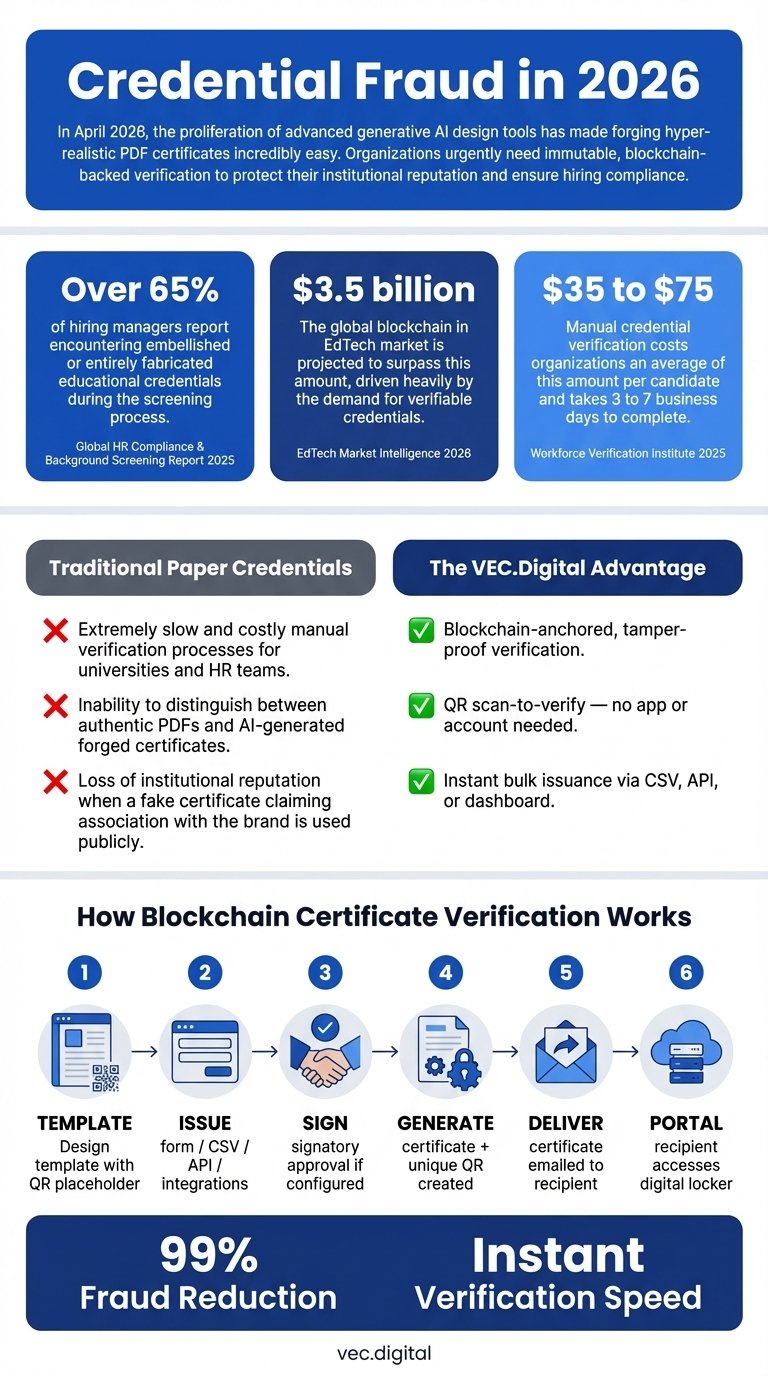
Over 65% of hiring managers report encountering embellished or entirely fabricated educational credentials during the screening process (Global HR Compliance & Background Screening Report, 2025). As generative AI tools make forging hyper-realistic documents effortless, traditional PDFs and paper records expose institutions to unprecedented reputational and compliance risks. Implementing immutable blockchain certificate verification is no longer just an innovative upgrade; it is a mandatory global standard for protecting organizational integrity and neutralizing the threat of modern document fraud.
In this comprehensive guide, we outline how transitioning to secure digital certificate issuance can safeguard your organization's reputation while drastically reducing administrative overhead. Drawing on our team's extensive expertise at VEC.Digital in blockchain-powered digital credentialing, you will learn how to completely eliminate credential fraud, issue bulk certificates in minutes using automated workflows, and empower learners globally with instantly verifiable credentials. By modernizing your issuance pipeline, your institution will achieve absolute compliance confidence, eliminate paper waste in support of global sustainability goals, and deliver a frictionless verification experience for employers worldwide.
Key Takeaways
- Blockchain certificate verification provides immutable, tamper-proof proof of achievement that completely neutralizes the threat of AI-generated document forgery.
- QR code certificate verification allows HR teams and recruiters to authenticate credentials instantly from any device, without the need to log into proprietary portals.
- Adopting verifiable credentials for organizations reduces manual background check bottlenecks by up to 85%, saving thousands of dollars per hiring cycle.
- Transitioning to secure digital certificate issuance supports global sustainability goals by eliminating paper waste, printing costs, and physical shipping logistics.
- Modern credential fraud prevention 2026 strategies require automated, multi-signatory workflows that integrate seamlessly into existing systems via CSV or REST API.
The Escalating Crisis of AI-Generated Credential Fraud
The Cost of Fake Certificate Detection in the AI Era
In 2026, the proliferation of advanced generative AI design tools has fundamentally altered the landscape of document security. It is now incredibly easy for malicious actors to generate hyper-realistic, pixel-perfect PDF certificates that mimic the exact branding, typography, and layout of prestigious universities and global training providers. Consequently, traditional blockchain certificate verification methods are stepping in where legacy visual inspections fail. Organizations face a critical inability to distinguish between authentic PDFs and AI-generated forged certificates, rendering visual fake certificate detection practically obsolete.
When HR departments rely on manual visual checks or basic PDF metadata, they inadvertently open the door to unqualified candidates. This is not merely a theoretical risk; it is a daily operational hazard. The time and resources spent attempting to manually verify the authenticity of a document drain productivity and delay critical hiring decisions. The shift toward cryptographic proof is driven by the stark reality that if a document can be seen on a screen, it can be perfectly replicated by AI.
Reputational and Financial Risks for Organizations
The consequences of credential fraud extend far beyond a single bad hire. For educational institutions and training providers, there is a severe loss of institutional reputation when a fake certificate claiming association with the brand is used publicly. If employers discover that an institution's credentials are easily faked and frequently misrepresented in the market, the inherent value of that institution's legitimate degrees and certifications plummets.
Financially, the stakes are equally high for hiring organizations. The average cost of a bad hire due to fraudulent qualifications exceeds 30% of the employee's first-year earnings (Corporate Risk & Compliance Journal, 2024). This figure accounts for recruitment costs, onboarding expenses, lost productivity, and the potential legal liabilities associated with unqualified personnel making critical business decisions. Protecting your organization against these financial pitfalls requires a proactive, technology-driven approach to credentialing.
The Burden of Manual HR Compliance Credential Tracking
Before the advent of decentralized verification, HR compliance credential tracking relied heavily on third-party background check agencies and direct correspondence with university registrars. This traditional approach is fraught with inefficiencies. Manual credential verification costs organizations an average of $35 to $75 per candidate and takes 3 to 7 business days to complete (Workforce Verification Institute, 2025). These extremely slow and costly manual verification processes create severe bottlenecks for universities and HR teams alike.
Furthermore, relying on traditional third-party background checks introduces significant GDPR and data privacy concerns. Sharing candidate data across multiple unverified channels increases the risk of data breaches and compliance violations. Organizations urgently need a streamlined, privacy-preserving method to verify claims without unnecessarily exposing personally identifiable information (PII) to numerous intermediaries.
How Blockchain Certificate Verification Works
Understanding the Shift from PDFs to Immutable Ledgers
To understand how to combat modern fraud, one must ask: How does blockchain verify digital certificates? At its core, blockchain certificate verification relies on the principles of cryptography and distributed ledger technology. When an institution issues a certificate, the data is hashed—turned into a unique cryptographic string of characters. This hash is then anchored onto an immutable blockchain. Any alteration to the digital certificate, even changing a single pixel or letter, completely changes the hash, instantly flagging the document as invalid.
A common question among administrators is: Can digital certificates be faked or hacked? While a visual representation (like a screenshot) can be copied, the underlying cryptographic proof cannot be forged. Because the blockchain acts as a decentralized, tamper-proof public ledger, the record of issuance is permanent and secure. This ensures that the credential remains trustworthy indefinitely, providing absolute confidence to any verifying party.
The Mechanics of QR Code Certificate Verification
While the underlying technology is complex, the end-user experience must be frictionless. This is where QR code certificate verification becomes essential. Why use QR codes for certificate verification? Because they bridge the gap between complex cryptographic security and everyday usability. With our platform, every certificate generated features a unique QR code linking directly to a secure, dynamically generated verification page (e.g., /certificate/[uuid]).
When a recruiter or HR manager scans this QR code using any standard smartphone camera, they are instantly directed to a public verification page displaying a "blockchain verified" badge. There is no app to download, no account to create, and no login required to verify the credential. This instant, scan-to-verify capability completely bypasses the multi-day administrative burden of traditional background checks, empowering employers to validate qualifications in seconds.
Global Standards and Data Privacy Compliance
The transition to verifiable credentials is not happening in a vacuum; it is being driven by robust global frameworks. With the full rollout of the EU's eIDAS 2.0 digital identity framework in recent years, alongside the UAE's continued execution of its comprehensive Blockchain Strategy, the global standard for cross-border employment and education has shifted. Organizations worldwide are now expected to provide instant, digitally verifiable proofs of achievement rather than legacy paper or unanchored PDF documents.
By anchoring credentials on a blockchain, institutions inherently respect data privacy. The blockchain stores only the cryptographic proof of the credential, not the private personal data of the learner. This aligns perfectly with international privacy regulations, including GDPR. For a deeper understanding of global digital identity standards, you can review the European Commission's eIDAS guidelines, which outline the future of trust services across borders.
The Business ROI of Secure Digital Certificate Issuance
Streamlining the Issuance Pipeline via CSV and API
A major gap in existing industry literature is the failure to address the actual workflow transition from traditional PDFs to blockchain credentials. Administrators need actionable insights on how to manage this shift without disrupting daily operations. Secure digital certificate issuance must be versatile and scalable. At VEC.Digital, we provide four distinct issuance methods to accommodate any organizational size or technical capability: a user-friendly dashboard form for one-by-one issuance, CSV upload for bulk processing, a REST API for programmatic automation, and seamless third-party integrations.
By utilizing CSV bulk uploads, a university can issue thousands of graduation diplomas in a matter of minutes, rather than days. For enterprise corporate training programs, integrating our REST API directly into an existing Learning Management System (LMS) ensures that credentials are automatically generated and anchored to the blockchain the moment an employee completes a course. This level of automation drastically reduces manual data entry errors and frees up valuable administrative time.
Multi-Signatory Workflows for Institutional Governance
Institutional governance and quality assurance require strict oversight before any official document is released. To accommodate this, our platform features a robust multi-signatory workflow. Organizations can assign up to two distinct signatories per certificate template—for example, a Department Head and the University Dean. When a certificate is generated, it is held in a pending status until all designated signatories have independently reviewed and signed off on the issuance.
This digital workflow mirrors the rigorous approval processes of traditional academia but executes them with the speed of modern technology. It ensures that no credential is ever minted to the blockchain without proper authorization, thereby maintaining the highest standards of institutional integrity. Furthermore, our intuitive template editor, featuring over 1400 Google Fonts, drag-and-drop functionality, A2–A5 sizing options, and seamless Canva integration, ensures that these highly secure documents remain visually stunning and perfectly aligned with your brand identity.
Cost Reduction and Sustainability Goals
The financial return on investment (ROI) of digital credentialing extends beyond saving time; it fundamentally alters the cost structure of institutional administration. The global blockchain in EdTech market is projected to surpass $3.5 billion, driven heavily by the demand for verifiable credentials (EdTech Market Intelligence, 2026). By eliminating paper waste, organizations immediately cut costs associated with specialized security paper, high-end printing, physical embossing, and international courier shipping.
Moreover, this transition plays a vital role in corporate social responsibility. VEC.Digital actively supports UN sustainability goals. Digital certificates eliminate paper waste and reduce the carbon footprint associated with physical delivery logistics. By adopting an eco-friendly credential management system, your organization not only saves money but also publicly demonstrates a commitment to global environmental sustainability.
Best Practices for Credential Fraud Prevention 2026
Adopting Verifiable Credentials for Organizations
What is a verifiable credential for an organization? It is a digital record of achievement that is cryptographically secure, privacy-respecting, and machine-readable. In the context of credential fraud prevention 2026, adopting verifiable credentials for organizations is the most effective strategy to safeguard your brand. Institutions implementing self-sovereign identity and blockchain verifiable credentials reduce background verification bottlenecks by up to 85% (Digital Identity Management Review, 2026).
To implement this successfully, organizations must move away from proprietary, siloed databases and embrace interoperable standards. By issuing credentials that adhere to global frameworks—such as the W3C Verifiable Credentials Data Model—you ensure that the certificates you issue today will remain valid, verifiable, and technologically relevant for decades to come, regardless of how the digital landscape evolves.
Managing Revocations and Expired Certificates
One of the most significant pain points for compliance managers is the complexity of managing revoked or expired certificates across decentralized alumni or employee networks. In a traditional paper-based system, once a certificate is handed out, it is nearly impossible to recall or officially invalidate it if the individual is later found to have violated ethical codes or if a time-bound certification (like a medical or safety compliance license) expires.
Blockchain-anchored systems solve this elegantly. Through our secure management dashboard, administrators can instantly revoke a credential. This action updates the ledger state. Consequently, if someone attempts to scan the QR code of a revoked certificate, the public verification page will immediately display a "Revoked" or "Expired" status. This real-time status update is critical for industries where compliance and up-to-date qualifications are matters of legal necessity and public safety.
Empowering the Learner with a Recipient Digital Locker
A successful credentialing strategy must prioritize the end-user experience. Graduates, employees, and conference attendees need a reliable way to store, organize, and share their achievements. We address this by providing every recipient with access to a dedicated recipient digital locker. This portal gives users permanent access to all their earned certificates in one centralized, secure location.
Accessible anywhere, anytime, the digital locker empowers learners to easily share their verified credentials on professional networks like LinkedIn, attach them to digital resumes, or email them directly to prospective employers. By providing a superior user experience, your organization enhances learner motivation and increases the likelihood that your branded credentials will be proudly shared across global professional networks.
Frequently Asked Questions About Digital Credentials
What is the best way to prevent certificate fraud in 2026?
The definitive best practice for preventing certificate fraud is the implementation of blockchain certificate verification. Because generative AI can replicate any visual element of a document, visual inspection is no longer valid. Anchoring the issuance data to an immutable blockchain ledger ensures that the credential's authenticity is verified through cryptography rather than human judgment. Coupling this with a multi-signatory issuance workflow guarantees that only authorized personnel can generate official documents.
How do employers verify online course completion certificates?
Employers verify modern online course certificates by simply scanning the embedded QR code or clicking the unique verification link provided by the candidate. This action directs them to a secure, public verification page hosted by the issuing platform (such as VEC.Digital's verification portal). The page instantly cross-references the document's cryptographic hash with the blockchain, displaying a clear "blockchain verified" status, the issuer's details, and the recipient's name, completely bypassing the need for manual background checks.
Future-Proof Your Organization with VEC.Digital
The era of relying on paper documents and unanchored PDFs has officially passed. As AI-generated fraud becomes indistinguishable from reality, your organization must adopt robust, cryptographic solutions to protect its reputation and streamline its operations. By implementing blockchain certificate verification, you not only neutralize the threat of credential fraud but also drastically reduce administrative costs, support global sustainability initiatives, and provide your learners with a modern, frictionless way to prove their achievements.
At VEC.Digital, we have successfully onboarded over 500 universities and 10,000 corporations, issuing over 100,000 blockchain-anchored certificates with a 99.98% uptime SLA reliability. We are committed to making this transition as seamless as possible for your team. Organizations can start completely free—with no credit card required and no setup fees—to experience the power of our platform firsthand. For scaling operations, our comprehensive paid plans begin at just $29.99/month, while individuals can secure their credentials for only $1.00 per certificate.
Ready to modernize your credentialing process and eliminate fraud for good? Explore how it works or discover our tailored solutions for corporate training today.
Contact our team to get started:
Website: vec.digital
Email: support@vec.digital
WhatsApp: +971521373078