
Credential Fraud Prevention in 2026: Why Blockchain Verification is Replacing Static PDFs
Published on April 24, 2026

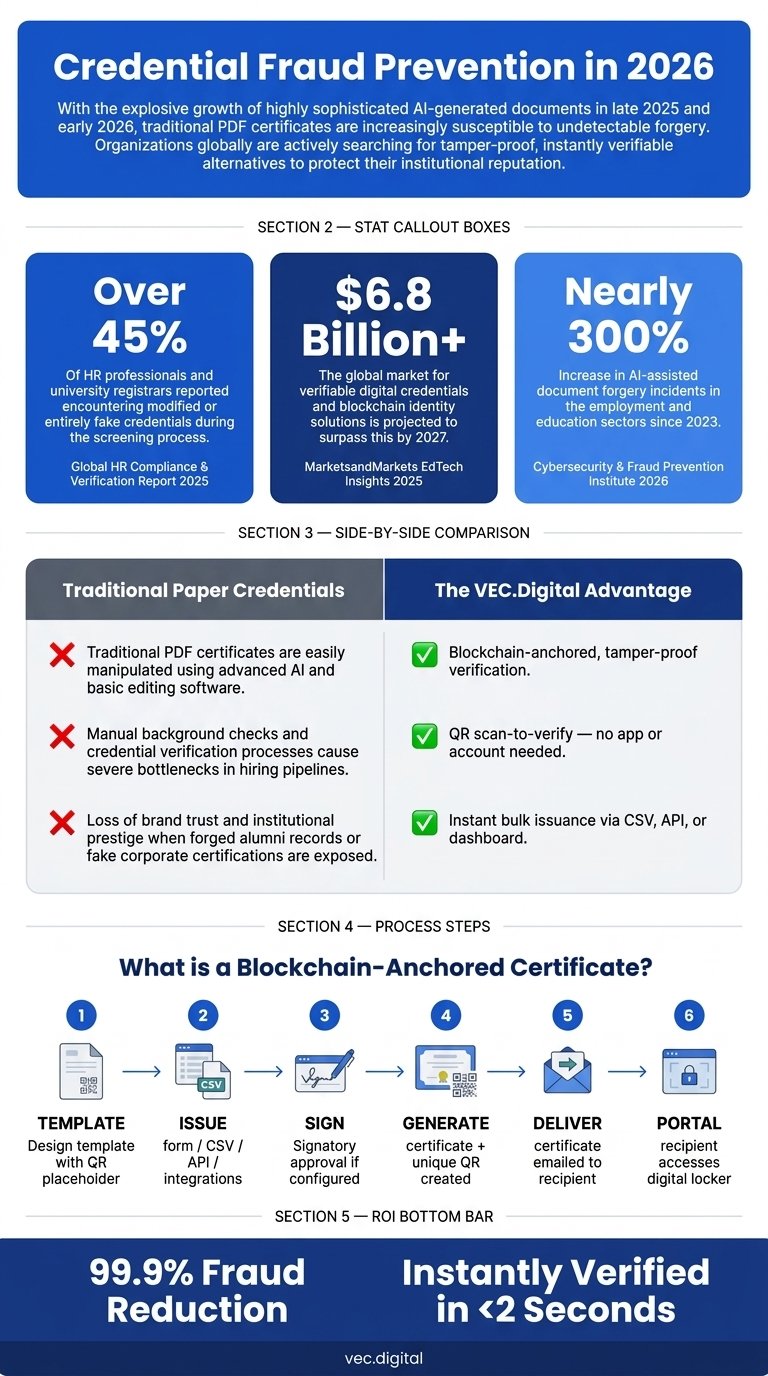
AI-assisted document forgery incidents in the employment and education sectors have increased by nearly 300% since 2023, rendering traditional verification methods dangerously obsolete (Cybersecurity & Fraud Prevention Institute, 2026). Effective credential fraud prevention requires institutions to abandon easily manipulated static documents in favor of immutable, instantly verifiable technologies. Organizations worldwide are now forced to rethink how they issue, manage, and authenticate academic and corporate achievements to protect their institutional prestige.
In this comprehensive guide, our team at VEC.Digital will walk your organization through the transition from vulnerable legacy PDFs to secure, blockchain-powered credentialing. You will learn how to eliminate digital credential fraud, deploy bulk certificates in minutes without technical friction, and provide learners globally with permanently accessible, easily verifiable credentials that align with international compliance standards.
Key Takeaways
- AI-assisted document forgery has surged, making legacy PDF certificates a critical liability for institutional reputation.
- Blockchain-anchored certificates provide an immutable, mathematically verifiable record that guarantees credential authenticity.
- QR code scan-to-verify technology eliminates manual background check bottlenecks, allowing instant validation by employers globally.
- Multi-signatory workflows and REST APIs enable organizations to automate secure issuance without requiring deep technical expertise.
- Global compliance standards like eIDAS 2.0 are driving a worldwide shift toward standardized, verifiable digital identities.
The Escalating Threat of Digital Credential Fraud in 2026
The landscape of professional and academic verification has shifted dramatically. As we navigate through 2026, the sophisticated nature of digital manipulation has made credential fraud prevention a top priority for every forward-thinking organization. The rapid democratization of advanced artificial intelligence and image-editing tools has created an environment where standard digital documents can no longer be trusted at face value. HR managers, university administrators, and corporate training directors are finding themselves on the front lines of a battle against increasingly undetectable forgeries.
The statistics surrounding this issue are alarming and highlight a systemic vulnerability in global hiring and admissions pipelines. Over 45% of HR professionals and university registrars reported encountering modified or entirely fake credentials during the screening process (Global HR Compliance & Verification Report, 2025). This is not merely a localized issue; it is a global epidemic affecting multi-national corporations, prestigious universities, and specialized training providers alike. When standard PDF certificates are issued, they are effectively handed over to the recipient in a format that invites alteration, placing the burden of exhaustive verification squarely on the shoulders of the next institution or employer.
Why PDF Certificates Are No Longer Secure
A common question among administrators is: Why are PDF certificates no longer secure in 2026? The answer lies in the fundamental architecture of the Portable Document Format and the evolution of AI. Historically, a PDF was considered a "read-only" equivalent of a printed page. However, modern AI tools can seamlessly match fonts, replicate institutional signatures, strip metadata, and alter dates or grades without leaving obvious digital footprints. A candidate can easily take a legitimate certificate issued to a colleague, use basic software to swap the name, and present it as their own.
Because static PDFs lack an independent, mathematically verifiable anchor, the only way an employer can confirm authenticity is by contacting the issuing institution directly. This creates a massive administrative burden. When organizations rely on PDFs, they inadvertently contribute to a global ecosystem of slow, manual verification that frustrates candidates, delays hiring, and drains institutional resources.
The Cost of Institutional Reputation Damage
Beyond the immediate operational bottlenecks, the long-term cost of digital credential fraud is measured in reputational damage. When an individual uses a forged certificate from your institution to secure employment or academic admission, and that fraud is eventually exposed, the integrity of your entire credentialing program is called into question. Loss of brand trust and institutional prestige is a severe consequence of failing to modernize issuance pipelines.
Universities and corporate training providers spend decades building their reputations. A certificate bearing your organization's logo is a proxy for your standards, curriculum, and authority. If that proxy can be easily counterfeited, the value of a legitimate credential diminishes. By implementing robust fraud prevention mechanisms, organizations not only protect the public and prospective employers but also preserve the hard-earned value of the credentials held by their honest alumni and certified professionals.
What is a Blockchain-Anchored Certificate?
To effectively combat forgery, the industry is moving rapidly toward cryptographic solutions. But what is a blockchain-anchored certificate? In simple terms, it is a digital credential whose unique mathematical fingerprint (a hash) is permanently recorded on an immutable blockchain ledger. When an organization issues a certificate through a platform like VEC.Digital, the content of that certificate is processed through a cryptographic algorithm. The resulting unique string of characters is anchored to the blockchain, serving as an unalterable proof of issuance.
If a bad actor attempts to alter even a single pixel or character on the digital certificate—such as changing a grade from a 'B' to an 'A' or altering the issue date—the mathematical fingerprint changes entirely. When the altered certificate is checked against the blockchain record, the fingerprints will not match, and the verification will instantly fail. This mechanism provides absolute certainty without requiring the verifying party to understand the underlying cryptographic technology.
Moving Beyond Theoretical Web3 to Practical Application
While much of the industry discourse over the past few years has focused heavily on the philosophical benefits of Web3 and decentralized architecture, there has been a significant informational gap regarding practical, day-to-day implementation for administrators. HR managers and university registrars do not need to become blockchain developers; they need streamlined tools that make blockchain verification virtually invisible and frictionless to the issuer.
This is where modern platforms excel. By abstracting the complexity of the blockchain, administrators can focus entirely on the user experience and business value. The transition from legacy systems to blockchain-anchored credentials should not disrupt existing operations. Instead, it should enhance them by integrating seamlessly into current workflows, ensuring that every certificate generated is automatically anchored, secured, and ready for public verification without any additional steps from the issuing staff.
How Do You Verify a Digital Certificate Online?
Another frequently asked question is: How do you verify a digital certificate online? The process must be instantaneous and accessible to anyone, anywhere in the world. When a certificate is anchored on the blockchain, it can be verified through a dedicated public portal. For example, VEC.Digital provides a seamless verification experience where anyone can visit our verification page to confirm a credential's authenticity instantly.
A properly verified certificate will prominently display a "blockchain verified" badge, assuring the employer or academic institution that the document is authentic, unaltered, and officially issued by the stated organization. This eliminates the need for phone calls, emails, or waiting days for a registrar's office to respond to a background check request. The cryptographic proof speaks for itself, providing immediate trust in a trustless digital environment.
Core Strategies for Credential Fraud Prevention
Implementing effective credential fraud prevention requires a strategic shift from manual oversight to automated, cryptographically secure systems. Organizations must adopt issuance pipelines that inherently reject tampering. The most successful strategies in 2026 revolve around removing friction for the verifier while maximizing security for the issuer.
As the global workforce becomes increasingly remote and borderless, the methods we use to validate skills and achievements must adapt. Relying on physical paper documents or easily manipulated digital files is no longer viable. Instead, organizations must leverage technologies that provide instant, global verification capabilities.
Transitioning to QR Code Scan-to-Verify Certificates
How do QR code certificates work for employers? The integration of Quick Response (QR) codes into digital credentials has revolutionized the verification process. Every certificate issued through VEC.Digital features a unique QR code that links directly to a secure, dynamically generated URL (e.g., /certificate/[uuid]). No app, no account, and no login are required to verify the credential.
This scan-to-verify functionality is becoming an industry standard. In fact, 85% of modern enterprises now require one-click or QR-based digital verification for third-party compliance and training certificates (Corporate L&D Trends Index, 2026). When a hiring manager receives a resume or a digital portfolio containing a QR-enabled certificate, they simply scan it with their smartphone. They are immediately directed to the immutable blockchain record, confirming the candidate's qualifications in seconds. This elegant solution bridges the gap between physical and digital realms, allowing even printed versions of the certificate to retain their verifiable integrity.
Eliminating Manual Background Check Bottlenecks
Manual background checks and credential verification processes cause severe bottlenecks in hiring pipelines. In traditional setups, an HR professional must contact the issuing university or training provider, submit a formal request, pay a verification fee, and wait days or even weeks for a response. This delay can result in losing top talent to competitors who have faster onboarding processes.
By adopting blockchain-anchored certificates, organizations entirely eliminate these bottlenecks. The verification process becomes asynchronous and instantaneous. Employers can independently verify a candidate's entire educational and professional history over the weekend, at midnight, or across different time zones without waiting for administrative offices to open. This global accessibility is crucial for modern, agile organizations that require rapid, trustworthy hiring decisions.
Implementing Secure Digital Certificate Issuance Without Technical Friction
A common hesitation among organizational leaders is the perceived technical complexity of adopting new credentialing technologies. Many wonder, what are the best platforms for verifiable credentials, and how can we adopt them without overwhelming our non-technical staff? The key to successful adoption is choosing a platform that prioritizes user experience and integrates smoothly with existing administrative workflows.
At VEC.Digital, we understand that technical complexity and friction for non-technical HR or admin staff are significant barriers to entry. Therefore, our platform is designed to make secure digital certificate issuance as intuitive as sending an email. We have focused on creating an interface that empowers administrators to design, issue, and manage credentials without writing a single line of code.
Overcoming Adoption Barriers for Non-Technical Administrators
To ensure a smooth transition, organizations need robust design and issuance tools. VEC.Digital offers an intuitive template editor equipped with over 1,400 Google Fonts, drag-and-drop functionality, and support for various formats including A2–A5 sizes in both portrait and landscape orientations. Furthermore, our seamless Canva integration allows design teams to create stunning backgrounds that reflect the organization's brand identity perfectly.
Once the template is designed, issuing the certificates must be equally straightforward. We provide four distinct issuance methods to accommodate different organizational needs:
- Dashboard Form: Ideal for issuing credentials one-by-one for bespoke achievements or small cohorts.
- CSV Upload: Perfect for bulk issuance, allowing administrators to generate hundreds or thousands of certificates in minutes simply by uploading a spreadsheet.
- REST API: Enables programmatic issuance, automatically triggering certificate generation when a learner completes a course in a Learning Management System (LMS).
- Third-Party Integrations: Connects seamlessly with the tools your organization already uses daily.
Streamlining with Multi-Signatory Workflows and REST APIs
In many academic and corporate environments, a certificate requires authorization from multiple stakeholders—such as a Department Head and a University Dean, or a Lead Instructor and a Compliance Officer. VEC.Digital's advanced multi-signatory workflow accommodates up to two signatories per template. The certificate is securely held in a pending state until ALL signatories have independently reviewed and signed off on the issuance pipeline. This ensures strict internal compliance and quality control before any document is anchored to the blockchain.
Furthermore, the recipient experience is paramount. Upon issuance, recipients are granted access to a personalized digital locker—a secure portal where they have permanent access to all their certificates. They can view, download, or share their credentials anywhere, anytime. This empowers learners and professionals to take ownership of their verifiable data, sharing it effortlessly on professional networks or directly with prospective employers. For more details on how organizations can leverage these tools, explore our higher education solutions.
Global Compliance and the Future of Verifiable Credentials
As we look toward the future, credential fraud prevention is evolving from an institutional best practice into a strict legal and regulatory requirement. The global market for verifiable digital credentials and blockchain identity solutions is projected to surpass $6.8 billion by 2027 (MarketsandMarkets EdTech Insights, 2025). This massive growth is driven by a worldwide consensus that digital trust must be standardized and technologically enforced.
Governments and international bodies are actively establishing frameworks to govern digital identities and credentials. Organizations that proactively adopt blockchain-anchored solutions today are positioning themselves ahead of the regulatory curve, ensuring they remain compliant and competitive on the global stage.
Navigating International Standards (eIDAS 2.0 and Beyond)
As regulatory frameworks like the EU's eIDAS 2.0 and the UAE Digital Government Strategy mature in 2026, strict digital trust and data compliance standards are becoming mandatory. Globally recognized, instantly verifiable credentials are no longer a luxury but a compliance necessity for international institutions, training providers, and cross-border employment. These frameworks demand high levels of cryptographic assurance and data portability.
By utilizing platforms that adhere to global data models—such as the W3C Verifiable Credentials Data Model—organizations ensure that their certificates are interoperable and recognized across borders. Furthermore, aligning with international education standards recognized by bodies like UNESCO ensures that academic mobility is supported by robust, fraud-proof digital infrastructure.
Sustainability and Eco-Friendly Credential Management
In addition to security and compliance, the transition to digital credentials plays a vital role in corporate social responsibility. Traditional paper certificates require significant resources to print, package, and ship globally, contributing to environmental degradation and unnecessary carbon emissions.
VEC.Digital is deeply committed to sustainability and actively supports UN sustainability goals. By adopting our platform, organizations eliminate paper waste, drastically reduce printing and physical delivery costs, and contribute to eco-friendly credential management globally. A blockchain-anchored digital certificate is not only mathematically secure and instantly verifiable; it is also a zero-waste solution that aligns with the environmental values of modern enterprises and educational institutions.
Future-Proof Your Organization with VEC.Digital
The transition from vulnerable static PDFs to immutable, blockchain-anchored credentials is an essential step for any organization committed to academic integrity, corporate compliance, and global trust. By implementing robust credential fraud prevention strategies, you protect your institutional reputation, eliminate manual verification bottlenecks, and provide your learners with a modern, secure, and permanently accessible digital locker.
At VEC.Digital, we have successfully issued over 100,000 certificates, onboarding more than 500 universities and earning the trust of over 10,000 corporations globally. Our platform delivers 99.98% uptime SLA reliability, ensuring your issuance pipelines are always operational. We invite you to experience the future of secure credentialing without any financial risk. Organizations can start completely free—with no credit card required and no setup fees. As your needs grow, our paid plans start at just $29.99/month, while individuals pay only $1.00 per certificate.
Ready to secure your institution's legacy and streamline your verification processes? Discover how it works and take the first step toward effortless, trustworthy digital credential issuance today.
Contact Us:
Website: vec.digital
Email: support@vec.digital
WhatsApp: +971521373078