
Defeating AI-Generated Fakes: How to Prevent Degree Fraud in 2026
Published on November 9, 2026

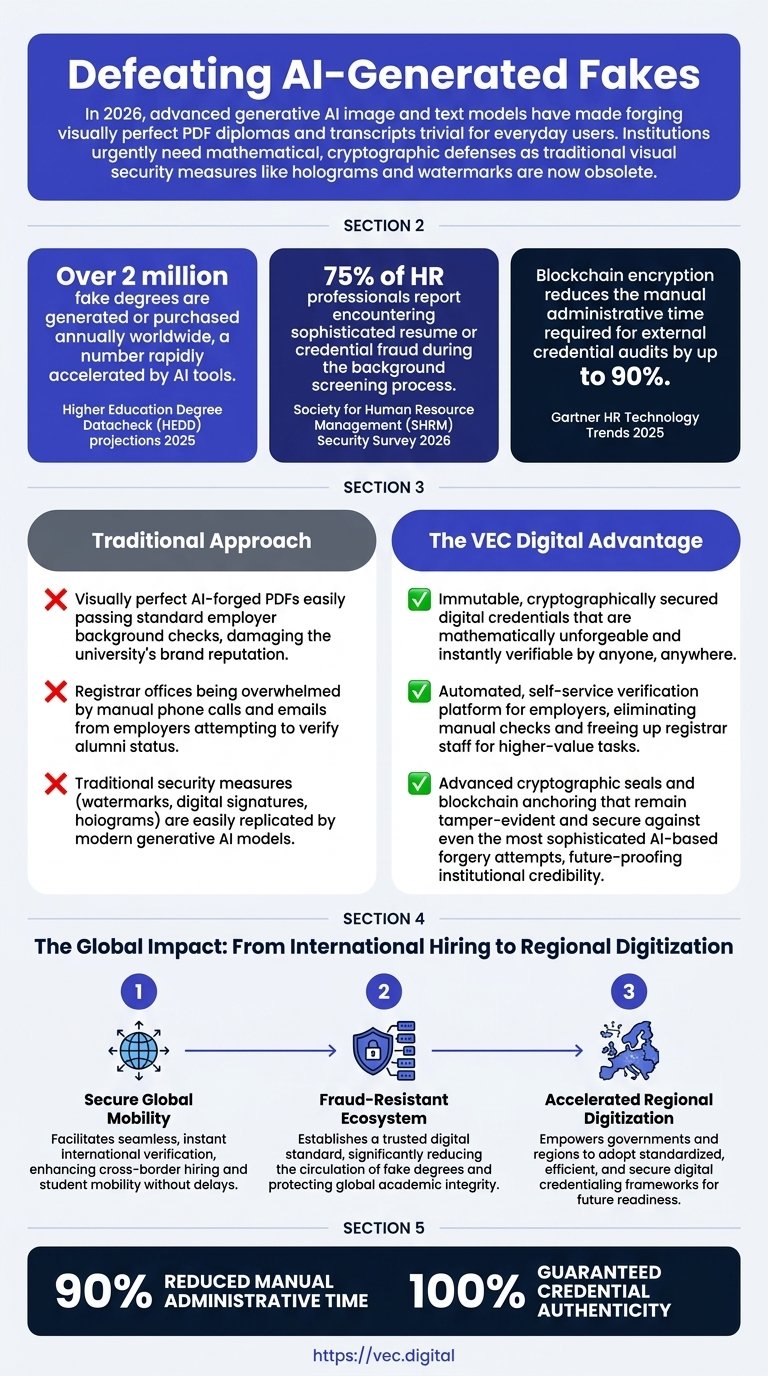
According to Higher Education Degree Datacheck (HEDD) projections for 2025, over 2 million fake degrees are generated or purchased annually worldwide, a staggering number rapidly accelerated by the democratization of AI tools. For decades, academic institutions and corporate training centers relied on complex visual security featuresâ-such as watermarks, embossed seals, and holographic stampsâ-to protect the integrity of their credentials. Today, those visual defenses have been entirely neutralized by advanced generative AI image and text models, making it trivial for everyday users to forge pixel-perfect PDF diplomas and transcripts. As the digital landscape evolves, institutions urgently need to adopt mathematical, cryptographic defenses to effectively prevent degree fraud and protect their hard-earned reputations.
In this comprehensive guide, we will explore the critical shift from visual security to cryptographic certainty, providing actionable strategies for modernizing your credentialing infrastructure. By leveraging the expertise of our team at VEC Digital in secure technology implementations, you will learn how to transition away from vulnerable legacy systems. You will discover how to implement blockchain-anchored verification systems, scale your operations with automated issuance engines, and provide frictionless auditing capabilities for global employers, ensuring your institution's credentials remain the gold standard of professional trust.
Key Takeaways
- Generative AI forgery has rendered traditional visual security measures, including watermarks and standard PDFs, completely obsolete in the fight against credential fraud.
- Implementing blockchain certificate verification shifts the burden of proof from vulnerable visual inspection to immutable mathematical certainty.
- Institutions can eliminate massive administrative overhead by adopting a secure digital diploma platform that automates the entire issuance and auditing lifecycle.
- A modern QR code certificate maker provides global employers with zero-friction, instant verification capabilities without requiring app installations or account logins.
- Deploying a robust bulk certificate generator allows universities and enterprise HR teams to securely issue thousands of tamper-proof credentials in minutes.
The Rise of AI Diploma Forgery: Why Traditional Defenses Are Failing
For generations, the fight to prevent degree fraud was primarily focused on shutting down "diploma mills"â-unaccredited, fraudulent entities that operated in the shadows to sell entirely fabricated degrees. While these bad actors still exist, the modern threat landscape has shifted dramatically. The most pervasive threat today is not the fake university, but the individual AI-driven forgery of legitimate documents from highly respected, accredited institutions. This democratization of forgery means that the barrier to entry for creating a fake credential has dropped from requiring specialized printing equipment to simply typing a prompt into a consumer-grade artificial intelligence platform.
As we look toward the future of academic and corporate integrity, it is vital to understand the mechanics of this new threat. Institutions can no longer rely on the assumption that a document looking authentic actually is authentic. The visual layer of security has been permanently breached, necessitating a fundamental architectural shift in how we issue, store, and verify records of human achievement.
Can AI Forge a Diploma or Transcript?
The short answer is an unequivocal yes. Modern generative AI models, particularly advanced image generation and text-layout algorithms, can easily forge a diploma or transcript with terrifying accuracy. A user can feed a low-resolution image of a university's legitimate diploma into an AI tool, instruct the model to upscale the image, replicate the exact typography, match the institutional colors, and replace the original graduate's name with their own. The AI can even generate highly realistic digital signatures of current university deans or registrars.
This capability extends beyond just the diploma itself. AI tools can generate comprehensive, multi-page academic transcripts complete with realistic course codes, perfectly calculated GPAs, and institutional watermarks. Because these models understand the contextual layout of official documents, the resulting forgeries do not exhibit the traditional tell-tale signs of tampering, such as misaligned text, mismatched fonts, or pixelation around the edges of copied text blocks. The output is a flawless, high-definition digital file that easily passes casual visual inspection by recruiters or hiring managers.
Furthermore, the speed at which these forgeries can be produced is alarming. What once might have taken a skilled graphic designer hours or days to fabricate can now be generated by anyone with an internet connection in a matter of seconds. This rapid proliferation of visually perfect fakes fundamentally undermines the trust that employers place in the credentials presented by job applicants, forcing institutions to seek out new, technologically advanced methods to secure their records.
Why Standard PDF Certificates Are No Longer Secure
For the past two decades, the standard PDF has been the default format for digital document delivery. When institutions first moved away from purely physical printing, the PDF offered a convenient way to email credentials to graduates and corporate trainees. However, the question often arises: Why are standard PDF certificates no longer secure? The reality is that the PDF format was designed for portability and visual fidelity, not for cryptographic security or immutable data storage.
Even when a PDF is "locked" or secured with a standard digital signature, the underlying data can often be stripped, modified, and re-saved using widely available, inexpensive PDF editing software. Bad actors can simply open the document, bypass basic password protections, alter the recipient's name or the date of issuance, and export a new, visually identical PDF. When an employer receives this modified file, there is no built-in mechanism for them to verify its origin without initiating a slow, manual background check process.
Because standard PDFs operate in a siloâ-disconnected from a central, verifiable databaseâ-they act merely as digital pieces of paper. They lack the dynamic connectivity required for modern trust verification. In an era where digital manipulation is effortless, relying on a static file format is akin to leaving the vault door wide open. To truly secure digital student records, the credential must be inextricably linked to an immutable ledger that cannot be altered by any localized editing software.
The Reputational and Financial Cost of Credential Fraud
The consequences of failing to modernize credential security are severe and far-reaching. According to the Global EdTech Security Council in 2026, 40% of academic registrars cite highly realistic AI-forged documents as their top reputational security concern. When an individual uses a forged diploma from a prestigious university to secure a job they are unqualified for, and subsequently fails or commits malpractice, the resulting scandal inevitably tarnishes the university's brand. The public and the media do not blame the AI tool; they question how the institution allowed its credentials to be so easily co-opted.
Beyond academia, the financial impact on the corporate sector is staggering. The Society for Human Resource Management (SHRM) Security Survey for 2026 reports that 75% of HR professionals report encountering sophisticated resume or credential fraud during the background screening process. When these fakes slip through the cracks, companies suffer immense financial losses due to bad hires, the cost of retraining, and in some cases, severe legal liabilities.
Protecting against this requires a proactive approach. By implementing robust, verifiable digital credentials, institutions not only protect their own legacy and prestige but also provide a critical service to the global economy by ensuring that the talent pipeline is built on a foundation of absolute, verifiable truth.
The Global Impact: From International Hiring to Regional Digitization
The challenge to prevent degree fraud is not confined to any single country or educational system; it is a critical global issue. As the modern workforce becomes increasingly mobile, professionals frequently cross international borders to pursue career opportunities. An engineer educated in Europe may seek employment in the Middle East, while a healthcare professional from Asia might apply for a residency in North America. This global mobility relies entirely on the rapid, reliable verification of international credentials.
However, the traditional methods of cross-border verification are notoriously slow, expensive, and prone to error. Employers and international compliance bodies are often forced to navigate complex bureaucratic channels, deal with language barriers, and wait weeks or even months for official confirmation from foreign universities. This friction not only delays critical hiring timelines but also creates windows of opportunity for sophisticated fraudsters to exploit the chaos.
High Legal and Compliance Liabilities for Employers
For corporate employers, the stakes of credential verification go far beyond simply hiring the right fit for the company culture; it is a matter of strict legal and regulatory compliance. The Coalition for Academic Integrity noted in 2026 that credential fraud costs employers and compliance bodies billions of dollars annually in bad hires, legal liabilities, and retraining. In highly regulated industries such as healthcare, aviation, engineering, and finance, hiring an individual based on a forged degree or a fake compliance training certificate can lead to catastrophic outcomes.
If an uncertified engineer signs off on a structural blueprint, or an unlicensed medical professional administers care, the employing organization faces massive lawsuits, regulatory fines, and permanent damage to their market reputation. Employers are legally obligated to perform due diligence, but when faced with visually perfect AI forgeries, their standard screening processes often fall short. They require a systemic solution that provides instant, infallible proof of a candidate's qualifications.
This is where compliance training certificate automation becomes vital for enterprise organizations. By utilizing a system that automatically generates securely anchored credentials upon the completion of mandatory safety or regulatory training, HR departments can maintain a flawless, instantly auditable record of their workforce's compliance status, completely insulating the company from the risks of internal credential tampering.
Academic Degree Fraud Prevention in the Middle East and Beyond
The urgency to modernize credentialing is particularly pronounced in regions undergoing rapid technological transformation. For example, academic degree fraud prevention Middle East initiatives are heavily integrated into broader national digitization frameworks. Programs like the 'Dubai Paperless Strategy' in the UAE and 'Saudi Vision 2030' in Saudi Arabia mandate the transition of public sector, healthcare, and educational records into secure, digital-first formats.
These regions attract a massive influx of highly skilled global expatriate talent to fuel their ambitious infrastructure, technology, and healthcare projects. Consequently, regional authorities and employers require bulletproof verification systems to maintain strict regulatory standards. A forged medical degree or engineering certification in these high-stakes environments is unacceptable. By adopting blockchain-secured credentials, institutions in the Middle East and around the world can instantly validate the qualifications of incoming talent, aligning with national goals for digital excellence and operational transparency.
This global shift toward digital trust infrastructure means that universities worldwide must upgrade their issuance systems. An institution that cannot provide instantly verifiable digital credentials will soon find its graduates at a severe disadvantage in the international job market, as employers naturally gravitate toward candidates whose backgrounds can be authenticated with zero friction.
How Do Universities Detect Fake Degrees Today?
A common question from both employers and students is: How do universities detect fake degrees? Historically, when an employer suspected a forgery, they would contact the university's registrar office directly. The registrar staff would then manually cross-reference the details on the provided document against their internal, highly secure student information systems (SIS) or legacy physical archives. They would look for discrepancies in graduation dates, misspelled faculty names, incorrect degree classifications, or mismatched student ID numbers.
While this manual cross-referencing is accurate, it is entirely unscalable. As the volume of AI-generated fakes increases, registrar offices are becoming completely overwhelmed by the sheer number of verification requests. Furthermore, this reactive approach places the burden of detection on the employer to first suspect a fraud and on the university to manually investigate it. It is a slow, labor-intensive process that drains administrative resources and delays graduate employment.
To truly solve this problem, the paradigm must shift from reactive detection to proactive, automated proof. Instead of forcing employers to ask, "Is this real?" universities must provide credentials that inherently prove their own authenticity the moment they are presented.
What is the Best Way to Prevent Degree Fraud? Enter Cryptographic Trust
If visual security is dead and manual verification is unscalable, what is the best way to prevent degree fraud? The answer lies in replacing visual vulnerability with mathematical certainty. Institutions must adopt a "trust infrastructure" that relies on advanced cryptography to secure their records. By anchoring credentials to an immutable, decentralized ledger, the authenticity of a document is no longer dependent on how it looks, but on its unique, unalterable digital footprint.
This technological leap ensures that even if a fraudster uses the most advanced generative AI to create a visually flawless replica of a diploma, the forgery will fail the verification test instantly because it lacks the mathematical proof of origin. This approach completely neutralizes the threat of AI forgery, providing absolute peace of mind for issuers, recipients, and employers alike.
Moving Beyond Visual Security to Mathematical Certainty
The core concept behind modern credential security is the cryptographic hash function. When a university issues a digital diploma through a secure platform, the system takes all the data within that certificateâ-the student's name, the degree earned, the date, and the institution's detailsâ-and runs it through a complex mathematical algorithm. This algorithm generates a unique, fixed-length string of characters known as a "hash."
This hash acts as a digital fingerprint for the document. Even the slightest alteration to the certificate's dataâ-changing a single letter in a name or a single digit in a graduation yearâ-will result in a completely different hash. This hash is then permanently recorded on a secure ledger. When an employer wants to verify the document, the system recalculates the hash of the presented certificate and compares it to the hash stored on the ledger. If they match perfectly, the document is 100% authentic. If they differ in any way, the document is immediately flagged as a forgery.
This process moves the verification of a credential entirely out of the realm of human visual inspection. It does not matter how realistic the AI-generated signature looks or how perfectly the university seal is replicated; if the mathematical fingerprint does not match the official institutional record, the fraud is instantly exposed.
How Blockchain Certificate Verification Works (Without the Jargon)
To implement this cryptographic security at scale, leading institutions utilize blockchain certificate verification. While blockchain is often associated with volatile cryptocurrencies, its underlying technology is simply a highly secure, decentralized method of storing data. Think of it as a global, digital public notary that never sleeps and cannot be bribed or hacked.
When a university generates a certificate's unique digital fingerprint (the hash), it anchors that fingerprint onto the blockchain. The blockchain does not store the student's private dataâ-it only stores the mathematical proof that the university issued a specific document at a specific time. Because the blockchain is immutable (meaning data cannot be changed or deleted once recorded) and distributed across thousands of servers globally, no single bad actor can alter the record.
This creates a permanent, tamper-proof environment. Even if the university's own internal servers were to experience a catastrophic failure or a cyberattack, the proof of the students' credentials would remain safe and verifiable on the blockchain. This level of security is unprecedented in academic history, completely eliminating the possibility of credential tampering and ensuring that the institution's reputation remains pristine.
Are Blockchain Degrees Legally Recognized by Employers?
As this technology gains traction, a frequent question from students is: Are blockchain degrees legally recognized by employers? The answer is a resounding yes. Employers and global corporate entities do not view blockchain as a separate type of degree; they view it as a superior method of verifying a traditional degree. The academic qualification itself is still granted by the accredited university; the blockchain simply serves as the infallible proof of that grant.
In fact, modern employers actively prefer verifiable digital credentials over traditional paper or standard PDF formats. Major global corporations, government agencies, and international compliance bodies recognize that cryptographically secured credentials drastically reduce their hiring risks and compliance liabilities. As noted by Gartner HR resources in their 2025 technology trends, blockchain encryption reduces the manual administrative time required for external credential audits by up to 90%. Because the verification is instant, mathematically proven, and requires no manual phone calls to the university, employers increasingly view blockchain-anchored degrees as the new gold standard for professional records.
Relieving the Burden on Academic Registrars and HR Teams
While the primary goal is to prevent degree fraud, the operational benefits of modernizing credential infrastructure are equally transformative. For decades, academic registrars and enterprise Learning and Development (L&D) teams have been bogged down by the manual, repetitive tasks associated with issuing, tracking, and verifying certificates. By adopting advanced automation engines, institutions can reclaim thousands of hours of administrative time, allowing their staff to focus on strategic initiatives rather than endless paperwork.
The transition to a secure, automated system fundamentally changes the day-to-day operations of an institution. It removes the friction from graduation week, simplifies corporate compliance audits, and provides a seamless, professional experience for the end-userâ-the graduate or the employee.
Eliminating Manual Verification Overload
The manual verification process is a massive drain on institutional resources. When a large employer or a background screening agency needs to verify the credentials of 50 recent graduates, they typically send a batch request to the university registrar. The registrar's staff must then manually search the student information system for each individual, confirm their graduation status, draft an official response, and securely transmit that confirmation back to the employer. This process can take days or weeks, frustrating employers and delaying the start dates for the graduates.
By implementing a secure digital diploma platform, this entire process is automated. The institution essentially pre-verifies the credentials at the moment of issuance by anchoring them to the blockchain. When an employer needs to verify a candidate, they interact directly with the cryptographic proof, completely bypassing the registrar's office. This self-service verification model eliminates the manual overload on university staff, saving institutions significant operational costs while simultaneously improving the speed and reliability of the auditing process.
How Do Employers Verify Digital Certificates?
To make this system work, the verification process must be entirely frictionless for the employer. How do employers verify digital certificates in this modern paradigm? The most effective and widely adopted solution is the integration of a QR code certificate maker into the credential design process. When a certificate is generated, the platform automatically embeds a unique, cryptographically secure QR code directly onto the document's layout.
When an employer or auditor receives the digital certificate (or even a printed hardcopy of it), they simply open the standard camera app on their smartphone and scan the QR code. In less than two seconds, without needing to download any proprietary apps or create an account, they are routed to a dedicated, secure verification URL (e.g., /certificate/[uuid]).
This verification page instantly displays the real-time status of the credential. It shows the issuing institution's verified identity, the recipient's exact details, the date of issuance, and crucially, a "Blockchain Verified" security badge confirming that the document's cryptographic hash perfectly matches the immutable ledger. This scan-to-verify technology bridges the gap between the physical and digital worlds, turning every certificate into its own instant background check.
The Role of a Bulk Certificate Generator in Scaling Secure Issuance
Issuing highly secure credentials must also be efficient at scale. During university graduation weeks, or after massive corporate compliance training cohorts, administrators are tasked with generating thousands of personalized certificates simultaneously. Doing this manually is a recipe for data entry errors, misspelled names, and delayed deliveries.
To solve this, institutions rely on a robust bulk certificate generator. This automated engine allows operations teams to upload a standard CSV file containing all the necessary recipient data (names, course titles, unique IDs). The system then automatically parses this data, maps it to dynamic placeholders within the institution's approved visual template, and initiates the batch generation process.
Within minutes, the platform can generate 5,000+ personalized, cryptographically secured certificates, anchor their hashes to the blockchain, and automatically dispatch them to the recipients via customized email deliveries. This high-volume automation ensures that scaling credential issuance does not result in a corresponding increase in administrative friction, allowing organizations to recognize learner achievements rapidly and flawlessly.
Building a Future-Proof Digital Diploma Platform
To permanently prevent degree fraud, institutions must view their credentialing strategy not as a series of isolated software purchases, but as the adoption of a comprehensive, future-proof trust infrastructure. The goal is to build an ecosystem where the creation, management, delivery, and auditing of credentials happen seamlessly within a unified, highly secure environment.
This requires moving away from disjointed legacy systemsâ-where design happens in one program, data management in a spreadsheet, and email delivery in anotherâ-and consolidating operations into a dedicated digital credentialing engine designed specifically for the demands of the modern educational and corporate landscape.
Transitioning to Secure Digital Student Records
The foundation of this infrastructure is the transition to secure digital student records. A modern digital diploma platform acts as the central nervous system for an institution's credentialing operations. It provides a visual, drag-and-drop template editor that allows administrators to design beautiful, brand-aligned certificates without needing graphic design skills, while simultaneously embedding the deep cryptographic security required to prevent forgery.
Furthermore, these platforms feature robust multi-signatory approval pipelines. Before a batch of high-stakes diplomas or compliance certificates is officially generated and anchored, the system can automatically hold them in a draft status. Designated organizational authorities (such as a university dean or a corporate compliance officer) are notified to securely log in, review the batch, and apply their electronic signatures. This strict administrative governance prevents accidental or rogue issuance, ensuring that every credential released into the wild has been fully authorized by the institution's leadership.
Integrating a QR Code Certificate Maker for Frictionless Audits
As discussed, the ultimate value of a secure credential is how easily it can be verified by a third party. By natively integrating a QR code certificate maker into the platform, institutions ensure that every document they produce is inherently verifiable. This integration is not an afterthought; it is a core component of the design process.
Administrators can precisely map out where the unique QR code will appear on the certificate template, ensuring it complements the visual design rather than detracting from it. Because the QR code generation is tied directly to the cryptographic hashing engine, there is zero risk of mismatched data. The QR code becomes the permanent, physical-to-digital link that guarantees the document's authenticity, regardless of whether it is viewed on a screen, shared on LinkedIn, or printed and framed on an office wall.
Ensuring Long-Term Institutional Integrity
Ultimately, the adoption of verifiable digital credentials is about protecting the long-term integrity and legacy of the issuing institution. In a world where AI can replicate visual reality with terrifying precision, the only way to maintain trust is to rely on systems that are mathematically immune to manipulation.
By automating the issuance process, securing the data with blockchain technology, and providing frictionless verification tools for global employers, institutions can confidently navigate the challenges of the digital age. They empower their graduates with credentials that hold undeniable weight in the job market, while simultaneously drastically reducing their own administrative overhead and compliance risks.
Secure Your Institutionâ's Legacy with VEC Digital
The threat of AI-generated diploma forgery is real, pervasive, and evolving rapidly. Institutions that continue to rely on standard PDFs and visual security measures are leaving their reputations vulnerable and their graduates at a disadvantage. It is time to transition to a credentialing infrastructure built on absolute, cryptographic trust.
At VEC Digital, we provide the comprehensive technology engine required to completely prevent degree fraud. Our platform seamlessly combines a visual drag-and-drop certificate maker, high-volume automated CSV issuance, multi-signatory governance pipelines, and unbreakable blockchain certificate verification. We empower universities, corporate HR teams, and EdTech platforms to issue beautifully designed, instantly verifiable digital credentials at scale, with zero friction for both the issuer and the verifier.
Protect your brand reputation, eliminate manual verification overload, and give your learners the secure, job-market-ready credentials they deserve. Secure your organizationâ's credentials todayâ-design your first template in minutes with no setup fees.
Ready to modernize your credentialing operations?
Visit our website: https://vec.digital
Contact our expert team: support@vec.digital