
Digital Certificate Fraud Prevention in 2026: Securing Credentials with Blockchain
Published on April 22, 2026

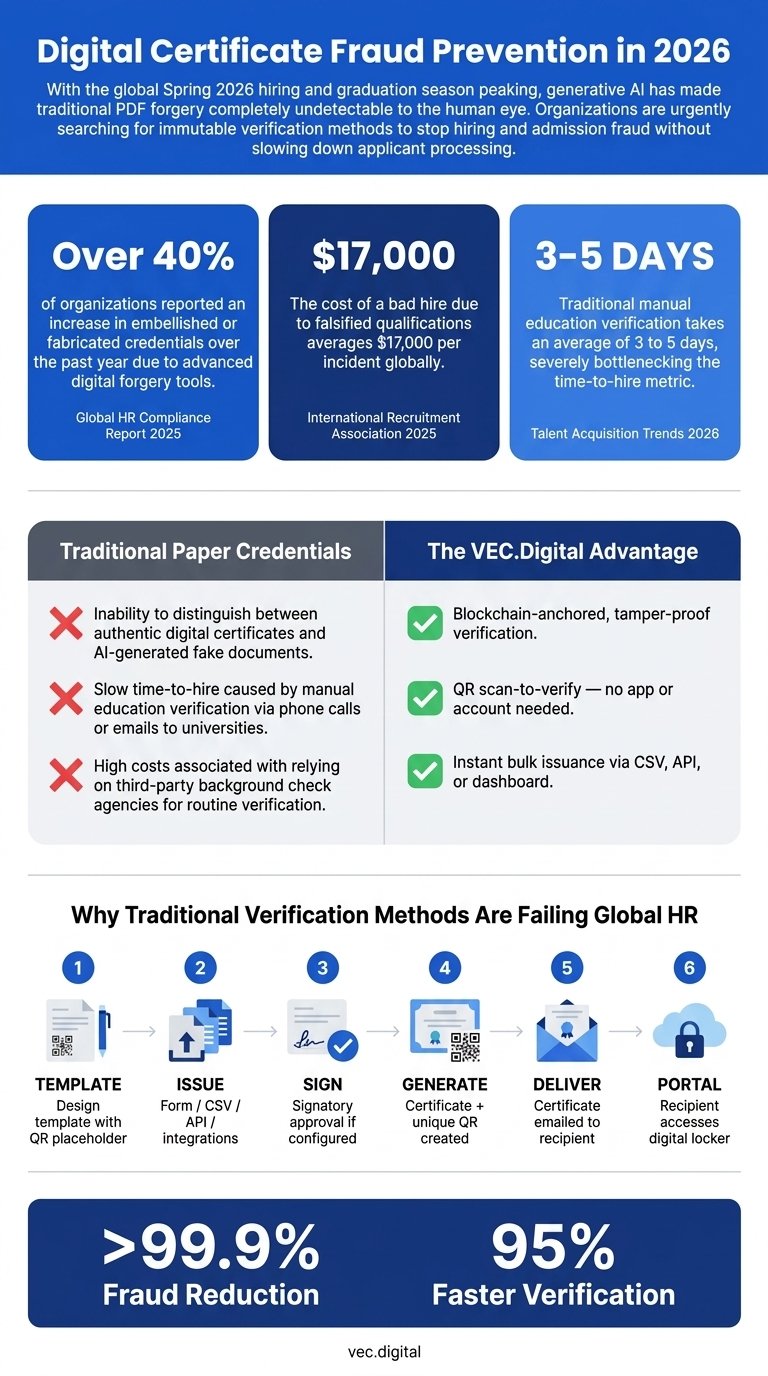
Over 40% of organizations reported an increase in embellished or fabricated credentials over the past year due to advanced digital forgery tools, according to the Global HR Compliance Report (2025). As generative AI makes traditional PDF forgery completely undetectable to the human eye, implementing robust digital certificate fraud prevention has become a critical mandate for global institutions. Relying on outdated manual background checks now exposes universities, training providers, and corporate HR departments to severe reputational and financial risks.
In this comprehensive guide, our team at VEC.Digital will explore how blockchain-powered digital credentialing is transforming the global landscape of trust and verification. By transitioning from vulnerable visual checks to instant cryptographic verification, your organization will learn how to eliminate credential fraud entirely, bypass expensive third-party bottlenecks, and issue globally accessible, tamper-proof credentials in minutes. You will also discover how modernizing your issuance pipeline supports global sustainability goals by eliminating paper waste.
Key Takeaways
- Digital certificate fraud prevention is shifting from manual PDF inspection to immutable, blockchain-anchored cryptographic verification.
- The average cost of a bad hire due to falsified qualifications is $17,000 globally, making fake certificate detection an urgent financial priority for HR teams.
- Blockchain credential verification empowers employers to authenticate claims instantly via a simple QR code scan, eliminating 3-to-5-day manual delays.
- Implementing secure digital badges and verifiable credentials protects institutional brand reputation while supporting global UN sustainability goals by eliminating paper waste.
- Modern issuance pipelines, including automated certificate workflows and multi-signatory approvals, ensure credential integrity before issuance even occurs.
The Escalating Crisis of Credential Fraud in 2026
The landscape of academic and professional credentialing has fundamentally changed. We are entering an era where digital certificate fraud prevention is no longer a secondary IT concern, but a primary operational imperative. With the global Spring 2026 hiring and graduation season peaking, the sheer volume of credentials moving across borders is unprecedented. Unfortunately, the tools used to forge these documents have evolved faster than the traditional methods used to verify them.
For decades, organizations relied on visual indicators to determine authenticity—watermarks, complex borders, embossed seals, and specific typographic layouts. Today, those visual cues offer zero protection. The democratization of advanced design software and artificial intelligence has created an environment where distinguishing between an authentic digital certificate and an AI-generated fake document is virtually impossible for the naked eye.
How Generative AI Has Weaponized Fake Certificate Detection
Generative AI has effectively weaponized credential forgery. In the past, creating a convincing fake required specialized skills and significant time. Now, bad actors can generate pixel-perfect replicas of university diplomas, professional licenses, and corporate training certificates in seconds. They can seamlessly alter names, dates of issuance, and grades on existing PDFs without leaving any digital artifacts that traditional fake certificate detection software might catch.
This inability to distinguish between authentic digital certificates and AI-generated fake documents places immense pressure on recruitment directors and university registrars handling large-scale applicant processing. When a PDF can be manipulated flawlessly, the document itself ceases to be a reliable container of truth. The trust must instead be anchored to the source of issuance, which is precisely why cryptographic verification is replacing visual inspection.
The Hidden Costs of Bad Hires and Compliance Failures
The financial implications of inadequate verification are staggering. According to the International Recruitment Association (2025), the cost of a bad hire due to falsified qualifications averages $17,000 per incident globally. This figure encompasses wasted onboarding resources, lost productivity, severance pay, and the cost of restarting the recruitment process. However, in heavily regulated industries, the costs extend far beyond human resources budgets.
Consider healthcare, finance, and engineering sectors. These industries face severe compliance risks if they are unable to accurately track expiring certifications or if they accidentally employ individuals with fabricated licenses. A single unverified credential in a clinical or structural engineering setting can lead to catastrophic legal liabilities, massive regulatory fines, and irreparable brand damage. For training providers, when their certificates are easily forged and sold online, the intrinsic value of their educational programs plummets, directly impacting future enrollments.
Why Traditional Verification Methods Are Failing Global HR
When asked, "How do employers verify digital certificates?", the historical answer has been a combination of manual outreach and reliance on external agencies. However, as the volume of global applicants increases, these legacy systems are buckling under the pressure. Effective digital certificate fraud prevention requires speed and scale, two elements entirely absent from traditional verification models.
The modern workforce is highly mobile and increasingly remote. Employers are frequently hiring across borders, reviewing candidates from universities and training programs they have no familiarity with. Relying on outdated methods in this fast-paced, globalized environment is a recipe for operational bottlenecks and lost talent.
The Bottleneck of Manual Education Verification
Manual education verification is notoriously inefficient. The standard process involves an HR representative locating the contact information for a university registrar, sending an email or making a phone call, and waiting for a human on the other end to check their internal databases. According to Talent Acquisition Trends (2026), traditional manual education verification takes an average of 3 to 5 days, severely bottlenecking the time-to-hire metric.
In a competitive global talent market, a five-day delay can mean losing a top-tier candidate to an organization with a more agile hiring process. Furthermore, this manual process is prone to human error, time zone delays, and language barriers, making it an unsustainable model for modern, multinational corporations.
The Limitations of Expensive Third-Party Background Checks
To bypass the internal labor of manual verification, many organizations outsource the task to third-party background check agencies. While these agencies can eventually confirm a candidate's history, this approach introduces high costs associated with routine verification. Organizations end up paying premium fees for data that should be inherently verifiable.
This reliance on third-party intermediaries creates a critical informational gap in the market. Most existing literature focuses on how HR can manually spot fake resumes or advises paying for these expensive services. There is a profound lack of understanding that training providers and universities can—and should—issue self-verifying credentials. By doing so, they empower employers to instantly authenticate a claim, bypassing third-party bottlenecks entirely and returning control to the issuing institution and the credential holder.
Cross-Border Hiring and the Push for Global Standards
With remote work now a permanent global standard, international hiring requires a universal language of trust. Employers cannot be expected to recognize the security features of every regional university's paper diploma. This challenge has prompted regulatory bodies to take action. For instance, regulations like the EU's Digital Identity Framework (eIDAS 2.0) are actively pushing organizations toward cryptographically secure, verifiable credentials for establishing cross-border trust.
By adopting universally recognized cryptographic standards, organizations can ensure that a certificate issued in Dubai can be instantly and confidently verified by an employer in London, Singapore, or New York, without any need for localized knowledge or manual translation of security features.
Modernizing Digital Certificate Fraud Prevention with Blockchain
To combat the sophisticated threats of 2026, the paradigm must shift from trusting the document to trusting the cryptography behind the document. This is where blockchain credential verification fundamentally alters the landscape. By anchoring credential data to an immutable ledger, we remove the need for blind trust and replace it with mathematical certainty.
The impact of this technological shift is massive. The Tech Verification Institute (2026) reports that blockchain-based identity and credential verification is projected to save global enterprises $5 billion annually in compliance and background check costs by 2027. This isn't just about security; it's about profound operational efficiency.
What Are Verifiable Credentials in HR?
A common question among HR professionals is, "What are verifiable credentials in HR?" In the context of global standards like the W3C Verifiable Credentials Data Model, a verifiable credential is a digital record of a qualification that is cryptographically sealed by the issuer. It contains metadata that proves exactly who issued it, who received it, and that it has not been altered since the moment of issuance.
For HR teams, verifiable credentials mean the end of manual background checks for education and training. When an applicant submits a verifiable credential, the employer's system can instantly check the cryptographic signature against the blockchain. If the signature matches, the claim is 100% authentic. If even a single comma has been altered by AI, the signature breaks, and the verification fails instantly.
Can Blockchain Certificates Be Faked? Understanding Cryptographic Trust
Inevitably, administrators ask, "Can blockchain certificates be faked?" The definitive answer is no, provided the underlying architecture is robust. When VEC.Digital anchors a certificate, a unique digital fingerprint (a hash) of that specific certificate's data is generated and permanently recorded on an immutable blockchain.
Because blockchains are decentralized and tamper-proof, bad actors cannot retroactively alter the ledger. If a fraudster tries to create a fake certificate claiming they graduated from your institution, they cannot generate the matching cryptographic hash on the blockchain because they do not hold your institution's private issuance keys. Therefore, when an employer attempts to verify the fake document, the system will immediately flag it as invalid. Every authentic VEC certificate proudly displays a "blockchain verified" badge on its public verification page, providing instant visual confirmation of this underlying cryptographic truth.
Sustainability and the Shift Away from Paper Credentials
Beyond security, modernizing the issuance pipeline aligns with critical global sustainability initiatives. Traditional credentialing relies heavily on paper, specialized printing inks, embossed foils, and international physical shipping—all of which contribute to a massive carbon footprint.
VEC.Digital is deeply committed to supporting UN sustainability goals. By transitioning to fully digital, blockchain-verified credentials, institutions completely eliminate paper waste, reduce printing and physical delivery costs, and contribute to eco-friendly credential management globally. Secure digital badges are not only more secure than paper; they are infinitely more sustainable for our planet.
The Mechanics of Instant Verification: How It Works
Understanding the theory behind digital certificate fraud prevention is important, but practical execution is what transforms organizational workflows. The true power of modern credentialing lies in its frictionless user experience. We have designed the VEC platform so that verifying a complex, cryptographically secure document is as easy as taking a photograph.
Institutions are recognizing this necessity. EdTech Global Insights (2026) states that 85% of higher education institutions plan to issue digitally verifiable credentials by the end of 2026 to combat diploma mills. To meet this demand, the mechanics of issuance and verification must be seamless for all parties involved: the issuer, the recipient, and the verifying employer.
How Do QR Codes Work for Certificate Verification?
A frequent query is, "How do QR codes work for certificate verification?" The process is elegantly simple. Every certificate issued through VEC.Digital features a unique, dynamically generated QR code. This QR code acts as a direct bridge to the blockchain record.
When an employer or compliance officer wants to verify a document, they simply scan the QR code using any standard smartphone camera. There is no proprietary app to download, no account to create, and no login required. The scan instantly redirects the user to a secure, unique URL (e.g., /certificate/[uuid]) hosted on our public certificate verification page. Here, the system automatically checks the blockchain ledger and displays the "blockchain verified" badge alongside the untampered certificate data. It takes less than three seconds.
Empowering Employers to Verify Online Course Certificates Instantly
For those wondering "How to verify an online course certificate?", the QR code methodology is the definitive answer. Training providers and online educators frequently suffer brand damage when their completion certificates are forged. By embedding a blockchain-linked QR code onto every digital certificate, training providers empower employers to perform their own instant audits.
This self-verifying ecosystem completely bypasses third-party background check agencies. The employer gains immediate confidence in the applicant's skills, the applicant experiences a faster time-to-hire, and the training provider protects their institutional reputation by making their credentials impossible to forge.
Scaling Up: Bulk Issuance and Automated Certificate Workflows
Issuing secure credentials must be scalable. VEC.Digital supports four distinct issuance methods to accommodate any organizational size. Administrators can use the dashboard form for issuing certificates one-by-one, utilize CSV uploads for bulk issuance to hundreds of graduates simultaneously, leverage our REST API for programmatic, automated generation, or connect via third-party integrations.
These automated certificate workflows ensure that whether you are a boutique corporate training firm issuing ten certificates a month, or a massive global university issuing tens of thousands of diplomas at graduation, the cryptographic security remains identical and effortless.
Best Practices: What is the Best Way to Prevent Certificate Fraud?
When organizations ask, "What is the best way to prevent certificate fraud?", the answer requires a holistic approach. It is not enough to simply apply a digital signature at the end of a broken process. True digital certificate fraud prevention requires securing the entire lifecycle of the credential, from the initial design and approval stages to the recipient's long-term storage and sharing capabilities.
At VEC.Digital, we provide a comprehensive suite of tools designed to enforce security best practices without sacrificing usability or aesthetic quality. Our template editor, for example, offers over 1400 Google Fonts, drag-and-drop functionality, A2–A5 sizing in portrait or landscape, and Canva integration for stunning backgrounds—ensuring your secure documents also look world-class.
Implementing Multi-Signatory Workflows for Internal Security
Internal fraud—where unauthorized staff issue legitimate certificates—is a hidden risk in many organizations. To combat this, VEC.Digital features a robust multi-signatory workflow. Organizations can mandate up to two signatories per certificate template.
For example, a university diploma might require the digital signature of both the University President and the Dean of the specific college. The certificate is held securely in a pending state until ALL required signatories have independently reviewed and signed off on the issuance pipeline. This dual-control mechanism ensures absolute internal compliance before the credential ever reaches the blockchain.
Providing Recipients with a Secure Digital Locker
A credential is only valuable if the recipient can easily access and share it. Traditional PDFs are often lost in email inboxes or stored on vulnerable local hard drives. VEC.Digital solves this by providing every recipient with a secure digital locker.
This portal grants recipients permanent, centralized access to all their earned certificates. They can log in from anywhere in the world, at any time, to view their achievements, download secure copies, or share direct verification links to their LinkedIn profiles and prospective employers. This global accessibility is vital for the modern, mobile workforce.
Protecting Institutional Brand Reputation
Ultimately, the goal of verifiable credentials 2026 initiatives is brand protection. When an organization's certificates are trusted implicitly by global HR departments, the value of that organization's educational output rises. By adopting blockchain verification, you send a clear message to the market: your institution's standards are uncompromising, your graduates are fully vetted, and your brand is protected by the highest tiers of cryptographic security.
Secure Your Organization's Credentialing Future with VEC.Digital
The era of visual verification is definitively over. As generative AI continues to make document forgery trivial, organizations must evolve to protect their reputations, safeguard their compliance standing, and support their graduates and trainees in a competitive global job market. Transitioning to blockchain-anchored digital credentials is no longer a futuristic concept; it is the baseline standard for trust in 2026.
Our team at VEC.Digital is dedicated to making this transition effortless for organizations worldwide. We provide a complete, end-to-end platform that handles everything from beautiful template design and multi-signatory approvals to immutable blockchain anchoring and instant QR code verification. Best of all, we believe in removing barriers to entry. Organizations can start completely free—with no credit card required and no setup fees. As your needs scale, our paid plans start at just $29.99/month, while individuals pay a mere $1.00 per certificate.
Don't let outdated manual processes and vulnerable PDFs compromise your institution's integrity. Empower your recipients, support global sustainability, and eliminate credential fraud permanently.
Ready to modernize your credential issuance?
Visit our website to learn more: vec.digital
Email our global team: support@vec.digital
Connect via WhatsApp: +971521373078