
Digital Certificate Fraud Prevention in 2026: Stop Fake Degrees
Published on April 26, 2026

Instances of sophisticated, AI-generated fake diplomas and certifications have surged by 58% year-over-year, leaving organizations highly vulnerable to credential misrepresentation. As generative AI makes traditional PDF forgery visually indistinguishable from authentic documents, implementing robust digital certificate fraud prevention is no longer optional for modern institutions. This alarming trend is compelling global universities and corporate training providers to urgently rethink how they issue and validate credentials.
In this comprehensive guide, our team at VEC.Digital—experts in blockchain-powered digital credentialing—will explore how to fundamentally secure your credential issuance pipeline. You will learn how to permanently eliminate credential fraud, instantly verify international candidates without massive administrative overhead, and deploy a seamless, globally accessible scan-to-verify system that protects your institutional reputation.
Key Takeaways
- AI-driven forgery has made traditional PDF certificates obsolete, requiring new security measures.
- Blockchain anchoring creates immutable, tamper-proof records that guarantee document authenticity globally.
- QR code verification allows instant, login-free background checks for employers worldwide.
- Administrative efficiency is vastly improved by eliminating the traditional 3-5 day manual verification bottleneck.
- Global compliance is maintained through decentralized systems that respect international data privacy regulations.
The Escalating Threat of AI-Generated Fake Credentials
The landscape of academic and professional credentialing is undergoing a seismic shift. In recent years, the rapid proliferation of generative artificial intelligence has fundamentally altered the security dynamics of digital documents. What was once a specialized skill—forging a realistic diploma or certification—can now be accomplished by anyone with access to consumer-grade AI tools. This technological democratization, while beneficial in many sectors, has created a severe vulnerability for educational institutions and corporate training providers worldwide.
For decades, organizations relied on standard PDF documents or physical paper certificates to signify achievement. However, these legacy formats possess no inherent security mechanisms. They are static representations of data that can be easily manipulated. As the global spring graduation season approaches, institutions and employers are entering peak credential verification season, making the need for digital certificate fraud prevention more critical than ever.
The Rise of Sophisticated Forgery Tools
One of the most pressing questions administrators face today is: How do you prevent PDF certificate forgery? The unfortunate reality is that traditional PDFs cannot be fully protected against modern alteration techniques. Watermarks, digital signatures, and password protections are routinely stripped or bypassed by advanced software. According to a 2026 report by Cybersecurity Ventures, instances of sophisticated, AI-generated fake diplomas and certifications have increased by 58% year-over-year.
This widespread availability of AI tools makes PDF certificate forgery fast, cheap, and visually indistinguishable from originals. Fraudsters no longer need to operate complex "diploma mills" with physical printing presses; they can generate flawless digital replicas in seconds. This accessibility has flooded the job market with fake degree certificates, placing an immense burden on hiring managers and human resources departments who must filter through these fabricated documents.
The Cost of Reputational Damage
The impact of this fraud extends far beyond the individual deceptive candidate; it strikes at the core of an institution's brand equity. When diploma mills or fraudsters successfully issue fake credentials under a university's or training provider's brand, the reputational damage can be devastating. Employers who hire underqualified candidates based on these forged documents inevitably lose trust in the issuing institution's standards.
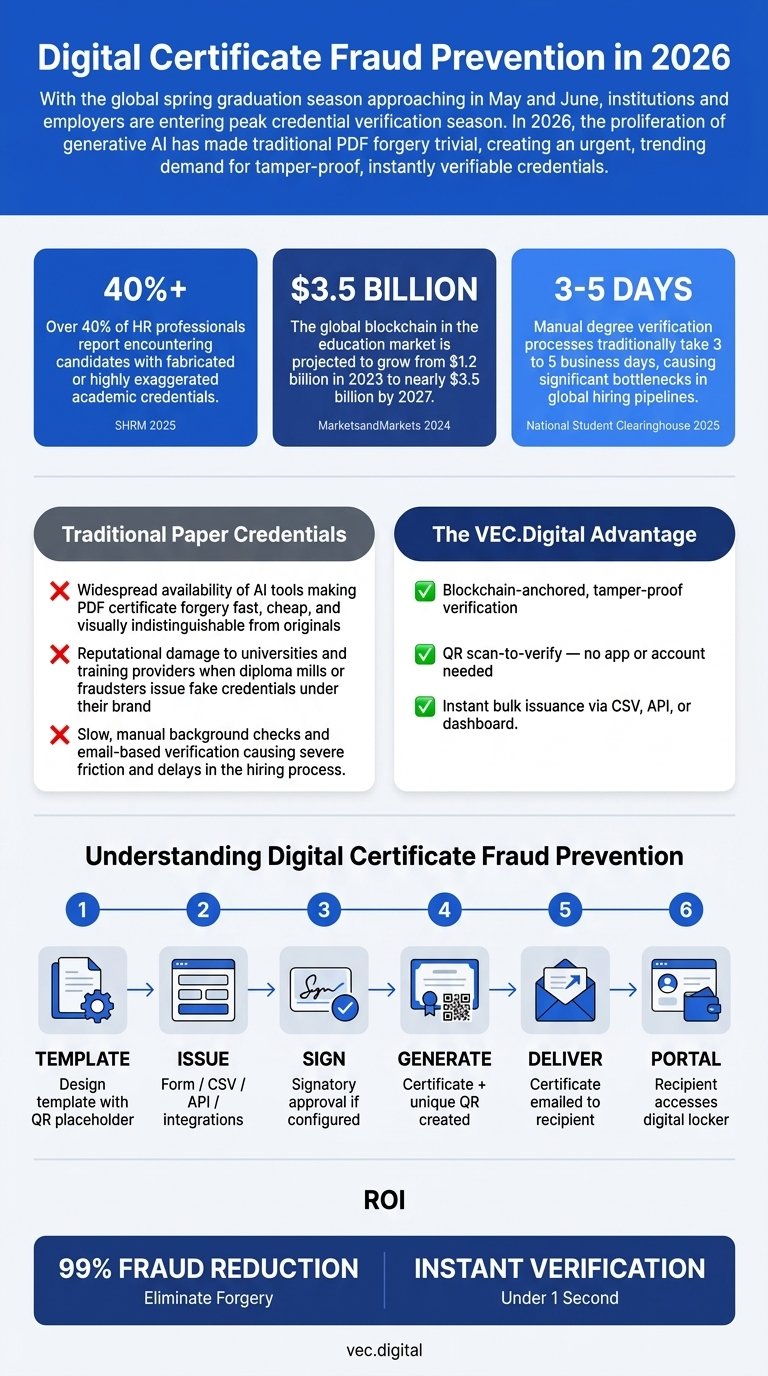
This loss of trust has measurable consequences. According to a 2025 study by SHRM, over 40% of HR professionals report encountering candidates with fabricated or highly exaggerated academic credentials. When employers cannot trust the documents presented to them, the value of the genuine credentials issued by that institution plummets. Protecting your brand's integrity requires a proactive shift away from easily manipulated formats toward systems that offer cryptographic certainty.
Understanding Digital Certificate Fraud Prevention
To effectively combat the rising tide of credential fraud, organizations must move beyond the concept of simply "digitizing" paper certificates. True digital certificate fraud prevention requires a paradigm shift toward verifiable credentials—a framework that ensures data integrity, provenance, and instant verifiability without relying on manual human intervention.
While much of the industry dialogue surrounding advanced credentialing focuses heavily on the underlying cryptography and tokenization aspects of blockchain technology, this highly technical approach often alienates non-technical HR and education leaders. The true value of these systems lies in their operational simplicity, user experience, and the immediate cost-savings of a streamlined issuance pipeline.
What Are Verifiable Credentials in Education?
A common question among academic administrators is: What are verifiable credentials in education? In practical terms, verifiable credentials are digital records that contain mathematically provable claims about a learner's achievements. Unlike a standard PDF, a verifiable credential carries an embedded cryptographic proof that confirms exactly who issued it, to whom it was issued, and that it has not been altered since the moment of issuance.
For a deeper understanding of the technical standards governing these systems, the W3C Verifiable Credentials Data Model outlines the global framework for expressing these secure claims. However, from a business perspective, verifiable credentials represent a frictionless way to package trust. They allow an institution to issue a digital asset that any third party can instantly trust without needing to contact the institution's registrar or administrative office.
The Global Context of Cross-Border Verification
The modern workforce is inherently global. The rise of remote, cross-border hiring means employers in regions like the UAE or the European Union frequently need to verify credentials from institutions located in APAC or the Americas. This globalization of talent introduces significant compliance and logistical challenges.
Global data privacy regulations, such as the EU's General Data Protection Regulation (GDPR) and the UAE's Personal Data Protection Law (PDPL), strictly regulate how personal academic and professional data can be shared and processed. For more information on global privacy standards, resources like GDPR.eu provide extensive guidance. Because these regulations restrict traditional methods of data sharing, decentralized, blockchain-anchored verifiable credentials have emerged as the premier compliant method to standardize instant, privacy-preserving background checks.
The industry is recognizing this shift rapidly. According to Gartner in 2026, 85% of global enterprise employers plan to transition to automated, instantly verifiable credential systems by the end of 2027. Organizations that fail to adopt these standards risk isolating their graduates from the global job market.
How Blockchain Certificate Verification Neutralizes Threats
At the heart of modern credential security is blockchain technology. While the term is often associated with volatile financial markets, its application in data security is profoundly stable and transformative. Blockchain certificate verification provides the immutable infrastructure necessary to guarantee the authenticity of every issued document.
By anchoring a cryptographic hash (a unique digital fingerprint) of a certificate to a decentralized ledger, institutions create a permanent, unalterable record of that credential's existence. If a fraudster attempts to alter even a single pixel or character on the certificate, the digital fingerprint changes, and the verification system will immediately flag the document as invalid.
Can Blockchain Technology Prevent Fake Degrees?
Administrators frequently ask: Can blockchain technology prevent fake degrees? The answer is an unequivocal yes. Because the blockchain acts as a decentralized, tamper-proof ledger, it removes the single point of failure inherent in traditional database systems. Once a certificate is anchored, it cannot be backdated, modified, or deleted by unauthorized actors.
This level of security is driving massive investment in the sector. The global blockchain in the education market is projected to grow from $1.2 billion in 2023 to nearly $3.5 billion by 2027, according to a 2024 report by MarketsandMarkets. This growth underscores a universal recognition among educational leaders that cryptographic anchoring is the most effective defense against credential fraud.
How Can You Check if a Digital Certificate is Genuine?
The true power of blockchain-anchored credentials lies in how easily they can be validated by third parties. How can you check if a digital certificate is genuine? With a platform like VEC.Digital, the process is instantaneous and requires no specialized technical knowledge. When a certificate is viewed online, the system automatically cross-references the document's cryptographic hash with the blockchain record.
If the records match, the system displays a prominent "blockchain verified" badge on the public certificate verification page. This visual confirmation provides immediate peace of mind to employers and universities. Furthermore, this verification process is entirely decentralized, meaning the verifier does not need to create an account, log into a proprietary portal, or pay a fee to confirm the document's authenticity. You can explore how this seamless process works by visiting our dedicated verification page.
Operational Efficiency: Replacing Manual Checks with QR Codes
While the security benefits of blockchain are paramount, the operational efficiencies gained by adopting a modern issuance pipeline are equally compelling. Traditional verification processes are notoriously slow, labor-intensive, and prone to human error. By integrating QR code certificate verification, institutions can entirely bypass these administrative bottlenecks.
The goal is to shift the burden of proof away from the university's administrative staff and onto the credential itself. When a document is self-verifying, the entire ecosystem—from the learner to the employer—operates with unprecedented speed and efficiency.
Overcoming the Manual Verification Bottleneck
Slow, manual background checks and email-based verification cause severe friction and delays in the global hiring process. Historically, when an employer needed to verify a candidate's degree, they would send an email or make a phone call to the university's registrar. The administrative staff would then manually search through legacy databases or physical archives to confirm the record.
According to the National Student Clearinghouse in 2025, manual degree verification processes traditionally take 3 to 5 business days. This delay can cause employers to lose top candidates to faster-moving competitors. Furthermore, fulfilling these manual verification requests from global employers results in high administrative overhead and costs for the issuing institution. Automating this process is a critical step in modernizing institutional operations.
Why Should Institutions Use QR Codes on Digital Certificates?
Why should institutions use QR codes on digital certificates? The answer lies in accessibility. Every certificate issued through VEC.Digital features a unique QR code linking directly to a secure, unique URL (e.g., /certificate/[uuid]). When an employer or auditor scans this code with any standard smartphone camera, they are instantly directed to the public verification page.
This scan-to-verify functionality requires no app downloads, no account creation, and no login credentials. It bridges the gap between the physical and digital worlds; even if a learner prints their digital certificate for a physical portfolio, the QR code remains scannable, ensuring that the document's blockchain-backed authenticity can always be confirmed in real-time.
How Do Employers Verify Online Course Certificates?
For corporate training providers and online educators, the volume of issued certificates can be staggering. How do employers verify online course certificates efficiently when thousands are issued monthly? The scan-to-verify pipeline provides a universal solution. Employers simply scan the QR code or click the verification link embedded in the digital file.
This instant validation is particularly crucial for compliance-driven industries, such as healthcare, finance, and aviation, where verifying a candidate's up-to-date training is a strict regulatory requirement. By providing employers with a frictionless verification experience, training providers significantly enhance the value of their programs. Learn more about optimizing these workflows on our How It Works page.
Best Practices for Secure Digital Certificate Issuance
Transitioning to a secure, blockchain-anchored credentialing system requires careful planning and the right technological partner. To maximize the benefits of secure digital certificates, organizations must implement best practices across their entire issuance pipeline, from design and approval to distribution and lifecycle management.
VEC.Digital provides a comprehensive suite of tools designed to make this transition as seamless as possible, empowering organizations to issue visually stunning, cryptographically secure documents without requiring extensive IT resources.
Implementing Multi-Signatory Workflows
Security begins before the certificate is even issued. In many academic and corporate environments, credentials require authorization from multiple stakeholders—such as a department head and a university dean. VEC.Digital facilitates this through a robust multi-signatory workflow. Administrators can assign up to two signatories per certificate template.
Crucially, the certificate is held in a pending state until all designated signatories have independently reviewed and signed off on the issuance. This internal control mechanism prevents unauthorized or accidental issuance, ensuring that every document bearing the institution's brand has undergone the proper internal vetting process.
Streamlining the Issuance Pipeline
Flexibility in how certificates are generated is vital for organizations of different sizes. VEC.Digital supports four distinct issuance methods to accommodate any operational requirement:
- Dashboard Form: Ideal for issuing credentials one-by-one, allowing administrators to manually input learner details for bespoke awards.
- CSV Upload: Enables bulk issuance, allowing organizations to generate thousands of certificates simultaneously by uploading a simple spreadsheet.
- REST API: Provides programmatic access for deep integration into existing Learning Management Systems (LMS) or HR platforms, fully automating the issuance pipeline.
- Third-Party Integrations: Seamlessly connects with popular enterprise tools to trigger certificate generation based on specific organizational events.
Additionally, the platform features an intuitive template editor equipped with over 1,400 Google Fonts, drag-and-drop functionality, support for A2–A5 sizes in both portrait and landscape orientations, and a direct Canva integration for importing custom backgrounds. This ensures that security never comes at the expense of brand aesthetics.
Enhancing the Learner Experience and Sustainability
The end-user experience is a critical component of modern credentialing. Upon issuance, recipients are granted access to a secure digital locker—a centralized portal where they maintain permanent access to all their earned certificates. This locker is accessible anywhere, anytime, empowering learners to easily share their achievements on professional networks or directly with prospective employers.
Furthermore, transitioning to digital credentials aligns with global environmental initiatives. VEC.Digital actively supports UN sustainability goals by helping organizations eliminate paper waste. Digital certificates reduce the environmental impact associated with printing, physical delivery logistics, and paper archiving, contributing to a more eco-friendly and sustainable approach to global credential management.
Secure Your Organization's Future with VEC.Digital
The era of easily forged, unverified PDF certificates is rapidly coming to an end. As AI-driven forgery becomes more sophisticated, global institutions must proactively defend their reputations and streamline their operational workflows. Implementing robust digital certificate fraud prevention through blockchain anchoring and QR code verification is the definitive solution to these modern challenges.
At VEC.Digital, we empower universities, HR managers, and training providers to issue trustworthy, verifiable digital credentials efficiently and securely. Our platform eliminates the administrative burden of manual verification, guarantees document authenticity globally, and provides an exceptional, sustainable experience for your learners.
We believe that high-level cryptographic security should be accessible to organizations of all sizes. That is why we offer a comprehensive free plan—requiring no credit card and no setup fees—allowing you to start securing your credentials in minutes. For growing institutions, our paid organizational plans begin at just $29.99/month, and individual users can issue certificates for as little as $1.00 per credential. Discover how we can tailor our platform to your specific needs by visiting our Higher Education Solutions page.
Don't let credential fraud compromise your institution's legacy. Upgrade your issuance pipeline today and join the thousands of global corporations and universities that trust VEC.Digital.
Contact Us Today:
Website: vec.digital
Email: support@vec.digital
WhatsApp: +971521373078