
Digital Certificate Fraud Prevention in 2026: The Blockchain Solution
Published on April 25, 2026

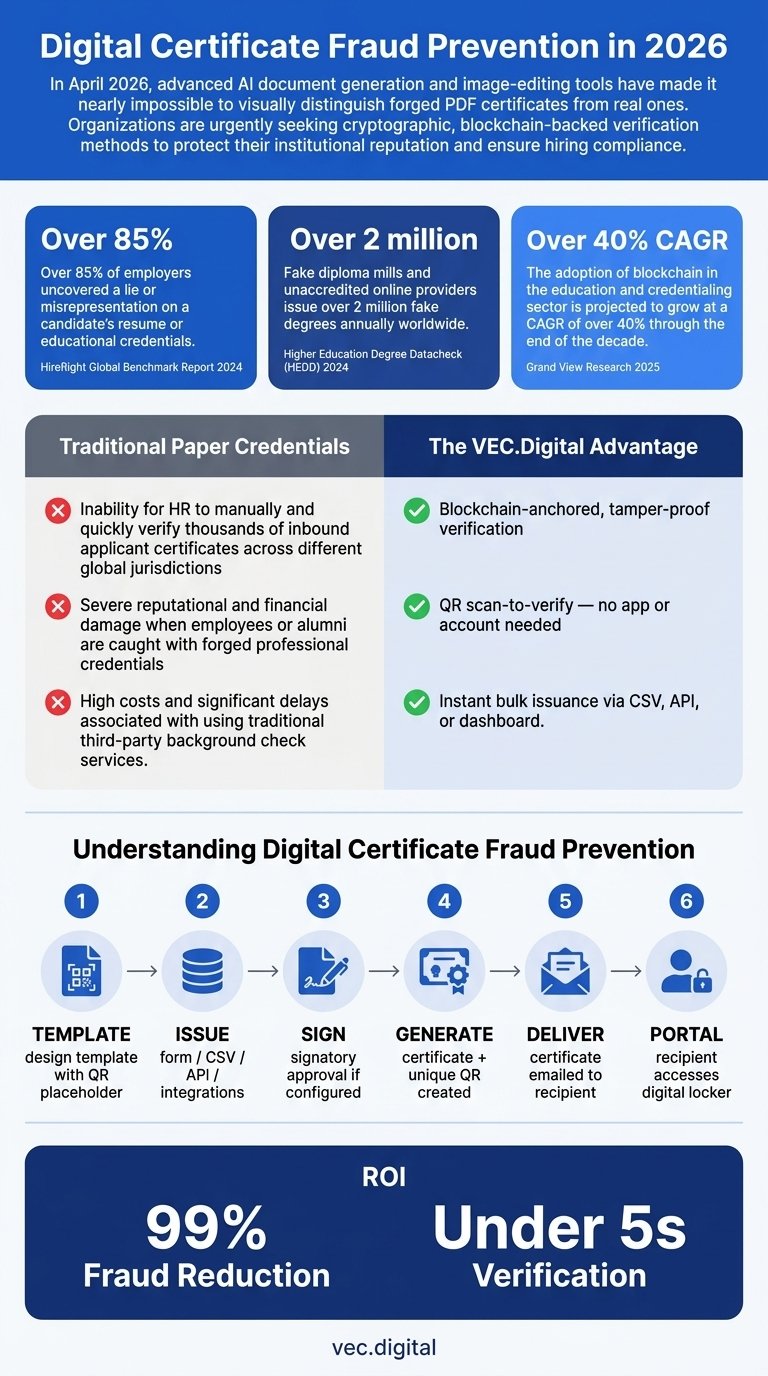
Over 85% of employers uncovered a lie or misrepresentation on a candidate's resume or educational credentials in 2024, according to the HireRight Global Benchmark Report. As sophisticated AI editing tools make forged documents virtually indistinguishable from authentic ones, digital certificate fraud prevention has become a critical mandate for global organizations. The continued reliance on easily manipulated legacy PDFs is exposing institutions to severe reputational damage, compliance violations, and costly hiring mistakes.
In this comprehensive guide, our team at VEC.Digital will demystify the mechanics of modern credential forgery and explain how zero-trust cryptography neutralizes these escalating threats. You will learn how to eliminate credential fraud entirely, implement a scalable QR-code-to-blockchain verification pipeline, and issue trustworthy, globally accessible credentials that save your human resources department thousands of hours in manual screening. By transitioning to a secure digital infrastructure, your organization can protect its reputation while empowering learners with credentials they can seamlessly share worldwide.
Key Takeaways
- Advanced AI tools have rendered traditional PDFs obsolete, necessitating robust digital certificate fraud prevention protocols.
- Blockchain credential verification provides an immutable, tamper-proof record that guarantees the authenticity of every issued document.
- A QR code certificate verification system allows employers and compliance officers to instantly validate credentials without requiring logins or proprietary apps.
- Transitioning to verifiable digital credentials significantly reduces the financial burden of manual background checks, which typically cost global enterprises up to $100+ per candidate.
- Implementing secure certificate issuance not only protects institutional integrity but also actively supports global sustainability goals by eliminating physical paper waste.
The Escalating Crisis of Credential Forgery
Why Are Standard PDF Certificates No Longer Secure?
For over a decade, the standard method for issuing digital awards was generating a static PDF and emailing it to a recipient. However, why are standard PDF certificates no longer secure in today's technological landscape? The answer lies in the rapid democratization of advanced artificial intelligence and photo-editing software. As of early 2026, generative AI tools have made it nearly impossible to visually distinguish forged PDF certificates from real ones. A malicious actor can take a legitimate certificate, seamlessly alter the name, date, or specific qualification, and export a flawless new document in a matter of seconds.
In the past, institutions relied on physical security features like holograms, embossed seals, or specialized watermarks. When credentials moved online, many organizations mistakenly believed that locking a PDF with a password or adding a digital signature was sufficient. Unfortunately, these localized security measures are easily stripped or bypassed by modern software. Because a standard PDF is fundamentally just a visual representation of data rather than a cryptographically anchored record, it offers zero inherent proof of its own authenticity. This vulnerability makes robust digital certificate fraud prevention an urgent necessity rather than a technological luxury.
The Financial and Reputational Cost of Fake Degrees
The proliferation of easily accessible editing tools has fueled a massive underground economy. According to the Higher Education Degree Datacheck (HEDD) in 2024, fake diploma mills and unaccredited online providers issue over 2 million fake degrees annually worldwide. This staggering volume of fraudulent documentation places legitimate institutions in a precarious position. When an employee is hired based on a fabricated degree purportedly from a prestigious university, and that employee subsequently causes financial or operational harm due to incompetence, the ensuing scandal inevitably tarnishes the university's brand.
It is no surprise, then, that institutional leaders are taking decisive action. A 2025 report by Educause revealed that 70% of universities cite institutional reputation protection as the primary driver for adopting verifiable digital credentials. For corporate training boards, certification bodies, and higher education administrators, the integrity of their issued awards is their most valuable asset. A single high-profile instance of credential fraud can erode decades of built-up trust, making the shift to secure, cryptographically backed systems a critical component of institutional risk management.
The Burden on Global Human Resources Teams
Beyond the reputational risks to issuing institutions, the burden of combating fake credentials falls heavily on the shoulders of global Human Resources teams. In an era of remote work and cross-border hiring, HR professionals are inundated with applicant certificates from jurisdictions all over the world. The sheer inability for HR to manually and quickly verify thousands of inbound applicant certificates across different global educational systems creates massive bottlenecks in the talent acquisition pipeline.
Historically, verifying a candidate's background meant contacting a university registrar on another continent, navigating language barriers, and waiting weeks for a response, or paying exorbitant fees to clearinghouses. The Society for Human Resource Management (SHRM) reported in 2025 that manual background checks and credential verification cost global enterprises an average of $35 to $100+ per candidate. These high costs and significant delays associated with traditional third-party background check services are unsustainable for scaling businesses. Organizations need a localized, instant verification method that bypasses these archaic, manual workflows entirely.
Understanding Digital Certificate Fraud Prevention
What Is a Verifiable Credential?
To address the systemic vulnerabilities of legacy PDFs, the global technology and education sectors have pivoted toward a new standard. But what is a verifiable credential? At its core, a verifiable credential is a digital record that contains cryptographically secure proof of its origin, its recipient, and its integrity. Unlike a self-asserted claim (such as a line item on a resume) or a static image, a verifiable credential is mathematically bound to the institution that issued it.
When an organization issues a verifiable digital credential, the data is anchored using advanced cryptography. If even a single pixel or character of that credential is altered after issuance, the cryptographic signature is broken, and the document is instantly flagged as invalid. This zero-trust approach means that the verifier does not need to trust the physical appearance of the document, nor do they need to trust the person presenting it; they only need to trust the underlying mathematics that confirm the document's unbroken link to the original issuing authority.
How Do Employers Check if a Certificate Is Fake?
A common question among hiring managers is: how do employers check if a certificate is fake? In the past, this involved a tedious process of cross-referencing databases, making phone calls, or hiring specialized vetting agencies. Today, utilizing a modern fake certificate checker fundamentally changes this dynamic. Instead of relying on manual outreach, employers use automated cryptographic verification.
When presented with a modern digital credential, the employer simply scans a code or clicks a secure link. The verification system instantly queries the decentralized ledger to confirm three critical facts: First, did the claimed institution actually issue this specific credential? Second, was it issued to the specific individual presenting it? Third, has the credential been revoked, expired, or tampered with since the moment of issuance? If all three conditions are met, the employer receives an immediate, definitive confirmation of authenticity, entirely eliminating the guesswork and manual labor previously required.
The Shift Toward Zero-Trust Digital Cryptography
The transition from visual inspection to cryptographic verification is not just a corporate trend; it is becoming a global regulatory standard. State-level initiatives are setting precedents that mandate secure digital credentialing. For instance, the European Blockchain Services Infrastructure (EBSI) and the UAE National Blockchain Strategy have heavily invested in decentralized, cryptographic frameworks to ensure cross-border trust and data mobility.
These global initiatives highlight a fundamental shift: localized academic networks and manual verification are no longer sufficient for an interconnected world. By adopting zero-trust digital cryptography, institutions align themselves with international standards, ensuring that their credentials hold weight and are instantly recognizable whether the learner is applying for a job in Dubai, New York, or London. This global context underscores why proactive digital certificate fraud prevention is a strategic imperative for any forward-thinking organization.
How Blockchain Credential Verification Solves the Problem
Can Blockchain Prevent Credential Fraud?
As organizations search for the most robust security solutions, they often ask: can blockchain prevent credential fraud? The answer is a resounding yes. Blockchain technology serves as a decentralized, immutable ledger. When a certificate is issued, a unique cryptographic hash—a digital fingerprint of the document—is recorded on the blockchain. Because the blockchain is distributed across countless nodes globally, altering that record is computationally impossible.
This capability is driving massive adoption across the educational landscape. According to Grand View Research in 2025, the adoption of blockchain in the education and credentialing sector is projected to grow at a compound annual growth rate (CAGR) of over 40% through the end of the decade. By leveraging blockchain credential verification, institutions completely neutralize the threat of AI-driven document forgery. Even if a malicious actor uses advanced software to perfectly replicate the visual design of a certificate, they cannot replicate the cryptographic hash anchored on the blockchain. When verified, the forged document will immediately fail the check.
Immutable Records and Public Trust
The power of blockchain lies in its ability to create public trust without requiring a centralized intermediary. At VEC.Digital, every certificate you issue is anchored on an immutable blockchain. We focus entirely on the outcome: providing you and your learners with tamper-proof, publicly verifiable credentials. When a stakeholder views a certificate issued through our platform, they are greeted with a definitive "blockchain verified" badge on the public verification page.
This badge is not merely a visual design element; it is a real-time indicator that the document's cryptographic signature has been successfully authenticated against the ledger. This level of transparency builds immense trust. University administrators and certification board directors can rest easy knowing that their institutional brand is protected by state-of-the-art mathematics, while learners can proudly share their achievements knowing they carry undeniable proof of their hard work.
Eliminating the Need for Third-Party Background Checks
One of the most significant business advantages of blockchain verification is the total elimination of friction in the hiring process. As noted earlier, traditional background checks cost organizations an average of $35 to $100+ per candidate. By issuing blockchain-anchored credentials, universities and training providers effectively subsidize the hiring process for their corporate partners.
When an employer receives a blockchain-verified credential, they do not need to hire a third-party agency to confirm its validity. The verification is instant, deterministic, and entirely free for the verifying party. This dramatic reduction in HR overhead not only saves global enterprises millions of dollars annually but also significantly speeds up the time-to-hire. Candidates with verifiable credentials are moved to the front of the line, creating a powerful competitive advantage for the alumni of institutions that adopt this technology.
The QR Code Certificate Verification System Explained
How Does a QR Code Certificate Verification System Work?
Despite the complex cryptography operating behind the scenes, the user experience must remain incredibly simple. There is a significant informational gap in understanding exactly how this technology functions in practice. So, how does a QR code certificate verification system work in simple, non-technical terms for HR and academic decision-makers?
The process is designed to be frictionless. When an organization issues a certificate through a platform like VEC.Digital, the system automatically generates a unique QR code embedded directly into the document's design. This QR code acts as a direct bridge to the blockchain record. It contains a unique identifier (a UUID) that links specifically to that individual's secure public verification page. The pipeline is entirely automated: the institution clicks "issue," the system anchors the data and generates the QR code, and the final document is delivered to the recipient.
How Do You Verify a Digital Certificate Online?
For the end-user—typically a hiring manager, compliance officer, or auditor—the process is effortless. How do you verify a digital certificate online? You simply open the standard camera app on any smartphone and scan the QR code printed on the physical copy or displayed on a screen. Every VEC.Digital certificate features this unique QR linking directly to a secure URL (e.g., /certificate/[uuid]).
Crucially, there is no app to download, no account to create, and no login required to verify the document. The scanner is instantly routed to the public certificate verification page, where the system performs the cryptographic check in milliseconds. The page displays the original, unaltered certificate data alongside the "blockchain verified" badge. If the document presented by the candidate differs in any way from the immutable record on the screen, the fraud is instantly exposed. This seamless process transforms a multi-week background check into a three-second scan.
The Recipient Digital Locker Experience
While security is paramount for institutions, the experience of the learner is equally important. To maximize the utility of these secure awards, VEC.Digital provides a comprehensive recipient digital locker. When learners receive their credentials, they gain permanent access to a personalized portal where all their certificates are securely stored.
This digital locker empowers recipients to manage their professional identity from anywhere in the world, at any time. They can easily share secure links to their credentials on LinkedIn, attach them to digital portfolios, or present the QR codes during in-person interviews. By giving learners a centralized, accessible hub for their achievements, institutions dramatically increase the visibility of their brand and enhance the overall value of the educational programs they offer.
Implementing Secure Certificate Issuance in Your Organization
Multi-Signatory Workflows for Institutional Integrity
Issuing an official credential is a serious administrative action that often requires oversight from multiple departments. To maintain strict institutional integrity, secure certificate issuance must accommodate complex internal approval processes. VEC.Digital addresses this through an advanced multi-signatory workflow designed specifically for organizational compliance.
Our platform allows for up to two signatories per certificate template. For example, a university degree might require the explicit approval of both the Dean of the Faculty and the University President. Within the VEC system, the certificate is held securely in a pending state until all designated signatories have independently reviewed and signed off on the issuance. This ensures that no credential is ever anchored to the blockchain or delivered to a recipient without the proper, verifiable authorization from institutional leadership.
Seamless Integration and Bulk Issuance
Transitioning to a new credentialing system should not disrupt your existing operations. VEC.Digital is engineered to integrate smoothly into any organizational structure, offering four distinct issuance methods to suit different operational scales. For one-off awards, administrators can use the intuitive dashboard form. For graduating cohorts or large corporate training programs, the CSV upload feature allows for the bulk issuance of thousands of certificates in minutes. For organizations seeking full automation, our robust REST API and third-party integrations allow your existing Learning Management Systems (LMS) or HR software to trigger certificate generation programmatically.
Furthermore, security does not mean sacrificing aesthetics. The VEC template editor provides a rich design environment featuring over 1,400 Google Fonts, intuitive drag-and-drop functionality, and support for various formats including A2 through A5 sizes in both portrait and landscape orientations. With seamless Canva integration for high-quality backgrounds, your team can design breathtaking, brand-aligned certificates that carry the uncompromising security of blockchain technology.
Supporting Global Sustainability Goals
Beyond fraud prevention and operational efficiency, modernizing your credentialing process has a profound environmental impact. Traditional certificate issuance relies heavily on paper stock, chemical printing processes, and global shipping logistics—all of which contribute significantly to an organization's carbon footprint.
VEC.Digital is deeply committed to supporting UN sustainability goals. By transitioning to fully digital certificates, your organization eliminates paper waste, reduces the energy consumption associated with printing, and completely removes the carbon emissions tied to physical delivery and courier services. Adopting an eco-friendly credential management system demonstrates to your stakeholders, students, and corporate partners that your institution is not only technologically advanced but also environmentally responsible.
Future-Proof Your Institution with VEC.Digital
The rapid advancement of AI document forgery has forever changed the landscape of credentialing. Relying on legacy PDFs and manual verification processes is no longer a viable strategy for organizations that value their reputation and the success of their alumni. By embracing zero-trust cryptography and blockchain immutability, you can stop credential fraud in its tracks, save your HR partners invaluable time, and provide your learners with a modern, verifiable proof of their achievements.
At VEC.Digital, our team is dedicated to making this transition as seamless and accessible as possible. We believe that every organization, regardless of size, deserves access to world-class credential security. That is why we offer a completely free plan for organizations to start issuing immediately—requiring no credit card and no setup fees. As your needs grow, our paid organizational plans start at just $29.99 per month, while individuals can verify and issue for only $1.00 per certificate.
Ready to protect your institutional legacy and streamline your credentialing process? Explore how it works, or learn more about our tailored solutions for higher education and corporate training.
Contact our global team today:
Website: vec.digital
Email: support@vec.digital
WhatsApp: +971521373078