
Digital Certificate Fraud Prevention in 2026: Why Blockchain is the Only Defense
Published on April 12, 2026

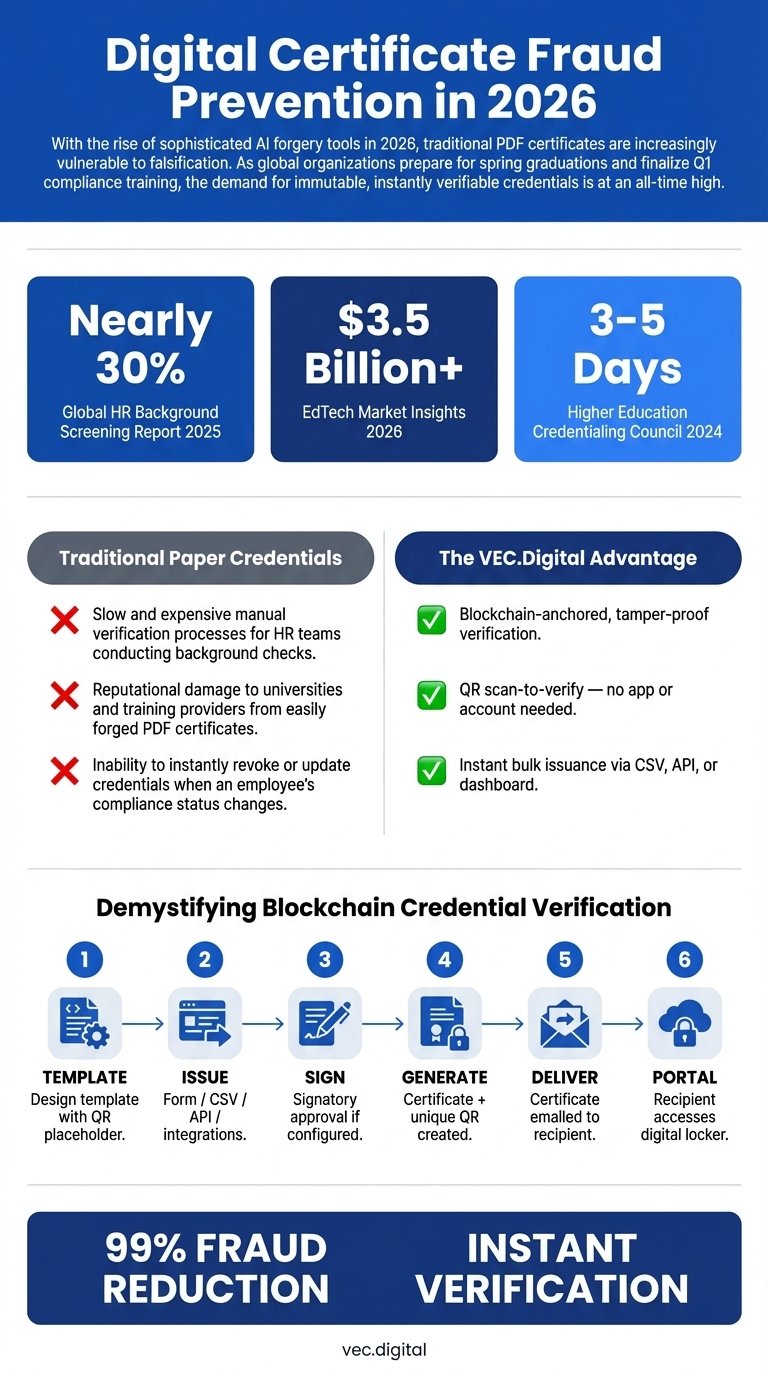
With nearly 30% of job applicants embellishing or forging educational credentials on their resumes according to the Global HR Background Screening Report (2025), traditional credentialing systems are failing to protect institutional integrity. The rapid advancement of AI forgery tools has rendered standard PDF certificates highly vulnerable, forcing global organizations to seek immutable, instantly verifiable alternatives. Implementing robust digital certificate fraud prevention is no longer optional for universities and enterprises that want to maintain global trust and compliance.
In this comprehensive guide, organizational leaders will discover how to eliminate credential fraud using blockchain-anchored verification and QR code technology. You will learn how to transition from slow, manual background checks to instant verification, how to issue bulk certificates seamlessly without developer resources, and how to empower learners globally with accessible, tamper-proof digital credentials from VEC.Digital.
Key Takeaways
- Effective digital certificate fraud prevention requires shifting from easily manipulated PDFs to immutable blockchain-anchored credentials.
- Instant QR code certificate verification reduces processing times for HR background checks by up to 98%.
- Automated secure digital certificate issuance allows non-technical staff to distribute credentials via bulk CSV uploads or REST APIs.
- Implementing reliable fake diploma detection mechanisms protects institutional reputation and ensures global compliance with data privacy standards.
- Providing learners with a secure digital locker enables the safe, seamless sharing of verifiable digital credentials across international borders.
The Escalating Crisis of Credential Fraud in 2026
The Impact of AI Forgery on Traditional PDFs
The landscape of educational and professional credentialing has shifted dramatically. As we navigate 2026, the proliferation of sophisticated artificial intelligence tools has made it easier than ever for malicious actors to generate highly convincing counterfeit documents. Traditional PDF certificates, which rely on static text and easily reproducible digital signatures, offer virtually no resistance to these modern forgery techniques. For universities, training providers, and corporate academies, this presents a severe reputational risk. When an employer discovers that a candidate holds a forged document bearing your institution's name, the trust in your legitimate alumni is immediately compromised.
Effective digital certificate fraud prevention must address this vulnerability at its core. Relying on visual inspections or basic digital watermarks is no longer sufficient. Institutions need a cryptographic guarantee that a document was issued by a specific authority to a specific individual, and that it has remained completely unaltered since the moment of issuance. Without this level of cryptographic security, organizations remain perpetually vulnerable to the reputational damage caused by easily forged PDF certificates.
The Hidden Costs of Manual Background Checks
Beyond the reputational risks, credential fraud imposes a massive operational burden on human resources departments and university registries globally. According to the Higher Education Credentialing Council (2024), the manual verification of traditional university degrees takes an average of 3 to 5 business days. This delay creates friction in the hiring process, frustrates top-tier candidates, and drains administrative resources as staff members are forced to field endless verification phone calls and emails.
Furthermore, the Global HR Background Screening Report (2025) reveals that nearly 30% of job applicants embellish or forge educational credentials on their resumes. This staggering statistic highlights why HR teams spend countless hours conducting slow and expensive manual background checks. By transitioning to a system that prioritizes proactive digital certificate fraud prevention, organizations can eliminate these hidden costs, allowing HR professionals to focus on talent acquisition and strategic initiatives rather than acting as full-time document investigators.
Demystifying Blockchain Credential Verification
What is a Verifiable Credential vs. a Standard PDF?
One of the most common questions from institutional administrators is: What is the difference between a PDF certificate and a verifiable credential? A standard PDF is essentially a digital photograph of a physical document. It contains no embedded proof of its own authenticity. Anyone with basic image editing software can alter the name, the date, or the qualification listed on a standard PDF. In contrast, verifiable digital credentials are data-rich assets anchored to an immutable ledger.
When you utilize digital certificate fraud prevention strategies powered by blockchain technology, the credential is not just a visual file. At the moment of issuance, the unique data footprint (or hash) of the certificate is permanently recorded on a blockchain. This creates an unalterable public record. When an employer or third party views the credential, the system automatically checks this mathematical fingerprint against the blockchain. If even a single pixel or character has been altered, the verification fails instantly. For more context on global standards for these data models, organizations often look to international frameworks like the W3C Verifiable Credentials Data Model, which emphasizes the necessity of cryptographic proof in modern digital ecosystems.
Can Blockchain Certificates Be Faked or Hacked?
Another frequent inquiry from compliance managers is: Can blockchain certificates be faked or hacked? The short answer is no, provided they are issued through a secure, enterprise-grade platform. Because every VEC certificate is anchored on an immutable blockchain, the record of issuance is decentralized and cryptographically secured. To "hack" a blockchain certificate, a bad actor would need to simultaneously alter the data across thousands of independent nodes worldwide—a computational impossibility.
This is the cornerstone of modern digital certificate fraud prevention. When an employer views a credential issued through our platform, they see a distinct "blockchain verified" badge on the public certificate verification page. This badge serves as an absolute guarantee of authenticity. By shifting the burden of proof from a manual phone call to an automated cryptographic check, institutions can confidently assure their stakeholders that their credentials are 100% tamper-proof.
Key Strategies for Digital Certificate Fraud Prevention
Implementing QR Code Certificate Verification
Administrators often ask: Why use QR codes on training certificates? and How do employers verify digital certificates? The answer lies in accessibility and speed. While blockchain provides the underlying security, the QR code provides the user interface. Every certificate issued through VEC.Digital features a unique QR code linking directly to a secure verification portal (e.g., /certificate/[uuid]). There is no app to download, no account to create, and no login required for the verifying party.
By simply scanning the QR code with a smartphone camera, an employer is instantly directed to the public verification page where the "blockchain verified" status is displayed. This seamless integration of digital certificate fraud prevention technology yields dramatic results. The HR Tech Automation Review (2025) found that organizations utilizing instant QR code verification reduce credential processing times by up to 98%. This transforms a multi-day administrative headache into a frictionless, seconds-long interaction.
Instant Revocation and Lifecycle Management
A major pain point for corporate training providers and compliance directors is the inability to instantly revoke or update credentials when an employee's compliance status changes. In highly regulated industries—such as healthcare, aviation, or financial services—holding an expired or revoked certification poses a severe liability. Traditional paper or PDF certificates cannot be "recalled" once they are emailed or handed to a candidate.
Comprehensive digital certificate fraud prevention must include robust lifecycle management. With a blockchain-anchored system, the issuing authority retains ultimate control over the credential's status. If a certification expires, or if a candidate violates compliance protocols, the administrator can revoke the credential with a single click from their secure management dashboard. Anyone who scans the QR code thereafter will immediately see that the certificate is no longer valid, ensuring real-time compliance tracking across global workforces.
Empowering Learners with Secure Digital Lockers
Candidates today demand credentials that they can easily share on professional networks like LinkedIn, include in digital portfolios, and carry with them throughout their careers. However, a common frustration is the lack of secure, socially-sharable credentials that candidates can confidently present to employers without fear of data loss or format corruption.
To address this, our platform provides every recipient with a permanent digital locker. This portal gives learners centralized access to all their verifiable credentials, accessible anywhere, anytime. This not only enhances the learner experience but also reinforces digital certificate fraud prevention. Because the credentials are shared directly from the secure locker via verified links or QR codes, the chain of trust remains unbroken from the issuer, to the learner, to the prospective employer.
Scaling Secure Digital Certificate Issuance Without IT Hurdles
How to Issue Blockchain Certificates in Bulk
A significant gap in the current industry dialogue is that existing blogs often focus too heavily on the technical aspects of cryptography, Web3, and blockchain nodes. They fail to explain how non-technical HR and university staff can actually utilize these systems. A common question is: How do I issue blockchain certificates in bulk? The reality is that implementing digital certificate fraud prevention should not require a team of specialized developers.
At VEC.Digital, we have abstracted the complexity of the blockchain to focus entirely on the user experience and business value. Our platform offers four distinct, user-friendly issuance methods to suit any organizational scale. Administrators can issue certificates one-by-one via a dashboard form, upload a bulk CSV file to issue thousands of credentials in minutes, utilize our REST API for programmatic issuance, or leverage third-party integrations. This automated pipeline ensures that higher education institutions and enterprise enterprises can scale their credentialing operations effortlessly.
Streamlining the Signatory Workflow
In academic and corporate environments, certificates often require approval from multiple department heads. Managing this manually—chasing down signatures via email or routing physical paper across a campus—is highly inefficient and prone to errors. To maintain strict governance while improving efficiency, a digitized signatory workflow is essential.
Our platform features a robust multi-signatory workflow that accommodates up to 2 signatories per template. When a certificate is generated, it is held in a pending state until ALL designated signatories have independently reviewed and signed off on the issuance. Only then is the document anchored to the blockchain and released to the recipient. This built-in governance is a critical layer of digital certificate fraud prevention, ensuring that no credential is ever issued without the proper internal authorizations.
Preventing Online Course Diploma Fraud
With the explosion of e-learning, training providers frequently ask: How to prevent online course diploma fraud? The digital nature of online education makes it particularly susceptible to diploma mills and unauthorized credential sharing. To combat this, online educators must adopt verifiable digital credentials that are intrinsically linked to the learner's verified identity and course completion data.
By utilizing our advanced template editor—which features over 1400 Google Fonts, drag-and-drop functionality, A2–A5 size options, portrait/landscape orientations, and seamless Canva integration for backgrounds—educators can design stunning, brand-aligned certificates. But more importantly, beneath the beautiful design lies an unforgeable cryptographic anchor. This combination of aesthetic flexibility and uncompromising digital certificate fraud prevention ensures that online academies can protect the value of their programs while providing a premium experience for their graduates.
Global Compliance and the Shift to Sustainable Credentialing
Meeting International Data Privacy Standards
Operating on a global scale requires adherence to strict data privacy regulations, such as the GDPR in Europe. Furthermore, national pushes for digital-first governance, such as the Dubai Paperless Strategy, mandate that organizations modernize their document handling. Institutions must issue credentials that are both tamper-proof and privacy-preserving.
Blockchain-anchored credentialing perfectly aligns with these global mandates. Because the blockchain stores only the cryptographic hash (the mathematical proof) rather than the individual's personal data, privacy is maintained. The actual personal information remains securely encrypted and under the control of the issuing institution and the learner. This architecture ensures that organizations can implement rigorous digital certificate fraud prevention without running afoul of international data protection laws.
Driving Sustainability Through Paperless Operations
The transition to digital credentials is not just about security; it is also a vital step toward environmental sustainability. Traditional credentialing relies heavily on paper, specialized printing, physical mailing, and continuous physical storage—all of which carry a significant carbon footprint. As global organizations align with the United Nations Sustainable Development Goals (SDGs), eliminating paper waste has become a corporate imperative.
VEC.Digital is deeply committed to this sustainability angle. By adopting our digital credentialing platform, organizations completely eliminate the need for paper certificates, reducing printing and physical delivery costs to zero. This eco-friendly approach to credential management allows institutions to champion sustainability while simultaneously upgrading their digital certificate fraud prevention capabilities. For further reading on how digital transformation is shaping sustainable global education, the UNESCO initiatives on digital education provide excellent broader context.
The Future of Skills-Based Hiring
The global job market is undergoing a fundamental shift toward skills-based hiring. Employers are increasingly looking beyond traditional multi-year degrees to focus on specific competencies, micro-credentials, and targeted corporate training. This shift demands faster, standardized verification of micro-credentials across borders. According to EdTech Market Insights (2026), the global blockchain in education and HR tech market is projected to exceed $3.5 billion, reflecting this massive structural change.
Furthermore, Digital Certification Global Trends (2026) reports that over 75% of top-tier global universities and enterprise training providers plan to implement verifiable digital credentials. Institutions that fail to adopt digital certificate fraud prevention technologies will find their graduates at a disadvantage in a fast-paced, digital-first hiring market. By partnering with a platform that guarantees 99.98% uptime SLA reliability, organizations can ensure their credentials are always available, always verifiable, and always trusted worldwide.
Secure Your Institution’s Future with VEC.Digital
The threat of AI-powered credential forgery is real, and the hidden costs of manual verification are draining valuable resources from organizations worldwide. However, the solution is highly accessible. By transitioning to a system that utilizes immutable blockchain anchoring and instant QR code verification, you can eliminate credential fraud, protect your institutional reputation, and dramatically streamline your administrative workflows.
VEC.Digital is the trusted partner for over 500 universities and 10,000 corporations globally, having successfully issued over 100,000 verifiable certificates. Our platform abstracts the technical complexity of the blockchain, providing your team with intuitive drag-and-drop editors, automated bulk issuance via CSV or REST API, and a secure multi-signatory workflow. We empower your organization to champion sustainability by eliminating paper waste, while giving your learners a permanent, globally accessible digital locker for their credentials.
Ready to implement foolproof digital certificate fraud prevention? Organizations can start completely free with no credit card required and no setup fees. Our paid plans for organizations start at just $29.99/month, and individuals pay only $1.00 per certificate. Discover how effortless secure credentialing can be by exploring how our platform works or reviewing our organization pricing plans.
Contact our global team today to secure your credentials:
Website: vec.digital
Email: support@vec.digital
WhatsApp: +971521373078