
Digital Certificate Fraud Prevention in 2026: Why Blockchain is the Only Solution
Published on April 19, 2026

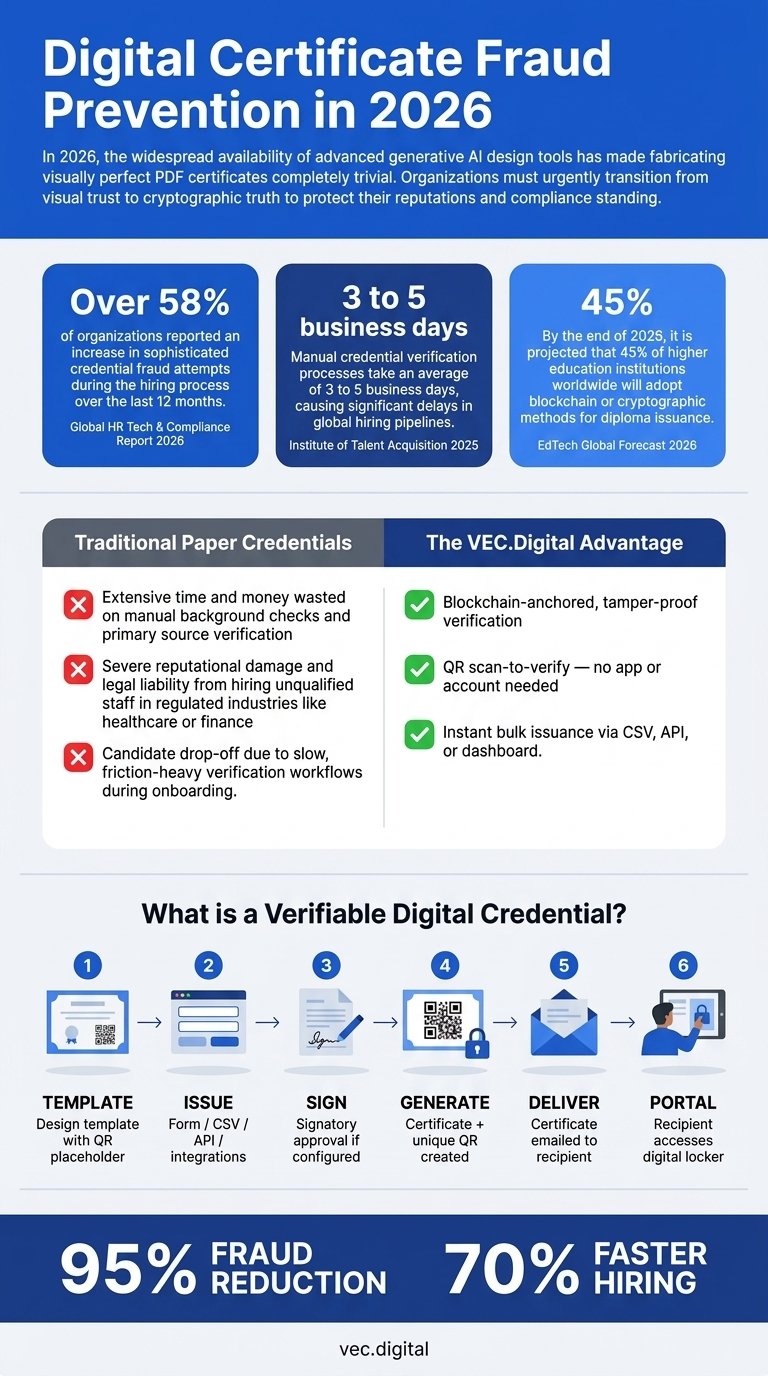
Over 58% of organizations reported a sharp increase in sophisticated credential fraud attempts during the hiring process over the last 12 months, according to the 2026 Global HR Tech & Compliance Report. As generative AI design tools make fabricating visually perfect documents trivial, digital certificate fraud prevention has become a critical mandate for institutions worldwide. The era of relying on visual watermarks and secure PDFs is over; today, protecting your organization's reputation requires an immediate shift from visual trust to cryptographic truth.
In this comprehensive guide, our team at VEC.Digital will show you exactly how to future-proof your credentialing strategy using blockchain-powered digital credentialing. You will learn how to eliminate the risk of fake degrees, drastically reduce background check costs, and issue bulk certificates in minutes with a multi-signatory workflow. By the end of this article, your organization will have a clear roadmap to implementing global, instantly verifiable credentials that empower learners and guarantee compliance confidence.
Key Takeaways
- Digital certificate fraud prevention requires abandoning easily manipulated visual security in favor of immutable blockchain anchoring.
- Manual fake certificate detection costs organizations $30 to $100 per candidate and causes critical delays in global hiring pipelines.
- Blockchain-backed verifiable credentials 2026 enable instant, zero-cost validation through simple QR code scans.
- Modernizing your issuance pipeline with secure digital certificates eliminates paper waste and actively supports UN sustainability goals.
- VEC.Digital provides a fully scalable platform featuring multi-signatory workflows, bulk CSV uploads, and a recipient digital locker for permanent, global access.
The Escalating Threat of Credential Fraud in 2026
To understand the urgency behind modern digital certificate fraud prevention, we must first examine the technological landscape of 2026. The widespread availability of advanced generative AI design software has fundamentally altered how organizations must approach document security. Fabricating a convincing university diploma or corporate compliance certificate is no longer the domain of skilled counterfeiters; it can be accomplished in seconds by anyone with an internet connection.
This reality has triggered a crisis of trust across global hiring markets, higher education admissions, and regulatory compliance sectors. Organizations that continue to rely on outdated verification methods are unknowingly exposing themselves to severe operational and legal risks.
Why Are PDF Certificates No Longer Considered Secure?
Many administrators frequently ask: Why are PDF certificates no longer considered secure? The answer lies in the fundamental nature of visual data. Traditional security measures—such as high-resolution watermarks, complex border designs, holographic overlays, and even encrypted PDF passwords—are visual and file-level protections. AI design tools can effortlessly clone these visual elements, strip password protections, and generate pixel-perfect replicas of legitimate documents.
Because a standard PDF is just a static file, once it is downloaded and emailed to an employer, the issuing institution loses all control over it. The document cannot be updated, and its authenticity cannot be mathematically proven without contacting the issuer directly. This is why visual security is effectively obsolete; if a document can be seen, it can be seamlessly replicated by artificial intelligence.
The Hidden Costs of Fake Degrees and Credentials
The financial and reputational toll of credential fraud is staggering. When organizations accidentally hire unqualified individuals—particularly in highly regulated industries like healthcare, finance, or engineering—they face severe legal liability and disastrous reputational damage. But even beyond the worst-case scenarios, the day-to-day administrative burden of fake certificate detection is draining organizational resources.
According to the International Employment Verification Watch (2025), traditional background check costs for verifying international credentials average $30 to $100 per candidate. When you scale this across hundreds or thousands of annual hires, the financial waste is monumental. This cost includes third-party vendor fees, international administrative outreach, and the manual labor required to trace a document back to its primary source.
The Global Hiring Bottleneck
With remote, cross-border hiring continuing to dominate the global workforce, verifying international credentials has become a massive bottleneck. Differing international education standards and the lack of unified global databases make manual verification nearly impossible.
The Institute of Talent Acquisition reported in 2025 that manual credential verification processes take an average of 3 to 5 business days. This delay causes significant friction in global hiring pipelines, often leading to candidate drop-off. Top-tier talent will not wait a week for an employer to manually verify their degree when competing offers are on the table. A frictionless, instant verification process is no longer just a security measure; it is a competitive advantage in talent acquisition.
What is a Verifiable Digital Credential?
As the inadequacies of static documents become undeniable, the global standard is shifting toward cryptographic solutions. To combat sophisticated forgery, organizations must understand and adopt the next generation of credentialing technology.
This shift is not merely a software upgrade; it is a fundamental reimagining of how trust is established and maintained across borders. By removing the reliance on human verification and visual inspection, verifiable credentials create a zero-trust environment where authenticity is mathematically guaranteed.
Defining Cryptographic Truth
A common question among HR and education professionals is: What is a verifiable digital credential? Unlike a standard digital document, a verifiable credential is a tamper-evident, cryptographically secured record of achievement. It separates the visual presentation of the certificate from its underlying data.
While the recipient still receives a beautifully designed document, the true value lies in the mathematical proof anchored to a decentralized network. This proof guarantees three essential facts: who issued the credential, who received it, and that the data has not been altered by a single byte since the moment of issuance. Organizations seeking deeper technical context on these global data models often refer to standards outlined by bodies like the World Wide Web Consortium (W3C).
How Do Employers Check if a Digital Certificate is Fake?
Historically, answering the question of how do employers check if a digital certificate is fake involved a tedious process of primary source verification—calling the university registrar, emailing the training provider, or paying a background check agency to do the legwork. With verifiable credentials, this process is entirely transformed.
Employers no longer need to scrutinize the visual elements of a document. Instead, they interact with the cryptographic proof. When an employer receives a secure digital certificate issued through a platform like VEC.Digital, they simply use the embedded verification link or QR code. The system instantly cross-references the document's unique cryptographic hash against the immutable ledger, providing an immediate "Valid" or "Invalid" response. The visual design is irrelevant to the verification process.
The Role of Decentralized Ledger Technology
Decentralized ledger technology (blockchain) is the engine that makes this cryptographic truth possible. When a certificate is generated, a unique digital fingerprint (hash) of that certificate is recorded on a blockchain. Because blockchains are immutable—meaning the data cannot be changed, deleted, or tampered with once recorded—this provides a permanent, universally accessible anchor of truth.
This decentralized approach solves the problem of cross-border verification. An employer in Tokyo can instantly verify a diploma issued by a university in London without needing access to the university's internal databases or understanding the local educational framework. The blockchain serves as a neutral, global source of truth.
How Blockchain Certificate Verification Solves the Crisis
Implementing effective digital certificate fraud prevention requires a system that is resilient against both current AI threats and future technological advancements. Blockchain anchoring provides this resilience by removing the human element from the verification equation.
Institutions worldwide are recognizing that protecting their brand equity means ensuring that no one can falsely claim affiliation with their programs. Blockchain certificate verification is the definitive answer to this challenge.
Can Blockchain Prevent Fake Degrees and Certificates?
Skeptics often ask: Can blockchain prevent fake degrees and certificates? The answer is an unequivocal yes. Because every VEC certificate is anchored on an immutable blockchain, the cryptographic hash cannot be forged. If a bad actor uses an AI tool to alter the recipient's name, the graduation date, or the grade on a downloaded PDF, the cryptographic hash of that altered document will change completely.
When an employer attempts to verify the altered document, the hash will not match the original fingerprint anchored on the blockchain by the issuing institution. The verification will instantly fail, exposing the fraud. This makes fabricating a verifiable credential mathematically impossible, completely neutralizing the threat of generative AI design tools.
Eliminating Verification Delays
Beyond security, the operational efficiency gained through blockchain verification is transformative. According to a 2026 Decentralized Identity Market Analysis, organizations utilizing instant QR-code verifiable credentials reduce primary source verification time by 99%, taking the process from days to mere milliseconds.
This massive reduction in time eliminates the global hiring bottleneck. HR managers can verify candidate credentials in real-time during an interview, accelerating the onboarding process, reducing candidate drop-off, and saving thousands of dollars in administrative costs per hiring cycle.
The 45% Higher Education Shift
The academic world is rapidly adapting to this new reality. The EdTech Global Forecast (2026) projects that by the end of the year, 45% of higher education institutions worldwide will adopt blockchain or cryptographic methods for diploma issuance.
Universities are realizing that their reputation is their most valuable asset. By issuing blockchain-verified academic credentials, they not only protect their brand from counterfeiters but also provide their alumni with a highly portable, globally respected digital asset that enhances their employability in the international job market.
Instant Validation: QR Code Certificate Verification
The true power of a verifiable credential is realized when it is placed in the hands of the recipient and the verifier. The technology must be incredibly sophisticated on the back end, yet flawlessly simple on the front end. This is where QR code certificate verification bridges the gap between complex cryptography and everyday usability.
VEC.Digital has engineered a verification experience that requires zero technical knowledge from the end-user, ensuring maximum adoption and utility across all industries and demographics.
How Do You Verify a Certificate Using a QR Code?
One of the most frequent inquiries from our corporate clients is: How do you verify a certificate using a QR code? We have designed the VEC.Digital platform to make this process entirely frictionless. Every certificate generated on our platform features a unique QR code linking directly to a secure verification page (e.g., /certificate/[uuid]).
To verify the document, an employer, conference organizer, or compliance auditor simply opens their standard smartphone camera and scans the code. There is no proprietary app to download, no account to create, and no login required. The scan instantly directs them to the VEC public certificate verification page, which displays the credential's details alongside a prominent "blockchain verified" badge, confirming its authenticity in milliseconds.
The Recipient Digital Locker Experience
A credential is only useful if the learner can easily access and share it. VEC.Digital provides every recipient with a secure digital locker—a centralized portal where they gain permanent access to all their earned certificates.
This digital locker is accessible anywhere, anytime, empowering learners to instantly share their verified achievements on professional networks like LinkedIn, attach them to digital resumes, or present them during global job interviews. By prioritizing the recipient experience, organizations increase learner motivation and amplify the organic reach of their training programs.
Eco-Friendly and Global Impact
Transitioning to digital credentialing is not just a technological imperative; it is an environmental one. Traditional paper certificates require massive amounts of water, timber, and energy to produce, print, and physically ship across the globe.
By adopting secure digital certificates, organizations eliminate paper waste, drastically reduce their carbon footprint, and lower physical delivery costs to zero. VEC.Digital is proud to support the UN Sustainable Development Goals (SDGs) by championing eco-friendly credential management globally, allowing institutions to align their operational upgrades with their corporate social responsibility initiatives.
Managing the Credential Lifecycle and Revocation
Issuing a certificate is only the beginning of its lifecycle. In dynamic environments such as corporate compliance, medical licensing, or professional memberships, credentials frequently expire, require updating, or must be invalidated due to ethical breaches. Effective digital certificate fraud prevention requires robust lifecycle management capabilities.
Traditional PDFs fail spectacularly in this regard. Once a static file is emailed to a recipient, it cannot be un-emailed. VEC.Digital solves this through dynamic, blockchain-anchored lifecycle management.
How Do Institutions Revoke a Digital Certificate?
Compliance directors frequently ask: How do institutions revoke a digital certificate? With VEC.Digital, revocation is a seamless, one-click process from the administrative dashboard.
Because the verification page dynamically checks the blockchain state in real-time, revoking a certificate instantly updates its status globally. If a recipient attempts to share a revoked or expired credential, anyone scanning the QR code will immediately see a "Revoked" or "Expired" status. This capability is absolutely critical for corporate training providers and regulatory bodies who must ensure that only currently qualified individuals are representing their certifications.
Multi-Signatory Workflows for Secure Issuance
Internal fraud or accidental issuance is another vector of risk. To ensure strict quality control, VEC.Digital features a robust multi-signatory workflow. Organizations can assign up to 2 signatories per certificate template.
When a certificate is generated, it is held in a pending state until ALL designated signatories have independently reviewed and signed off on the issuance. This workflow ensures that no single point of failure exists within your administrative team, providing an extra layer of internal security and compliance oversight before any credential goes live on the blockchain.
Scalable Issuance Methods and Custom Design
We understand that every organization operates differently, which is why VEC.Digital offers 4 distinct issuance methods to fit any operational scale:
- Dashboard Form: Ideal for issuing one-by-one credentials manually.
- CSV Upload: Perfect for bulk issuance to hundreds of graduates or conference attendees simultaneously.
- REST API: Enables programmatic issuance directly from your existing LMS, HRIS, or CRM platforms.
- Third-Party Integrations: Seamlessly connect VEC with your preferred software ecosystem.
Furthermore, security does not mean sacrificing aesthetics. The VEC template editor features drag-and-drop functionality, over 1400+ Google Fonts, support for A2–A5 sizes in both portrait and landscape, and direct Canva integration for stunning backgrounds. You can issue visually breathtaking certificates that are simultaneously anchored in cryptographic truth.
Why VEC.Digital is Your Partner in Fraud Prevention
The data from 2026 is clear: visual security is dead, and the global hiring market demands verifiable, cryptographic truth. Digital certificate fraud prevention is no longer optional for organizations that want to protect their reputation, streamline their operations, and provide genuine value to their learners and global partners.
VEC.Digital is the premier blockchain-powered digital certificate platform, trusted by over 500 universities and 10,000+ corporations worldwide. With over 100,000 certificates securely issued and a rock-solid 99.98% uptime SLA reliability, our team provides the enterprise-grade infrastructure you need to transition effortlessly into the future of credentialing.
Whether you are a university admissions officer looking to secure diplomas, an HR manager streamlining global onboarding, or a conference organizer issuing attendance records, VEC.Digital offers a frictionless, eco-friendly solution. Best of all, organizations can start completely free—no credit card required, no setup fees. Our paid plans start at just $29.99/month, and individuals can verify credentials for just $1.00 per certificate.
Stop risking your organization's reputation on outdated PDFs. Transition to immutable, QR-verifiable credentials today.
Ready to secure your credentials? Contact our team:
Website: vec.digital
Email: support@vec.digital
WhatsApp: +971521373078