
Digital Certificate Fraud Prevention in 2026: Why Blockchain Verification is Essential
Published on May 7, 2026

A staggering 85% of HR professionals report encountering embellished or entirely fake digital qualifications during the hiring process, signaling a critical vulnerability in modern recruitment and admissions according to the HR Tech Trends Review (2026). As generative AI and automated document editors become increasingly sophisticated, effective digital certificate fraud prevention is no longer just an IT concern—it is a fundamental requirement for institutional survival. The era of relying on visual inspections of standard PDF documents has officially come to an end, demanding a shift toward immutable, cryptographically secure solutions.
By reading this comprehensive guide, you will understand how to implement robust credential security measures that completely eliminate the risk of forgery while drastically streamlining your administrative workloads. Drawing on our team's deep expertise at VEC.Digital in blockchain-powered digital credentialing, we will explore how to transition from vulnerable legacy systems to verifiable, future-proof workflows. You will learn how to issue bulk certificates in minutes, provide learners with globally accessible credentials, and utilize instant verification technologies that protect your organization's reputation on an international scale.
Key Takeaways
- Digital certificate fraud prevention requires transitioning from static documents to cryptographically anchored records that cannot be altered by AI tools.
- Implementing blockchain credential verification reduces background check times from days to mere seconds, saving organizations thousands of dollars annually.
- Modern QR code certificate verification allows anyone to validate a credential instantly without needing specialized apps, accounts, or logins.
- Robust certificate revocation management is essential for compliance, allowing institutions to invalidate expired or revoked credentials in real-time.
- Adopting verifiable digital credentials supports global sustainability goals by completely eliminating paper waste, printing expenses, and physical shipping logistics.
The Escalating Crisis of AI-Assisted Credential Fraud
In recent years, the landscape of document forgery has undergone a terrifying evolution. What once required specialized graphic design skills and expensive software can now be accomplished by anyone with access to consumer-grade artificial intelligence. This technological shift has made digital certificate fraud prevention a top priority for organizations worldwide. The tools available today can perfectly replicate institutional logos, mimic authorized signatures, and generate hyper-realistic academic transcripts in a matter of seconds. Consequently, traditional methods of credential issuance have been rendered dangerously obsolete.
The statistics surrounding this issue paint a stark picture of the challenges facing educational institutions and corporate enterprises alike. According to the Global Credential Trust Report (2025), there has been a massive 40% increase in sophisticated credential fraud linked directly to highly accessible AI document editors. This surge in fraudulent activity places an immense burden on human resources departments, university admissions offices, and compliance managers who must carefully scrutinize every submitted document. When the visual differences between a genuine certificate and a forged one are virtually non-existent, organizations must look beyond the surface level to establish trust.
Why Are Standard PDF Certificates No Longer Secure?
For over two decades, the Portable Document Format (PDF) served as the standard for digital document sharing. However, to understand why standard PDF certificates are no longer secure, we must examine the fundamental nature of the file format itself. A standard PDF is essentially a flat, visual representation of data. Even when basic digital signatures or password protections are applied, these security measures are frequently bypassed by modern editing software. Bad actors can easily strip away underlying metadata, alter the text to reflect higher grades or different graduation dates, and re-save the document without leaving any obvious digital footprint.
Furthermore, standard PDFs lack a dynamic connection to the issuing institution. Once a PDF is emailed or downloaded, it becomes a static, isolated file. If the issuing university or training provider later discovers that a student engaged in academic misconduct and decides to revoke the qualification, there is no way to automatically update or invalidate the PDF that already exists on the student's hard drive. This disconnect creates a dangerous environment where individuals can continue to present revoked or expired credentials to unsuspecting employers, completely bypassing any basic digital certificate fraud prevention measures.
The True Cost of Manual Background Checks
The proliferation of fake degree detection challenges has forced organizations to rely heavily on manual background checks. This process typically involves an HR administrator physically calling or emailing a university's registrar office to confirm a candidate's graduation status. Not only is this workflow incredibly tedious, but it is also highly inefficient and prone to human error. Different time zones, varying privacy laws, and understaffed administrative offices often lead to significant delays in the hiring pipeline. In highly competitive job markets, a delay of several days can result in losing top talent to faster-moving competitors.
These inefficiencies carry a substantial financial burden. Organizations waste significant portions of their budget on traditional background check services that still rely on slow, manual phone-call verifications. However, the financial impact of modernizing these systems is equally profound. According to the Higher Ed Tech Council (2025), institutions transitioning to QR-code blockchain verification save an average of $45,000 annually in administrative and manual verification costs. By automating the trust verification process, organizations can reallocate valuable human resources to more strategic initiatives, rather than spending hours chasing down academic records.
Understanding Blockchain Credential Verification in 2026
As we navigate the complexities of digital identity in 2026, blockchain credential verification has emerged as the definitive solution to the credential fraud epidemic. Rather than relying on the visual integrity of a document, blockchain technology introduces cryptographic certainty. When an institution issues a certificate using blockchain architecture, a unique, mathematically irreversible digital fingerprint (a hash) of that certificate is permanently recorded on a decentralized ledger. This process, known as blockchain anchoring, ensures that any subsequent alteration to the document—even changing a single pixel or a single letter—will completely alter the hash, instantly flagging the document as invalid.
The global adoption of this technology is accelerating at an unprecedented rate. The global market for digital badges and verifiable credentials is projected to reach $5.8 Billion by 2027, according to MarketInsights Global (2026). This explosive growth is driven by international regulatory shifts and government-led digital transformation initiatives. For instance, the European Union's rollout of the eIDAS 2.0 framework and the UAE government's aggressive push toward paperless, decentralized identity systems have transformed cryptographic credential verification from a 'nice-to-have' feature into a strict legal and compliance requirement for cross-border talent mobility.
What Makes a Credential Verifiable in 2026?
To fully grasp the concept of verifiable credentials 2026, we must look at the underlying architecture that separates a truly verifiable document from a simple digital image. A verifiable credential consists of three distinct components: the issuer (the trusted organization granting the credential), the holder (the individual receiving the credential), and the verifier (the employer or institution checking the credential). In a modern verifiable ecosystem, these three parties interact through cryptographic proofs rather than direct, manual communication.
What makes a credential verifiable today is its ability to prove its own authenticity independently. When an organization uses platforms like VEC.Digital, every issued certificate contains embedded, tamper-proof metadata that links directly back to the blockchain anchor. The verification process does not require the verifier to contact the issuer; the cryptographic proof mathematically guarantees that the credential was issued by the claimed authority, that it was issued to the specific individual presenting it, and that it has not been altered or revoked since the moment of issuance. This self-contained trust model is the cornerstone of modern digital certificate fraud prevention.
Can Blockchain Prevent Fake Degrees and Certificates?
A common question among educational administrators is: Can blockchain prevent fake degrees and certificates? The answer is an unequivocal yes, provided the system is implemented correctly. Blockchain technology fundamentally alters the economics of forgery. In a traditional system, a forger only needs to fool the human eye. In a blockchain-anchored system, the forger must attempt to rewrite the immutable history of a decentralized ledger—a mathematically impossible feat given current computing capabilities.
When an organization anchors its certificates on the blockchain, it creates a permanent, publicly verifiable record of truth. If an individual attempts to generate a fake degree using AI tools and presents it to an employer, the employer simply scans the document. Because the fake document's digital fingerprint does not exist on the blockchain ledger under the official institution's signature, the verification system will immediately reject it. This binary outcome—either the cryptographic proof exists, or it does not—completely removes human subjectivity from the fake degree detection process, providing absolute certainty for HR and compliance teams.
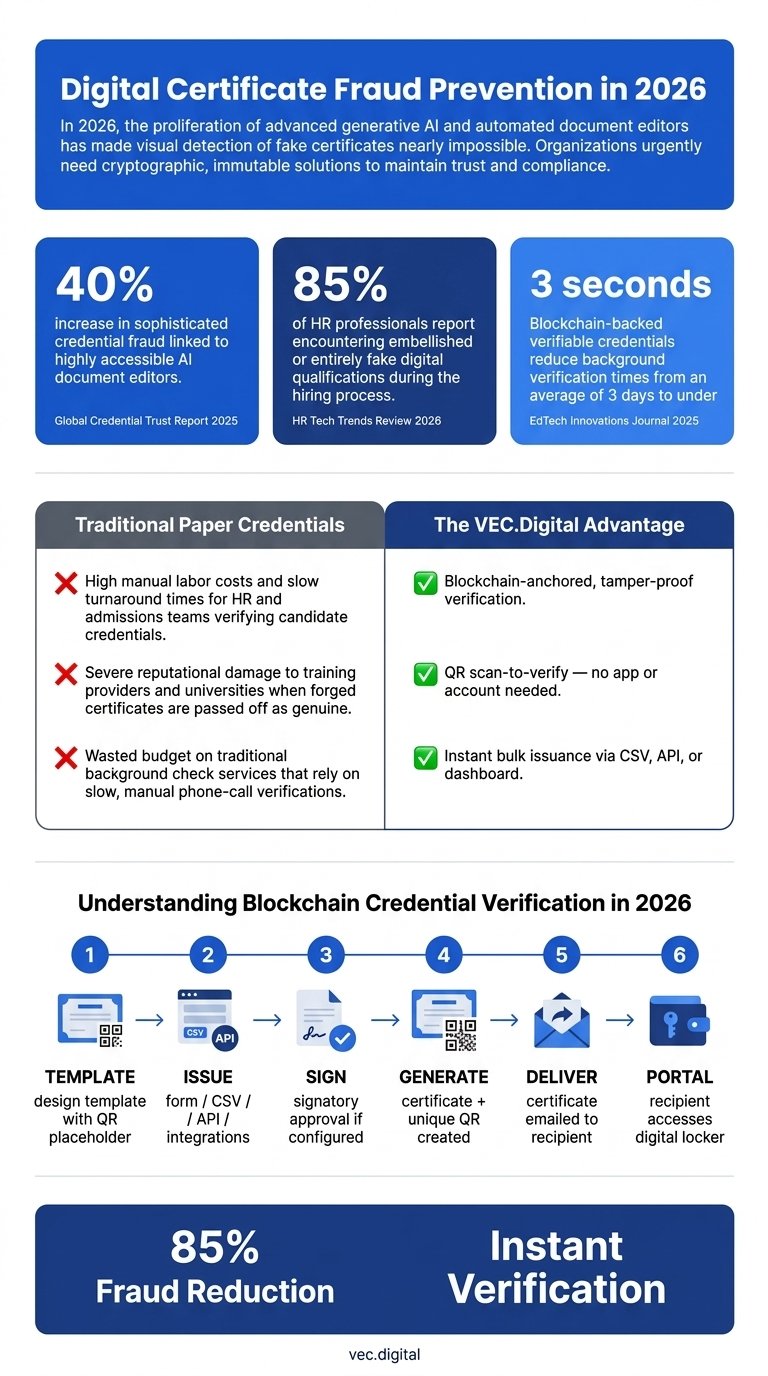
Transforming the Verification Experience: How QR Code Verification Works
While the underlying cryptography of blockchain is highly complex, the user experience must be incredibly simple to ensure widespread adoption. This is where QR code certificate verification bridges the gap between advanced security and everyday usability. Existing industry discussions often focus too heavily on the complex mathematics of blockchain, alienating non-technical HR and education leaders. However, the practical business application is remarkably straightforward: empowering anyone, anywhere in the world, to verify a credential instantly using the smartphone in their pocket.
At VEC.Digital, we believe that security should never come at the expense of accessibility. Every certificate generated through our platform includes a unique, dynamically generated QR code. This code serves as a direct bridge to the cryptographic proof. By focusing on the practical user experience—specifically how easy it is to implement scan-to-verify workflows without disrupting existing issuance pipelines—organizations can dramatically improve their digital certificate fraud prevention strategies while simultaneously enhancing the experience for both their alumni and their future employers.
How Do You Verify If a Digital Certificate Is Genuine?
For a busy hiring manager, the process of verifying a credential must be frictionless. So, how do you verify if a digital certificate is genuine in a modern workflow? It requires zero specialized software. When a candidate presents a VEC.Digital certificate—whether printed on physical paper or displayed on a screen—the verifier simply opens their standard smartphone camera and scans the embedded QR code.
This scan instantly redirects the verifier to a dedicated, secure public verification page (e.g., /certificate/[uuid]). No app download is required, no account creation is necessary, and no login barriers exist. Upon landing on the verification page, the system automatically checks the document's cryptographic hash against the blockchain ledger in real-time. If the credential is valid, the verifier is presented with a prominent "blockchain verified" badge, alongside the original credential data. This immediate visual confirmation provides absolute confidence in the document's authenticity, completely bypassing the need to contact the issuing institution.
Eliminating Friction for Global HR Teams
The impact of this streamlined process on global human resources operations cannot be overstated. High manual labor costs and slow turnaround times for HR and admissions teams verifying candidate credentials have long been a bottleneck in global talent acquisition. When dealing with international candidates, the complexities of verifying foreign degrees can bring the hiring process to a complete standstill. Language barriers, differing academic calendars, and unresponsive international registrar offices create a nightmare for compliance managers.
By adopting QR code certificate verification, organizations can eliminate these geographical and administrative barriers entirely. According to the EdTech Innovations Journal (2025), blockchain-backed verifiable credentials reduce background verification times from an average of 3 days to under 3 seconds. This exponential increase in efficiency allows global enterprises to make faster, more confident hiring decisions. Furthermore, by utilizing VEC.Digital's verification infrastructure, organizations ensure that their credentials can be validated seamlessly across borders, supporting international talent mobility and complying with stringent global hiring standards.
Navigating Certificate Revocation Management and Lifecycle Control
Issuing a secure credential is only the first half of the equation; managing that credential throughout its entire lifecycle is equally critical. Effective certificate revocation management is a fundamental component of comprehensive digital certificate fraud prevention. In many professional fields—such as healthcare, aviation, finance, and IT security—certifications are not permanent. They may expire, require periodic renewal, or be actively revoked due to ethical violations, compliance failures, or malpractice.
A severe reputational damage can occur to training providers and universities when forged or invalidated certificates are passed off as genuine by bad actors. If a professional loses their license but continues to present a static PDF certificate to clients or employers, the issuing body can be held legally and reputationally liable. Therefore, organizations must possess the capability to exert real-time control over the credentials they issue, ensuring that the public record always reflects the current, accurate status of an individual's qualifications.
How Do Organizations Revoke Digital Certificates Instantly?
Traditional paper certificates and standard PDFs offer zero revocation capabilities. Once they leave the issuer's hands, they are gone forever. So, how do organizations revoke digital certificates instantly in a verifiable ecosystem? Through the power of centralized dashboard management connected to decentralized ledgers. When an organization utilizes a platform like VEC.Digital, the administrative team retains ultimate control over the credential lifecycle.
If a compliance manager needs to invalidate a certificate, they simply log into their secure dashboard, locate the specific credential, and trigger a revocation command. This action immediately updates the credential's status on the public verification page. The next time an employer scans the QR code or clicks the verification link, the system will not display the "blockchain verified" badge; instead, it will prominently display a "Revoked" or "Expired" status. This real-time update mechanism ensures that invalidated credentials can never be successfully used again, providing a robust safety net against compliance failures.
Maintaining Compliance Across Borders
For global enterprises and international training providers, maintaining compliance across different regulatory environments is a complex challenge. Robust certificate revocation management ensures that organizations can adhere to industry-specific mandates regarding credential validity. Whether managing annual safety certifications for construction workers or tracking continuing medical education (CME) credits for healthcare professionals, the ability to enforce expiration dates automatically is invaluable.
Furthermore, this lifecycle control empowers learners by providing them with a secure, centralized repository for their achievements. Through the recipient digital locker provided by VEC.Digital, individuals gain permanent access to all their earned certificates via a user-friendly portal. This locker is accessible anywhere, anytime, ensuring that professionals can easily manage, share, and present their verified credentials to prospective employers globally, without the fear of losing physical documents or managing cumbersome file attachments.
Implementing a Future-Proof Issuance Pipeline with VEC.Digital
Transitioning to a cryptographically secure credentialing system may sound daunting, but modern platforms have abstracted the technical complexities away from the end-user. At VEC.Digital, our mission is to make enterprise-grade digital certificate fraud prevention accessible to organizations of all sizes. We have engineered a platform that integrates seamlessly into your existing workflows, ensuring that you can elevate your credential security without disrupting your daily operations.
Our comprehensive suite of tools is designed to meet the diverse needs of universities, corporate training departments, conference organizers, and professional associations. By offering a flexible, highly customizable environment, we enable organizations to maintain their unique brand identity while leveraging the immutable security of blockchain technology. From the initial design phase to global distribution, every step of the issuance pipeline is optimized for speed, security, and scale.
Streamlined Issuance and Multi-Signatory Workflows
One of the most significant bottlenecks in traditional certificate issuance is the physical signing process. Chasing down deans, department heads, or corporate directors for physical signatures is time-consuming and inefficient. VEC.Digital solves this through our advanced multi-signatory workflow. Our platform allows up to 2 signatories per template. When a certificate is generated, it is held in a pending state until ALL designated signatories have independently reviewed and digitally signed the batch. This ensures strict internal compliance and mirrors the rigorous approval processes of traditional academia, but with the speed of digital execution.
Once approved, organizations have access to 4 distinct issuance methods tailored to their operational scale. For low-volume needs, the dashboard form allows for one-by-one issuance. For larger cohorts, our CSV upload feature enables the bulk issuance of thousands of certificates in mere minutes. For enterprise clients seeking full automation, our robust REST API and third-party integrations allow you to connect VEC.Digital directly to your existing Learning Management Systems (LMS) or HR software. Combined with our powerful template editor—featuring over 1400 Google Fonts, drag-and-drop functionality, A2–A5 size support, and seamless Canva integration for stunning backgrounds—creating and issuing beautiful, secure credentials has never been easier. Learn more about our streamlined issuance features.
Sustainability and Empowering the Learner
Beyond security and efficiency, the transition to digital credentials represents a profound commitment to environmental responsibility. Traditional paper-based certification processes are incredibly resource-intensive, contributing significantly to deforestation and industrial waste. By adopting VEC.Digital's blockchain-anchored certificates, your organization actively supports global UN sustainability goals. Digital certificates completely eliminate paper waste, drastically reduce energy-intensive printing processes, and eradicate the carbon emissions associated with the physical delivery and shipping of documents worldwide.
This eco-friendly approach not only aligns with modern corporate social responsibility (CSR) mandates but also resonates deeply with today's environmentally conscious learners and professionals. By providing a recipient digital locker, you empower your alumni and employees with instant, lifelong access to their achievements in a format that is both highly secure and environmentally sustainable. It is a forward-thinking strategy that protects your institution's integrity while actively contributing to a greener global economy.
Secure Your Organization's Reputation Today
As we move deeper into 2026, the threat of AI-generated document forgery will only continue to escalate. Relying on outdated PDF certificates and manual verification processes exposes your organization to severe reputational damage, compliance risks, and soaring administrative costs. The transition to immutable, blockchain-anchored credentials is no longer a futuristic concept—it is the current global standard for trust and verification.
VEC.Digital provides the ultimate solution for effortless, trustworthy digital credential issuance. Our platform combines enterprise-grade cryptographic security with an intuitive, user-friendly experience, ensuring that your HR teams, administrators, and learners can navigate the digital credential landscape with absolute confidence. From our scan-to-verify QR codes to our robust multi-signatory workflows and instant revocation capabilities, we equip you with everything needed to completely eliminate credential fraud.
Protecting your organization's legacy has never been more accessible. We believe that every institution should have access to top-tier security, which is why a free plan is available for all organizations. You can start completely free—with no credit card required and no setup fees—and begin issuing secure credentials in minutes. For growing institutions, our paid plans start at just $29.99/month, while individuals pay a mere $1.00 per verifiable certificate.
Don't wait for a fraudulent credential to damage your institution's hard-earned reputation. Upgrade your issuance pipeline and join the thousands of global universities and corporations that trust VEC.Digital.
Ready to get started?
Website: vec.digital
Email: support@vec.digital
WhatsApp: +971521373078