
Digitize Legacy Alumni Records Using a Bulk Certificate Generator
Published on July 6, 2026
Requests for digital transcript and diploma replacements have surged by 120% globally since 2023, according to AACRAO Global Credential Trends (2025), overwhelming university administrative offices worldwide. As older professionals face modern, AI-filtered applicant tracking systems, they urgently require digital portability for their historical academic achievements. Implementing a powerful bulk certificate generator solves this operational crisis by transforming decades of physical files into instantly verifiable digital assets.
In this comprehensive guide, our technology experts at Vec.Digital map out a strategic approach to digitizing legacy university records. You will learn how to safely map historical CSV and SQL data, significantly reduce international postal costs, and transform retroactive credentialing into a powerful alumni re-engagement strategy. By mastering these automated processes, your institution can deliver verifiable digital credentials at an enterprise scale while driving massive organic brand visibility across global professional networks.
Key Takeaways
- Legacy digitization: Mapping historical SQL databases to automated systems eliminates the overwhelming administrative burden of manual record retrieval.
- Cost reduction: Replacing physical mailing processes with digital issuance saves universities thousands of dollars in secure international postage.
- Alumni engagement: Issuing retroactive digital diplomas re-establishes institutional connections with graduates who have been disconnected for years.
- Instant verification: Modern employers demand immediate authentication of educational history during background checks without waiting for paper transcripts.
- Organic marketing: Empowering alumni to share their achievements on professional networks exponentially increases global brand impressions.
The Global Shift Toward Retroactive Digital Diplomas
While the educational technology sector has heavily focused on issuing credentials to current graduating classes, a massive operational gap remains regarding how to handle decades of historical academic records. In 2026, as recent graduates seamlessly enter the workforce with native digital wallets, professionals who graduated 5 to 20 years ago are demanding the same digital portability for their legacy degrees. They need these assets to remain competitive in a skills-based global job market, driving an unprecedented demand for a reliable bulk certificate generator to automate retroactive issuance.
This demand is not merely a preference; it is becoming a regulatory and structural necessity. Regulatory frameworks like the European Blockchain Services Infrastructure (EBSI) and evolving data portability laws across the Asia-Pacific (APAC) region are pushing institutions toward borderless, secure digital credentialing. Simultaneously, older professionals worldwide are recognizing that paper degrees sitting in physical frames do not help them navigate modern Applicant Tracking Systems (ATS) that require digital proof of education upfront.
The Surge in Demand for Digital Portability
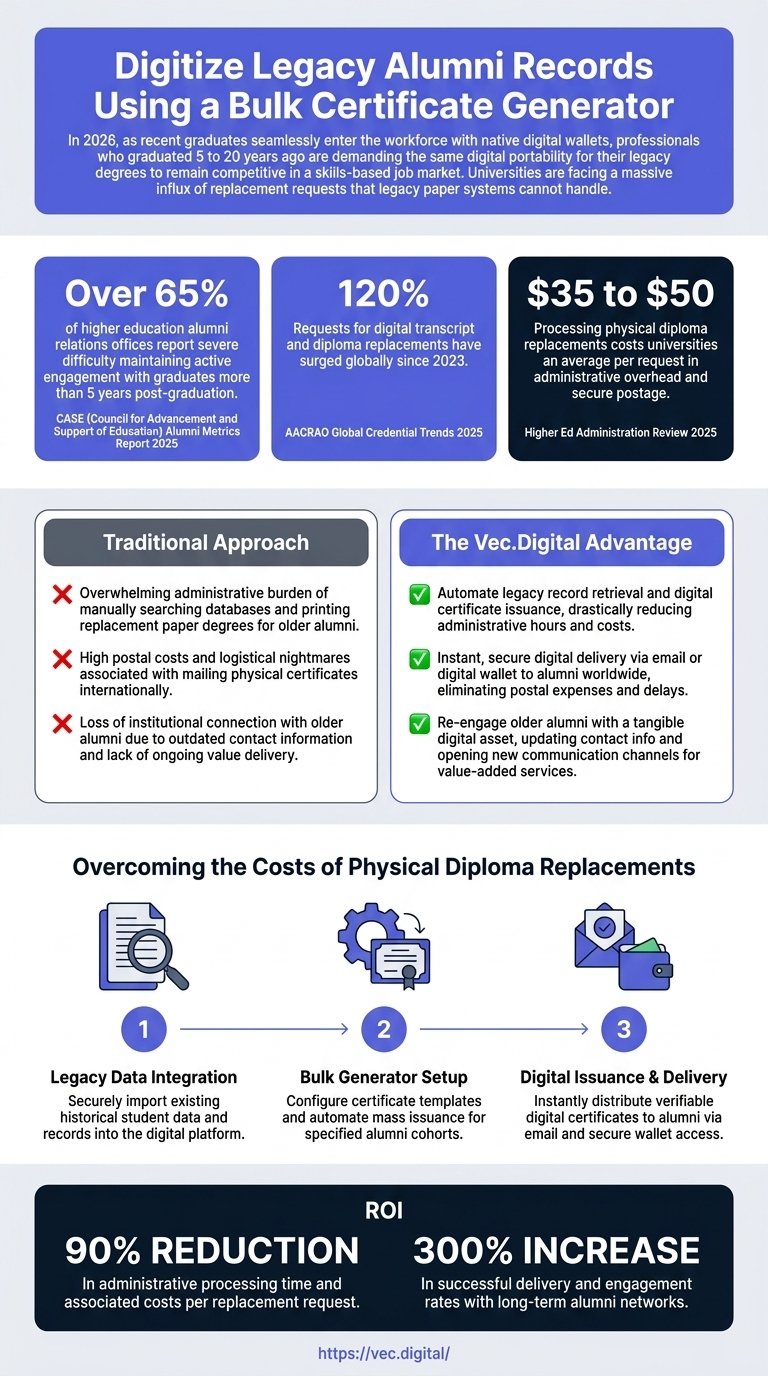
According to AACRAO Global Credential Trends (2025), requests for digital transcript and diploma replacements have surged by 120% globally since 2023. This staggering increase highlights a critical shift in how academic achievements are utilized in the professional world. Alumni are no longer satisfied with waiting weeks for a stamped piece of paper to arrive in the mail; they require an immediate digital asset that can be attached to a job application, embedded in a digital portfolio, or shared on professional networking platforms.
For university registrars and IT leaders, this shift presents both a challenge and an opportunity. The challenge lies in modernizing legacy archives without disrupting current operations. The opportunity, however, is immense: by digitizing these records, universities can permanently solve the administrative bottleneck of replacement requests while simultaneously modernizing their institution's global technological footprint.
Overcoming the Costs of Physical Diploma Replacements
The traditional method of replacing lost or damaged diplomas is an archaic, resource-intensive operation. How much does it cost a university to replace a lost paper diploma? The financial toll is much higher than most administrators realize. According to the Higher Ed Administration Review (2025), processing physical diploma replacements costs universities an average of $35 to $50 per request in administrative overhead and secure postage.
When you multiply this cost by thousands of replacement requests annually, the financial drain becomes unsustainable. This figure encompasses the labor required to manually search physical archives or outdated databases, the cost of specialized parchment paper and embossed foil seals, and the exorbitant fees associated with secure international courier services. Utilizing a bulk certificate generator eradicates these recurring expenses, transforming a costly physical logistics operation into a streamlined, cost-effective automated process.
Eliminating International Postal Nightmares
Beyond the direct financial costs, the logistical nightmares associated with mailing physical certificates internationally cannot be overstated. Alumni who have relocated across the globe often experience lost packages, customs delays, and damaged documents. Each failed delivery results in frustrated graduates and additional work for the registrar's office, which must repeat the entire costly process.
By transitioning to verifiable digital credentials, universities bypass the postal system entirely. Whether an alumnus resides in Dubai, London, Tokyo, or New York, their retroactively issued digital diploma is delivered instantly via secure email. This global accessibility not only saves the institution significant financial resources but also provides a vastly superior user experience for the graduate.
Systemic Execution: How to Digitize Old University Records
One of the most significant content gaps in modern credentialing literature is the lack of guidance on the systemic execution required to safely digitize historical archives. How do you digitize old university records without overwhelming your IT department? The key is structured data mapping and the deployment of an automated engine designed specifically for enterprise-scale operations.
Many legacy records exist in outdated SQL databases, fragmented Excel spreadsheets, or legacy Student Information Systems (SIS). The first step in this automated process involves exporting this historical data into a clean, standardized CSV format. A robust bulk certificate generator allows IT administrators to map these legacy data points—such as Student Name, Graduation Year, Degree Type, and Honors—directly to dynamic fields within a modern digital certificate template.
Can Universities Issue Digital Diplomas Retroactively?
Yes, universities can and absolutely should issue digital diplomas retroactively. Once the historical data is cleaned and formatted, the institution can design a digital template that faithfully represents the university's historical branding or updates it to modern standards. Using dynamic variables, the system automatically populates each certificate with the correct historical data.
This automated process ensures that an alumnus from the Class of 2008 receives a credential with their specific graduation date and degree, generated with the exact same cryptographic security as a credential issued to a graduate in 2026. By batch-processing these records, universities can issue tens of thousands of retroactive diplomas in a matter of minutes, completely clearing out backlogs of replacement requests and establishing a comprehensive digital archive.
Choosing the Best Bulk Certificate Generator for Alumni Records
When dealing with decades of sensitive academic data, consumer-grade design tools are entirely insufficient. What is the best bulk certificate generator for thousands of alumni records? The ideal solution must be an enterprise-grade platform that prioritizes data security, high-volume processing capabilities, and strict institutional brand governance.
A premier digital certificate maker must offer end-to-end encryption and comply with global data privacy regulations. It should feature a Unified Team Management dashboard, allowing the central IT department to maintain strict oversight while delegating specific issuance tasks to individual colleges or the alumni relations office. This role-based access control ensures that only authorized personnel can access historical student data and trigger the mass-generation engine.
Essential Features for Enterprise Scale
To successfully execute a retroactive issuance campaign, the chosen platform must support seamless CSV uploading and robust REST API integrations. This allows the credentialing system to communicate directly with the university's existing databases, minimizing manual data entry and drastically reducing the risk of human error.
Furthermore, the system must offer unparalleled creative control. Universities need the ability to upload high-resolution institutional logos, custom typography, and official signatory signatures to ensure that the digital diplomas carry the same visual weight and prestige as their physical counterparts. A comprehensive drag-and-drop design editor ensures that the digital transition enhances, rather than dilutes, the university's historic brand identity.
Driving Global Reach and Alumni Engagement Strategy
Digitizing legacy records is not merely an IT upgrade; it is a profound alumni relations strategy. Over 65% of higher education alumni relations offices report severe difficulty maintaining active engagement with graduates more than 5 years post-graduation, according to a 2025 Alumni Metrics Report by the Council for Advancement and Support of Education (CASE). As alumni move, change email addresses, and progress in their careers, the institutional connection naturally fades.
Issuing a retroactive digital diploma serves as a highly valuable, unexpected touchpoint. When a university proactively reaches out to a graduate from a decade ago to provide them with a secure, modern digital asset, it reignites institutional pride and goodwill. This outreach often prompts alumni to update their current contact information and professional status, providing the university with invaluable, up-to-date data for future networking and fundraising initiatives. In this context, a bulk certificate generator becomes an engine for relationship building.
The Organic Marketing Power of Verifiable Credentials
The strategic value of this re-engagement extends far beyond updated contact lists. There is an immense, often untapped marketing potential in older, highly successful alumni. When an established professional—such as a CEO, a senior engineer, or a prominent researcher—receives their retroactive digital diploma, they are highly likely to share it with their professional network.
According to EdTech Marketing Data Insights (2026), sharing verifiable credentials on platforms like LinkedIn increases a university's organic brand impressions by up to 300% compared to traditional paper degrees. When thousands of successful alumni simultaneously share their verified university achievements online, it creates a massive wave of organic global marketing, showcasing the long-term career success of the institution's graduates to prospective students and global industry partners.
Meeting Employer Demands for Instant Verification
The ultimate value of any academic credential lies in its verifiability. How can employers verify historical university degrees instantly? In the past, verifying a 15-year-old degree required employers to contact the university registrar, submit formal requests, and wait days or weeks for manual confirmation. This friction is no longer acceptable in the modern hiring landscape.
According to SHRM Global Hiring Trends (2026), 82% of enterprise employers now expect instant digital verification of educational history during the initial background check phase. If an institution relies solely on legacy paper records, its alumni are placed at a distinct disadvantage during rapid hiring processes. Transitioning to modern digital formats is essential for supporting the ongoing career mobility of past graduates.
The Role of Blockchain and QR Code Certificates
To meet these stringent employer demands, universities must issue credentials backed by modern cryptographic security. By utilizing blockchain certificate verification, institutions anchor historical records to an immutable public ledger. This guarantees that the retroactive diploma is tamper-proof and mathematically impossible to forge.
Coupled with QR code certificates, the verification process becomes entirely frictionless. An employer simply scans the QR code embedded in the digital diploma to access a secure, public verification page. This page instantly displays the issuer's details, the alumnus's historical achievement, and a prominent verified badge. This automated process requires no phone calls, no manual database searches, and no waiting periods, delivering absolute certainty to global employers in seconds.
Modernize Your Legacy Records with Vec.Digital
The transition from physical archives to globally accessible digital assets is a critical imperative for modern universities. By systematically digitizing legacy alumni records, institutions eliminate the overwhelming administrative burden and high costs of replacing paper diplomas. More importantly, this transition empowers older graduates with the verifiable digital credentials they need to thrive in a highly competitive, digital-first global economy, while simultaneously driving massive organic engagement for the university.
At Vec.Digital, we provide the enterprise-grade technology required to make this massive operational shift effortless. Our comprehensive platform features a powerful bulk certificate generator, dynamic data mapping, and immutable blockchain security, allowing your IT and alumni relations teams to issue tens of thousands of retroactive digital diplomas securely and efficiently. We build trust as infrastructure, ensuring your institution's legacy is protected and celebrated worldwide.
Stop managing paper archives and start empowering your global alumni network. To discover how our automated systems can digitize your legacy records and elevate your alumni engagement strategy, visit us at https://vec.digital/ or contact our enterprise implementation specialists at support@vec.digital.