
Do Blockchain Diplomas Violate Student Privacy? A Guide to Secure Credentialing in 2026
Published on August 3, 2026

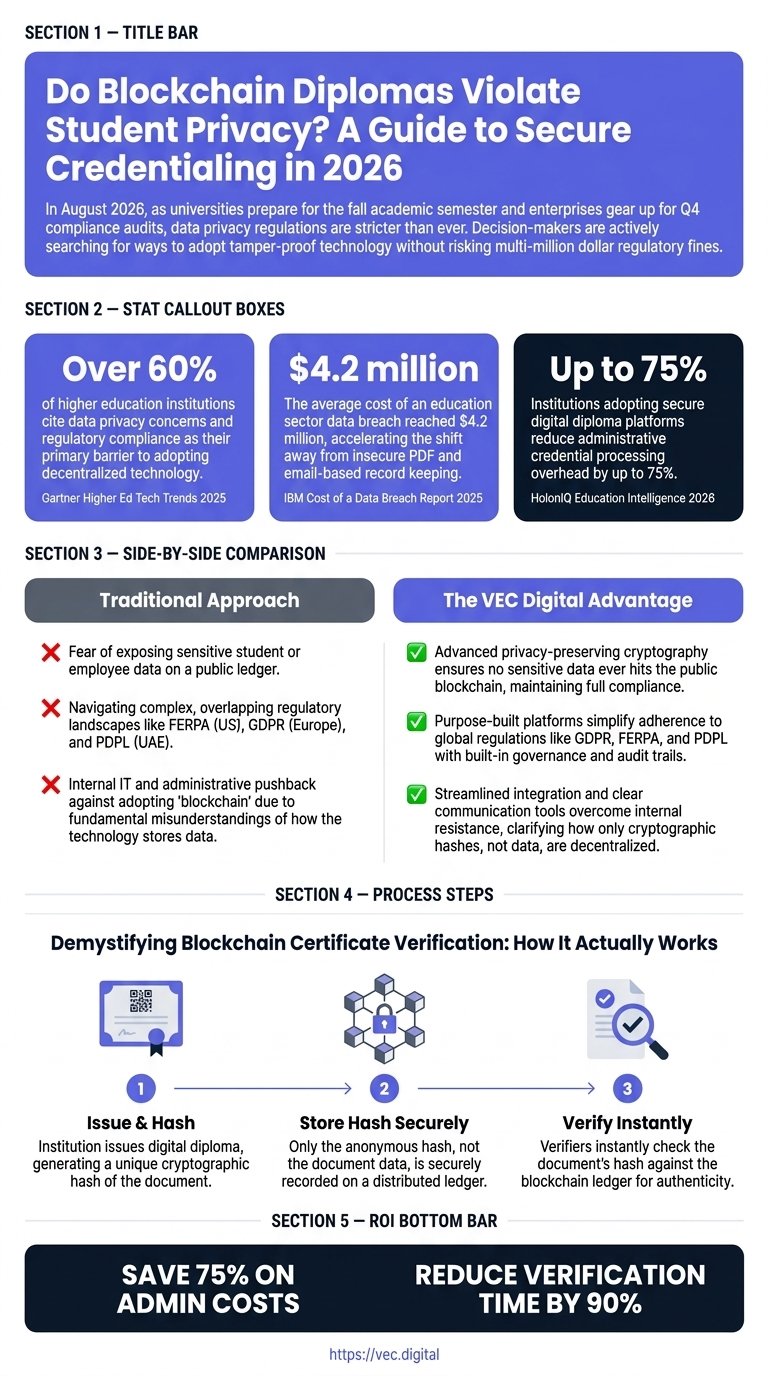
Over 60% of higher education institutions cite data privacy concerns and regulatory compliance as their primary barrier to adopting decentralized technology, according to the 2025 Gartner Higher Ed Tech Trends report. Implementing secure blockchain certificate verification solves this dilemma, but only if academic and corporate leaders understand how modern cryptography interacts with stringent global privacy laws. The challenge lies in balancing the demand for frictionless credential authentication with the absolute necessity of protecting sensitive personal information from unauthorized exposure.
In this comprehensive guide, you will discover how to navigate complex regulatory landscapes while modernizing your credentialing systems. Drawing on our deep expertise in Technology at VEC Digital, we will demonstrate how cryptographic hashing protects personal data, how to securely issue credentials at scale, and how to eliminate institutional fraud without risking multi-million dollar compliance fines. You will learn the exact mechanisms that make digital credentials legally compliant and operationally superior.
Key Takeaways
- Blockchain certificate verification uses cryptographic hashing to secure records without storing personally identifiable information (PII) on a public ledger.
- Modern verifiable digital credentials are fully compliant with global data protection laws, including GDPR, FERPA, and PDPL.
- Deploying a secure digital diploma platform can reduce administrative credential processing overhead by up to 75%.
- Institutions can effectively prevent degree fraud by moving away from easily manipulated standard PDFs to immutable, anchored records.
- Automated issuance systems, such as a bulk certificate generator, allow organizations to scale recognition instantly while maintaining strict multi-signatory governance.
The Global Data Privacy Challenge in Digital Credentialing
As universities prepare for the fall academic semester and global enterprises gear up for Q4 compliance audits, the regulatory environment surrounding data privacy is stricter than ever. Decision-makers are actively searching for ways to adopt tamper-proof technology without risking severe regulatory fines. The transition from legacy paper records to a digitized ecosystem has exposed significant vulnerabilities in how institutions handle sensitive data. Understanding this landscape is the first step toward implementing secure blockchain certificate verification.
The Rising Cost of Insecure Record Keeping
Relying on outdated methods for credential issuance is no longer just an operational inefficiency; it is a massive financial risk. According to the 2025 IBM Cost of a Data Breach Report, the average cost of an education sector data breach reached an astounding $4.2 million. This staggering figure is accelerating the shift away from insecure PDF and email-based record keeping. When institutions issue standard, unencrypted PDFs, they inadvertently create digital assets that can be easily intercepted, altered, or forged, leading to severe reputational damage and financial liability.
Furthermore, standard digital files do not possess inherent security measures that protect the data within them. A forged PDF diploma can easily pass a visual inspection, forcing employers and auditors to rely on slow, manual background checks. This inefficiency not only frustrates graduates and hiring managers but also drains institutional resources as administrative staff spend countless hours manually verifying records over the phone or via email.
Navigating FERPA, GDPR, and PDPL Safely
One of the most significant pain points for institutional leaders is the fear of exposing sensitive student or employee data on a public ledger. Navigating complex, overlapping regulatory landscapes like FERPA in the United States, GDPR in Europe, and the PDPL in the UAE requires a nuanced approach to data architecture. These laws dictate strict rules regarding data sovereignty, the right to be forgotten, and the minimization of stored personal information.
Many administrators mistakenly believe that utilizing decentralized technology inherently violates these privacy frameworks. Because blockchains are designed to be immutable—meaning data cannot be deleted or altered once recorded—the immediate assumption is that anchoring a student's record to this technology violates the core tenets of data privacy. However, this assumption stems from a fundamental misunderstanding of what data is actually being stored and how modern credentialing engines operate.
The Misconception Holding Institutions Back
Internal IT and administrative pushback against adopting decentralized verification is common. As noted earlier, over 60% of higher education institutions cite data privacy concerns as their primary barrier. This hesitation is largely due to a knowledge gap regarding cryptographic hashing. Institutions do not realize that enterprise-grade platforms never store the student's actual name, email, or grades on the public ledger.
Instead of viewing decentralized technology as a liability, forward-thinking organizations are recognizing it as the ultimate tool for compliance. By separating the personal data (which remains securely in the institution's private database) from the proof of authenticity (which is anchored immutably), organizations can achieve a zero-trust verification environment that satisfies both internal IT governance and external regulatory bodies.
Demystifying Blockchain Certificate Verification: How It Actually Works
To overcome institutional hesitation, it is critical to demystify the technology. Existing industry literature often praises the security of decentralized systems but fails to explain the underlying mechanics to business leaders. By understanding the core concepts of blockchain certificate verification, registrars and HR directors can make informed, confident decisions regarding their technological infrastructure.
What Is a Verifiable Digital Credential?
A verifiable digital credential is a secure, tamper-proof electronic record of an achievement, qualification, or compliance milestone. Unlike a traditional digital image or PDF, a verifiable credential contains embedded cryptographic proofs that allow anyone to instantly authenticate its origin, integrity, and validity. When an employer or auditor receives this credential, they do not need to contact the issuing university or corporation; the credential itself proves that it was issued by the claimed authority and has not been altered.
These credentials serve as a physical-to-digital bridge. They empower learners to take ownership of their achievements, creating a portable, lifelong record that holds recognizable weight in the global job market. For institutions, they represent a shift from being reactive defenders of academic integrity to proactive facilitators of trust.
Does Blockchain Store Personal Data? The Reality of Cryptographic Hashing
The most pressing question asked by compliance officers is: Does this technology store personal data? The definitive answer is no. Modern credentialing systems utilize a process called cryptographic hashing to protect personal information. When a certificate is generated, the system takes the data (such as the recipient's name, course, and date) and runs it through a mathematical algorithm (like SHA-256).
This algorithm produces a unique, fixed-length string of characters known as a "hash" or a digital fingerprint. This hash is entirely irreversible; it is mathematically impossible to look at the hash and reverse-engineer the student's name or grades. It is this anonymous, mathematical footprint—not the personally identifiable information—that is permanently anchored to the immutable ledger. If a forger attempts to alter even a single pixel or letter on the digital certificate, the resulting hash will change entirely, instantly flagging the document as fraudulent during the verification process.
How Cryptography Enhances Rather Than Compromises Privacy
By utilizing off-chain data storage combined with on-chain verification, institutions achieve the best of both worlds. According to 2026 data from HolonIQ Education Intelligence, institutions adopting secure digital diploma platforms reduce administrative credential processing overhead by up to 75%. This efficiency is gained precisely because the cryptographic method is so reliable.
When an auditor or employer scans a credential, the verification engine simply recalculates the hash of the presented document and compares it to the anonymous hash anchored on the ledger. If they match, the document is authentic. This zero-knowledge proof means that the institution can prove the validity of a record without ever exposing their internal databases to the public internet, thereby dramatically enhancing overall data privacy and network security.
Achieving Global Compliance: Are Blockchain Certificates GDPR and FERPA Compliant?
With the technical reality established, the conversation must turn to legal compliance. Ensuring that a credentialing system aligns with international law is paramount for global operations. The integration of blockchain certificate verification is not only compliant with these strict regulations but actually provides a more robust framework for adhering to them than traditional paper or legacy digital systems.
The Mechanics of GDPR Compliance in Decentralized Systems
The General Data Protection Regulation (GDPR) mandates strict guidelines on data processing, most notably the "Right to Erasure" (or the right to be forgotten). Because blockchains are immutable, critics often assume they are incompatible with GDPR. However, because enterprise credentialing platforms only store an irreversible hash on the ledger, they do not store "personal data" as defined by GDPR on the immutable layer.
If a student requests their data to be deleted under GDPR, the institution simply deletes the off-chain personal data from their private, centralized servers. The anonymous hash remains on the ledger, but it becomes a meaningless string of characters disconnected from any human identity. This architecture fully satisfies the Right to Erasure while maintaining the integrity of the institution's issuance history.
Protecting Student Records Under FERPA
In the United States, the Family Educational Rights and Privacy Act (FERPA) protects the privacy of student education records. Universities must maintain strict control over who can access this information. Traditional verification methods—where employers call the registrar's office and fax consent forms—are fraught with human error and potential FERPA violations.
A secure digital credential system places the power of consent directly into the hands of the student. The university issues the credential directly to the learner's digital environment. When the student shares their credential or its unique QR code with a prospective employer, they are explicitly granting consent for that specific verification. The automated system authenticates the record without exposing the university's broader student information system, ensuring absolute FERPA compliance while entirely removing the registrar from the manual verification loop.
Meeting the Demands of Modern Enterprise Compliance Officers
Corporate Learning & Development (L&D) and HR leaders face similar scrutiny. According to 2026 data from Corporate Compliance Insights, 82% of enterprise compliance officers now require strict zero-knowledge or cryptographic hash proofs before integrating new credentialing APIs. When managing OSHA, safety training, or financial compliance certificates for thousands of global employees, audit readiness is non-negotiable.
By implementing compliance training certificate automation, enterprises can centralize their records. When an external auditor requests proof of workforce compliance, the HR director can provide cryptographically secured, instantly verifiable records. This eliminates the disorganized scramble through disjointed legacy systems and spreadsheets, providing a frictionless, mathematically proven audit trail that satisfies the most rigorous compliance standards.
Strategic Implementation: How to Issue Blockchain Certificates for Universities
Understanding the security and compliance benefits is only part of the journey. The practical application of this technology determines its success. For academic deans, IT directors, and operations managers, knowing exactly how to issue blockchain certificates for universities and corporations seamlessly is critical for widespread adoption.
Designing a Secure Digital Diploma Platform
The foundation of a successful credentialing program begins with a robust digital diploma platform. Institutions require a system that eliminates manual design work while maintaining strict brand guidelines. A visual, drag-and-drop template editor allows administrators to create highly professional, aesthetically pleasing certificates without needing advanced graphic design skills.
By utilizing dynamic placeholders, institutions can map specific data points—such as recipient names, unique IDs, and signatory details—directly onto the template. This ensures that whether you are issuing one certificate or ten thousand, the visual formatting remains flawless. Furthermore, an embedded unique QR code on every template acts as the physical-to-digital link, ensuring that even printed hardcopies of diplomas retain their instant verifiability.
Balancing Instant External Verification with Internal Governance
While frictionless external verification is a massive benefit, it must be balanced with strict internal governance. Accidental or rogue issuance of credentials can severely damage an institution's reputation. To prevent this, enterprise platforms employ formal, multi-signatory approval pipelines.
In this automated sequence, certificates are generated and held in a draft status. Designated organizational authorities—such as a university dean or a corporate compliance officer—are notified to securely log in, review the batch, and electronically sign off. Only after all required signatories have approved the batch does the system proceed to anchor the hashes and dispatch the emails. This ensures that high-stakes compliance certificates and academic degrees are never issued without proper administrative oversight.
Handling Errors: Can Digital Credentials Be Revoked?
A common question regarding immutable technology is: Can digital credentials be revoked if issued by mistake? The answer is a resounding yes. While the historical record of the issuance (the hash) cannot be deleted from the ledger, the issuing institution retains absolute cryptographic authority over the validity status of the credential.
If a certificate was issued in error, or if a graduate is found to have violated academic integrity policies post-graduation, the university administrator can simply update the status of that specific credential to "Revoked" within their dashboard. The next time an employer scans the QR code or clicks the verification link, the public verification page will instantly display a red "Revoked" status, effectively neutralizing the credential while maintaining full transparency and control.
The Future of Global Academic and Corporate Integrity
The transition toward cryptographically secured records is not just a temporary trend; it is a fundamental evolution in how global society establishes trust. As AI-generated forgeries become more sophisticated, institutions must adopt proactive measures to protect their brand and their learners' futures. Implementing blockchain certificate verification is the definitive step toward this future.
Moving Beyond Vulnerable PDFs to Prevent Degree Fraud
To effectively prevent degree fraud, institutions must abandon the standard PDF. The ease with which bad actors can manipulate digital text and duplicate institutional logos has rendered legacy formats obsolete. By adopting a system that anchors every credential to an immutable ledger, universities and corporations create an environment where credential fraud is mathematically impossible.
This shift not only protects the institution but also significantly boosts the value of the credential for the learner. When a certificate holds a "Blockchain Verified" badge, it signals to the job market that the issuing organization adheres to the highest standards of technological security and academic integrity.
Supporting International Employability with Scan-to-Verify Systems
In a globalized workforce, employers need to verify credentials across borders quickly and reliably. A QR code certificate maker embedded within the issuance platform enables zero-friction verification in seconds. A hiring manager in London can scan the QR code of a diploma issued in Dubai and instantly view the authenticated details on a secure, dedicated URL, with no app installs or logins required.
This frictionless process speeds up graduate hiring timelines and background screening processes. It creates an "Employability Loop" where the seamless verification of alumni credentials enhances the reputation of the issuing institution, thereby attracting higher-quality prospective students and corporate partners.
Academic Degree Fraud Prevention in the Middle East and Beyond
The demand for secure credentialing is a global phenomenon, but regions rapidly expanding their educational and technological sectors are leading the charge. For example, academic degree fraud prevention in the Middle East has become a major priority as the region positions itself as a global hub for innovation and higher education.
Institutions globally are leveraging scalable automation to meet this demand. Utilizing a bulk certificate generator that processes standard CSV files allows event organizers, bootcamps, and massive university cohorts to automate graduation week. By uploading a single file, organizations can trigger the automated batch generation and delivery of thousands of personalized, cryptographically secured certificates, saving hundreds of administrative hours while ensuring flawless accuracy.
Secure Your Institution's Future with VEC Digital
The landscape of data privacy and credential security is evolving rapidly. Institutions that fail to modernize their infrastructure risk severe regulatory penalties, operational inefficiencies, and devastating reputational damage from credential fraud. However, by embracing secure, decentralized verification, you can turn compliance from a burden into a powerful competitive advantage.
At VEC Digital, we provide the comprehensive trust infrastructure required to navigate this transition seamlessly. Our platform offers an all-in-one solution that combines a visual template editor, frictionless CSV bulk generation, strict multi-signatory governance, and immutable cryptographic anchoring—all without requiring complex technical setup or exposing sensitive personal data.
Secure your organization's credentials today. Empower your learners to own their achievements, give employers the certainty to hire without doubt, and protect your institutional legacy. Design your first secure template in minutes with no setup fees.
Ready to eliminate credential fraud and automate your issuance?
Visit us at https://vec.digital or contact our enterprise implementation team directly at support@vec.digital.