
Eliminate the 14-Day Hiring Bottleneck With QR Code Verification for Student Records
Published on November 16, 2026

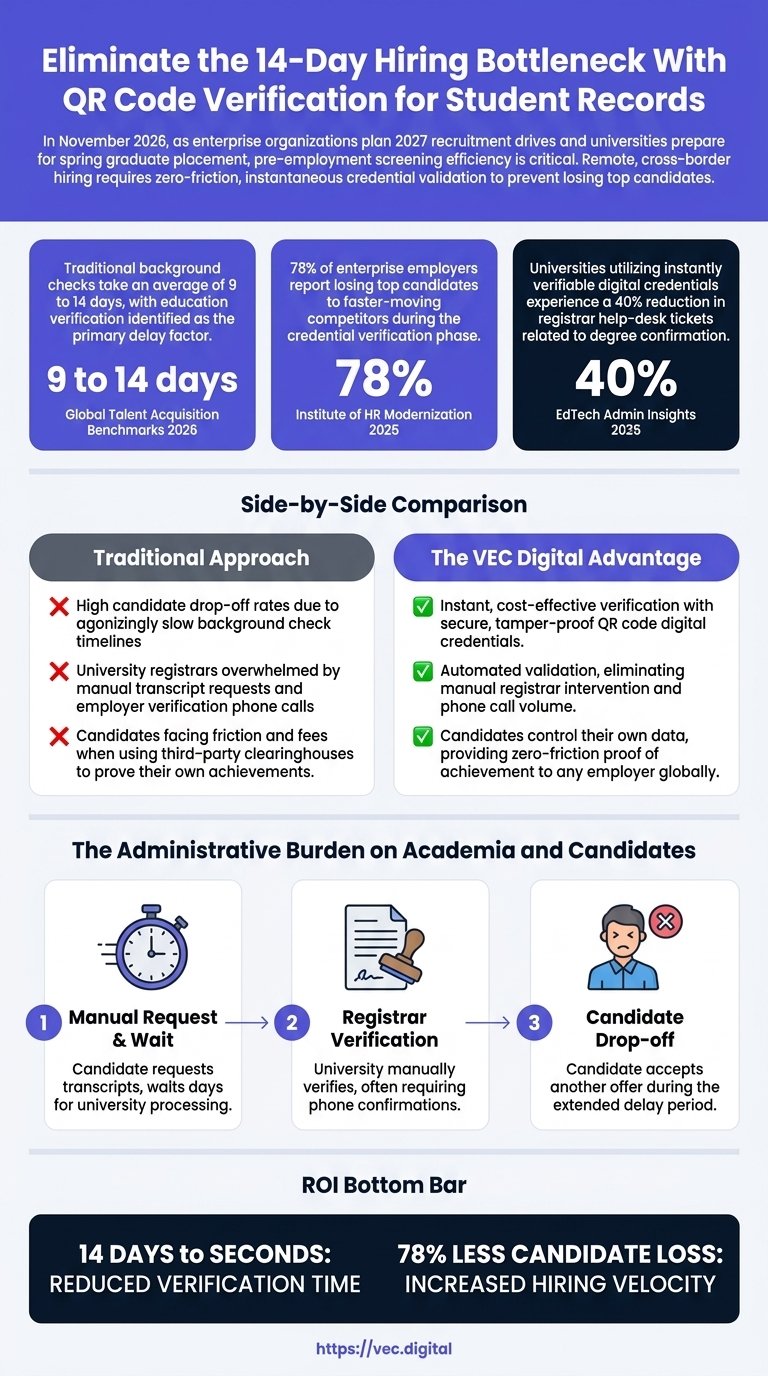
Traditional background checks take an average of 9 to 14 days, with education verification identified as the primary delay factor, according to the 2026 Global Talent Acquisition Benchmarks. This agonizingly slow timeline causes enterprise employers to consistently lose top-tier candidates to faster-moving competitors. To eliminate this critical bottleneck, universities and corporate HR teams must transition to QR code verification for student records to facilitate instantaneous, zero-friction credential validation.
By reading this comprehensive guide, enterprise HR leaders and university registrars will uncover how modernizing the academic screening process dramatically reduces time-to-hire and administrative overhead. Drawing upon our deep expertise in educational technology at VEC Digital, we will demonstrate how to bypass traditional third-party clearinghouses, implement cryptographically secure systems to completely eradicate diploma forgery, and transform the graduate employment journey into a seamless, globally scalable automated process.
Key Takeaways
- Implementing a QR code certificate maker eliminates the 14-day delay associated with traditional background checks.
- Verifiable digital credentials reduce HR administrative processing costs by bypassing expensive third-party educational clearinghouses.
- Blockchain certificate verification provides absolute cryptographic certainty, ensuring sophisticated diploma forgeries cannot bypass visual checks.
- Instant QR code verification for student records slashes university registrar help-desk tickets related to degree confirmation.
- Modernizing the screening pipeline is essential to prevent degree fraud and secure top talent in a competitive, borderless global hiring market.
The Hidden Cost of the 14-Day Hiring Bottleneck
The Pain of Traditional Background Checks
In the modern enterprise landscape, the competition for highly skilled talent is fierce. When a hiring manager identifies the perfect candidate, speed is of the essence. Unfortunately, the moment an offer is extended, the traditional background check process grinds the momentum to a halt. When enterprise leaders ask, "How long does education verification take for background checks?" the reality is grim. As noted by the 2026 Global Talent Acquisition Benchmarks, traditional background checks take an average of 9 to 14 days, with education verification identified as the primary delay factor.During this two-week waiting period, candidates are left in limbo. They continue to interview with other companies, and often, they receive competing offers that require immediate responses. The result is a catastrophic loss of talent. According to the Institute of HR Modernization (2025), an astonishing 78% of enterprise employers report losing top candidates to faster-moving competitors during the credential verification phase. The inability to rapidly confirm a candidate's academic background is no longer just an administrative annoyance; it is a critical vulnerability in corporate talent acquisition strategies.
The Global Remote Hiring Challenge
This delay is exponentially worsened by the rise of globalized remote workforces. Consider an HR manager based in Dubai who is looking to hire a software engineer who recently graduated from a university in Canada or Singapore. Relying on regional, phone-based verification is practically impossible due to time zone differences and language barriers. Furthermore, expecting physical, mailed transcripts to traverse the globe within a reasonable timeframe is simply not viable for modern business operations.In this borderless talent marketplace, relying on outdated methods creates a massive operational bottleneck. HR teams need a universally scannable, instantly recognizable standard of trust. This is where the transition to digital solutions becomes imperative. By adopting universally standardized digital records, global HR teams can instantly validate international credentials without picking up a phone or waiting for international postage.
The Administrative Burden on Academia and Candidates
University Registrars Overwhelmed by Manual Audits
The 14-day hiring bottleneck does not solely impact the corporate sector; it places an immense strain on higher education institutions. University registrars are perpetually overwhelmed by manual transcript requests and employer verification phone calls. Every time a graduate applies for a job, the university's administrative staff must manually locate the student's records, verify their completion status, print a physical transcript, seal it to prevent tampering, and mail it to the prospective employer.This manual process is highly inefficient and costly. However, institutions that have embraced modern credentialing technology are seeing immediate relief. According to EdTech Admin Insights (2025), universities utilizing instantly verifiable digital credentials experience a 40% reduction in registrar help-desk tickets related to degree confirmation. By empowering graduates to hold and share their own self-verifying records, universities can drastically reduce their administrative overhead and refocus their staff on student success initiatives.
Candidates Facing Friction and Fees
To circumvent the slow response times of university registrars, many employers rely on third-party educational clearinghouses. While these legacy databases attempt to centralize academic records, they introduce a new layer of friction for the candidate. Graduates are frequently forced to navigate clunky third-party portals, create new accounts, and pay exorbitant feesâ-sometimes ranging from $20 to $50â-just to prove they earned the degree they already spent thousands of dollars to obtain.This candidate-hostile experience damages the employer brand before the employee has even started their first day. The modern candidate expects a frictionless, digital-first experience. Forcing them to jump through administrative hoops to verify their own achievements is an outdated practice that leading organizations are rapidly abandoning in favor of instant, candidate-owned digital proofs.
Bridging the Gap: How Do Employers Verify Digital Certificates?
The Mechanics of Scan-to-Verify Integration
As the industry shifts away from manual audits, a common question arises: **how do employers verify digital certificates** instantly? The answer lies in the strategic deployment of a sophisticated **QR code certificate maker**. Instead of printing a static document, the university's credentialing system embeds a unique, cryptographically generated QR code directly onto the digital and physical diploma.So, how does scan-to-verify work for student records? The process is remarkably elegant and requires zero friction. When a candidate submits their digital diploma or a printed hardcopy, the HR manager simply opens the standard camera app on their smartphone and scans the embedded QR code. The camera instantly routes the reviewer to a dedicated, secure certificate URL (e.g., /certificate/[uuid]). Within milliseconds, the screen displays a highly secure verification page detailing the issuing institution, the graduate's name, the degree awarded, the date of issuance, and the exact signatory details. There are no apps to download, no accounts to create, and no fees to pay. The verification happens in real-time, completely bypassing the 14-day delay.
Financial and Operational ROI for Enterprise HR
The financial impact of implementing this instantaneous verification model is profound. By bypassing expensive third-party educational clearinghouses and eliminating the manual labor required to track down transcripts, HR departments realize immediate cost savings. According to Enterprise Screening Analytics (2026), replacing manual education audits with a scan-to-verify system reduces administrative processing costs by up to $15 per candidate.For an enterprise organization hiring 1,000 employees annually, this translates to $15,000 in direct administrative savings, not to mention the massive, unquantifiable value of securing top talent weeks faster than the competition. This operational efficiency is why forward-thinking organizations are overhauling their applicant tracking systems to natively support and demand instantly verifiable records.
Securing the Pipeline: The Role of Cryptography
Eradicating Sophisticated Diploma Forgeries
One of the most dangerous pain points for modern HR teams is that sophisticated diploma forgeries are easily bypassing manual visual checks by busy HR staff. With the advent of advanced graphic design software and AI-generated documents, creating a visually perfect replica of a university diploma takes only minutes. A standard PDF or a piece of high-quality parchment paper no longer constitutes proof of education.This leads to a critical security question: Can QR code certificates be faked by applicants? If a QR code simply links to an unsecure webpage, it can absolutely be spoofed. However, when paired with advanced cryptographic architecture, the answer is a definitive no. To truly prevent degree fraud, the QR code must be anchored to an immutable source of truth. This is why the most secure QR code certificate maker platforms do not rely on standard web hosting; they rely on decentralized cryptography.
The Necessity of Blockchain Certificate Verification
Do universities need blockchain to prevent degree fraud? Yes, absolutely. **Blockchain certificate verification** is the only technological standard that guarantees absolute immutability. When a university issues a digital diploma, our system takes a [cryptographic hash](https://en.wikipedia.org/wiki/Cryptographic_hash_function) of that document's data and anchors it to a public blockchain ledger. This creates a permanent, unalterable digital fingerprint.When the employer scans the QR code, the system doesn't just load a webpage; it actively checks the document's fingerprint against the blockchain ledger in real-time. If even a single pixel or letter on the certificate has been altered by the candidate, the hashes will not match, and the verification will instantly fail. If the document is authentic, the system displays a prominent "Blockchain Verified" security badge. The corporate sector has recognized this necessity. By late 2026, over 65% of Fortune 500 companies have mandated cryptographically verifiable proofs for all incoming academic and compliance records, according to the Corporate Security & Compliance Report (2026).
The Mutual Benefits for Academia and Corporate HR
Elevating Graduate Employability Metrics
Existing literature often focuses heavily on the technical mechanics of generating a QR code, failing to map this technology directly to the candidate experience and the HR time-to-hire metric. There is a strong need to bridge the gap between academic issuance (the university's role) and enterprise consumption (the employer's rapid screening process).For universities, adopting verifiable digital credentials is not just an administrative upgrade; it is a powerful marketing tool. When a university equips its graduates with instantly verifiable records, it directly enhances their employability. Graduates can share their achievements on professional networks, and prospective employers can hire them weeks faster than graduates from competing institutions. This seamless transition from student to employed professional dramatically boosts a university's graduate placement metrics, which is a critical factor in global university rankings.
Expanding into Corporate Compliance
The benefits of this technology extend far beyond academic degrees. Enterprise organizations are utilizing the exact same infrastructure for internal training. **compliance training certificate automation** ensures that internal corporate recordsâ-such as OSHA safety training, GDPR compliance, or specialized technical certificationsâ-are just as rigorously verified as academic degrees.By centralizing both academic and internal compliance records onto a single, cryptographically secure standard, the global workforce is moving toward a unified talent ecosystem. Employees carry their verified achievements with them, employers hire with absolute confidence, and the friction of the global labor market is fundamentally reduced. As noted by global labor analysts at the World Economic Forum, the future of work relies on frictionless, universally recognized skill verification.
Secure Your Hiring Pipeline with VEC Digital
The 14-day hiring bottleneck is an archaic relic of a paper-based past. In today's hyper-competitive, globalized talent market, organizations cannot afford to lose top candidates to slow, manual verification processes, nor can they risk their corporate reputation on easily forged PDF documents. By transitioning to a modern, scan-to-verify infrastructure, universities can empower their graduates, and enterprise HR teams can slash their time-to-hire to mere seconds.
We provide the ultimate trust infrastructure to make this transition seamless. Our comprehensive digital credential platform empowers institutions to design, automate, and authenticate high-resolution certificates backed by unbreakable blockchain technology. With our built-in QR code integration, zero-friction verification is guaranteedâ-requiring no app installs, no third-party clearinghouse fees, and no administrative headaches.
It is time to eliminate degree fraud, reduce your administrative processing costs, and accelerate your global hiring pipeline. Secure your organization's credentials today and design your first cryptographically secure template in minutes with no setup fees.
Ready to modernize your credentialing process? Visit our website: https://vec.digital Contact our enterprise support team: support@vec.digital