
Fixing Low Training Completion With Verifiable Digital Credentials
Published on August 14, 2026

An astonishing 74% of modern workers expect their employers to provide portable digital proofs of skills acquired on the job, yet many organizations still rely on unshareable, static documents (Future of Work Consortium, 2026). This disconnect is quietly sabotaging internal upskilling initiatives, making it critical for enterprises to adopt verifiable digital credentials to bridge the gap between corporate training and employee motivation. The inability to seamlessly recognize and reward learning is a global challenge that directly impacts talent retention, compliance tracking, and organizational growth.
By reading this comprehensive guide, you will uncover the strategic psychological mechanisms that drive learning engagement and understand how transitioning to cryptographically secure recognition systems transforms corporate education. Leveraging our expertise in enterprise technology and automated credentialing systems at VEC Digital, we will demonstrate how to eliminate manual administrative burdens, accurately track upskilling ROI, and deploy automated recognition engines that empower your global workforce.
Key Takeaways
- Verifiable digital credentials shift employee motivation from compliance-driven to career-driven by providing portable, shareable proof of skills.
- Implementing compliance training certificate automation reduces HR administrative verification and issuance time by up to 90%.
- Utilizing blockchain certificate verification guarantees absolute authenticity and protects organizational reputation against credential fraud.
- Deploying a modern digital diploma platform allows enterprises to visually track and showcase internal employee skill growth to leadership.
- Maximizing corporate L&D upskilling ROI requires moving away from isolated legacy systems toward globally interoperable recognition engines.
The Hidden Cost of Low Engagement in Corporate L&D
Why Employees Abandon Non-Mandatory Training
Corporate Learning and Development (L&D) departments invest millions annually into crafting high-quality educational content, yet they consistently face low engagement and completion rates for non-mandatory corporate training initiatives. When employees are asked to participate in optional upskilling modules, their primary calculation is based on time investment versus tangible reward. If the only reward is an internal checkmark on a localized Learning Management System (LMS), the motivation to complete the course plummets. Employees often feel their upskilling efforts are unrecognized outside of isolated corporate silos, leading to stalled professional development and wasted corporate resources.This lack of visible recognition is a critical failure point in modern enterprise human resources strategies. When an employee spends hours mastering a new software tool, leadership framework, or compliance standard, they want to showcase that achievement to their professional network. Without verifiable digital credentials, the achievement remains invisible. This invisibility breeds apathy, driving down completion rates and leaving organizations with an undertrained workforce in an increasingly competitive, AI-disrupted global market.
The Struggle to Prove Upskilling ROI
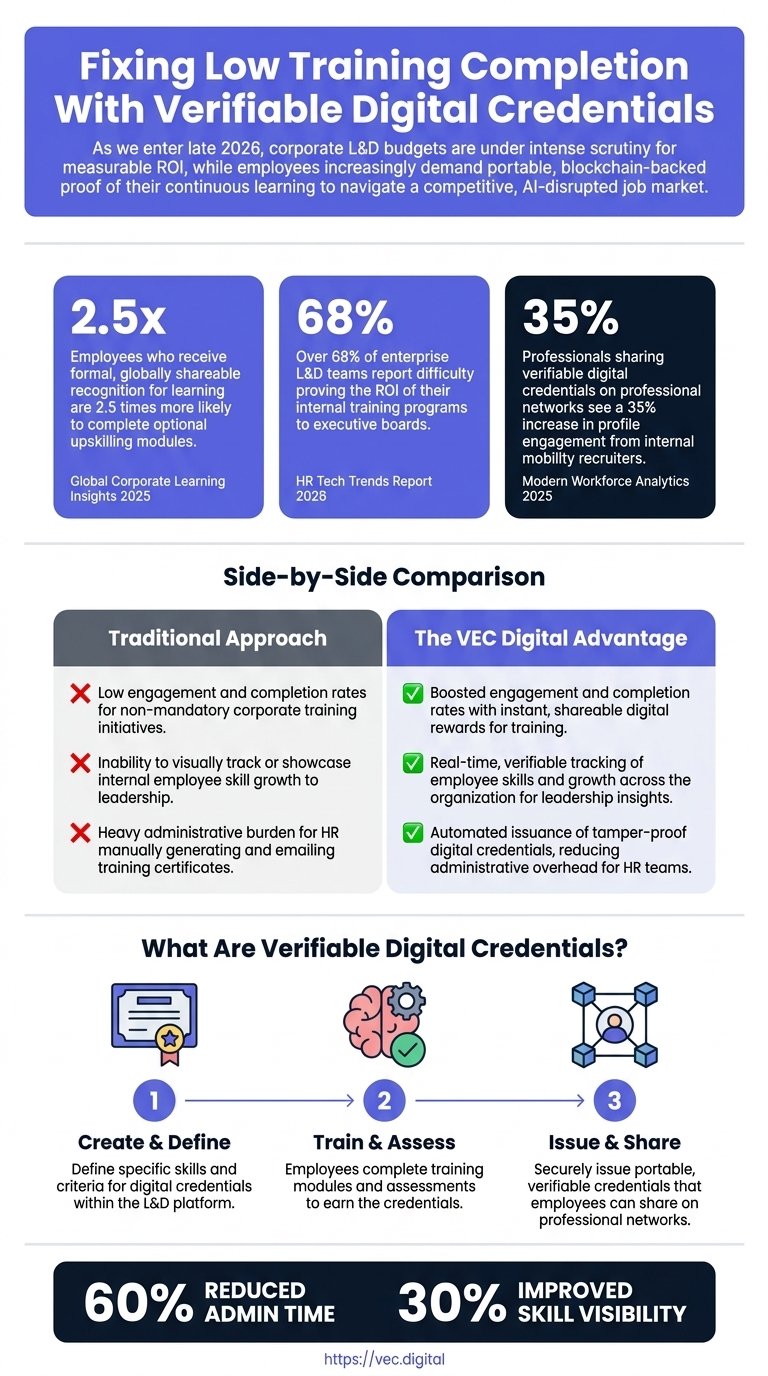
Beyond employee apathy, L&D leaders face a massive hurdle in demonstrating the value of their programs to executive boards. In fact, over 68% of enterprise L&D teams report difficulty proving the ROI of their internal training programs to executive boards (HR Tech Trends Report, 2026). When training data is locked inside legacy systems and completion certificates are scattered across disconnected local drives, it becomes nearly impossible to visually track or showcase internal employee skill growth to leadership.Executives require clear, data-driven insights to justify budget allocations. They need to see how upskilling directly correlates to increased productivity, better compliance, and higher internal mobility. When the output of a training program is merely a static list of names in a spreadsheet, the perceived value of the L&D initiative diminishes. By transitioning to a system that issues trackable, data-rich credentials, HR leaders can finally bridge the gap between educational expenditure and measurable business outcomes, effectively capturing corporate L&D upskilling ROI.
The Administrative Bottleneck of Manual Issuance
The operational reality of managing corporate training is often bogged down by heavy administrative burdens. HR teams and compliance officers spend countless hours manually generating, formatting, and emailing training certificates after every cohort or compliance cycle. This manual process is not only prone to human errorâ-such as misspelled names or incorrect datesâ-but it is also highly inefficient and unscalable for large, multinational enterprises.When an organization attempts to scale its training initiatives, this administrative bottleneck becomes a severe liability. If a company mandates a new global cybersecurity protocol for 10,000 employees, manually processing the completion records and dispatching the associated recognition can take weeks. This delay frustrates employees and creates massive compliance blind spots for the organization. Automating this issuance engine is no longer a luxury; it is an operational necessity for businesses aiming to maintain agility and strict regulatory compliance.
What Are Verifiable Digital Credentials?
Moving Beyond the Static PDF
To understand the solution, one must first ask: What is the difference between a PDF certificate and a **verifiable digital credential**? A standard PDF is merely a digital picture of a document. It contains no underlying data structure, offers no interactive capabilities, and, most dangerously, can be easily altered or forged using basic image editing software. It requires manual, time-consuming verification processes if an auditor or external employer needs to confirm its authenticity.In contrast, a verifiable digital credential is a dynamic, data-rich asset. It encapsulates specific metadataâ-such as the issuer's identity, the recipient's details, the date of issuance, and the specific competencies achievedâ-into a secure digital format. When someone views this credential, they can instantly verify its authenticity with a single click or scan, without needing to contact the issuing organization. This frictionless verification process completely eliminates credential fraud and establishes absolute trust in the digital record.
The Role of Blockchain Certificate Verification
A frequent question among enterprise IT leaders is: Are blockchain certificates useful for corporate L&D? The answer is a resounding yes. **Blockchain certificate verification** provides the ultimate layer of security and immutability. When an employee completes a training module, the resulting credential is cryptographically hashed and anchored to a public blockchain. This creates a permanent, tamper-proof record that exists independently of the issuing company's internal servers.This cryptographic security ensures that even if an organization updates its LMS or changes its software infrastructure, the employee's credential remains valid, accessible, and independently verifiable forever. For compliance officers dealing with high-stakes regulatory trainingâ-such as OSHA standards, GDPR compliance, or financial anti-money laundering (AML) certificationsâ-this level of immutable proof is invaluable during external audits, ensuring zero discrepancies in the compliance record.
Global Interoperability and Borderless Talent
The modern workforce is increasingly borderless, and corporate infrastructure must evolve to support global talent mobility. With major global hubs aggressively pushing for digital-first governmental and corporate infrastructures by 2030, multinational enterprises are abandoning siloed legacy systems. They are moving in favor of globally interoperable ecosystems to retain top-tier tech talent.For example, implementing verifiable digital credentials Dubai standards ensures that a credential issued in the Middle East carries the exact same verifiable weight and technological standard as one reviewed in London, New York, or Singapore. This global interoperability means that an employee's skills are recognized universally, enhancing the employer's brand reputation as a forward-thinking, technologically advanced organization that truly invests in its people's lifelong career trajectories.
The Psychological Shift: From Compliance to Career Growth
Unlocking Employee Motivation Through Shareability
Most L&D literature focuses heavily on improving course content to drive engagement, largely ignoring the psychological reward mechanism that drives adult learning. **Verifiable digital credentials** fundamentally shift employee motivation from a tedious compliance-driven mindset to a proactive, career-driven one. When employees know they will receive a high-quality, instantly shareable badge upon completion, the training transforms from a chore into an opportunity for personal brand building.The data strongly supports this behavioral shift. Employees who receive formal, globally shareable recognition for learning are 2.5 times more likely to complete optional upskilling modules (Global Corporate Learning Insights, 2025). By providing a digital asset that can be proudly displayed on professional networking sites like LinkedIn, employers tap into the intrinsic human desire for peer recognition and status enhancement, effectively solving the engagement crisis without needing to mandate the training.
Enhancing Internal Mobility and Talent Retention
How do verifiable digital credentials improve employee retention? The answer lies in internal talent mobility. When an organization issues digital badges for specific competencies, it inadvertently builds a highly searchable, verified database of internal skills. If a department needs a project manager with advanced data analytics capabilities, HR does not need to look externally; they can simply search their internal credential registry to find an employee who has recently upskilled in that exact area.Furthermore, employees who feel their growth is recognized are far less likely to leave. Professionals sharing verifiable digital credentials on professional networks see a 35% increase in profile engagement from internal mobility recruiters (Modern Workforce Analytics, 2025). This visibility ensures that ambitious employees are promoted from within, drastically reducing the massive costs associated with external hiring and onboarding, while simultaneously boosting overall company morale.
Creating a Culture of Continuous Learning
Establishing a true culture of continuous learning requires more than just providing access to an LMS library; it requires building an ecosystem of continuous positive reinforcement. When an organization utilizes verifiable digital credentials, they create a gamified, structured pathway for employee development. Each badge or certificate acts as a milestone in a broader career journey.This structured recognition engine allows employees to visualize their progress over time. Instead of viewing training as isolated, disconnected events, they see a cohesive portfolio of their growing expertise. This sense of progression is a powerful psychological motivator, encouraging lifelong learning habits that keep the organization's skill base sharp, adaptable, and ready to tackle future industry disruptions.
Automating the Recognition Engine for HR Teams
Implementing Compliance Training Certificate Automation
What is the best way to automate corporate training certificates? The most effective approach is deploying robust **compliance training certificate automation** that connects directly to your existing infrastructure via developer-ready APIs. By integrating an automated credentialing engine with your corporate LMS or HRIS platform, organizations can achieve zero-touch issuance.In this automated setup, the exact second an employee passes a final assessment or completes a required compliance module, the system triggers the generation of a personalized, cryptographically secure certificate. This document is immediately emailed to the recipient and logged in the central HR database. Transitioning from static PDFs to blockchain-anchored credentials reduces HR administrative verification and issuance time by up to 90% (Institute of HR Automation, 2026). This massive reduction in manual labor frees up HR professionals to focus on strategic talent initiatives rather than data entry.
Streamlining High-Volume Issuance
For organizations that conduct massive cohort training sessions, annual corporate kick-offs, or global compliance weeks, the question arises: How do you issue digital badges for employee training programs at scale? The solution lies in utilizing bulk issuance systems powered by CSV data parsing.Instead of generating certificates one by one, administrators can upload a single standardized spreadsheet containing thousands of recipient names, email addresses, and dynamic placeholder data. The credentialing system instantly reads this data, populates the visual templates, anchors the records for authenticity, and dispatches the digital assets to all recipients simultaneously. This seamless batch generation ensures that whether you are recognizing 50 executives or 10,000 frontline workers, the operational effort remains exactly the same.
Tracking Corporate L&D Upskilling ROI Effectively
How can HR track upskilling ROI effectively? The key is moving from qualitative assumptions to quantitative data tracking. Automated credentialing systems provide rich analytics dashboards that monitor exactly how many certificates have been issued, opened, shared, and verified by third parties.By analyzing this data, L&D leaders can see which training modules are generating the most engagement and which skills are being actively utilized or promoted by employees. This clear, visual data allows HR to present definitive proof of corporate L&D upskilling ROI to executive boards, demonstrating exactly how training budgets are translating into verified, recognizable organizational competencies.
Building a Future-Proof Digital Diploma Platform
Ensuring Cryptographic Security at Scale
As enterprises modernize their technological stacks, adopting a dedicated **digital diploma platform** becomes a foundational requirement. A true enterprise-grade platform does not just generate pretty images; it acts as the ultimate trust infrastructure for the organization. By leveraging advanced cryptographic security, these platforms ensure that every credential issued is completely immune to AI-generated forgery or manual tampering.This security is maintained through multi-signatory approval pipelines. Before any high-stakes compliance certificate is officially issued, the system can automatically hold the document in a pending state until designated organizational authorities securely log in and provide their digital sign-off. This strict governance prevents rogue issuance and ensures that the organization's brand reputation remains absolutely pristine in the eyes of external auditors and regulatory bodies.
Leveraging Instant QR Code Verification
A critical feature of a modern **digital diploma platform** is the elimination of verification friction. Every issued credential should feature a uniquely generated, embedded QR code. When an external auditor, a prospective internal hiring manager, or a compliance inspector needs to verify a record, they simply scan the code with any standard smartphone camera.This scan instantly routes the reviewer to a secure, dedicated verification URL that displays the verifiable digital credential's full detailsâ-including the "Blockchain Verified" security badge. This process takes less than two seconds, requires no app installations, and demands no account logins. It is the ultimate physical-to-digital link, providing absolute certainty and transparency at the speed of business.
Supporting ESG Goals with Paperless Operations
Beyond security and efficiency, transitioning to a digital-first credentialing system aligns perfectly with global Environmental, Social, and Governance (ESG) mandates. The carbon footprint associated with printing, packaging, and internationally shipping thousands of physical certificates is immense and increasingly unjustifiable for modern, ecologically conscious enterprises.By digitizing the entire recognition lifecycle, organizations drastically reduce their paper consumption and logistical emissions. This commitment to sustainable, paperless operations not only supports United Nations sustainability goals but also resonates deeply with a modern workforce that expects their employers to demonstrate tangible environmental responsibility alongside corporate innovation.
Transform Your L&D Strategy with VEC Digital
The era of manual data entry, unshareable PDF certificates, and unmeasurable training ROI is over. To attract, retain, and develop a world-class workforce, your organization must adopt an infrastructure that treats employee recognition with the security, portability, and importance it deserves. Implementing cryptographically secure, instantly verifiable credentials is the fastest, most effective way to boost L&D engagement and prove the definitive value of your training programs.
At VEC Digital, we provide the comprehensive trust infrastructure required to automate and secure your organization's credentialing processes at scale. Our platform offers frictionless API integrations, zero-touch automation, and immutable blockchain anchoringâ-giving you the power to issue with absolute confidence while empowering your employees to own their professional achievements.
Secure your organizationâ's credentials today and design your first template in minutes with no setup fees.
Website: https://vec.digital
Email: support@vec.digital