
Going Paperless: The Environmental and Financial ROI of Verifiable Digital Credentials in Higher Ed
Published on June 9, 2026
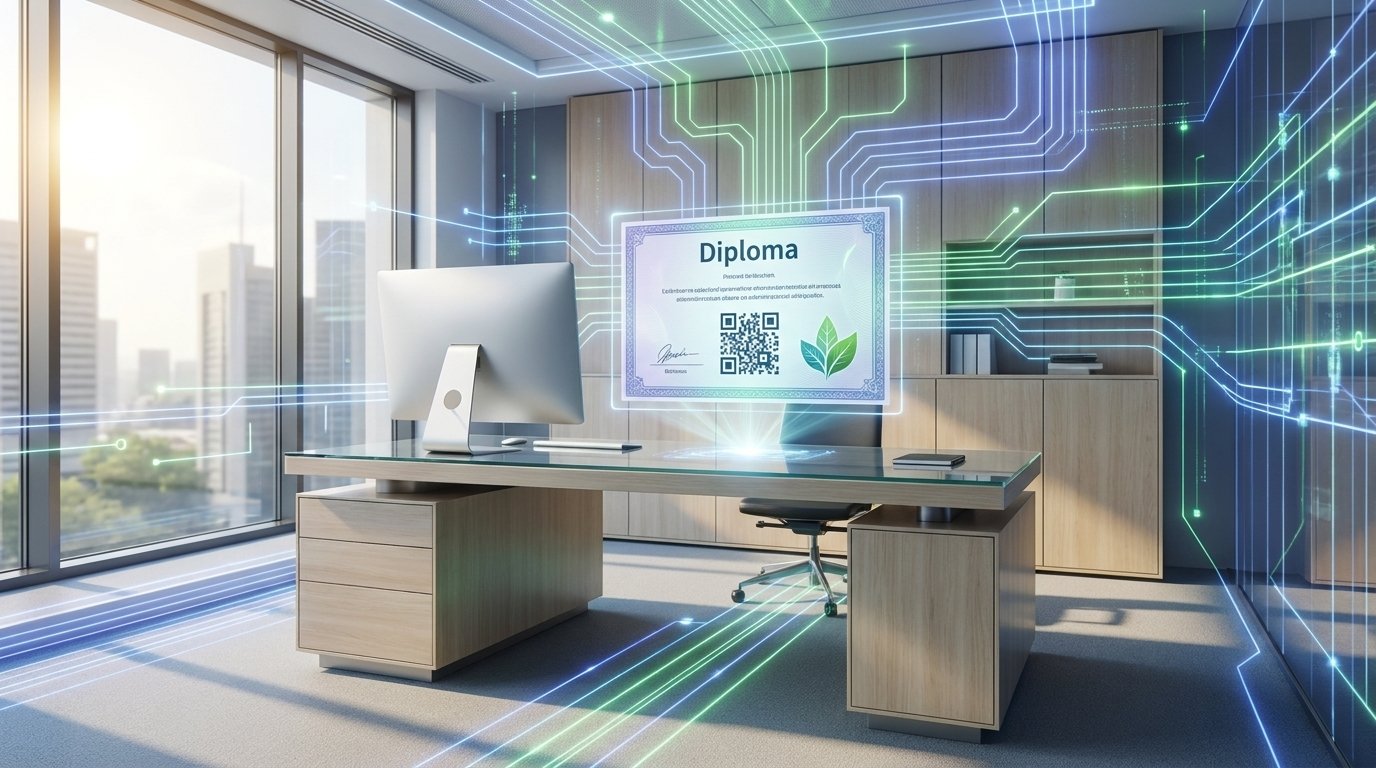
Following the heavy administrative load and exorbitant shipping costs of the global graduation season, universities are actively evaluating their budgets and discovering that traditional paper diplomas are a massive drain on resources. The transition to verifiable digital credentials has emerged as a top priority for institutional sustainability committees worldwide, offering an immediate solution to systemic logistical inefficiencies. By digitizing academic awards, higher education institutions are unlocking a revolutionary way to slash overhead costs while simultaneously achieving critical environmental targets.
In this comprehensive guide, our technology experts at Vec.Digital will break down the hidden financial and environmental costs of legacy credentialing systems. You will learn how to calculate the tangible return on investment (ROI) of going paperless, understand the direct impact on your institution's Environmental, Social, and Governance (ESG) goals, and discover how to seamlessly implement an automated, secure digital credentialing system. Ultimately, your organization will be equipped to modernize its administrative operations, reduce its carbon footprint, and deliver instant, tamper-proof value to global learners.
Key Takeaways
- Traditional paper credentialing costs universities up to $25 per student, but adopting a digital certificate maker slashes these expenses drastically.
- Global logistics and international shipping account for the majority of credential distribution costs, making verifiable digital credentials a financially superior alternative.
- Transitioning to cloud-based credentialing engines reduces the administrative carbon footprint by up to 90%, directly supporting ESG goals higher education initiatives.
- Modern institutions are utilizing a bulk certificate generator to eliminate the massive paper waste associated with uncollected or lost academic transcripts.
- Implementing blockchain certificate verification ensures that sustainability efforts do not compromise the absolute security and authenticity of academic awards.
The Hidden Costs of Traditional Academic Credentialing
For decades, the issuance of physical academic degrees has been viewed as an untouchable tradition. However, as global student mobility increases and administrative budgets tighten, the financial burden of this legacy process has become impossible to ignore. The shift toward verifiable digital credentials is no longer just about preventing diploma fraud; it is a critical financial strategy for modern universities. When institutions audit their credentialing processes, they frequently uncover a web of hidden expenses that drain resources away from core educational initiatives.
The financial strain extends far beyond the cost of specialized parchment and foil stamping. It encompasses the human resources required to manually verify, print, package, and dispatch thousands of documents simultaneously. Furthermore, the globalized nature of modern education means that alumni are scattered across continents, introducing complex international shipping logistics that are highly susceptible to delays, damage, and loss. By analyzing these hidden costs, administrators can clearly see the urgent need for digital transformation.
The Exorbitant Price of Global Logistics
One of the most significant pain points for university registrars is the exorbitant postal and courier fees required to mail physical diplomas, especially to international alumni. According to the International Student Mobility Logistics Data (2024), international shipping accounts for over 60% of the total cost and logistical delays in traditional university credential distribution. When a student graduates and returns to their home country, the university is forced to rely on expensive international courier services to ensure the safe delivery of their physical degree.
This logistical nightmare is compounded by the high administrative overhead involved in manually re-printing and re-shipping lost or damaged paper certificates. If a physical diploma is lost in transit or destroyed by environmental factors, the university must initiate a costly replacement process. This involves verifying the student's identity, re-authorizing the printing, paying for new materials, and funding a second round of premium shipping. These compounding costs create a highly inefficient financial model that severely impacts the institution's bottom line.
How Much Money Do Universities Save by Going Paperless?
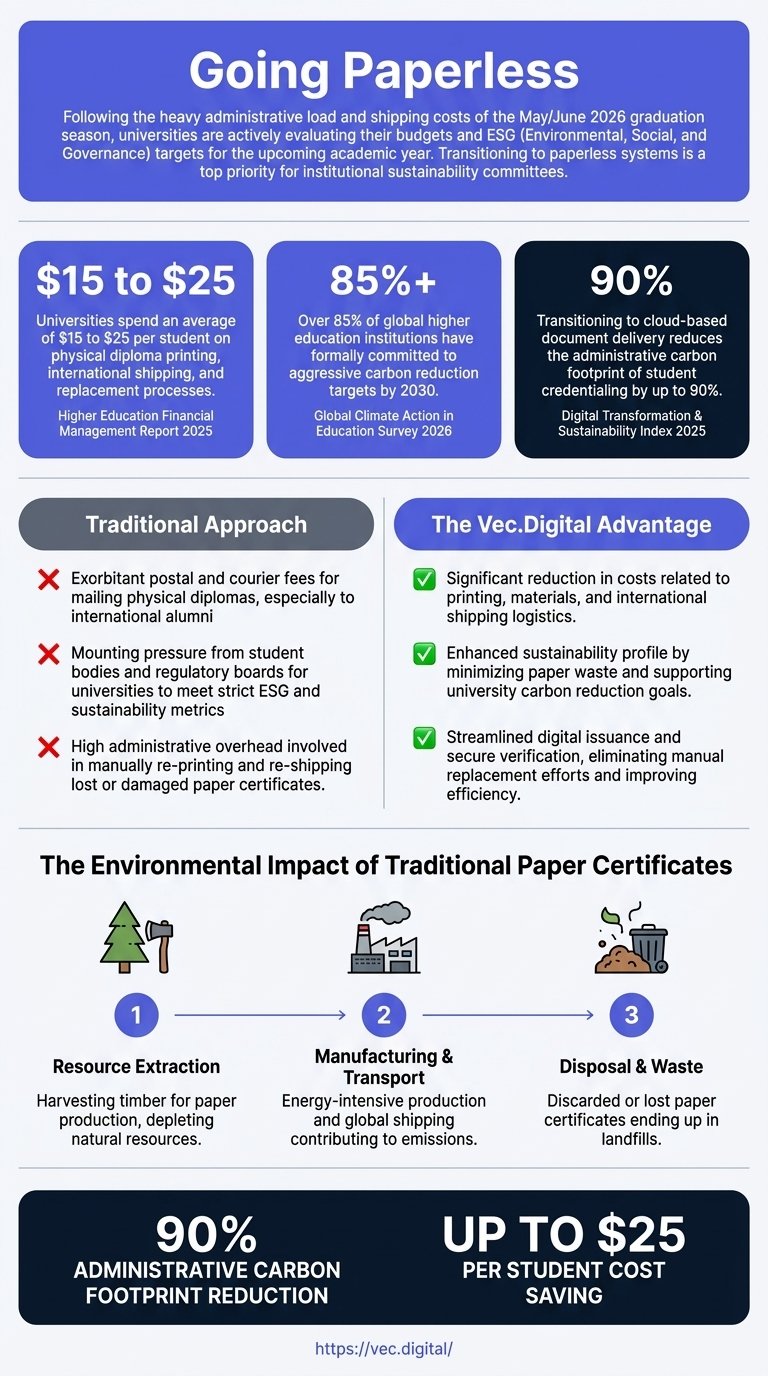
When institutions ask how much money they can save by going paperless, the data reveals a staggering financial opportunity. The Higher Education Financial Management Report (2025) states that universities spend an average of $15 to $25 per student on physical diploma printing, international shipping, and replacement processes. For a mid-sized university graduating 10,000 students annually, this translates to an expenditure of up to $250,000 every single year—purely for document distribution.
By implementing a robust digital certificate maker, universities can effectively eliminate these recurring expenses. Digital issuance requires zero physical materials, zero warehousing, and zero shipping fees. The marginal cost of issuing an additional digital credential is virtually zero. Furthermore, the automation of these systems frees up hundreds of hours of administrative labor, allowing university staff to focus on high-value tasks rather than stuffing envelopes and tracking lost packages. The financial ROI of this transition is typically realized within the first academic semester of implementation.
The Environmental Impact of Traditional Paper Certificates
Beyond the financial implications, the traditional credentialing process takes a severe toll on the environment. As global awareness of climate change intensifies, universities are facing mounting pressure from student bodies, faculty, and regulatory boards to meet strict sustainability metrics. The reliance on physical paper processes directly contradicts the modern mandate for environmental stewardship. Transitioning to verifiable digital credentials is a powerful, measurable way to align administrative operations with global ecological standards.
The environmental footprint of a physical diploma begins long before the student crosses the graduation stage. It involves the logging of trees, the intense water and energy consumption of paper mills, the application of chemical dyes and metallic foils, and the carbon emissions generated by the global transportation network required to deliver the final product. To truly understand the value of paperless administration, we must examine the full lifecycle of traditional academic documents.
Understanding the Footprint of Physical Diplomas
What is the environmental impact of traditional paper certificates? The massive environmental footprint associated with sourcing specialized paper, printing, and global logistics is far more extensive than most administrators realize. High-quality parchment paper requires significant natural resources to produce. When you multiply this by millions of graduates globally every year, the ecological toll becomes staggering. Furthermore, physical certificates are often packaged in heavy cardboard tubes or leather-bound folios, adding layers of non-recyclable materials to the waste stream.
The transportation phase is equally damaging. Shipping a physical document across the globe relies on cargo planes, delivery trucks, and extensive logistics networks, all of which burn fossil fuels and emit greenhouse gases. Additionally, there is a hidden layer of waste: the uncollected documents. Every year, thousands of academic transcripts and diplomas are printed but never claimed by the students, resulting in massive piles of specialized paper that eventually end up in landfills. The EdTech Operations Review (2026) highlights that institutions adopting a digital certificate maker see a 100% reduction in paper waste associated with uncollected or lost academic transcripts.
Are Digital Diplomas Environmentally Friendly?
Administrators frequently ask: Are digital diplomas environmentally friendly? The answer is a resounding yes. While digital infrastructure does require energy to operate, the carbon footprint of cloud-based storage and digital transmission is a fraction of the footprint generated by the physical paper supply chain. The Digital Transformation & Sustainability Index (2025) confirms that transitioning to cloud-based document delivery reduces the administrative carbon footprint of student credentialing by up to 90%.
By generating sustainable digital diplomas, universities instantly eliminate the need for deforestation, water-intensive milling, chemical printing, and fossil-fuel-reliant shipping. The digital format also completely eradicates the issue of uncollected paper waste. A student's digital credential exists securely in the cloud, accessible instantly upon issuance, and requires no physical resources to maintain. This paradigm shift represents one of the most effective and immediate ways for an institution to drastically reduce its Scope 3 emissions.
Meeting ESG and UN Sustainability Goals in Higher Education
In the modern academic landscape, sustainability is no longer a peripheral marketing initiative; it is a core operational mandate. With sweeping ESG reporting mandates taking effect globally—such as the Corporate Sustainability Reporting Directive (CSRD) in Europe—universities are no longer just encouraged to be sustainable; they are being audited on their carbon footprints. The adoption of verifiable digital credentials provides an immediate, measurable reduction in an institution's environmental impact, directly supporting these rigorous compliance frameworks.
Institutional sustainability committees are actively searching for high-impact, low-friction areas where they can modernize operations to meet these goals. Digitizing high-volume paper processes like academic credentialing is the perfect candidate. It is a highly visible change that demonstrates a commitment to innovation and environmental responsibility, resonating strongly with eco-conscious Gen Z and Alpha student demographics.
The Global Push for Carbon Reduction
The higher education sector is experiencing a massive global push toward carbon neutrality. According to the Global Climate Action in Education Survey (2026), over 85% of global higher education institutions have formally committed to aggressive carbon reduction targets by 2030. Achieving these targets requires a systematic dismantling of legacy, carbon-intensive processes. Gartner's research on corporate sustainability frequently emphasizes that digitizing administrative workflows is a foundational step in reducing enterprise-level emissions.
By moving to a paperless university administration model, universities can accurately quantify their carbon savings. They can report on the exact tonnage of paper saved, the reduction in chemical usage, and the elimination of shipping-related greenhouse gas emissions. These quantifiable metrics are essential for passing stringent ESG audits and maintaining the institution's reputation as a forward-thinking, responsible global actor.
How Can Higher Education Institutions Meet UN Sustainability Goals?
How can higher education institutions meet UN sustainability goals? The United Nations Sustainable Development Goals (SDGs) provide a blueprint for a better and more sustainable future. Transitioning to digital credentialing directly supports several key SDGs, most notably Goal 12 (Responsible Consumption and Production) and Goal 13 (Climate Action). By eliminating the demand for physical paper and the associated logistics, universities are actively participating in responsible resource management.
Furthermore, digital credentials support Goal 4 (Quality Education) by ensuring that learners worldwide have immediate, frictionless access to their academic records. In developing regions where postal infrastructure may be unreliable, a digital credential guarantees that a graduate can instantly prove their qualifications to prospective employers. For more context on global educational targets, administrators can reference the UN Sustainable Development Goals official framework. By leveraging a modern digital platform, universities transform a routine administrative task into a powerful driver of global equity and sustainability.
Transitioning to Verifiable Digital Credentials
Understanding the financial and environmental benefits is only the first step; the next challenge is implementation. Many university registrars and IT directors hesitate to overhaul legacy systems due to perceived technical complexity. However, modern verifiable digital credentials platforms are designed for seamless integration and user-friendly operation. Transitioning away from paper does not require a massive disruption to existing academic operations; rather, it involves adopting an intelligent, automated system that works in tandem with your current databases.
The goal is to create a frictionless experience for both the administrative staff issuing the awards and the students receiving them. By utilizing intuitive design interfaces and robust data integration tools, universities can issue thousands of secure, branded digital diplomas in a matter of minutes, completely revolutionizing the post-graduation administrative sprint.
How Do We Transition Our University to Verifiable Digital Credentials?
How do we transition our university to verifiable digital credentials? The process begins with selecting a comprehensive digital credentialing engine that supports high-volume issuance and enterprise-grade security. The first practical step is utilizing a bulk certificate generator. Administrators can simply export student data (names, degree types, graduation honors) from their Student Information System (SIS) into a standard CSV file. This data is then securely mapped to dynamic fields within a pre-designed digital template.
Once the data is mapped, the automated process takes over. The system generates individualized, secure digital certificates for the entire graduating class simultaneously. These credentials are then instantly distributed to the students via secure email links. For institutions looking for deeper integration, modern platforms offer REST API capabilities, allowing the university's existing academic databases to communicate directly with the credentialing engine, triggering automated issuance the moment a student's final grades are approved.
Can Digital Certificates Completely Replace Physical Graduation Diplomas?
A common question among alumni associations is: Can digital certificates completely replace physical graduation diplomas? Technologically and functionally, yes. A digital credential provides far more utility than a piece of paper; it can be instantly shared on professional networks like LinkedIn, embedded in digital portfolios, and verified by employers in seconds. However, the transition does not have to be absolute or immediate.
Many forward-thinking universities adopt a hybrid model during their transitional phase. They issue the digital credential instantly upon graduation—satisfying the immediate need for proof of qualification—while offering the physical paper diploma as an optional, premium "keepsake" that the student can request and pay for independently. This approach drastically reduces the default paper waste and shipping costs while still accommodating traditionalists, smoothly paving the way for a fully paperless university administration in the near future.
The Role of a Digital Certificate Maker in Modern Administration
A high-quality digital certificate maker is the creative engine behind this transition. It is crucial that the digital diploma retains the prestige, branding, and aesthetic authority of the institution. Administrators need an intuitive, drag-and-drop design environment where they can upload university seals, apply exact brand color palettes, and utilize professional typography.
This design flexibility ensures that the digital credential is not just a sterile data file, but a beautiful, visually striking award that students are proud to showcase online. By centralizing the design and issuance process within a single platform, cross-functional teams—from the registrar's office to the marketing department—can collaborate seamlessly to ensure that every credential issued perfectly represents the university's global brand.
The Future of Paperless University Administration
As we look toward the future of higher education, it is clear that digital transformation is accelerating. The universities that thrive will be those that embrace technology not just for operational efficiency, but for enhanced security and student experience. The adoption of verifiable digital credentials is the cornerstone of this modern administrative architecture. By completely eliminating the reliance on physical documents, institutions are future-proofing their operations against rising logistical costs and tightening environmental regulations.
However, the true power of a paperless system lies in its ability to combine environmental sustainability with cryptographic security. In the digital age, credential fraud is a sophisticated global industry. Traditional paper diplomas, no matter how ornate, are increasingly vulnerable to forgery. Modern digital credentials solve this problem permanently by embedding advanced verification technologies directly into the digital asset.
Combining Sustainability with Unbreakable Security
The ultimate advantage of a digital system is the integration of blockchain certificate verification. When a digital diploma is issued, its unique cryptographic signature is anchored to an immutable blockchain ledger. This means that the record of issuance can never be altered, hacked, or forged. If a malicious actor attempts to modify a digital credential, the cryptographic hash will break, instantly flagging the document as invalid.
To make this security accessible to employers and auditors, these platforms utilize QR code certificates. Every digital diploma features a unique, scannable QR code. When an employer scans this code, they are instantly routed to a secure, university-branded verification page that confirms the credential's authenticity in real-time. This entirely automated verification process eliminates the need for employers to call the university registrar, further reducing the administrative burden on the institution while providing absolute, foolproof security.
Scaling Global Operations Efficiently
As universities expand their reach through online learning platforms and international satellite campuses, the ability to scale administrative operations efficiently is paramount. A paperless, cloud-based credentialing system scales infinitely without a corresponding increase in physical resources or logistical complexity. Whether an institution is issuing 100 certificates for a local seminar or 100,000 diplomas for a massive open online course (MOOC), the environmental footprint and the marginal cost remain virtually zero.
This scalability empowers educational institutions to democratize learning, offering verifiable proof of achievement to students in every corner of the globe without the friction of international shipping or the environmental guilt of massive paper consumption. It is a profound alignment of technological innovation, financial prudence, and global sustainability.
Secure Your Institution's Future with Vec.Digital
The evidence is clear: transitioning to verifiable digital credentials is one of the most impactful decisions a university can make to reduce operational costs, eliminate administrative friction, and aggressively meet global ESG targets. By moving away from the expensive, carbon-heavy legacy of paper diplomas, your institution can instantly save up to $25 per student while eradicating the massive environmental footprint associated with global document shipping.
At Vec.Digital, we provide the ultimate infrastructure for effortless digital certification and verification at scale. Our platform combines an intuitive digital certificate maker, automated bulk issuance engines, instant QR code verification, and immutable blockchain security to deliver a flawless, paperless credentialing experience. We empower universities, corporate HR departments, and event organizers to issue with absolute confidence, knowing their credentials are secure, globally accessible, and environmentally sustainable.
Ready to eliminate credential fraud, slash your administrative overhead, and achieve your institution's sustainability goals? Transform your certification process today.
Website: https://vec.digital/ Email: support@vec.digital