
How a Digital Diploma Platform Prepares Universities for 2027 Identity Wallet Mandates
Published on October 27, 2026

Over 40% of universities cite integration with global digital wallet standards as a top IT priority for the 2026-2027 academic year, according to the 2026 Educause Trend Report. As international mandates like eIDAS 2.0 reshape how governments and employers authenticate qualifications, adopting a robust digital diploma platform is no longer optional for higher education institutions. The era of static documents is ending, and universities must immediately pivot to ensure their graduates' credentials remain globally portable and instantly verifiable.
In this guide, our team at VEC Digital leverages our deep expertise in educational technology to map out exactly how institutions can transition legacy systems into modern, wallet-ready infrastructures. You will learn how to overcome the technical overwhelm of adopting new data standards, eliminate the administrative burden of manual credential audits, and seamlessly issue credentials that graduates can carry anywhere in the world.
Key Takeaways
- Digital diploma platforms are essential for aligning university records with upcoming 2027 government identity wallet mandates.
- Adopting decentralized identity standards ensures graduates can port their academic achievements globally without friction.
- Implementing blockchain certificate verification can reduce a university's administrative workload by up to 85% annually.
- Cryptographically secure verifiable digital credentials are replacing PDFs to permanently prevent degree fraud.
- Modernizing digital student records protects institutional reputation and increases the employability of international students.
The Shift Toward Decentralized Identity Standards
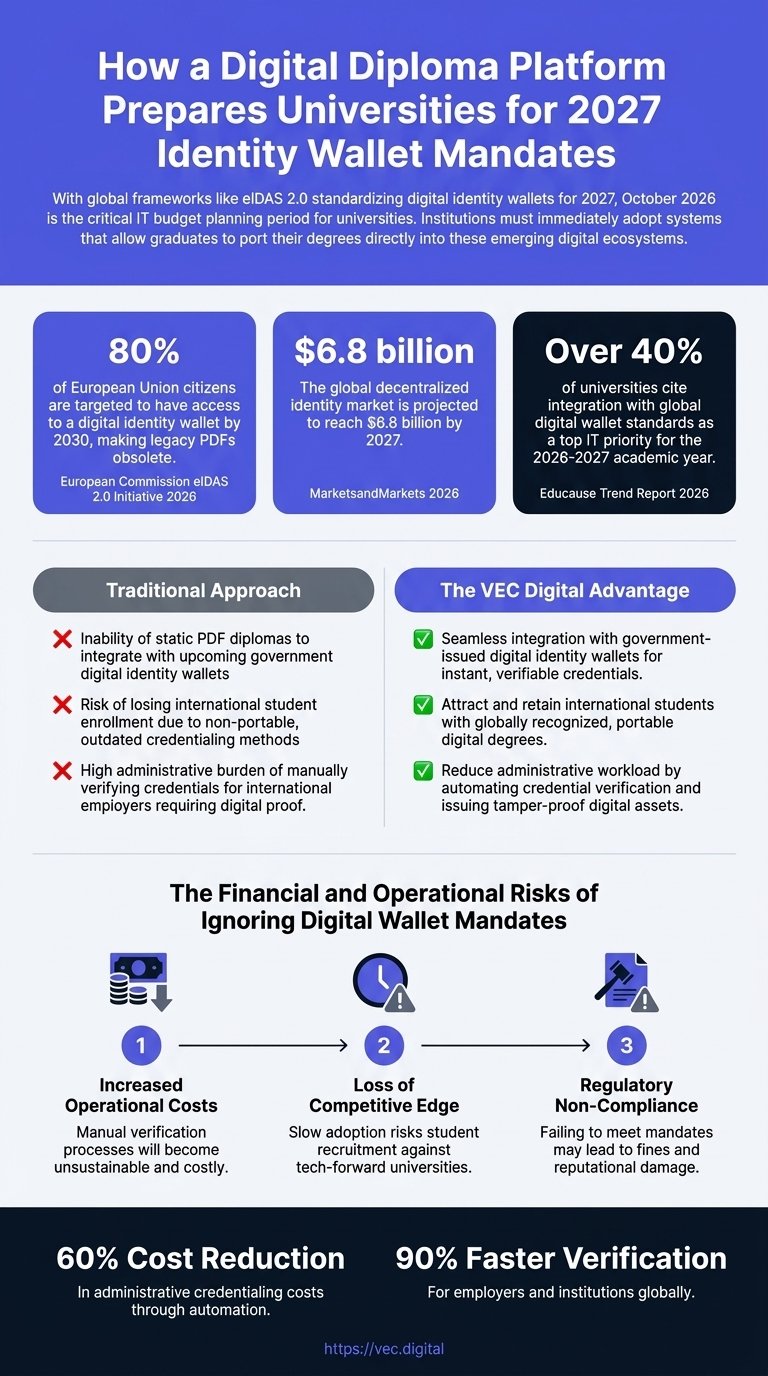
The global landscape of data ownership is undergoing a massive transformation. For decades, universities have acted as the sole custodians of academic records, forcing alumni and employers to route every verification request through a central registrar's office. Today, the global decentralized identity market is projected to reach $6.8 billion by 2027, according to a 2026 report by MarketsandMarkets. This financial surge underscores a fundamental shift: individuals are taking ownership of their data via secure mobile applications, and institutions must supply data in formats that these applications can read.
As governments across the European Union, the UAE, and Singapore deploy national digital identity ecosystems, the traditional methods of issuing degrees are rapidly becoming obsolete. A modern digital diploma platform acts as the vital bridge between a university's internal database and these emerging global networks, translating academic achievements into universally recognized, cryptographically secure formats.
Why are PDF certificates no longer accepted for international background checks?
For years, the standard electronic alternative to a paper diploma was a simple PDF. However, static PDFs possess a critical flaw: they are incredibly easy to alter. With the rise of sophisticated AI image editors and document manipulation software, a standard PDF offers zero cryptographic proof of authenticity. When an international employer or immigration authority receives a PDF, they cannot mathematically prove who issued it, whether it was altered after issuance, or if it has been revoked.
Because of this vulnerability, regulatory bodies and multinational corporations are phasing out the acceptance of unencrypted PDFs. They require a format where the trust is embedded directly into the file itself, rather than relying on visual inspection. This is why institutions are moving toward systems that issue credentials anchored by complex cryptography, ensuring that any tampering instantly invalidates the file.
What are the new digital identity standards for university records?
The new benchmark for digital student records is heavily influenced by the World Wide Web Consortium (W3C) Verifiable Credentials Data Model. This standard defines a secure, machine-readable format for expressing credentials on the web. Under this framework, a university (the Issuer) provides a cryptographically signed digital file to the student (the Holder), who stores it in a digital wallet. The student can then present this file to an employer (the Verifier), who can instantly authenticate it without ever needing to contact the university.
These standards require credentials to be issued as structured data (often in JSON format) paired with digital signatures. By adopting these standards, universities ensure their graduates possess credentials that are interoperable across borders, software platforms, and national identity frameworks.
The Financial and Operational Risks of Ignoring Digital Wallet Mandates
October 2026 marks a critical IT budget planning period for higher education. Institutions that fail to allocate resources toward a modern digital diploma platform face severe operational bottlenecks and reputational damage. The transition is not merely a technological upgrade; it is an economic necessity driven by the demands of the modern workforce.
Employers are no longer willing to wait weeks for a university registrar to manually confirm a degree. According to the HR Tech Council (2025), 65% of multinational employers now prioritize candidates whose academic credentials can be cryptographically verified in under 5 seconds. If a university's degrees cannot be verified instantly, its graduates are placed at a distinct disadvantage in the competitive global job market.
High administrative burden of manually verifying credentials
The traditional credential verification process is a drain on university resources. When an employer or background check agency requests verification, university staff must manually search legacy databases, retrieve the record, draft a confirmation, and securely transmit it back to the requesting party. During peak hiring seasons, this manual process creates massive backlogs, delaying employment for graduates and consuming hundreds of administrative hours.
By failing to modernize, institutions are committing themselves to an unsustainable operational model. The inability of static PDF diplomas to integrate with upcoming government digital identity wallets means that universities will continue to bear the full weight of verification requests, rather than empowering employers to verify the data independently through automated systems.
The risk of losing international student enrollment
International students represent a crucial revenue stream and diversity metric for global universities. These students are particularly sensitive to credential portability, as they frequently cross borders for employment, further education, and visa applications. If a university issues credentials using outdated, non-portable methods, it creates immense friction for alumni navigating international bureaucracies.
As digital identity wallets become the norm, prospective international students will actively evaluate a university's technological infrastructure before enrolling. They will seek out institutions that provide verifiable digital credentials that integrate seamlessly with their home country's digital infrastructure. Universities that lag behind risk losing these highly mobile students to forward-thinking competitors who guarantee frictionless credential portability.
How to Prepare Academic Records for eIDAS 2.0 and Global ID Mandates
The most prominent catalyst for this global shift is the European Commission's eIDAS 2.0 Initiative. According to the European Commission (2026), 80% of European Union citizens are targeted to have access to a digital identity wallet by 2030, making legacy PDFs obsolete. While eIDAS is a European framework, its impact is global. Any university outside the EU that educates European citizens, or whose graduates seek employment in Europe, must comply with these interoperability standards.
Preparing for these mandates requires a strategic overhaul of how academic records are generated, stored, and distributed. It demands a shift away from isolated, proprietary university databases toward open, standardized ecosystems. A comprehensive digital diploma platform handles this complex translation, allowing universities to remain compliant without needing to build custom cryptographic infrastructure from scratch.
Overcoming technical overwhelm when aligning legacy systems
One of the primary barriers to adoption is the technical overwhelm IT directors face when trying to align legacy institutional systems with new W3C verifiable credential standards. University databases are often deeply entrenched, complex, and highly customized. The thought of migrating decades of student data into a new cryptographic format can paralyze decision-makers.
The solution lies in leveraging an automated credentialing engine that connects to existing systems via REST APIs. Rather than ripping out and replacing the core Student Information System (SIS), IT teams can integrate a modern issuance layer on top of their existing infrastructure. This allows the university to trigger the generation of a verifiable credential automatically upon graduation, translating the legacy data into a globally compliant format without disrupting internal operations.
How does a digital diploma platform integrate with digital identity wallets?
Integration between a university's issuance system and a student's digital wallet relies on standardized communication protocols. When a university uses a modern digital diploma platform, the system generates a credential containing specific data fields (name, degree, date, issuer ID) and signs it with the university's private cryptographic key.
The platform then delivers this credential to the student, often via a secure email link or a QR code. When the student scans the QR code or clicks the link using their digital wallet app, the wallet securely downloads the JSON file and stores it locally on the device. Because the file is structured according to global standards (like W3C), the wallet application instantly recognizes it as a valid academic credential, displaying it neatly alongside the user's digital driver's license or passport.
Leveraging Blockchain Certificate Verification for Global Portability
To achieve true global portability, the underlying security of the credential must be unassailable. This is where blockchain certificate verification becomes critical. By anchoring the cryptographic hash of a diploma to a public, immutable blockchain, universities create a permanent, tamper-proof record of issuance that exists independently of the university's own servers.
The operational benefits of this approach are staggering. According to the Global EdTech Alliance (2025), blockchain-anchored digital credentialing can reduce a university's administrative verification workload by up to 85% annually. By decentralizing the verification process, universities empower employers to authenticate degrees instantly and securely, freeing up registrar staff to focus on higher-value tasks.
How to issue W3C verifiable credentials for students?
Issuing W3C-compliant credentials does not require university staff to become cryptography experts. By utilizing a specialized digital diploma platform, the process is streamlined and highly automated. First, the university designs the visual representation of the certificate using a visual drag-and-drop editor. Next, they define the dynamic data fields (such as the student's name, major, and graduation date).
When it is time to issue the degrees, administrators can use a bulk certificate generator feature to upload a standard CSV file of the graduating class. The platform's automated system parses the data, applies the university's digital signature, anchors the transaction to the blockchain, and dispatches the W3C-compliant credentials directly to the students' inboxes. This automated process can securely issue thousands of verifiable credentials in a matter of minutes.
Can blockchain diplomas be stored in a mobile digital wallet?
Yes, and this is the core functionality that prepares universities for the 2027 mandates. It is a common misconception that blockchain credentials require users to manage complex cryptocurrency wallets. In reality, modern verifiable credentials are designed to be user-friendly.
The credential itself is a lightweight data file containing the cryptographic proof of the blockchain transaction. When a student imports this file into a government-approved digital identity wallet (such as those being developed for eIDAS 2.0), the wallet software abstracts the complexity. The student simply sees a visual representation of their diploma on their smartphone screen, which they can securely share with employers via a decentralized identity exchange protocol.
Preventing Degree Fraud at Scale with Modern Infrastructure
Beyond compliance and portability, the shift toward decentralized identity is fundamentally about trust. The proliferation of diploma mills and sophisticated forgery techniques has severely damaged the integrity of academic records. To permanently prevent degree fraud, institutions must adopt systems that make forgery mathematically impossible.
When a university anchors its digital student records to a blockchain, it creates an immutable source of truth. If a malicious actor attempts to alter a graduate's GPA or change the name on a diploma, the cryptographic hash of the altered document will no longer match the hash anchored on the blockchain. Any automated verification system will instantly flag the document as invalid, protecting both the employer from a bad hire and the university from reputational damage.
Ensuring strict governance with multi-signatory approvals
Security must also be enforced internally before a credential is ever issued. A robust digital diploma platform includes formal internal security pipelines to prevent accidental or rogue issuance. Through a multi-signatory approval system, certificates are held in a secure draft status until designated organizational authoritiesâ-such as the University Dean and the Chief Registrarâ-securely log in to review and electronically sign them.
This strict governance ensures that every credential anchored to the blockchain has undergone rigorous internal auditing. When combined with instant Scan-to-Verify QR code integration, institutions create a bulletproof ecosystem: meticulously approved internally, immutably secured on the blockchain, and instantly verifiable by the outside world.
Future-Proof Your University with VEC Digital
The mandate is clear: by 2027, the global workforce will expect academic credentials to be instantly verifiable, cryptographically secure, and fully portable within digital identity wallets. Universities that rely on static PDFs or manual verification processes will find themselves facing insurmountable administrative burdens and a severe competitive disadvantage in attracting international students.
At VEC Digital, we provide the comprehensive trust infrastructure required to navigate this transition flawlessly. Our blockchain-powered digital diploma platform empowers your institution to issue tamper-proof, W3C-ready credentials at scale, completely eliminating the possibility of credential fraud while reducing your administrative workload. With features like frictionless API integrations, automated CSV batch generation, and zero-friction QR code verification, we make modernizing your academic records effortless.
Secure your organizationâ's credentials today and ensure your graduates are ready for the digital identity ecosystems of tomorrow. Design your first template in minutes with no setup fees.
Contact our team to begin your transition: Website: https://vec.digital Email: support@vec.digital