
How Blockchain Certificate Verification is Replacing the Apostille for Global Education
Published on August 17, 2026

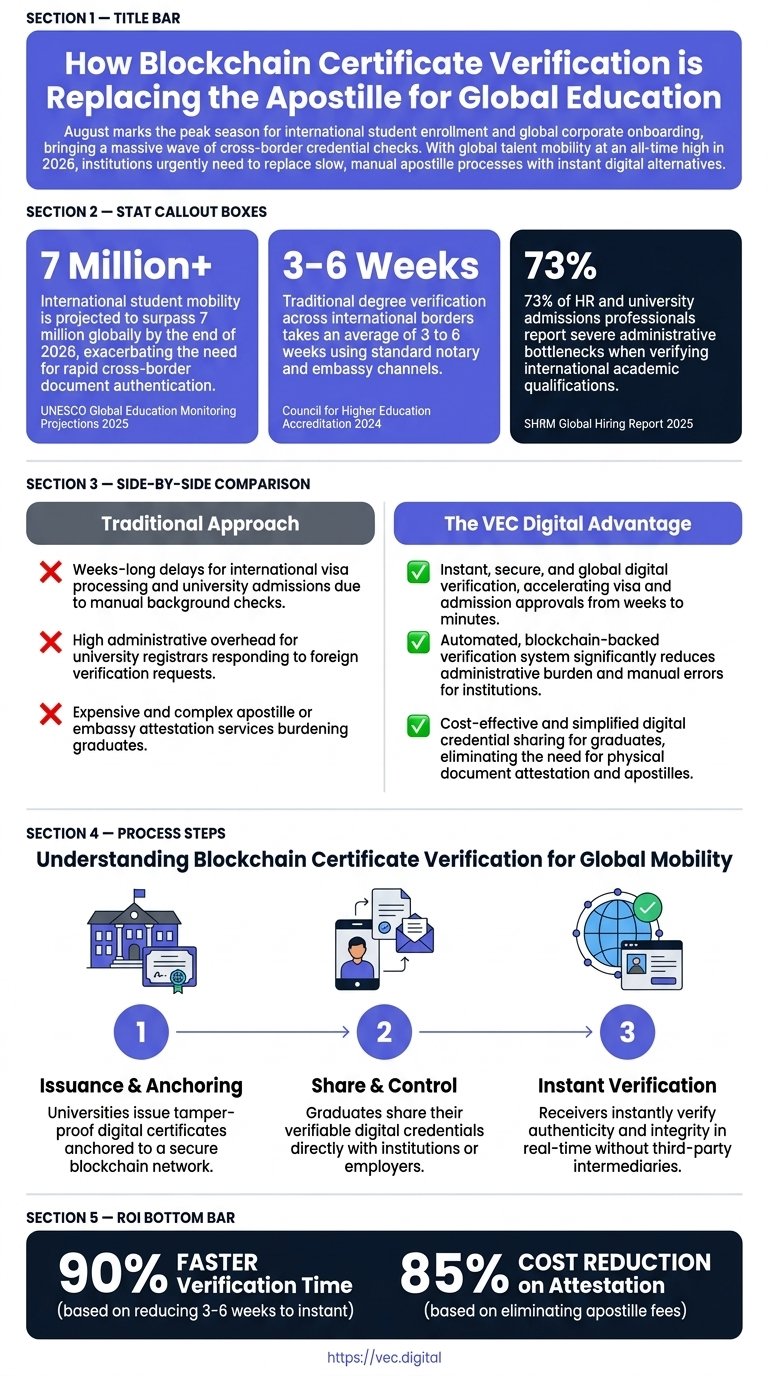
International student mobility is projected to surpass 7 million globally by the end of 2026, exacerbating the need for rapid cross-border document authentication according to UNESCO Global Education Monitoring Projections (2025). As registrars and admissions teams struggle to process this unprecedented influx, blockchain certificate verification has emerged as the definitive solution to eliminate weeks-long processing delays. Relying on traditional notary and embassy channels is no longer a viable strategy for modern academic institutions operating on a global scale.
In this article, our technology experts at VEC Digital break down how decentralized credentialing engines are fundamentally transforming global talent mobility. You will learn how to bypass traditional embassy bottlenecks, implement a secure digital diploma platform to prevent degree fraud globally, and drastically reduce administrative overhead for your university registrar operations. By adopting these advanced technological frameworks, your institution can ensure absolute trust while providing graduates with frictionless access to international opportunities.
Key Takeaways
- Blockchain certificate verification eliminates the 3 to 6-week delays traditionally associated with the Hague Apostille and embassy attestations.
- Implementing a secure digital diploma platform empowers universities to instantly prevent degree fraud across international borders.
- Modern verifiable digital credentials provide automated, scan-to-verify solutions for global employers and immigration authorities.
- The push for academic degree fraud prevention Middle East is leading global trends, reducing foreign credential processing times by 60%.
- Automated issuance systems act as a powerful bulk certificate generator, saving registrars thousands of hours during peak graduation and enrollment seasons.
The Global Crisis in Cross-Border Credentialing
The Bottleneck of Traditional Apostille and Embassy Channels
For decades, international students and expatriate professionals have been forced to rely on an archaic system of physical document authentication. Traditional degree verification across international borders takes an average of 3 to 6 weeks using standard notary and embassy channels, according to the Council for Higher Education Accreditation (2024). This multi-step process typically involves a local notary public, a state or provincial government office, a federal authentication department, and finally, the destination country's embassy or consulate. Each step introduces the potential for human error, lost documents, and severe bureaucratic delays.
These weeks-long delays for international visa processing and university admissions cause immense stress for graduates and significant logistical hurdles for institutions. When prospective students or new hires ask, "What is the fastest way to authenticate a diploma for a foreign visa?" the traditional answer has always been expedited shipping and expensive third-party expeditors. However, even these costly services cannot bypass the fundamental inefficiency of manual background checks. The global economy moves in milliseconds, yet our academic authentication infrastructure is still operating on a timeline dictated by physical mail and rubber stamps. By transitioning to blockchain certificate verification, institutions can instantly bypass these legacy bottlenecks.
The Rise of Sophisticated Diploma Mills
As the demand for global mobility increases, so does the sophistication of international diploma mills exploiting borders to hide forged documents. Bad actors leverage the disconnect between international verification agencies to produce highly convincing fraudulent degrees. Because traditional verification relies on easily manipulated physical attributesâ-such as embossed seals, specific paper weights, and wet ink signaturesâ-fraudsters can easily replicate these features using modern printing technology. This presents a critical challenge for admissions offices and corporate HR departments.
So, how do universities prevent degree fraud globally? The answer lies in shifting the foundation of trust from the physical document to an immutable digital record. When an institution issues a credential backed by cryptographic security, the physical appearance of the certificate becomes secondary to its digital signature. If a fraudster attempts to alter a single pixel or character on a digitally secured document, the cryptographic hash breaks, instantly flagging the document as invalid during an audit. This zero-trust architecture completely neutralizes the threat of diploma mills, regardless of where the document is presented in the world.
The Administrative Burden on Registrars
The fallout from these inefficient systems lands squarely on the desks of university registrars and admissions officers. In fact, 73% of HR and university admissions professionals report severe administrative bottlenecks when verifying international academic qualifications, according to the SHRM Global Hiring Report (2025). Every time a foreign embassy, a multinational corporation, or another university needs to verify an alumnus's credentials, it triggers a manual review process. Registrars must locate the student's record in legacy databases, draft a formal letter of attestation, and route it through internal approval pipelines before finally dispatching it.
This high administrative overhead for university registrars responding to foreign verification requests is unsustainable, particularly during peak enrollment seasons in August and September. The manual processing of these requests drains institutional resources, inflates operational budgets, and distracts academic staff from higher-value tasks. The modern university requires an automated system that allows third parties to self-verify credentials instantly, without ever needing to contact the registrar's office directly.
Understanding Blockchain Certificate Verification for Global Mobility
Beyond Localized Security: The Cross-Border Advantage
Most industry content focuses solely on how decentralized ledgers secure domestic records against local fraud. However, there is a massive knowledge gap regarding the strategic application of immutable records for cross-border mobility. Blockchain certificate verification is not merely a security upgrade; it is a fundamental reimagining of how trust is established between sovereign nations and international organizations. By anchoring academic records to a globally distributed, immutable ledger, universities create a single source of truth that is universally accessible and permanently tamper-proof.
When a student crosses a border, their digital credentials travel with them seamlessly. Unlike physical documents that lose their presumed authenticity the moment they leave their country of origin, a cryptographically secured credential maintains its integrity regardless of geography. The verification engine does not rely on a local server that might be blocked by international firewalls or subject to regional downtime; it relies on a decentralized network that guarantees 99.99% uptime and universal accessibility. This cross-border advantage is what makes decentralized credentialing the ultimate catalyst for frictionless global talent mobility.
How Immutable Records Bypass Bureaucratic Delays
A common question among international educators and policymakers is: Can blockchain certificate verification replace the Hague Apostille? To understand the answer, one must understand the purpose of the Hague Apostille Convention. Established to simplify the authentication of public documents abroad, the Apostille was a revolutionary concept in 1961. However, while it covers over 120 countries, processing times remain heavily localized and prone to extreme bureaucratic delays. The Apostille essentially verifies the signature and seal of the official who signed the documentâ-it does not verify the educational achievement itself.
Cryptographic verification bypasses this entirely by providing direct, irrefutable proof of the issuing institution's digital signature and the exact contents of the credential at the time of issuance. Because the cryptographic hash cannot be forged, the need for a government intermediary to vouch for the document's authenticity is eliminated. The digital credential serves as its own notary. As global immigration authorities and corporate compliance departments increasingly recognize the mathematical certainty of decentralized ledgers, the traditional apostille is rapidly becoming an obsolete requirement for academic mobility.
Ensuring Global Legal Acceptance
With the rapid adoption of this technology, many administrators ask: Are verifiable digital credentials legally accepted internationally? The answer is a resounding yes, driven by sweeping updates to international data and electronic signature laws. Frameworks such as the eIDAS regulation in the European Union and the ESIGN Act in the United States have established robust legal precedents for the validity of electronic signatures and digital records. Furthermore, global accreditation bodies are actively updating their compliance standards to mandate the use of secure digital records.
For universities, this means that issuing credentials via a secure infrastructure ensures full compliance with international data protection laws, including GDPR and FERPA. Because the decentralized ledger only stores a cryptographic hashâ-an unreadable string of charactersâ-and not the student's personally identifiable information (PII), student privacy is strictly maintained. The actual data remains securely hosted by the issuing institution or within the student's personal digital wallet. This perfect balance of absolute transparency for verification and absolute privacy for the student is driving the global legal acceptance of these modern credentials.
The Mechanics of a Modern Digital Diploma Platform
Transitioning from Paper to Cryptographic Authenticity
The journey toward modernization begins with implementing a comprehensive digital diploma platform. This platform acts as the central hub for designing, generating, and anchoring academic records. One of the most significant pain points for graduates today is the expensive and complex apostille or embassy attestation services that burden them financially and emotionally. By transitioning to a digital-first issuance model, universities completely remove this burden from their alumni. The credential is generated natively as a digital asset, imbued with cryptographic authenticity from the moment of creation.
This transition does not mean sacrificing the prestige or aesthetic value of the traditional diploma. Modern platforms utilize visual drag-and-drop editors that allow institutions to recreate their historic, ornate certificate designs perfectly. The difference is that these designs are layered with dynamic placeholders and invisible security features. When a cohort graduates, the system automatically populates the recipient details, anchors the batch to the decentralized ledger, and dispatches the digital diplomas directly to the students' inboxes. The result is a seamless, zero-friction experience that honors the institution's legacy while embracing the future of security.
The Role of Instant QR Code Verification
To make this technology truly useful on a global scale, it must be accessible to anyone, anywhere, without technical expertise. How to check if an international degree is genuine? The solution is elegant and universally understood: the QR code. Every document generated through a modern digital diploma platform features a unique, embedded QR code. When a foreign employer, visa officer, or admissions counselor receives the credential, they simply scan the code with their standard smartphone camera.
This action instantly routes the reviewer to a dedicated, secure verification URL hosted by the issuing institution. Within milliseconds, the page displays a "Blockchain Verified" security badge, confirming the issuer's identity, the recipient's details, the date of issuance, and the cryptographic integrity of the document. There are no apps to download, no accounts to create, and no fees to pay. This scan-to-verify integration serves as the ultimate physical-to-digital link, allowing students to print their diplomas for framing while maintaining instant, irrefutable digital verification.
Integrating with Existing University Systems
For a credentialing solution to be scalable, it cannot exist in a vacuum; it must communicate flawlessly with the university's existing technological ecosystem. Modern credential engines offer robust Developer APIs and seamless integrations with popular Learning Management Systems (LMS) like Canvas, Moodle, and Blackboard, as well as comprehensive Student Information Systems (SIS). This interoperability enables zero-touch automation for the registrar's office.
The moment a student's final grade is officially recorded and approved in the SIS, the automated pipeline triggers the API. The system instantly generates the certificate, anchors it, and emails it to the graduate. For high-volume events like university-wide graduations, administrators can utilize a bulk certificate generator feature, uploading a standard CSV file of thousands of recipient names to process the entire graduating class in minutes. This level of operational automation saves hundreds of administrative hours and completely eliminates the manual data entry errors that plague traditional issuance methods.
Regional Leadership and the Push for Paperless Governance
The Middle East as a Blueprint for Digital Transformation
While the need for secure credentialing is global, certain regions are accelerating adoption at an unprecedented pace. The Middle East and GCC region is leading the shift toward paperless governance, with foreign credential processing times dropping by 60% when leveraging smart digital records, according to Gulf Business Technology Trends (2026). Governments in this region have recognized that economic diversification and rapid modernization require a frictionless flow of highly skilled international talent.
The aggressive push for academic degree fraud prevention Middle East has resulted in sweeping mandates for digital transformation. By replacing paper-heavy bureaucratic processes with automated digital verification engines, these nations are drastically reducing the time it takes for expatriates to secure work visas and for international students to enroll in regional universities. This proactive approach serves as a powerful blueprint for other global hubs seeking to modernize their administrative infrastructure and attract top-tier global talent.
Adapting to High Expatriate Influxes
Hubs with high expatriate influxes, particularly in the UAE and Saudi Arabia, are actively seeking instant verification engines to modernize talent acquisition and student visa processing without compromising strict security standards. When a multinational corporation in Dubai hires an engineer from a university in Europe, the HR department cannot afford to wait six weeks for a paper apostille to clear. They require immediate, mathematically certain proof of the candidate's qualifications.
By adopting blockchain certificate verification, universities worldwide make their graduates infinitely more employable in these fast-moving, high-growth economic zones. An institution that provides instantly verifiable digital credentials signals to global employers that its graduates are ready to onboard immediately, without administrative friction. This direct alignment with the needs of international corporate HR departments significantly boosts the global reputation and perceived value of the university's degree programs.
The Environmental and Economic Impact
Beyond security and efficiency, the shift away from physical document authentication aligns closely with global sustainability goals. The traditional process of printing diplomas on heavy cardstock, applying foil seals, packaging them in leather binders, and shipping them via international air freight carries a massive carbon footprint. Furthermore, the economic cost of replacing lost, damaged, or stolen physical diplomas over a graduate's lifetime is substantial.
Transitioning to a paperless credentialing system actively supports UN Sustainability Goals by drastically reducing paper waste and eliminating the carbon emissions associated with global document courier services. For the university, this translates to a massive reduction in operational expenditures. The funds previously allocated to specialized printing presses, international postage, and manual administrative labor can be redirected toward core academic initiatives and student support services, proving that eco-friendly operations are also economically superior.
Strategic Implementation for Higher Education Administrators
Reducing Audit and Verification Times
The ultimate metric of success for any administrative technology is its impact on operational efficiency. Institutions adopting decentralized credentialing reduce administrative audit and verification times by up to 85%, according to the Gartner Hype Cycle for Higher Education (2025). This staggering reduction is achieved by shifting the burden of verification away from the registrar's office and onto the automated system. When an external auditor or compliance officer needs to verify a batch of credentials, they no longer need to submit a formal request and wait for a manual database query.
Instead, the auditor can independently scan the QR codes or process the digital files through a public verification portal. The cryptographic engine performs the audit instantly, checking the hash against the immutable ledger and returning a definitive "Valid" or "Invalid" result. This self-service model empowers external parties to complete their compliance checks on their own schedule, while simultaneously freeing the university's administrative staff to focus on strategic, student-facing initiatives.
Empowering Graduates for the Global Job Market
How do foreign employers verify university degrees in the modern era? They expect digital fluency. Today's graduates are entering a highly competitive, digital-first global job market. A physical piece of paper locked in a filing cabinet does nothing to enhance a graduate's online professional profile. By issuing verifiable digital credentials, universities empower their alumni to seamlessly integrate their achievements into their digital identities.
Graduates can embed their secure credentials directly into their LinkedIn profiles, personal portfolios, and digital resumes. When a prospective employer clicks on the credential, they are immediately taken to the university's branded verification page. This not only proves the graduate's qualifications instantly but also drives high-quality, organic traffic back to the university's website, turning the alumni network into a powerful global marketing engine. The credential becomes a dynamic asset that actively works to advance the graduate's career.
Future-Proofing Your Institutional Reputation
In an era where artificial intelligence can generate hyper-realistic forged documents in seconds, relying on visual inspection to prevent fraud is institutional negligence. The reputation of a university is its most valuable asset; a single high-profile scandal involving a forged degree can cause irreparable damage to an institution's global standing. Future-proofing your university requires adopting a security posture that is mathematically immune to forgery.
By implementing a multi-signatory approval pipeline within your digital credentialing system, you ensure strict internal governance. Certificates can be held in a secure draft status until designated academic authorities securely log in and electronically sign them, preventing accidental or rogue issuance. Combined with the immutable nature of the decentralized ledger, this comprehensive security architecture guarantees absolute authenticity, completely eliminating the possibility of credential fraud and protecting the issuing organization's brand reputation for decades to come.
Secure Your Institutionâ's Credentials Today
The global landscape of academic and professional mobility is evolving rapidly. The archaic, weeks-long processes of the Hague Apostille and manual embassy attestations are being entirely replaced by the speed, security, and mathematical certainty of cryptographic authentication. For higher education administrators, registrars, and corporate compliance leaders, the mandate is clear: modernizing your credentialing infrastructure is no longer optional; it is an operational imperative to protect your reputation and empower your graduates globally.
At our core, we believe in making credential fraud impossible. VEC Digital provides the comprehensive "trust infrastructure" required to issue, manage, and authenticate certificates seamlessly. Our platform combines a visual drag-and-drop template editor, instant scan-to-verify QR code integration, and robust API automation to scale your operations effortlessly. Eliminate administrative bottlenecks, ensure strict compliance, and give your learners the power to own their achievements securely.
Secure your organizationâ's credentials todayâ-design your first template in minutes with no setup fees and experience the future of frictionless verification.
Website: https://vec.digital
Email: support@vec.digital