
How QR Code Certificates Solve Global Degree Verification Delays
Published on June 5, 2026
With over 7 million students projected to enroll in tertiary education outside their home countries by 2026, the demand for seamless cross-border credential authentication has reached a critical breaking point. Universities relying on manual administrative systems are discovering that traditional verification methods actively harm alumni competing in a fast-paced global job market. By transitioning to QR code certificates, academic institutions can instantly eliminate weeks of administrative delays and bridge the gap between international graduates and enterprise employers.
Our team at Vec.Digital specializes in bridging these technological gaps through advanced credentialing systems that modernize how educational achievements are shared and authenticated worldwide. In this comprehensive guide, you will learn how to bypass the high costs of international document shipping, resolve the operational bottlenecks overwhelming your registrar's office, and implement a decentralized verification engine that empowers graduates to secure global employment without bureaucratic friction.
Key Takeaways
- QR code certificates eliminate the 4 to 6-week delays traditionally associated with international background checks.
- Adopting verifiable digital credentials aligns universities with the expectations of a highly mobile, remote-first global workforce.
- Replacing physical paper shipments with digital solutions saves institutions up to $120 per document while supporting UN sustainability goals.
- A professional digital certificate maker allows academic registrars to automate credential issuance at scale securely.
- Blockchain certificate verification provides immutable, self-sovereign proof of education that foreign employers can trust instantly.
The Administrative Burden of Global Credential Authentication
The landscape of higher education has fundamentally shifted from regional to global. As borders become less relevant to the modern workforce, the administrative systems supporting these transitions must evolve. The reliance on legacy credentialing methods has created an immense operational bottleneck for university registrars and admissions officers worldwide.
To understand the sheer scale of this challenge, we must look at the data driving international student mobility. The operational friction is no longer a localized issue; it is a systemic challenge affecting higher education institutions across every continent.
The Surge in Cross-Border Employment
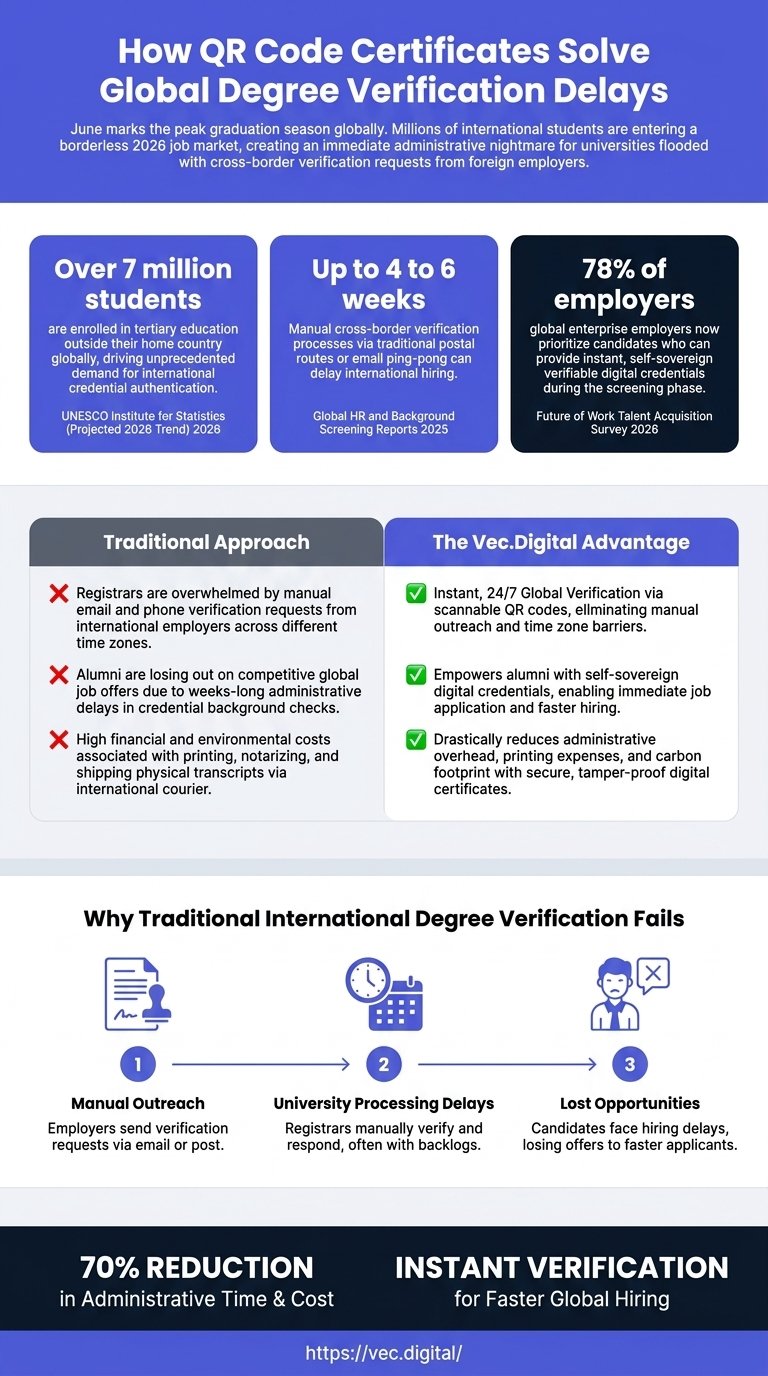
According to the UNESCO Institute for Statistics (Projected 2026 Trend), over 7 million students are enrolled in tertiary education outside their home country globally, driving unprecedented demand for international credential authentication. This massive cohort of international learners will soon graduate into a borderless job market, bringing with them an avalanche of verification requests from foreign employers.
With the rise of global digital nomad visas and remote-first workforces, regulatory networks like the European Quality Assurance Register (EQAR) and global credential evaluators are pushing higher education institutions toward decentralized, instant-verification models. The traditional model, where an employer mails or emails a university to confirm a candidate's degree, simply cannot scale to meet the demands of millions of mobile professionals.
When an institution fails to modernize its approach, the registrar's office becomes a bottleneck. Staff members are forced to spend countless hours manually cross-referencing student databases, drafting official confirmation letters, and communicating with international entities. This manual labor detracts from strategic university initiatives and degrades the overall administrative efficiency of the institution.
The True Cost of Physical Document Shipping
Beyond the time expenditure, the financial and environmental costs of legacy verification are staggering. According to the Higher Education Administrative Cost Index (2025), shipping physical, notarized degrees internationally costs universities and students an average of $45 to $120 per document. When multiplied by thousands of graduating international students, this represents a massive drain on university budgets and student finances.
Furthermore, this reliance on physical paper and international couriers stands in direct opposition to global sustainability initiatives. Organizations worldwide are striving to meet UN sustainability goals by reducing their carbon footprints. Shipping heavy, wax-sealed documents across oceans via air freight contributes unnecessarily to global emissions when a secure, digital alternative is readily available.
By adopting a robust digital credentials platform target="_blank" rel="noopener", universities can entirely eliminate these shipping costs. This transition not only frees up institutional capital but also positions the university as a forward-thinking, environmentally responsible entity that prioritizes sustainable administrative processes.
Why Traditional International Degree Verification Fails
The core issue with traditional degree verification is that it was designed for a localized, analog world. When these legacy processes are stretched across international borders, they break down, causing severe friction for all parties involved: the university, the employer, and most importantly, the graduate.
Understanding the specific failure points of the old system is crucial for institutions looking to implement modern technological solutions. The pain points extend far beyond mere inconvenience; they represent active barriers to global employment.
Time Zone and Language Barriers
Registrars are currently overwhelmed by manual email and phone verification requests from international employers across different time zones. When an HR manager in Tokyo needs to verify a degree from a university in London or New York, the simple act of a phone call becomes a logistical nightmare. The resulting "email ping-pong" can drag on for days as parties attempt to coordinate across disparate working hours.
Language barriers further complicate this process. Traditional phone-based degree verification often requires bilingual staff or translation services, adding another layer of complexity and potential miscommunication. When dealing with high-stakes employment background checks, even a minor misunderstanding regarding a graduate's honors or major can jeopardize their job offer.
These manual touchpoints introduce human error into what should be an objective, binary confirmation of facts. A system reliant on human availability and linguistic compatibility is inherently fragile in a globalized economy.
Navigating International Data Privacy Laws
Another significant hurdle in manual verification is the complex web of international data privacy regulations. When foreign employers request academic records, universities must ensure compliance with frameworks like the General Data Protection Regulation (GDPR) in Europe or similar laws in other jurisdictions. Sharing sensitive student data via unencrypted emails or unrecorded phone calls exposes the institution to severe legal and financial risks.
Because privacy laws vary so drastically from country to country, university administrators are often forced to act as amateur legal analysts, determining what information can be legally shared with an employer in a specific foreign nation. This hesitation and need for legal clearance further slows down the verification timeline.
Modern credentialing systems solve this by giving the student self-sovereign control over their data. When a student chooses to share their verified digital record, they are actively consenting to the data exchange, thereby simplifying the privacy compliance burden for the issuing university.
The Impact on Alumni Career Opportunities
The most devastating consequence of these administrative failures falls squarely on the alumni. According to Global HR and Background Screening Reports (2025), manual cross-border verification processes via traditional postal routes or email ping-pong can delay international hiring by up to 4 to 6 weeks. In today's competitive job market, a 6-week delay is often the difference between a candidate securing a position and an employer moving on to the next applicant.
Alumni are literally losing out on competitive global job offers due to weeks-long administrative delays in credential background checks. When an enterprise employer has to choose between two equally qualified candidates, they will invariably select the one whose background can be cleared in 24 hours over the one whose university takes a month to respond to an email.
This reality damages the university's reputation. An institution's ultimate value proposition is the career success of its graduates. If the university's administrative machinery prevents alumni from securing employment, the institution is failing in its primary mission.
How QR Code Certificates Transform Cross-Border Hiring
The solution to these systemic failures lies in cryptographic technology and mobile accessibility. By embedding verifiable data directly into the credential itself, universities can remove themselves as the middleman in the verification process, allowing employers to authenticate degrees instantly and autonomously.
The cornerstone of this modern approach is the use of QR code certificates. This technology bridges the physical and digital worlds, providing a universally understood interface for instant data retrieval and authentication.
Instant Scanning for Foreign Employers
When a university issues a certificate equipped with a unique, dynamic QR code, it fundamentally alters the hiring timeline. A foreign employer reviewing a candidate's resume or digital portfolio simply points their smartphone camera at the code. Within seconds, they are routed to a secure, university-branded public verification page that displays the issuer, recipient, date of issuance, and official signatory details.
This instant authentication bypasses time zones, language barriers, and postal delays entirely. The data is presented clearly, in a standardized format, proving beyond a doubt that the document is authentic and unaltered. This frictionless experience is highly valued by modern organizations. In fact, according to the Future of Work Talent Acquisition Survey (2026), 78% of global enterprise employers now prioritize candidates who can provide instant, self-sovereign verifiable digital credentials during the screening phase.
By providing QR-enabled documents, universities are giving their alumni a distinct competitive advantage. They are transforming their graduates into "pre-verified" candidates who can move swiftly through corporate background checks.
Decentralized and Self-Sovereign Identity
The power of these modern credentials lies in the concept of self-sovereign identity. Instead of the university holding the record hostage in a siloed database, the graduate is given ownership of a cryptographically secure digital asset. They can store this asset in a digital locker and share it with whomever they choose, whenever they need to.
This decentralized approach removes the university from the day-to-day burden of answering verification emails. The cryptographic proof is baked into the document itself. Even if the university's primary servers were to undergo maintenance, blockchain-anchored credentials remain independently verifiable on the public ledger.
This model not only empowers the student but dramatically reduces the operational overhead for the institution. Registrars can transition from being reactive data-fetchers to proactive administrators focused on higher-level institutional goals.
Meeting Generation Z Expectations
The demographic shift in higher education cannot be ignored. Today's graduates are digital natives who manage their lives, finances, and social interactions via mobile devices. They expect their academic achievements to follow suit. According to the EdTech Student Experience Monitor (2026), 92% of Generation Z graduates expect their academic achievements to be accessible via mobile devices for instant sharing on platforms like LinkedIn.
A physical piece of paper in a leather binder, while ceremonially significant, holds little practical utility for a graduate networking in digital spaces. QR-enabled credentials provide the best of both worlds. They can be printed for ceremonial purposes (with the QR code remaining scannable on the paper) while existing natively as a digital asset optimized for social sharing and online portfolios.
When universities meet these expectations, they boost alumni engagement and satisfaction, leading to stronger post-graduate networks and higher institutional prestige.
Implementing a Verifiable Digital Credentials System
Recognizing the need for modernization is only the first step. The critical phase is implementation. Universities need systems that are robust enough to handle enterprise-level data but intuitive enough for non-technical administrative staff to operate without extensive training.
Transitioning from legacy paper processes to a secure digital framework requires a strategic approach, utilizing tools designed specifically for high-volume, secure document generation and authentication.
Digitizing International Student Records
The foundation of a modern credentialing system is a professional digital certificate maker. This tool allows universities to recreate their traditional, branded diplomas in a dynamic digital format. Administrators can use drag-and-drop interfaces to place university seals, official typography, and dynamic data fields exactly where they belong.
Digitizing records means moving away from static PDFs or physical prints. Instead, the university creates a master template. When a student graduates, the system dynamically populates this template with the student's specific details—name, degree, honors, and unique identifier—culminating in the generation of a unique QR code tied specifically to that individual's achievement.
This process ensures that the digital diploma retains the gravitas and visual identity of the institution while gaining the superpowers of digital authentication. It is a seamless blend of tradition and modern technology.
Automating the Issuance Engine
For large universities graduating thousands of students simultaneously, manual data entry is a critical vulnerability. It introduces the risk of typos and consumes massive amounts of administrative time. To solve this, institutions must leverage a bulk certificate generator.
By utilizing an automated process, universities can connect their existing Student Information Systems (SIS) or Learning Management Systems (LMS) directly to the credentialing engine. Through CSV uploads or secure API connections, registrars can issue thousands of personalized, QR-enabled diplomas in a matter of minutes.
This automated engine handles the heavy lifting. It generates the unique cryptographic hashes, creates the individual verification pages, and automatically emails the secure digital credentials directly to the graduates' inboxes. What used to take weeks of printing, signing, and stuffing envelopes is reduced to a few clicks on a centralized dashboard.
Integrating Blockchain Certificate Verification
To achieve the highest level of global trust, the system must be tamper-proof. This is where blockchain certificate verification becomes essential. When a credential is generated, a unique digital fingerprint (hash) of that document is anchored to an immutable public blockchain.
If a malicious actor attempts to alter the digital diploma—for example, changing a "B.A." to a "Ph.D."—the cryptographic fingerprint will change. When an employer scans the QR code of the altered document, the system will compare the new fingerprint against the original one anchored on the blockchain. The mismatch will instantly flag the document as invalid or forged.
This provides absolute certainty to foreign employers. They do not need to trust a potentially spoofed email address or a forged PDF; they rely on the mathematical certainty of the blockchain. For institutions, this completely eradicates the threat of diploma mills and credential fraud tarnishing their academic reputation.
Frequently Asked Questions About Global Credentialing
As universities transition to decentralized verification models, administrators and faculty often have specific questions about the practical application of these technologies in a global context. Below, we address the most common inquiries regarding international credential authentication.
How do employers verify international university degrees?
Historically, employers verified international degrees by contacting the issuing university's registrar via phone or email, or by hiring third-party background screening agencies. Today, employers verify modern degrees by simply scanning the embedded QR code or clicking the secure verification link provided by the candidate, instantly accessing the university-backed authentication page.
Can foreign employers scan QR code certificates?
Yes. QR codes are a universal technology standard accessible via any standard smartphone camera or QR scanning application worldwide. The employer does not need to download a specific proprietary app, register for an account, or pay a fee. The scan instantly routes them to the public verification URL via their standard web browser, making it a truly borderless solution.
How long does international degree verification take?
Traditional manual verification can take anywhere from 4 to 6 weeks due to postal delays, time zone differences, and administrative backlogs. However, when utilizing verifiable digital credentials equipped with cryptographic security, the verification process takes less than three seconds. It is instantaneous and available 24/7/365.
What is the best digital certificate maker for global universities?
The best platforms for global universities are those that combine intuitive design capabilities with enterprise-grade security. A superior system must offer API integrations for automated bulk issuance, custom dynamic fields, built-in signatory approval processes, and, most importantly, immutable blockchain anchoring to ensure global trust and compliance.
Do international background check companies accept verifiable digital credentials?
Absolutely. Global background screening firms and credential evaluators highly prefer verifiable digital credentials. Because these documents are mathematically proven to be untampered and originate directly from the issuing institution's verified digital identity, background check companies can clear candidates instantly, reducing their own operational overhead and improving their turnaround times for enterprise clients.
How can universities digitize international student records?
Universities can digitize records by adopting a comprehensive credentialing platform that integrates with their existing student databases. By exporting graduate data (via CSV or API) into a secure credentialing engine, the university can automatically map student data to branded design templates, generate unique cryptographic hashes, and issue secure digital assets directly to the students' digital wallets or email addresses.
Future-Proof Your University's Certification Process
The global mobility of students and professionals is not a temporary trend; it is the permanent future of the worldwide economy. As international hiring accelerates, universities can no longer afford to rely on physical paper, international couriers, and manual email verification to support their alumni. The administrative burden is too high, the costs are too steep, and the negative impact on graduate career prospects is too severe.
By embracing cryptographic verification and automated issuance systems, educational institutions can transform a costly administrative nightmare into a streamlined, value-adding service. Empowering your graduates with instantly verifiable, self-sovereign digital diplomas ensures they remain highly competitive in the global job market, while simultaneously reducing your operational costs and supporting global sustainability initiatives.
It is time to eliminate cross-border verification delays and secure your institution's reputation on the global stage. If your university is ready to modernize its credentialing infrastructure, our team provides the secure, scalable technology required to make the transition effortless. Discover how to automate your issuance and provide unbreakable cryptographic trust for your alumni today.
Website: https://vec.digital/ target="_blank" rel="noopener" Email: support@vec.digital