
How QR Code Certificates Turn Your Alumni Network Into a Global Marketing Engine
Published on June 13, 2026

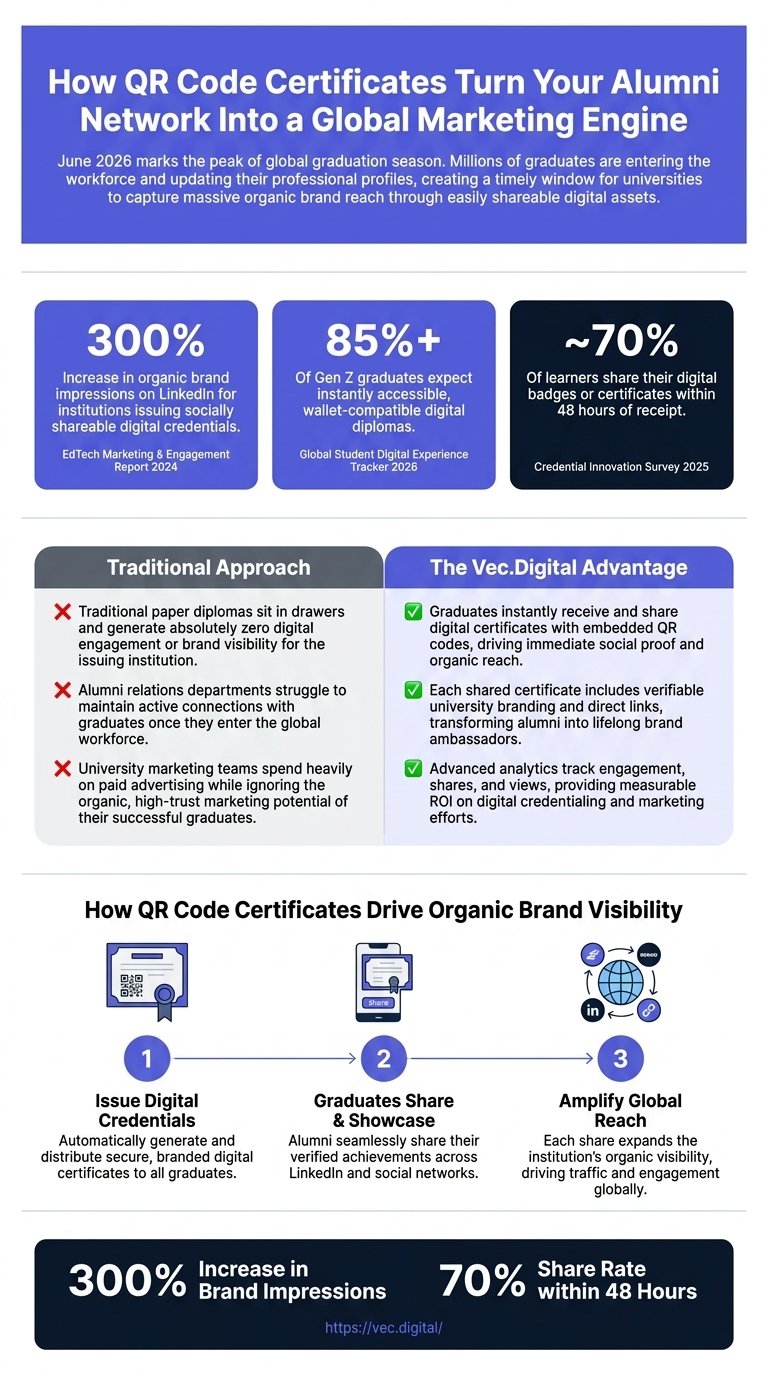
June 2026 marks the peak of global graduation season, with millions of international graduates entering the workforce and updating their professional profiles worldwide. Yet, for many prestigious institutions, this massive milestone translates to zero digital engagement because traditional paper diplomas sit forgotten in drawers or remain framed on living room walls. By adopting QR code certificates, forward-thinking universities and enterprise platforms are transforming these static, physical achievements into dynamic, globally visible marketing assets.
In this comprehensive guide, we will explore how shifting your perspective from purely administrative fraud prevention to strategic marketing ROI can revolutionize your institution's digital presence. Drawing on our deep expertise in credentialing technology at Vec.Digital, you will learn how to boost organic brand visibility, automate your digital issuance system, and turn your global alumni network into your most powerful inbound marketing engine.
Key Takeaways
- Discover how QR code certificates generate up to a 300% increase in organic brand impressions on professional networks.
- Learn to leverage verifiable digital credentials to capture inbound marketing traffic and attract prospective students.
- Understand why an enterprise-grade digital certificate maker is essential for modern higher education marketing and operational efficiency.
- Explore data-driven strategies to boost university alumni engagement and prevent the loss of critical employment data post-graduation.
- Master the implementation of shareable digital diplomas to enhance global education brand visibility across international borders.
The Hidden Cost of Traditional Paper Diplomas
Why Paper Fails in a Digital-First World
For centuries, the physical diploma has been the ultimate symbol of academic achievement. However, in today's interconnected, digital-first economy, traditional paper diplomas sit in drawers and generate absolutely zero digital engagement or brand visibility for the issuing institution. When a student graduates, the physical piece of paper they receive cannot be easily shared with international employers, nor does it link back to the university's digital ecosystem. This represents a monumental missed opportunity for organic marketing.Furthermore, students experience significant friction when trying to quickly prove their academic achievements to modern employers on digital-first job platforms. Scanning a physical document, getting it notarized, or waiting weeks for a university registrar to confirm a degree via email slows down the hiring process. In an era where digital transformation dictates the speed of business, relying on analog proof of achievement is no longer viable for ambitious professionals or the institutions that educate them.
The Disconnect in Alumni Relations
Alumni relations departments globally struggle to maintain active connections with graduates once they enter the international workforce. After the cap and gown are put away, the primary touchpoints between an institution and its alumni often devolve into generic newsletters or direct requests for financial donations. This transactional approach frequently leads to disengagement.The statistical reality is staggering: universities typically lose track of up to 60% of their alumni's employment data and professional progression within five years of graduation, according to the Alumni Professional Networks Survey (2024). When institutions lose this data, they lose the ability to showcase their most successful graduates to prospective students. They also lose the opportunity to build a thriving, interconnected corporate network that benefits both the university and its alumni.
The Shift Toward Verifiable Digital Credentials
To combat these systemic issues, there is a massive global shift toward digital-first credentialing. Modern learners are demanding more from their educational investments. They want assets that work for them in the digital economy. In fact, over 85% of Gen Z graduates now expect their institutions to provide instantly accessible, wallet-compatible digital diplomas upon course completion, as reported by the Global Student Digital Experience Tracker (2026).By issuing verifiable digital credentials, universities are meeting this modern demand while simultaneously solving their own administrative and marketing challenges. These digital assets are not merely PDFs; they are cryptographically secure, interactive web pages that serve as living proof of a graduate's capabilities. When an institution transitions to this model, they instantly upgrade their technological infrastructure, align with global sustainability goals by reducing paper waste, and open the door to unprecedented digital marketing opportunities.
How QR Code Certificates Drive Organic Brand Visibility
Transforming Graduates into Brand Ambassadors
University marketing teams spend heavily on paid advertising, international recruitment campaigns, and costly promotional materials while frequently ignoring the organic, high-trust marketing potential of their successful graduates. Every time an alumnus secures a prestigious job, earns a promotion, or speaks at an industry event, it is a testament to the quality of their education. **QR code certificates** turn these individual successes into direct, measurable brand visibility for the university.When graduates share their achievements online, they act as micro-influencers for their alma mater. The data supports this strategy overwhelmingly: institutions issuing socially shareable digital credentials experience up to a 300% increase in organic brand impressions on LinkedIn, according to the EdTech Marketing & Engagement Report (2024). This organic reach is far more valuable than paid advertisements because it comes with the built-in social proof of a successful, real-world graduate.
The Mechanics of Shareable Digital Diplomas
A common question among educators and administrators is: *How do students add their digital diplomas to LinkedIn?* The process, when powered by a robust digital certification engine, is entirely seamless. Upon graduation, students receive a secure email containing a link to their dedicated, blockchain-anchored verification page. With a single click of an embedded "Add to Profile" button, the credential's metadata—including the issuing institution's logo, the degree title, and the unique verification URL—is automatically populated into the "Licenses & Certifications" section of their LinkedIn profile.Because the process is frictionless, adoption rates are incredibly high. Approximately 70% of learners share their digital badges or certificates on professional networks within 48 hours of receipt, as noted in the Credential Innovation Survey (2025). This rapid sharing creates a viral loop of brand exposure exactly when the graduate's network is most likely to be engaging with their profile to offer congratulations.
Inbound Marketing Through Verification Pages
Most existing articles treat QR codes and digital certificates strictly as administrative or security tools to prevent forgery. There is a glaring lack of strategic content addressing how these verification pages serve as a community-building tool and an automated inbound marketing engine for the institution. Every shared digital diploma includes a unique link back to a public verification page hosted by the university or its credentialing partner.When an employer, colleague, or prospective student clicks on that credential from a LinkedIn feed, they are routed to a beautifully designed, branded landing page. This page not only verifies the graduate's achievement but also prominently features the university's branding, mission, and links to relevant academic programs. Referral traffic from clicked verification pages accounts for a 25% boost in prospective student inbound web visits for early-adopter universities, according to the Higher Ed Inbound Marketing Study (2025). This transforms a simple security feature into a continuous, high-converting lead generation system.
Bridging the Gap: Marketing Meets Credential Security
Beyond Fraud Prevention
While the marketing benefits of a **digital certificate maker** are profound, they are built on a foundation of absolute cryptographic trust. Educational fraud is a multi-billion dollar global problem. Fake degrees and unverified claims damage the reputation of legitimate institutions and devalue the hard work of honest students. However, the narrative must shift from purely 'fraud prevention' to the untapped marketing ROI of digital credentials.The beauty of modern certification systems is that security and marketing are no longer mutually exclusive; they are symbiotic. A highly secure, blockchain-anchored certificate is inherently more valuable to a graduate, making them more likely to share it proudly. When an employer scans the QR code, they are greeted not just with a "verified" checkmark, but with a comprehensive digital experience that reinforces the prestige and technological sophistication of the issuing university.
Global Reach for International Students
With international student mobility hitting record highs in 2026, graduates are returning to their home countries or moving abroad for work in unprecedented numbers. A student might graduate from a university in the United Kingdom, return home to India, and apply for a remote position with a company based in Dubai. In this borderless economy, traditional methods of credential verification—such as international phone calls or mailed transcripts—are obsolete.A globally scannable QR verification system allows universities to project their brand authority into international job markets seamlessly, without geographic limitations. How do QR code certificates work for university graduates? It is remarkably simple: the graduate presents the QR code (either digitally on a smartphone or printed on a physical copy) to a prospective employer anywhere in the world. The employer scans it with a standard smartphone camera and is instantly directed to the immutable digital record. No apps, no accounts, and no waiting periods are required.
Privacy and Compliance in Digital Verification
As institutions digitize their records, a critical question arises: *Are QR codes on degree certificates safe and privacy-compliant?* The answer is a resounding yes, provided the underlying technology is enterprise-grade. Leading platforms utilize advanced encryption and blockchain anchoring to ensure that data cannot be altered or tampered with after issuance.Furthermore, privacy compliance is baked into the architecture. Public verification pages only display the necessary metadata required to prove the achievement—such as the recipient's name, the degree awarded, the issue date, and the cryptographic proof. Sensitive personal information, such as grades or financial records, remains securely locked within the university's internal systems. This ensures compliance with global data protection regulations like GDPR, giving both the institution and the graduate complete peace of mind.
Building Your Institution's Digital Credential Strategy
Choosing the Right Digital Certificate Maker
Implementing a successful credentialing program requires the right technological infrastructure. *How does a digital certificate maker help with higher education marketing?* A premium platform acts as the central hub for designing, issuing, and managing your entire credential ecosystem. It allows marketing and design teams to create visually stunning, on-brand certificates using intuitive drag-and-drop interfaces, ensuring that every digital asset reflects the institution's prestige.When selecting a platform, institutions must look for solutions that offer automated bulk issuance, custom dynamic fields, and built-in signatory approval systems. The ability to upload custom background designs and utilize hundreds of professional fonts ensures that the digital transition does not compromise the traditional aesthetic value of the university's awards. The system should operate seamlessly in the background, allowing administrators to issue thousands of secure credentials in minutes.
Integrating QR Codes into Academic Transcripts
While diplomas are the most visible awards, comprehensive academic records are equally important. Administrators frequently ask: *Can you put a verification QR code on an academic transcript?* Absolutely. The same technology that secures a digital diploma can be applied to transcripts, compliance records, internship acknowledgments, and participation certificates.By embedding dynamic QR codes onto academic transcripts, universities empower students to share verified proof of specific coursework, GPA, and academic honors instantly. This granular level of verification is highly attractive to corporate recruiters seeking specific skill sets. It also further expands the university's digital footprint, as each verified document serves as another potential entry point for inbound traffic to the institution's web properties.
The User Experience for Graduates
For a digital credential strategy to succeed, the user experience for the graduate must be flawless. If accessing or sharing a certificate requires navigating complex software or paying hidden fees, adoption rates will plummet. The goal is to remove all friction between the moment of achievement and the moment of public celebration.The ideal system delivers the credential directly to the graduate's inbox. From there, they can view the high-resolution certificate, download a secure PDF version for their personal archives, and use one-click integrations to broadcast their success across social media. By prioritizing the graduate's experience, universities ensure that their alumni become enthusiastic, lifelong ambassadors for the brand.
Maximizing Alumni Engagement for Long-Term Success
Reconnecting with Lost Alumni
One of the most powerful applications of **university alumni engagement** technology is the ability to reconnect with graduates who have fallen off the radar. By digitizing historical records and retroactively issuing verifiable digital credentials to past graduating classes, universities can re-establish contact with thousands of alumni.This initiative acts as a massive re-engagement campaign. When alumni receive a modern, secure digital version of their past achievements, it reignites their connection to the university. It prompts them to update their current contact information and employment status, directly combating the data loss that plagues traditional alumni relations departments. This renewed connection often leads to increased participation in alumni events, mentorship programs, and philanthropic giving.
The Benefits for Alumni Networks
*What are the benefits of verifiable digital credentials for alumni networks?* Beyond simple record-keeping, these digital assets foster a sense of exclusive community and professional prestige. When an alumni network is powered by verifiable credentials, it becomes a trusted pool of talent for global employers. Corporate partners know that any candidate sourced from this network has irrefutable proof of their qualifications.Additionally, universities can issue continuous learning badges to alumni who participate in post-graduate webinars, executive education courses, or alumni leadership roles. This strategy transforms the alumni network from a passive directory into an active, lifelong learning community, continuously driving brand engagement year after year.
Automating the Issuance Engine
Managing the generation and distribution of thousands of credentials across multiple graduating classes requires robust technical automation. Manual data entry is not only time-consuming but highly prone to human error. By utilizing an automated process via CSV uploads or REST API integrations, institutions can connect their existing Student Information Systems (SIS) or Learning Management Systems (LMS) directly to their credentialing platform.This automated engine ensures that the moment a student's final grade is approved, their secure digital diploma is generated, signed by the appropriate digital signatories, and delivered instantly. Administrative staff are unburdened from the tedious tasks of printing, signing, and mailing physical papers, allowing them to focus on high-value strategic initiatives like global student recruitment and marketing.
Secure Your Institution's Future with Vec.Digital
The transition from traditional paper documents to shareable digital diplomas is no longer just a technological upgrade; it is a strategic imperative for modern education brand visibility. By embracing verifiable digital credentials, your institution can eradicate diploma fraud, streamline administrative operations, and unlock an unprecedented organic marketing engine driven by your most successful graduates.
At Vec.Digital, we provide the comprehensive tools you need to effortlessly create, manage, publish, and authenticate certificates globally. Our platform combines a powerful drag-and-drop design editor with immutable blockchain security and instant QR verification, ensuring your credentials are both beautiful and tamper-proof. With a 99.98% uptime guarantee and seamless API integration, we empower universities and enterprises to issue with confidence and scale without limits.
Stop letting your institution's greatest achievements gather dust in a drawer. Transform your alumni network into a global marketing force today.
Ready to revolutionize your digital credentials? Visit us at: https://vec.digital/ Contact our Happiness Centre: support@vec.digital