
How Scaling EdTech Platforms Automate Learner Recognition Using a Bulk Certificate Generator
Published on June 12, 2026

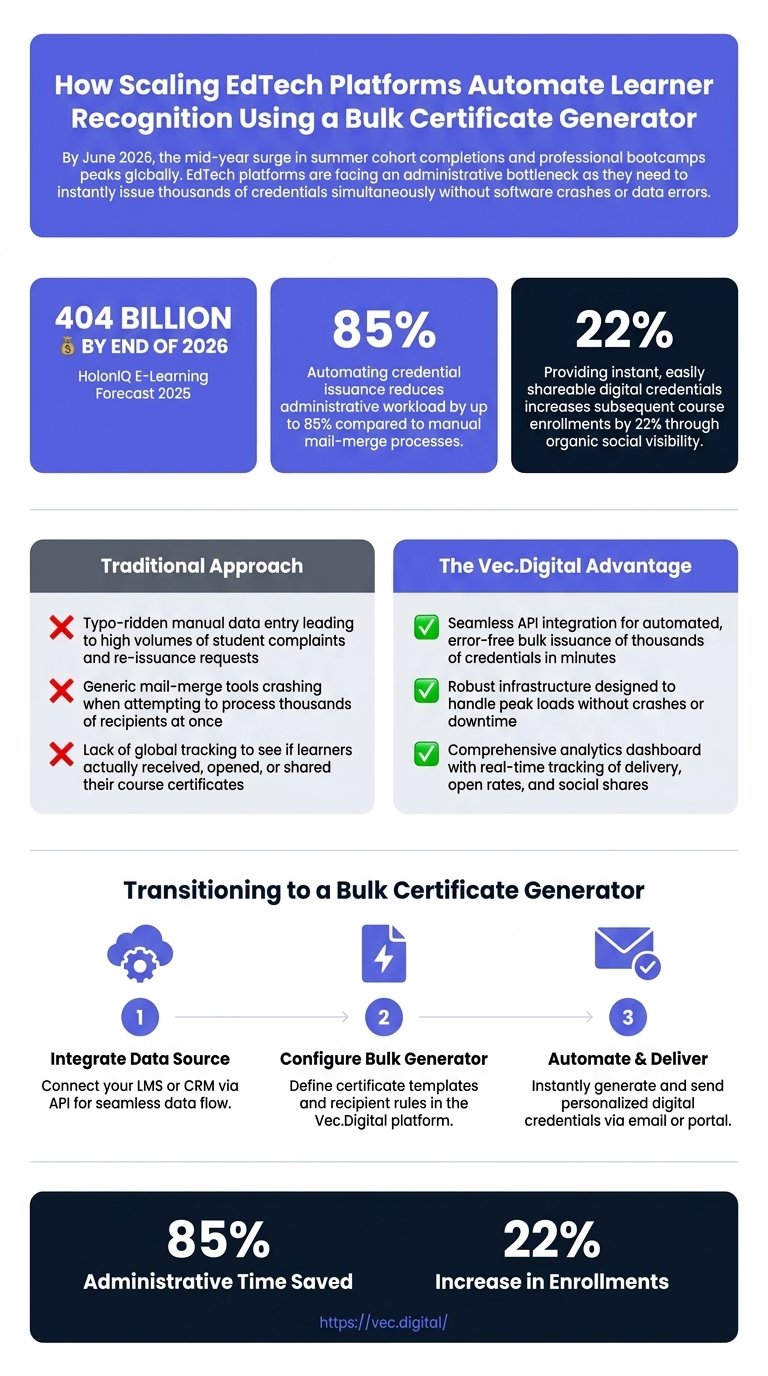
The global EdTech market is projected to reach $404 billion by the end of 2026, driven by continuous upskilling, according to the 2025 HolonIQ E-Learning Forecast. As student cohorts scale, administrative teams are encountering severe operational bottlenecks, making a robust bulk certificate generator essential for modern digital academies. Relying on manual data entry to issue thousands of graduation awards is no longer a viable or secure strategy for growing educational platforms.
In this comprehensive guide, our team at Vec.Digital will explore how transitioning to an automated credentialing system transforms educational operations. You will learn how to automate certificate delivery, securely integrate learning management systems via API, and leverage verifiable digital credentials to turn graduate recognition into a powerful, organic marketing engine for your institution.
Key Takeaways
- Automated Data Processing eliminates manual entry errors and reduces administrative overhead by up to 85%.
- Secure API Integrations allow educational platforms to connect their systems directly to a digital certificate maker for instant issuance.
- Cryptographic Verification ensures that digital certificates from online bootcamps and universities are globally trusted by employers.
- Global Privacy Compliance is maintained by replacing unencrypted emailed spreadsheets with secure, cloud-based data handling.
- Organic Marketing Growth is achieved when learners share their verifiable digital credentials on professional networks, boosting subsequent course enrollments.
The Operational Bottlenecks in Modern EdTech
The Hidden Costs of Manual Data Entry
For many emerging online learning platforms, the initial approach to learner recognition involves manually designing and distributing documents. However, as enrollment numbers climb into the thousands, this manual approach quickly becomes a critical liability. Typo-ridden manual data entry leads to high volumes of student complaints, tarnishing the celebratory moment of course completion. When an administrative team must manually verify names, course titles, and dates of completion, the margin for human error grows exponentially.
These errors do not just frustrate learners; they create a massive backlog of re-issuance requests that drain administrative resources. According to the 2025 EdTech Operations Benchmark Report, automating credential issuance reduces administrative workload by up to 85% compared to manual mail-merge processes. By eliminating the need to type out individual student details, educational institutions can reallocate their staff to higher-value tasks, such as curriculum development and student engagement.
Why Generic Tools Fail at Scale
A common question among operations managers is, "How do you create thousands of certificates at once?" Historically, teams have turned to generic office software and basic mail-merge plugins. While these tools might suffice for a classroom of twenty students, they are fundamentally unequipped for enterprise-level operations. Generic mail-merge tools frequently crash when attempting to process thousands of recipients at once, leading to corrupted files, unsent emails, and significant downtime.
To successfully scale an EdTech platform, you need a dedicated bulk certificate generator engineered specifically for high-volume data processing. A specialized system allocates dedicated server resources to handle massive batches of data seamlessly, ensuring that whether you are issuing fifty or fifty thousand credentials, the operation executes flawlessly without timing out or dropping records.
The Global Data Privacy Imperative
Beyond operational efficiency, the way an institution handles student data is under increasing legal scrutiny worldwide. With the tightening of data privacy laws worldwide, such as the EU's GDPR and the UAE's Federal Decree-Law on Data Protection, EdTech platforms can no longer rely on emailing unencrypted spreadsheets of student data to third-party designers or using unsecured desktop applications. A secure, cloud-based engine that processes data compliantly is now a global legal necessity.
Modern credentialing platforms utilize end-to-end encryption and secure cloud infrastructure to ensure that sensitive learner information—such as full names, email addresses, and academic performance metrics—is never exposed to unauthorized parties. By centralizing this process within a compliant ecosystem, universities and online course creators mitigate the risk of catastrophic data breaches.
Transitioning to a Bulk Certificate Generator
What is a Bulk Certificate Generator?
A bulk certificate generator is a specialized software solution designed to automate the creation, personalization, and distribution of digital awards at scale. Instead of designing one document at a time, administrators create a single, master template utilizing dynamic fields (such as [Student_Name] or [Completion_Date]). The system then ingests a structured data file, mapping the data to the corresponding fields, and generates thousands of unique, personalized documents in a matter of seconds.
At Vec.Digital, our comprehensive platform goes beyond simple document generation. We provide an intuitive, drag-and-drop digital certificate maker that allows organizations to maintain absolute creative control while leveraging enterprise-grade automation. This ensures that every credential issued is both visually stunning and cryptographically secure.
Automating with Secure CSV Uploads
One of the most frequent inquiries we receive from EdTech founders is, "How do I automatically generate certificates from a CSV file?" The process is remarkably straightforward when utilizing a modern platform. Administrators simply export their student roster from their database into a standard CSV format. This file is then securely uploaded into the credentialing system, which automatically reads the columns and populates the dynamic fields on the chosen template.
This automated process completely bypasses manual data entry. The system parses the data, applies the designated branding, embeds a unique verification QR code for each recipient, and dispatches the final verifiable digital credentials directly to the learners' inboxes. The entire operation, which previously took weeks of manual labor, is condensed into a secure, five-minute automated sequence.
Maintaining Brand Consistency Across Instructors
In decentralized e-learning environments or large universities, multiple instructors often manage their own cohorts. A major pain point in these environments is inconsistent branding when multiple instructors manually issue completion awards outside of a central system. This fragmentation dilutes the institution's brand identity and makes it difficult to maintain a standard of quality.
Implementing a unified team management system solves this issue by centralizing the design and issuance process. Administrators can lock approved templates, ensuring that all instructors issue credentials that adhere strictly to corporate branding guidelines. By routing all generation through a single, secure platform, the institution guarantees that every learner receives a high-quality, authentic representation of their achievement.
Seamless LMS Integration and API Automation
Connecting Your Learning Management System
For fully automated operations, relying on manual CSV uploads is only the first step. The ultimate goal for scaling academies is to achieve zero-touch issuance. Course creators frequently ask, "Can I integrate a digital certificate maker with my LMS?" and "How do I automate certificate delivery to students upon course completion?" The answer lies in robust REST API connectivity.
By utilizing API webhooks, educational platforms can connect their Learning Management System (LMS) directly to their bulk certificate generator. When a student achieves a 100% completion rate or passes a final exam, the LMS automatically triggers an API call to the credentialing system. The system instantly generates the personalized award and delivers it to the student in real-time, providing immediate gratification and removing administrators from the process entirely.
Processing High Volumes Without System Crashes
According to the 2025 Gartner Technology Outlook, over 60% of commercial e-learning platforms plan to fully integrate their LMS with automated credentialing APIs within the next 12 months. This shift highlights the urgent need for infrastructure that can handle continuous, high-volume data streams without faltering. Legacy systems simply cannot process concurrent API requests during peak graduation seasons.
A modern platform guarantees high availability and load balancing. For instance, our architecture at Vec.Digital is built to maintain a 99.98% uptime SLA, ensuring that even during the busiest mid-year surges or massive bootcamp completions, your API calls are processed instantly. This reliability is crucial for maintaining a professional user experience for your learners.
Choosing the Best Certificate Maker for Online Courses
When evaluating the best certificate maker for online courses, decision-makers must look beyond basic design capabilities. The ideal solution must offer a trifecta of features: intuitive design tools, robust API/CSV automation, and uncompromising security. While many educational technology tools offer rudimentary PDF generation, they lack the underlying cryptographic security required to make those documents verifiable.
Your chosen platform must serve as a comprehensive engine that not only creates beautiful documents but also anchors them securely, manages signatory approvals, and provides detailed analytics. By selecting a platform built for enterprise scale, you future-proof your institution's credentialing operations against rapid growth and evolving compliance requirements.
The Value of Verifiable Digital Credentials in the Job Market
Proving Skills to Global Employers
A critical question raised by prospective students is, "Are digital certificates from online bootcamps verifiable?" In today's competitive job market, a simple PDF is no longer sufficient proof of skill. Employers are increasingly skeptical of unverified documents due to the rising prevalence of diploma mills and credential fraud. They require irrefutable proof that a candidate actually completed the rigorous training they claim.
According to the 2026 LinkedIn Workplace Learning Report, 75% of global employers now actively filter for verifiable digital badges or micro-credentials when evaluating candidates. By issuing bulk certificate generator outputs that are cryptographically secure, EdTech platforms empower their learners to prove their competencies instantly. This tangible career value directly increases the perceived ROI of your educational programs.
Eradicating Credential Fraud with Blockchain and QR Codes
To provide this level of assurance, modern credentials must be immutable. This is where advanced technologies like blockchain certificate verification and dynamic QR code certificates come into play. When an institution issues an award through a secure platform, the document's unique data signature is anchored to a public blockchain. This creates a permanent, tamper-proof record of the achievement.
Simultaneously, a unique QR code is embedded directly onto the document. Any employer or auditor can simply scan this code with their smartphone to be instantly directed to a dedicated, public verification page. This page displays the issuer's details, the recipient's name, the date of issuance, and a prominent "blockchain verified" badge. This instant authentication process requires no app or registered account, removing all friction from the verification process.
Democratizing Access to Professional Recognition
By moving away from physical paper—which is costly to print, slow to mail, and easily lost—institutions democratize access to professional recognition. A learner in a remote region can instantly receive, store, and share their verifiable digital credentials with global employers just as easily as a student in a major metropolitan hub.
Furthermore, this digital transformation aligns perfectly with global sustainability goals. Transitioning to paperless, cloud-based issuance significantly reduces an institution's carbon footprint. It is a forward-thinking approach that benefits the environment, reduces operational costs, and provides learners with a superior, modern experience.
Turning Learner Recognition into an Organic Marketing Engine
Tracking Global Engagement and Open Rates
One of the most significant drawbacks of traditional credentialing methods is the complete lack of global tracking to see if learners actually received, opened, or shared their course certificates. Once a physical document is mailed or a basic PDF is emailed, the institution loses all visibility into the learner's engagement. This represents a massive missed opportunity for data-driven insights.
By utilizing a sophisticated bulk certificate generator, organizations gain access to real-time analytics dashboards. Administrators can track delivery success rates, open rates, and social sharing metrics. This data allows EdTech platforms to understand how their alumni interact with their awards and to optimize their post-course engagement strategies accordingly.
Driving Course Enrollments Through Social Sharing
When a learner completes a challenging course, they are naturally inclined to celebrate their achievement with their professional network. Modern digital credentials are designed specifically for seamless sharing on platforms like LinkedIn, X (Twitter), and Facebook. When an alumnus shares their verified badge, it acts as a powerful, organic endorsement of your educational platform to their entire network.
The impact of this organic visibility is substantial. According to 2026 Digital Learning Industry Trends, providing instant, easily shareable digital credentials increases subsequent course enrollments by 22% through organic social visibility. Every shared certificate serves as a high-converting advertisement for your programs, driving highly qualified leads back to your enrollment pages without any additional marketing spend.
Building Long-Term Institutional Trust
Ultimately, the transition to automated, verifiable credentialing is about building and maintaining institutional trust. When your academy is known for issuing secure, easily verifiable awards, your reputation in the global marketplace strengthens. Employers will begin to recognize and trust your specific credentials, making your graduates more employable and your courses more desirable.
By shifting the focus from mere aesthetic design to robust, scalable operations, EdTech founders and operations managers can eliminate administrative bottlenecks, secure their data, and transform learner recognition into a strategic asset that drives continuous growth.
Secure Your Organization's Credentials Today
Scaling an educational platform requires operational infrastructure that can grow seamlessly alongside your student body. Continuing to rely on manual data entry and disjointed software tools will only lead to administrative burnout, security vulnerabilities, and missed marketing opportunities. By adopting a comprehensive, automated credentialing system, you empower your team to issue thousands of secure, verifiable awards in minutes.
At Vec.Digital, we provide the ultimate solution for effortless digital certification at scale. Our platform combines an intuitive design editor with powerful API and CSV automation, all backed by immutable blockchain security and instant QR verification. We are committed to helping organizations worldwide eradicate credential fraud while streamlining their administrative operations.
Ready to automate your learner recognition and protect your institution's reputation? Start issuing verifiable credentials with confidence.
Website: https://vec.digital/
Email: support@vec.digital