
How to Automate Verifiable Digital Credentials Using a Modern LMS API
Published on July 25, 2026

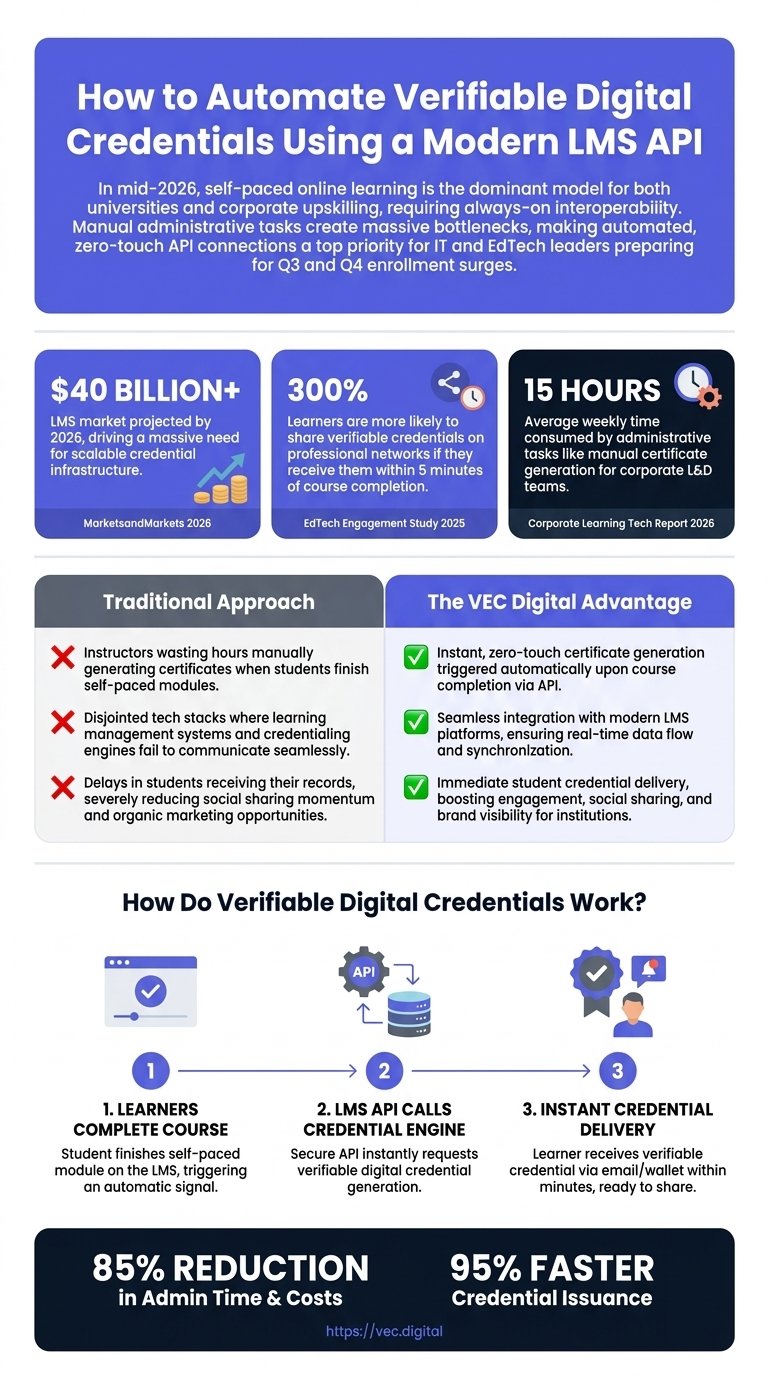
Administrative tasks such as manual certificate generation consume an average of 15 hours per week for corporate L&D teams, according to the Corporate Learning Tech Report (2026). This massive operational bottleneck not only drains institutional resources but also delays the delivery of critical proof of achievement to learners. In an era where global education and remote corporate upskilling demand instant, secure validation, transitioning to automated verifiable digital credentials is no longer optional—it is a foundational requirement for scale.
In this comprehensive guide, our team at VEC Digital bridges the gap between technical API implementation and executive business ROI. You will learn how to connect your Learning Management System (LMS) to a robust REST API, enabling zero-touch automation that issues secure, tamper-proof certificates the exact second a learner passes an assessment. By the end of this article, you will understand how to map data payloads, eliminate manual data entry vulnerabilities, and transform your credentialing system into a frictionless engine for global growth.
Key Takeaways
- Verifiable digital credentials eliminate the 15 hours per week L&D teams waste on manual generation.
- Integrating a best bulk certificate generator with API allows for instant, zero-touch certificate delivery.
- Modernizing with a digital diploma platform drives a 22% higher course completion rate.
- Implementing compliance training certificate automation centralizes and secures global corporate audits.
- Utilizing blockchain certificate verification ensures absolute cryptographic security and prevents degree fraud.
The Business Case for Zero-Touch Credentialing
As the global e-learning landscape expands rapidly, institutions are facing unprecedented administrative pressure. The global LMS market is projected to exceed $40 billion by 2026, according to MarketsandMarkets (2026), driving a massive need for scalable credential infrastructure. Relying on legacy processes to manage this volume is a recipe for operational failure, making the adoption of verifiable digital credentials a critical strategic initiative.
For EdTech founders, IT directors, and corporate training managers, bridging the gap between learning delivery and credential issuance requires a seamless, automated system. Disjointed tech stacks where learning management systems and credentialing engines fail to communicate seamlessly create friction that directly impacts the bottom line. Let us examine the tangible business benefits of integrating a modern certificate API.
Eliminating Administrative Bottlenecks
One of the most significant pain points for universities and corporate academies is instructors wasting hours manually generating certificates when students finish self-paced modules. When an organization scales from hundreds to tens of thousands of learners, manual issuance becomes mathematically impossible to sustain without hiring dedicated, non-revenue-generating administrative staff.
By leveraging an API-driven automated process, the generation and delivery of certificates happen in milliseconds. The moment a learner meets the predefined criteria in your LMS, a server-to-server request is triggered. This zero-touch approach reclaims those 15 hours per week, allowing educators and HR professionals to focus on curriculum development and strategic organizational growth rather than data entry.
Driving Learner Engagement and Course Completion
The speed of credential delivery directly correlates with learner engagement and institutional marketing. Delays in students receiving their records severely reduce social sharing momentum and organic marketing opportunities. When a student completes a rigorous bootcamp or corporate training program, their enthusiasm is at its peak immediately upon finishing.
According to the EdTech Engagement Study (2025), learners are 300% more likely to share verifiable credentials on professional networks if they receive them within 5 minutes of course completion. Furthermore, platforms featuring automated, zero-touch credentialing see a 22% higher average course completion rate due to instant reward mechanics (Global E-Learning Adoption Index, 2025). Instant gratification transforms your alumni network into a global, organic marketing engine.
Overcoming Disjointed Tech Stacks
Modern organizations utilize a myriad of software solutions—HRIS platforms, compliance trackers, and varied LMS environments. When these systems are siloed, data must be manually exported via CSV and imported into a separate design tool, creating a fragile pipeline prone to human error.
An API-first approach unifies these disjointed tech stacks. By utilizing standard web protocols, your LMS becomes the single source of truth, dictating commands to the credentialing engine flawlessly. This interoperability is essential for multinational corporations managing compliance across dozens of regional offices and regulatory frameworks.
How Do Verifiable Digital Credentials Work?
Understanding the underlying technology is vital for IT leaders tasked with securing institutional data. Blockchain certificate verification represents a paradigm shift from traditional paper or static PDF documents, which are highly susceptible to forgery. But how exactly do these secure digital assets function within an automated ecosystem?
A verifiable credential is a cryptographically secure digital record that proves a specific claim about an individual (such as graduation or course completion). Unlike a standard PDF, which can be easily altered using basic photo editing software, a modern credential contains embedded data that can be instantly authenticated by third parties, such as prospective employers or compliance auditors.
The Anatomy of a Secure Digital Record
How do verifiable digital credentials work in practice? When your LMS triggers the API to issue a certificate, the credentialing platform generates a unique cryptographic hash of the document's data. This hash acts as a digital fingerprint. Any alteration to the document—even changing a single pixel or letter—will completely change the hash, immediately flagging the document as fraudulent.
This digital fingerprint is then anchored to a secure, decentralized ledger. When an employer scans the embedded QR code on the certificate, the system compares the document's current hash against the hash stored on the blockchain. If they match, the system displays a verification badge, confirming absolute authenticity.
Can an LMS Integrate Directly with a Blockchain Certificate Verification System?
Yes, absolutely. A common question among IT directors is: Can an LMS integrate directly with a blockchain certificate verification system? The answer lies in the middleware provided by modern credentialing platforms like VEC Digital. You do not need to build complex blockchain infrastructure or write smart contracts within your LMS.
Instead, your LMS simply communicates with the credentialing platform via standard REST API endpoints. The platform abstracts the complexity of the blockchain, handling the cryptographic hashing, anchoring, and verification page generation on your behalf. This allows your development team to focus purely on the standard API payload, keeping the integration lightweight and highly secure.
Are Digital Certificates Issued via API Secure?
Security vulnerabilities arising from manual data entry and unencrypted email attachments are a massive liability for enterprise organizations. Sending sensitive student data across unprotected channels violates privacy regulations and exposes the institution to data breaches. So, are digital certificates issued via API secure?
When implemented correctly, API issuance is exponentially more secure than manual processes. Data is transmitted server-to-server using HTTPS encryption, and authentication is handled via secure tokens (such as OAuth 2.0 or dedicated API keys). This ensures that only authorized systems can trigger certificate generation. Furthermore, because human intervention is removed from the data transfer process, the risk of accidental data leaks or typos is completely eliminated.
Developer Guide: Connecting Your LMS to a Certificate API
Transitioning from manual issuance to a zero-touch automated system requires a clear technical roadmap. For developers and product managers, integrating the best bulk certificate generator with API capabilities involves establishing a secure, real-time communication channel between your learning environment and the credentialing engine.
This section outlines the practical steps for building this connection, ensuring that your architecture is robust, scalable, and capable of handling high-volume enrollment surges without latency.
What is the Best API for Generating Digital Certificates?
When evaluating infrastructure, organizations frequently ask: What is the best API for generating digital certificates? The ideal solution must offer a RESTful architecture, comprehensive webhook support, and the ability to process high-volume batch requests seamlessly. It should not just generate an image; it must generate a verifiable, interactive digital asset.
A top-tier API provides endpoints for template management, recipient creation, dynamic data injection, and real-time status callbacks. It should also support seamless multi-signatory approvals if your internal governance requires a sign-off before final issuance. By selecting an API designed specifically for enterprise scale, you ensure that your system can handle the rigorous demands of global education networks.
How Do I Automate Certificate Generation in Moodle or Canvas?
For institutions utilizing popular platforms, a frequent inquiry is: How do I automate certificate generation in Moodle or Canvas? Both of these LMS platforms support event-driven architecture, typically through webhooks or dedicated plugin architectures that can execute HTTP POST requests.
To automate issuance, your developer will configure the LMS to listen for a specific event—such as "Course Completed" or "Final Grade Posted." Once this event occurs, the LMS constructs a JSON payload containing the learner's details (name, email, course ID, grade) and sends an automated POST request to the certificate API endpoint. The API receives this data, merges it with your pre-designed visual template, anchors the record, and automatically dispatches the credential to the learner's inbox.
Mapping Webhooks and REST Architecture for Real-Time Delivery
Real-time delivery relies on a robust REST API architecture. When the initial POST request is made, the credentialing platform processes the task asynchronously. To keep your LMS updated, you can configure webhooks—automated callbacks that notify your system when the certificate has been successfully generated and emailed.
This bi-directional communication ensures that your LMS database is always in sync with the credentialing platform. If an email bounces or a required signatory has not yet approved the document, the webhook alerts your internal dashboard, providing total visibility into the issuance pipeline without requiring manual status checks.
Structuring Dynamic Data for Automated Issuance
The visual presentation of a certificate is just as important as its underlying security. When automating issuance for thousands of learners globally, you must ensure that every certificate is perfectly personalized. This requires a deep understanding of compliance training certificate automation and how to map dynamic variables effectively.
Hardcoding data is impossible at scale. Instead, modern systems utilize dynamic placeholders within visual templates that are populated on the fly by the incoming API payload.
How Do You Pass Dynamic User Data to a Certificate Template via REST API?
A critical technical hurdle for many teams is understanding: How do you pass dynamic user data to a certificate template via REST API? The process begins within the visual template editor. When designing your certificate, you insert dynamic tags, such as {{RecipientName}}, {{CourseTitle}}, or {{CompletionDate}}.
When your LMS triggers the API, it sends a JSON object where the keys exactly match those dynamic tags. For example:
- "RecipientName": "Jane Doe"
- "CourseTitle": "Advanced Cybersecurity Protocols"
- "CompletionDate": "October 12, 2026"
The credentialing engine parses this JSON payload, maps the values to the corresponding visual layers on the template, and renders the final high-resolution document. This ensures that whether you are issuing one certificate or ten thousand, every document is flawlessly personalized with zero manual formatting required.
Preventing Security Vulnerabilities in Data Transfer
As mentioned earlier, manual data entry and unencrypted email attachments pose severe security risks. By utilizing an automated API pipeline, you mitigate these risks entirely. The dynamic data passed in the JSON payload is encrypted in transit.
Furthermore, because the final certificate is hosted on a secure, dedicated URL (e.g., /certificate/[uuid]) and accessed via QR code or direct link, you eliminate the need to send bulky, easily intercepted PDF attachments through unsecured email servers. The learner receives a secure access link, ensuring that their personal achievement data remains protected and compliant with global privacy standards.
Achieving Compliance Training Certificate Automation at Scale
For corporate HR and compliance officers, tracking mandated training across a global workforce is a logistical nightmare. Compliance training certificate automation solves this by turning the LMS into a self-sustaining compliance engine. When an employee completes their annual OSHA, GDPR, or cybersecurity training, the API instantly generates their certification.
This automated process ensures that corporate audits are frictionless. Because every certificate is cryptographically verifiable, auditors can scan the QR codes or review the digital ledger to confirm that all employees are up-to-date with their mandatory training, eliminating the need for frantic spreadsheet cross-referencing during compliance reviews.
Preparing Your Infrastructure for Global Scalability
As global remote work and cross-border hiring continue to rise, multinational corporations and international universities require automated systems that can instantly issue secure, globally verifiable credentials regardless of the learner's time zone. A localized, manual approach simply cannot survive in a borderless digital economy.
To future-proof your organization, IT leaders must adopt architectures that prioritize interoperability, security, and instant global access. A digital diploma platform powered by robust APIs is the cornerstone of this modern infrastructure.
The Shift Toward API-First Microservices
The technology landscape is undergoing a massive structural shift. Nearly 68% of enterprise organizations plan to adopt API-first microservices to handle secondary LMS functions like badging and credentialing, according to Gartner IT Infrastructure Insights (2026). Monolithic systems that try to do everything—learning delivery, video hosting, and credentialing—often fail to execute any of them perfectly.
By adopting a microservices architecture, you decouple the credentialing engine from the LMS. This means that if you ever migrate to a new LMS in the future, your historical credential data and issuance infrastructure remain completely intact and unaffected. Your API simply points to the new learning platform, ensuring unparalleled business continuity.
Supporting a Borderless Workforce with a Digital Diploma Platform
In a globalized job market, a credential issued in Dubai must be instantly verifiable by an employer in London or New York. Traditional paper records require costly, time-consuming international background checks. An automated digital diploma platform eliminates this geographic friction entirely.
Because the credentials are API-generated, securely hosted, and blockchain-anchored, verification happens in real-time via any smartphone camera globally. This universal interoperability empowers your graduates and employees to seamlessly prove their qualifications anywhere in the world, dramatically increasing the perceived value of your institution's educational programs.
Automate Your Credential Engine Today
The transition from manual administrative toil to a fully automated, zero-touch credentialing system is a strategic imperative for modern educational and corporate institutions. By integrating your LMS with a powerful REST API, you eliminate hours of wasted labor, eradicate data entry vulnerabilities, and provide your learners with instant, cryptographically secure proof of their achievements.
At VEC Digital, we provide the trust infrastructure required to scale your operations flawlessly. Our comprehensive API empowers developers to build seamless integrations in hours, not months, while our visual template editor and blockchain anchoring ensure every certificate issued is beautiful, tamper-proof, and globally verifiable. Stop letting manual processes throttle your growth.
Ready to transform your institutional credentialing and eliminate administrative bottlenecks forever? Explore our developer documentation and design your first automated template today.
Website: https://vec.digital Email: support@vec.digital