
How to Build a Zero-Touch Issuance System Using a Bulk Certificate Generator API
Published on November 19, 2026

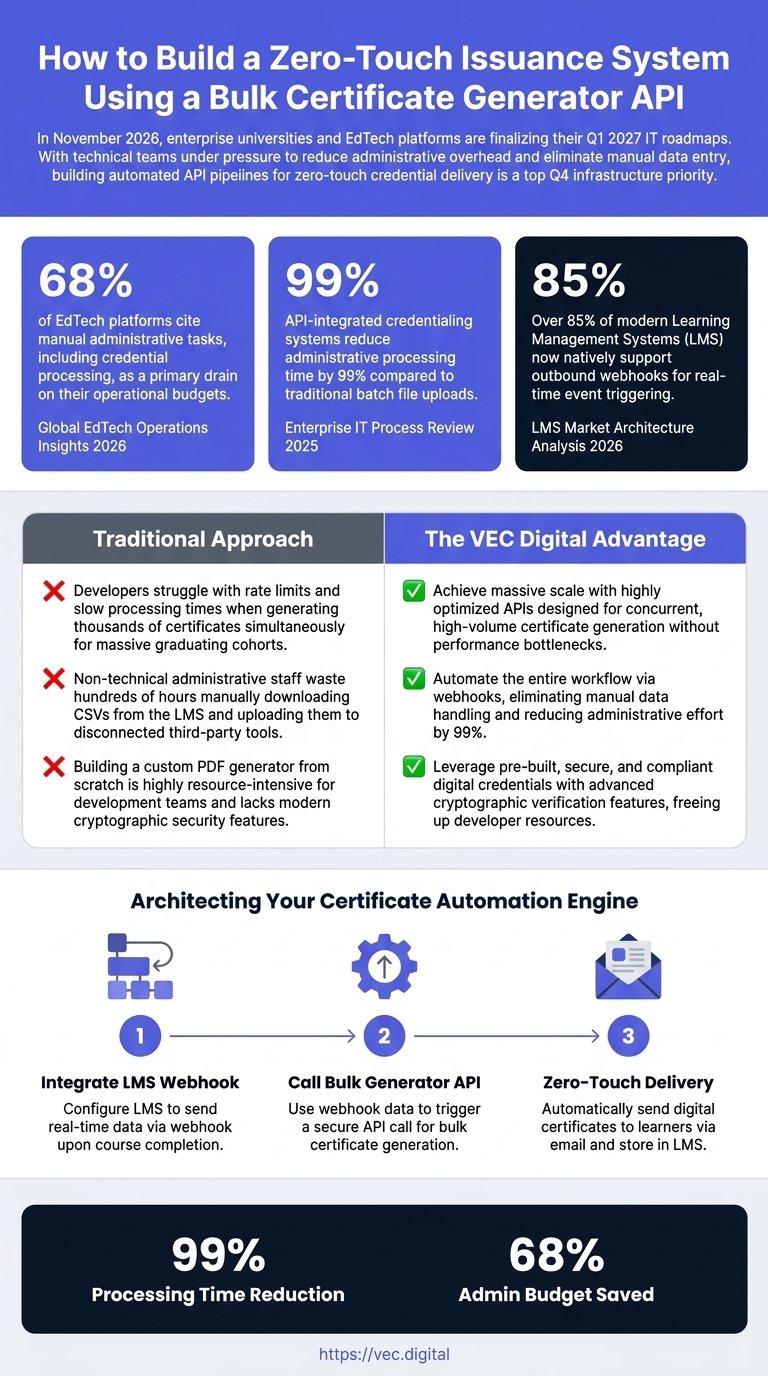
According to the Global EdTech Operations Insights (2026), 68% of EdTech platforms cite manual administrative tasks, including credential processing, as a primary drain on their operational budgets. When dealing with tens of thousands of global learners passing courses at all hours of the day, relying on manual data entry is no longer a sustainable business practice. To scale operations efficiently, institutions and technology companies require a robust bulk certificate generator that integrates directly into their existing learning infrastructure, eliminating friction and ensuring instant delivery.
In this comprehensive guide, our team at VEC Digital leverages our deep expertise in educational technology and systems architecture to show you exactly how to build an API-driven credentialing engine. You will learn how to configure webhook listeners, map dynamic JSON payloads to secure certificate templates, and completely eliminate administrative bottlenecks for your global cohorts.
Key Takeaways
- Implementing a zero-touch issuance system reduces administrative processing time by 99%.
- Modern LMS platforms can trigger a bulk certificate generator API instantly via webhooks.
- Mapping JSON payload variables directly to a digital diploma platform eliminates manual data entry errors.
- Automated REST APIs easily handle rate limits to automate employee training certificates at global scale.
- Cryptographically verifiable digital credentials protect institutional reputation and drastically boost social sharing.
The Global Shift Toward Zero-Touch Credentialing
What is a zero-touch issuance system?
A zero-touch issuance system is an automated operational pipeline where digital certificates are generated, secured, and delivered to a recipient without any human intervention. From the moment a learner passes a final assessment or completes a compliance module, the underlying software architecture handles the data transfer, template population, cryptographic hashing, and email dispatch instantaneously. This systemic approach is becoming the global standard for modern education and corporate training environments.
The operational impact of this technology is staggering. According to the Enterprise IT Process Review (2025), API-integrated credentialing systems reduce administrative processing time by 99% compared to traditional batch file uploads. By removing the human element from the data transfer process, organizations eliminate the risk of typos, duplicated records, and missed deliveries, ensuring a flawless experience for the end-user.
Overcoming the Limitations of Manual CSV Uploads
For years, the standard operating procedure for issuing credentials involved non-technical administrative staff wasting hundreds of hours manually downloading CSV files from a Learning Management System (LMS) and uploading them to disconnected third-party tools. This manual batching process is inherently flawed when scaling a global program. As borderless EdTech platforms process course completions daily across multiple time zones, this 24/7 global completion rate makes manual oversight impossible.
Delayed certificate delivery caused by manual batching creates significant frustration for learners who expect instant proof of achievement upon passing a course. In a highly competitive digital learning market, forcing a student to wait days or weeks for their credential diminishes the perceived value of the program and negatively impacts post-course engagement metrics.
The Resource Drain of Building Custom PDF Generators
Faced with the frustrations of manual uploads, many internal development teams attempt to build custom PDF generation scripts in-house. However, building a custom PDF generator from scratch is highly resource-intensive for development teams and fundamentally lacks modern cryptographic security features. Maintaining custom rendering libraries, managing font files across different server environments, and ensuring cross-platform compatibility quickly becomes a maintenance nightmare.
Furthermore, standard PDFs fail to prevent modern credential fraud. A static PDF can be easily altered using basic image editing software, compromising the integrity of the issuing institution. Transitioning to a dedicated, API-driven digital diploma platform ensures that credentials are not only generated automatically but are also cryptographically secured and instantly verifiable by third parties.
Architecting Your Certificate Automation Engine
How to trigger a digital certificate upon course completion?
The foundation of automated credentialing relies on an event-driven architecture. When a specific event occurs within your LMSâ-such as a student achieving a passing grade on a final examâ-the system must instantly notify your credentialing engine. This is typically achieved using outbound webhooks. A webhook acts as a reverse API, sending a real-time HTTP POST request containing the learner's data to a designated endpoint the exact second the completion event occurs.
To implement this, developers must configure a secure listener endpoint that authenticates the incoming webhook request, parses the payload, and forwards the relevant variables to the certificate generation API. This seamless machine-to-machine communication forms the backbone of a zero-touch pipeline.
Can Canvas LMS send data via webhooks for certificates?
Yes, Canvas LMS, along with virtually all enterprise-grade learning platforms, supports robust data transmission for automated credentialing. In fact, over 85% of modern Learning Management Systems (LMS) now natively support outbound webhooks for real-time event triggering, according to the LMS Market Architecture Analysis (2026). Platforms like Canvas, Moodle, and Blackboard allow administrators to configure specific event triggersâ-such as course_completed or module_passedâ-which automatically dispatch a JSON payload containing the user's ID, name, email, and course details.
By capturing this outgoing data, developers can bypass manual database queries entirely. The LMS pushes the data exactly when it is needed, ensuring that the credentialing system is always operating on the most up-to-date and accurate learner information.
Mapping JSON Payloads to Dynamic Template Fields
One of the most critical technical gaps in existing automation literature is the precise methodology for mapping data. When your LMS fires a webhook, it delivers a JSON payload. To generate a personalized certificate, the variables within this payload must be mapped directly to dynamic placeholders within your visual certificate template (e.g., {{RecipientName}}, {{CourseTitle}}, {{CompletionDate}}).
Within your API endpoint logic, you must extract the values from the LMS payload and format them to match the schema required by your certificate generator. For example, if your LMS sends {"user": {"full_name": "Jane Doe"}, "course": {"title": "Advanced Data Science"}}, your middleware script will parse these fields and inject them into the API POST request directed at the credentialing platform. This ensures that every certificate is dynamically rendered with pixel-perfect accuracy, utilizing the exact fonts and alignments defined in the master template without any manual adjustments.
Scaling High-Volume Issuance with a Bulk Certificate Generator API
How do I batch create training certificates using a REST API?
While real-time, one-off generation is ideal for self-paced courses, many universities and corporate training programs operate on a cohort model, requiring the simultaneous issuance of thousands of credentials at the end of a semester or training week. To batch create training certificates using a REST API, developers utilize specialized batch endpoints designed to accept arrays of recipient objects in a single HTTP request.
Instead of making 5,000 individual API callsâ-which is inefficient and prone to network timeoutsâ-a developer can compile the cohort data into a single, structured JSON array. The API receives this array, queues the generation tasks on its internal servers, and processes them asynchronously. This method drastically reduces network overhead and ensures that massive graduations are handled smoothly and securely.
Handling Rate Limits and Global Concurrent Processing
Developers frequently struggle with rate limits and slow processing times when generating thousands of certificates simultaneously for massive graduating cohorts. When an API limits the number of requests per second, a poorly designed integration can crash or drop records, resulting in missing certificates and administrative chaos.
To solve this, a modern best bulk certificate generator with API capabilities will utilize advanced message brokering and asynchronous processing queues. When you submit a batch request, the API immediately returns a success response acknowledging receipt of the data (often with a batch ID for tracking), while the actual rendering and blockchain anchoring occur in the background. This architecture allows global EdTech platforms to process massive data loads without holding open HTTP connections, completely circumventing traditional rate limit bottlenecks.
What is the best API for generating digital certificates?
The demand for developer-friendly REST APIs in credential and compliance platforms has grown by 150% year-over-year (Developer Tech Infrastructure Trends, 2026). The best API for this task must offer more than just basic PDF rendering. It must provide OAuth 2.0 authentication for maximum security, comprehensive webhook event callbacks (to notify your system when a certificate has been successfully delivered or viewed), and native support for blockchain anchoring.
Furthermore, an enterprise-grade API will offer clear, well-documented endpoints for template management, multi-signatory approvals, and dynamic QR code generation. By choosing a system built specifically for high-volume, secure issuance, development teams can integrate a world-class credentialing engine in a matter of days rather than months.
Integrating with Leading Learning Management Systems (LMS)
How do I automate certificate generation in Moodle and Canvas?
Automating generation within industry-leading platforms like Moodle and Canvas requires a strategic approach to API integration. In Canvas, administrators can utilize the Canvas API and Webhook Subscriptions to listen for the Submission Evaluated or Course Completed events. Once triggered, a lightweight middleware application (often hosted on AWS Lambda or Google Cloud Functions) catches the webhook, formats the data, and securely POSTs it to your credentialing platform's API.
In Moodle, similar functionality can be achieved using Event 2 API plugins or custom scripts hooked into Moodleâ's native Event API. The core principle remains the same: decouple the heavy lifting of certificate rendering and cryptographic security from the LMS itself, offloading it to a specialized, automated engine that guarantees uptime and compliance.
Ensuring Cryptographic Security for Digital Diplomas
When integrating these systems, security must remain the top priority. Academic fraud is a global crisis, and issuing unsecured digital documents exposes institutions to severe reputational damage. A highly secure system anchors the cryptographic hash of every generated certificate to an immutable blockchain ledger.
This means that even though the process is completely automated and zero-touch, the resulting verifiable digital credentials possess a level of security that surpasses traditional paper diplomas. When an employer or auditor scans the embedded QR code on the certificate, they are instantly directed to a verification page that cross-references the blockchain record, proving beyond all doubt that the document is authentic and unaltered.
Boosting Social Sharing and Learner Engagement
The speed of delivery directly correlates with learner satisfaction and marketing ROI. Organizations utilizing zero-touch automation see a 40% increase in learners sharing their credentials on social media within the first 24 hours of completion (Digital Badging ROI Report, 2026). When a student receives a beautifully designed, verifiable credential via email the exact second they pass their final exam, their excitement is at its peak.
This immediate gratification encourages them to add the credential to their LinkedIn profile and share it with their network. For EdTech platforms and universities, this translates into organic, highly visible brand marketing, driven entirely by the efficiency of their automated API infrastructure.
Securing Corporate Audits with API-Driven Compliance
Automating Employee Training Certificates at Scale
Beyond academia, global enterprises face immense pressure to maintain accurate records of employee upskilling and mandatory safety training. To effectively automate employee training certificates, HR and Learning & Development (L&D) systems architects must integrate their corporate intranets or HRIS (Human Resources Information Systems) with a reliable credentialing API.
Because multinational corporations operate across various time zones and regulatory environments, their training completion rates occur around the clock. By implementing a zero-touch pipeline, an enterprise ensures that the moment an employee in Tokyo or London completes their mandatory cybersecurity training, their localized, compliant certificate is generated and securely stored in their digital locker without any intervention from the central HR team.
Centralizing Compliance Training Certificate Automation
When regulatory bodies conduct audits for OSHA, GDPR, or industry-specific safety standards, disorganized records can lead to severe financial penalties. Compliance training certificate automation solves this by centralizing all issuance data through a single API gateway. Every certificate generated via the API is logged, timestamped, and cryptographically secured.
During an audit, compliance officers do not need to hunt through disparate legacy systems or physical filing cabinets. They can simply pull a comprehensive digital report from the credentialing platform, utilizing the instant QR-code verification feature to prove to external auditors that every employee's training record is authentic, current, and tamper-proof.
Secure Your Organizationâ's Credentials Today
Transitioning from manual administrative tasks to a fully automated, zero-touch credentialing pipeline is no longer just a technical upgradeâ-it is a strategic necessity for global scalability. By integrating a robust API, your organization can eliminate manual data entry, bypass rate limit bottlenecks, and deliver cryptographically secure, verifiable credentials the exact moment a learner achieves success.
At VEC Digital, we provide the trust infrastructure required to automate and secure your high-volume issuance needs. Our developer-ready REST API and intuitive visual template editor empower your technical teams to build seamless integrations that save time, protect your brand reputation, and delight your learners.
Secure your organizationâ's credentials todayâ-design your first template and explore our API documentation to build your automation engine. Visit us at https://vec.digital or contact our technical integration team directly at support@vec.digital to get started.