
How to Connect Your LMS to a Bulk Certificate Generator and Eliminate Manual Issuance
Published on July 3, 2026

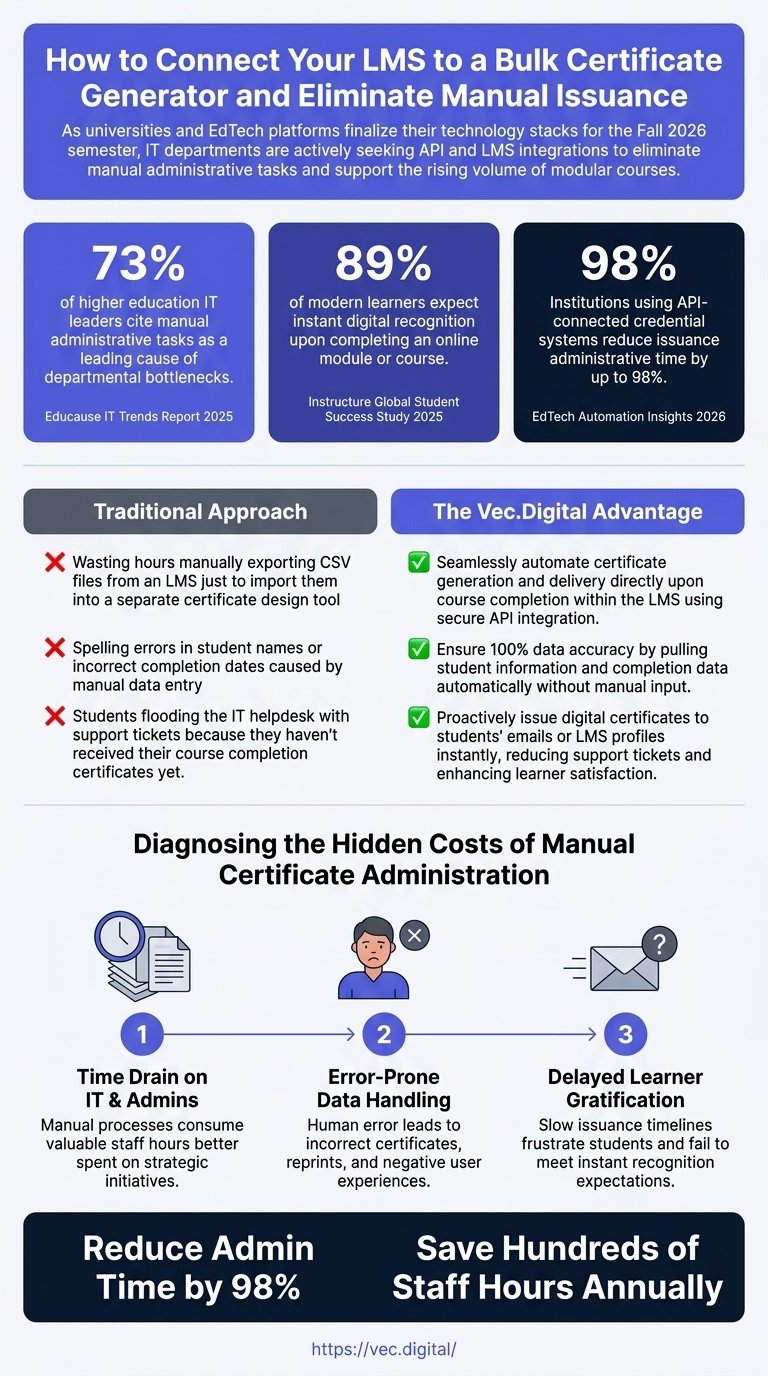
According to the 2025 Educause IT Trends Report, 73% of higher education IT leaders cite manual administrative tasks as a leading cause of departmental bottlenecks. As global institutions scale their online offerings, relying on a robust bulk certificate generator has become an operational necessity rather than a luxury. The traditional methods of credential administration are simply no longer sustainable for modern educational infrastructure.
In this comprehensive guide, we will explore how integrating your Learning Management System (LMS) with an automated issuance system eliminates tedious manual data entry and accelerates student recognition. Leveraging our extensive technology expertise at Vec.Digital, you will learn how to architect zero-touch processes, maintain strict brand consistency across departments, and deploy verifiable digital credentials globally. By implementing these strategies, your institution will transform credentialing from a costly administrative burden into a seamless, highly secure automated engine.
Key Takeaways
- Automated API integrations eliminate the need for manual data entry and CSV file transfers.
- Connecting your LMS directly to a bulk certificate generator reduces administrative time by up to 98%.
- Implementing verifiable digital credentials ensures global compliance with emerging digital wallet standards.
- Using a centralized digital certificate maker maintains strict brand consistency across all university departments.
- Anchoring records with blockchain certificate verification permanently protects institutions against academic fraud.
The Global Shift Toward Automated Credential Issuance
The landscape of global education and corporate training has fundamentally changed over the past decade. As digital transformation accelerates, the mechanisms by which we recognize and validate human achievement must also evolve. Institutions worldwide are moving away from paper-based diplomas and manual processing, seeking instead to implement a bulk certificate generator that can keep pace with rapid digital course consumption.
This shift is not merely a matter of convenience; it is a strategic imperative driven by changing learner demographics, new regulatory frameworks, and the exponential growth of digital learning platforms. To remain competitive on an international scale, academic registrars and EdTech founders must prioritize automated, scalable infrastructure over legacy manual operations.
Managing the Rise of Modular Learning
The traditional four-year degree is no longer the sole focus of higher education. Today, micro-credentials, bootcamps, and modular learning paths dominate the academic landscape. According to UPCEA in 2026, over 60% of universities now offer short-form or modular online courses requiring high-volume certification capabilities. This explosion in course volume means that institutions are issuing credentials at a frequency never seen before.
When an institution shifts from issuing a single diploma at the end of a multi-year program to issuing dozens of micro-credentials per student per semester, traditional administrative systems break down. A centralized digital certificate maker becomes essential to handle this throughput. Without automated systems in place, the sheer volume of certificates required for modular learning can completely paralyze an IT or registrar's office, leading to severe operational delays.
Meeting Modern Learner Expectations
Today's digital-native learners operate in a world of instant gratification and immediate digital delivery. Whether they are completing a corporate compliance module in Tokyo or an advanced coding bootcamp in London, their expectations remain the same. The Instructure Global Student Success Study in 2025 revealed that 89% of modern learners expect instant digital recognition upon completing an online module or course.
When there is a delay between course completion and credential issuance, learner engagement drops significantly. Students want to immediately share their verifiable digital credentials on professional networks like LinkedIn to showcase their new skills to prospective employers. An automated issuance engine satisfies this demand by generating and delivering the credential the very second the final grade is recorded in the LMS.
Preparing for Digital-First Credential Wallets
Beyond learner expectations, there are significant global regulatory pushes driving the adoption of automated credentialing. With the European Union and various US states pushing for digital-first credential wallets by 2027, global academic institutions are under immense pressure to upgrade their legacy LMS setups. Moving from manual batch-printing to API-driven instant digital issuance is now a baseline requirement for international university compliance.
These government-backed digital wallets require credentials to be issued in specific, machine-readable formats that guarantee authenticity. By integrating your LMS with a modern issuance platform, you ensure that every credential generated is instantly compatible with these emerging global standards, future-proofing your institution against upcoming regulatory shifts.
Diagnosing the Hidden Costs of Manual Certificate Administration
Despite the clear advantages of automation, many organizations still rely on outdated processes to issue awards. While these manual methods may have sufficed when issuing a few dozen certificates a year, they introduce massive hidden costs when scaled. Understanding these pain points is the first step toward justifying the implementation of a bulk certificate generator.
The financial and operational toll of manual administration is often buried within the daily routines of administrative staff. By dissecting these inefficiencies, IT directors and registrars can clearly see why integrating an LMS directly with an automated issuance system is a critical business priority.
The Endless Cycle of CSV Exports and Imports
One of the most pervasive administrative nightmares in modern education is the manual data transfer process. Staff members find themselves wasting hours manually exporting CSV files from an LMS just to import them into a separate certificate design tool. This process involves downloading student rosters, cleaning the data in spreadsheet software, mapping the columns to a design template, and praying the system doesn't crash during the batch generation.
This endless cycle of exporting and importing is not only tedious but highly inefficient. It drains valuable human resources that could be better spent on strategic academic initiatives. Every hour an administrator spends wrestling with a CSV file is an hour lost to the institution. Furthermore, this manual process inherently delays the delivery of the credential to the learner, negatively impacting their educational experience.
Data Entry Errors and Helpdesk Bottlenecks
Human intervention in data transfer inevitably leads to human error. Manual data entry is the primary cause of spelling errors in student names, incorrect completion dates, and mismatched course titles on final credentials. When a student receives a certificate with their name misspelled, it undermines the authority and professionalism of the issuing institution.
These errors create a cascading effect of operational friction. Students flooding the IT helpdesk with support tickets because they haven't received their course completion certificates yet—or because the certificates contain errors—places a massive burden on technical support teams. The cost of investigating, correcting, and re-issuing a single flawed certificate far outweighs the cost of automating the process correctly from the start.
Fragmented University Branding Across Departments
In large global universities or enterprise corporations, different departments often operate in isolated silos. The Business School might use one software to issue awards, while the Engineering faculty uses another. This leads to institutions struggling to maintain consistent university branding across hundreds of different departmental courses.
When certificates look completely different depending on which department issued them, the overall brand equity of the institution is diluted. A centralized issuance platform solves this by providing a unified dashboard where authorized templates are locked in, ensuring that every credential—regardless of the issuing department—adheres to strict corporate or academic brand guidelines.
Bridging the Gap: How to Connect an LMS to a Bulk Certificate Generator
Recognizing the problem is only half the battle; the solution lies in seamless technical integration. Connecting a Learning Management System (LMS) to a bulk certificate generator requires moving beyond surface-level design discussions and focusing on the operational data layer. This is where true digital transformation occurs.
Most industry blogs explain how to design pretty credentials or discuss the theoretical value of digital badges, but they completely ignore the operational integration layer. There is a strong need for practical guidance on connecting an LMS directly to an issuance system via API to achieve zero-touch administration. Let us explore exactly how these systems communicate.
Moving Beyond Theoretical Badge Design
While aesthetics are important, a beautiful certificate is useless if it takes three weeks to reach the learner. The focus must shift from pure graphic design to data architecture. An automated issuance system acts as a listener, waiting for specific event triggers from your LMS. When a student achieves a 100% score on a final exam, the LMS fires a secure digital signal containing the student's name, email, and course details.
This payload is securely transmitted to the certificate generation engine, which instantly maps the incoming data to the appropriate pre-approved template. The system then renders the final PDF or digital badge, embeds the necessary cryptographic security, and dispatches it directly to the learner's inbox. This entire sequence happens in milliseconds, completely invisible to the human administrators.
Can You Connect a Digital Certificate Maker via API to an LMS?
A frequent question from IT directors is whether modern digital certificate makers support robust API connectivity. The answer is a definitive yes. Application Programming Interfaces (APIs) are the bridges that allow two distinct software platforms to communicate securely. By utilizing RESTful APIs, your institution can programmatically trigger certificate generation without ever logging into a secondary dashboard.
This API-first approach allows for incredible flexibility. Whether your institution uses a massive global LMS or a custom-built proprietary learning platform, as long as your system can send standard HTTP requests, it can connect to a modern credentialing engine. This ensures that your investment in automation is future-proof, regardless of how your internal software stack evolves over the next decade.
How Do I Automatically Issue Certificates from Canvas?
Canvas is one of the most widely used learning management systems globally, and automating issuance from it is highly straightforward. The process typically involves setting up Webhooks within the Canvas developer console. A Webhook is essentially an automated message sent from Canvas when a specific event occurs—such as a "Course Completed" trigger.
When the student meets the completion criteria, Canvas automatically sends a JSON payload to the endpoint provided by your credential platform. The platform catches this payload, extracts the student's Canvas ID, name, and course metadata, and dynamically generates the verifiable credential. This completely bypasses the need for manual grading exports and guarantees that the student receives their award the moment they finish their coursework.
What is the Best Bulk Certificate Generator for Moodle?
Similarly, Moodle, an open-source LMS heavily utilized by global universities and NGOs, requires a slightly different but equally effective approach. The best generation systems for Moodle utilize dedicated plugins or standard API integrations that map Moodle's native completion tracking to the issuance engine.
By connecting Moodle's database to an automated credential platform, course creators can define specific logic—such as requiring a minimum grade in a final quiz—before the system fires the issuance command. This ensures that academic rigor is maintained while completely removing the administrative overhead of verifying grades and manually typing out certificates.
Architecting a Zero-Touch Issuance System for EdTech Platforms
The ultimate goal for any scaling organization is "zero-touch" administration—a state where the entire lifecycle of a credential, from design to delivery to verification, occurs without manual human intervention. Implementing a bulk certificate generator as the core of this architecture yields unprecedented efficiency and security.
By removing the human element from the data transfer process, organizations not only speed up delivery but also drastically reduce operational costs. This allows educational institutions to reallocate their budgets toward improving curriculum and student support rather than funding administrative data entry.
How Do You Automate Verifiable Digital Credentials in EdTech?
Automating verifiable credentials requires a system that not only generates an image but embeds verifiable data into the file itself. When an EdTech platform triggers an issuance command, the automated engine must simultaneously generate a unique cryptographic hash for that specific credential. This hash is what makes the document verifiable by third parties.
The automation sequence involves the LMS sending the completion data, the credential engine generating the visual certificate, the system appending a unique QR code to the design, and finally, the creation of a dedicated, public-facing verification URL. This ensures that when an employer scans the QR code, they are taken directly to a secure page hosted by the issuing platform, confirming the document's authenticity instantly.
Scaling Operations: What is the Easiest Way to Issue 10,000 Certificates at Once?
For massive open online courses (MOOCs) or large-scale corporate compliance rollouts, issuing 10,000 certificates simultaneously is a common requirement. The easiest way to handle this volume is through a dedicated bulk generation engine designed specifically for high-throughput processing. Attempting to generate 10,000 high-resolution PDFs on a standard desktop computer will inevitably crash the software.
Cloud-based issuance platforms utilize distributed server architectures to process massive batches in parallel. When a command to issue 10,000 credentials is received—either via API or a bulk data upload—the system distributes the rendering tasks across multiple servers. This allows tens of thousands of secure, personalized, and verifiable certificates to be generated and emailed in a matter of minutes, maintaining a 99.98% uptime SLA.
How to Generate Certificates in Bulk from an Excel Sheet?
While API integration is the gold standard, many organizations still operate on legacy systems that cannot support Webhooks. In these scenarios, the most efficient alternative is bulk CSV uploading. To generate certificates in bulk from an Excel sheet, the user simply exports their student data to a standard CSV format.
Within the credential platform's unified dashboard, the user uploads the CSV file. The system's intelligent mapping tool automatically aligns the columns in the spreadsheet (e.g., "First Name", "Course Title") with the dynamic text variables on the certificate template. With a single click, the platform processes the entire spreadsheet, generating and distributing thousands of personalized credentials without requiring the user to manually edit a single document.
Achieving 98% Reduction in Administrative Time
The impact of this zero-touch architecture is staggering. According to EdTech Automation Insights in 2026, institutions using API-connected credential systems reduce issuance administrative time by up to 98%. This metric represents a fundamental transformation in how academic registrars operate.
Tasks that previously took a team of administrators three weeks at the end of a semester are now completed by automated servers in three seconds. This 98% reduction in administrative overhead allows universities to handle the massive influx of micro-credentialing demands without needing to exponentially increase their administrative headcount, preserving institutional budgets.
Securing the Future of Global Education with Technology
Efficiency and speed are critical, but they must never come at the expense of security. As the world transitions entirely to digital records, the threat of credential fraud has grown exponentially. A modern bulk certificate generator must not only automate the issuance process but also fundamentally secure the documents it creates.
This is where advanced cryptographic technologies come into play. By anchoring credentials to immutable ledgers, institutions can guarantee the lifelong integrity of their academic awards, protecting their reputation in an increasingly complex digital world.
Anchoring Academic Integrity on the Blockchain
Traditional digital certificates, such as standard PDFs, are notoriously easy to forge using basic photo editing software. To combat this, forward-thinking platforms employ blockchain certificate verification. When a certificate is generated, its unique cryptographic signature is anchored to a public blockchain. Because blockchains are immutable by nature, this record can never be altered, deleted, or forged.
If a malicious actor attempts to change the name or the grade on a downloaded PDF, the cryptographic hash of the altered document will no longer match the hash anchored on the blockchain. When an employer attempts to verify the forged document, the system will immediately flag it as invalid. This provides foolproof, easily shareable proof of authenticity that any employer or individual can verify instantly.
Driving the $404 Billion EdTech Market Forward
The global demand for secure, scalable education technology is soaring. According to HolonIQ in 2025, the global EdTech market is projected to reach $404 billion, heavily driven by scalable infrastructure and credentialing systems. As global investments pour into online learning platforms, the underlying infrastructure must be rock-solid.
By adopting API-driven, blockchain-backed automated issuance systems, educational institutions and corporate HR departments position themselves at the forefront of this $404 billion market. They signal to their learners, partners, and regulatory bodies that they are committed to technological excellence, supreme data security, and operational efficiency.
Conclusion: Secure Your Organization's Credentials Today
The era of manual data entry, endless CSV exports, and vulnerable paper diplomas is rapidly coming to an end. By connecting your Learning Management System directly to a powerful automated issuance engine, you eliminate administrative bottlenecks, eradicate data entry errors, and deliver instant gratification to your learners. More importantly, by utilizing verifiable digital credentials backed by blockchain technology, you permanently protect your institution's reputation against credential fraud.
At Vec.Digital, our comprehensive drag-and-drop design editor and robust API architecture empower organizations to design, automate, and secure high-quality credentials effortlessly. We provide the technology infrastructure necessary to scale your educational offerings globally, ensuring that every certificate you issue is instantly verifiable, beautifully branded, and delivered with zero manual effort.
Stop wasting hours on manual administration and start building trust as infrastructure. Start issuing verifiable certificates in minutes and secure your organization's credentials today.
Website: https://vec.digital/ Email: support@vec.digital