
How to Defeat AI-Generated Diploma Forgery with Blockchain Verification
Published on July 10, 2026

In an era where advanced generative AI tools can create pixel-perfect counterfeit documents in seconds, institutions globally are facing a severe crisis in academic integrity. To effectively prevent degree fraud, higher education administrators must move beyond legacy systems that rely on easily manipulatable paper or standard digital files. As the global job market becomes increasingly borderless, the urgency for a tamper-proof, cryptographically secure method of issuing and verifying academic achievements has never been greater.
In this comprehensive guide, we leverage our deep expertise in credentialing technology to show you exactly how immutable blockchain anchoring outpaces modern forgery tactics. You will learn the technical vulnerabilities of traditional PDFs, discover how cryptographic hashing secures student records, and explore actionable strategies to implement a robust digital diploma platform without disrupting your existing automated processes. By transitioning to verifiable digital credentials, your institution can protect its reputation, eliminate administrative bottlenecks, and guarantee absolute authenticity for every graduate.
Key Takeaways
- AI-generated forgery is rendering traditional paper and standard PDF certificates obsolete across the global education sector.
- Cryptographic hashing provides an immutable, tamper-proof record that advanced image generation tools simply cannot replicate.
- A robust digital diploma platform reduces employer background screening times by up to 80%, accelerating graduate employability.
- Institutions can adopt blockchain certificate verification while maintaining strict student data privacy and regulatory compliance.
- Global adoption of verifiable digital credentials is accelerating, standardizing trust and eliminating borders in professional hiring.
The New Era of Forgery: Why Traditional PDFs Fail Against AI
The technological landscape of document creation has shifted dramatically. Institutions that rely on standard digital files are finding themselves highly vulnerable to sophisticated manipulation. To successfully prevent degree fraud in today's climate, administrators must first understand the specific mechanisms that make legacy formats so susceptible to modern counterfeiting.
How AI Makes Pixel-Perfect Counterfeits Trivial
Many administrators ask: Why are standard PDF certificates no longer secure? The answer lies in the accessibility of generative AI and advanced image-editing software. In the past, forging a diploma required specialized printing equipment, custom watermarked paper, and skilled graphic design. Today, AI tools can replicate institutional seals, mimic authorized signatures, and match typography with zero technical skill required from the user.
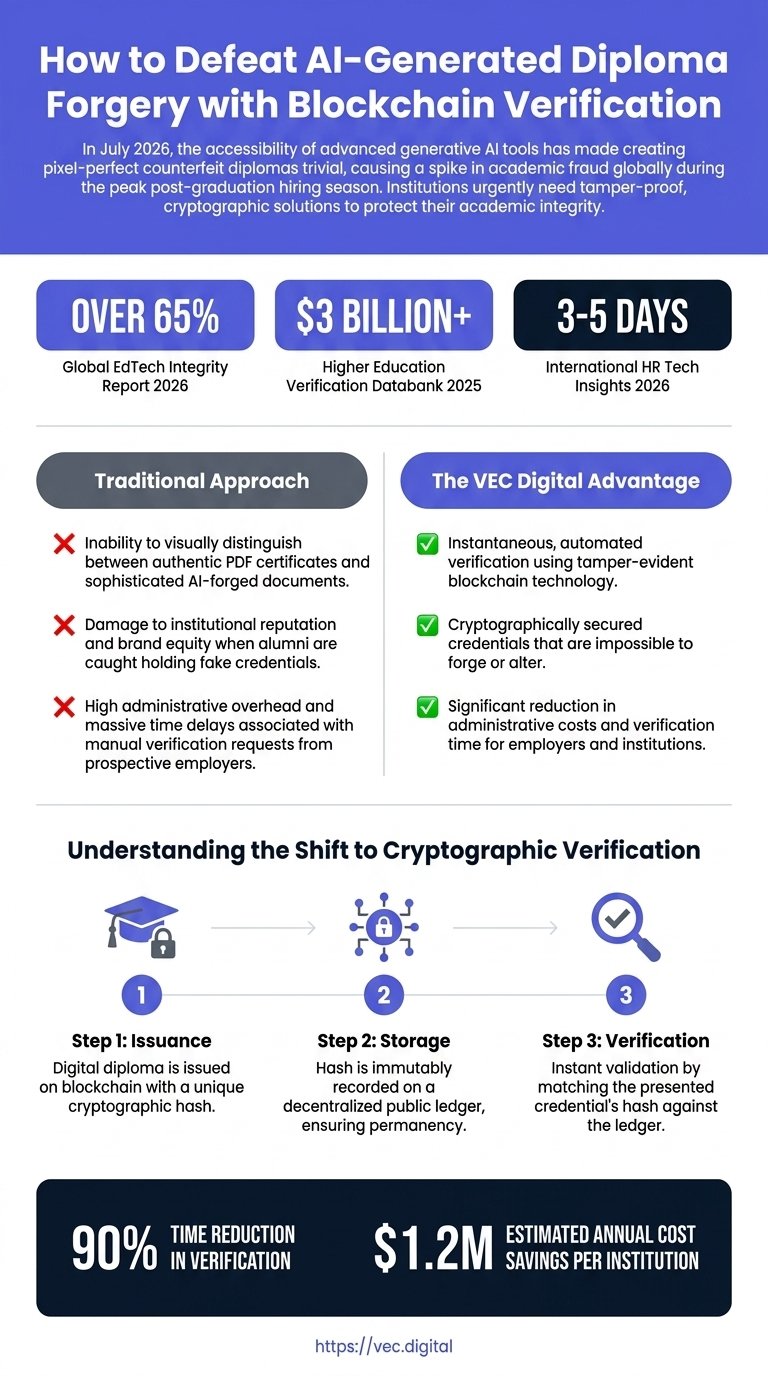
Because a standard PDF is merely a visual representation of data—a collection of pixels on a screen—it possesses no inherent security layer to verify the data's origin. An AI-generated forgery and an authentic PDF look identical to the human eye, resulting in a critical inability to visually distinguish between authentic certificates and sophisticated counterfeit documents. According to the Global EdTech Integrity Report (2026), over 65% of higher education institutions reported an increase in sophisticated, AI-generated credential fraud attempts in the past year alone.
The Cost of Inaction on Institutional Reputation
The financial and reputational stakes of academic forgery are monumental. The global market for counterfeit degrees and illicit diploma mills is estimated to exceed $3 billion annually, according to the Higher Education Verification Databank (2025). When employers hire candidates based on fraudulent qualifications, the resulting fallout damages not only the hiring company but deeply erodes the brand equity of the supposed issuing university.
Damage to institutional reputation occurs rapidly when alumni or fraudulent actors are caught holding fake credentials bearing a university's name. A loss of trust from top-tier employers means legitimate graduates may face increased scrutiny or reduced hiring rates. Protecting this brand equity requires a proactive shift away from visually verifiable documents toward mathematically verifiable data structures.
Understanding the Shift to Cryptographic Verification
To combat the rise of AI-generated fakes and effectively prevent degree fraud, the education and corporate training sectors must adopt technologies that verify the underlying data rather than the visual presentation. This is where cryptographic verification becomes the cornerstone of modern credentialing.
What is a Verifiable Digital Credential?
A frequent question among academic deans and HR leaders is: What is a verifiable digital credential? Unlike a static image or a basic PDF, a verifiable digital credential is a machine-readable data package. It contains the visual design of the certificate alongside embedded cryptographic metadata that proves exactly who issued it, who received it, and when it was issued.
This standardized digital identity framework ensures that the document acts as a self-contained proof of achievement. Because the credential carries its own verification protocol, it does not rely on a central database that could be hacked or taken offline. The credential itself is the proof, creating a frictionless ecosystem of trust between the university, the graduate, and the prospective employer.
How Cryptographic Hashing Outpaces AI Image Generation
Can blockchain prevent certificate fraud? Yes, by utilizing a process known as cryptographic hashing. When an institution issues a certificate through a modern platform, the system takes the unique data of that specific diploma (student name, degree, date, honors) and runs it through an algorithm to generate a unique, fixed-length string of characters known as a hash.
This hash is then anchored to the blockchain. If a bad actor uses AI to alter even a single pixel of the document—such as changing a "B" grade to an "A," or altering the recipient's name—the underlying data changes. When the altered document is scanned or uploaded for verification, the new hash will not match the original hash stored on the blockchain. The verification will instantly fail, exposing the forgery. This mathematical certainty completely neutralizes the threat of visual AI manipulation.
How Blockchain Certificate Verification Works in Practice
Transitioning from theory to application requires an understanding of how these systems operate in the real world. To prevent degree fraud at scale, institutions need automated, reliable infrastructure that operates seamlessly in the background.
Moving Beyond Watermarks and Secure Paper
For decades, universities relied on physical security measures: embossed seals, micro-printing, and custom watermarks. However, in an era of global remote hiring, mailing physical documents across borders is slow, expensive, and environmentally unsustainable. Furthermore, physical documents are often scanned and emailed to employers, instantly losing all their physical security features in the digital translation.
Blockchain certificate verification replaces these physical safeguards with digital immutability. Governments and educational bodies worldwide are recognizing this shift. For instance, the adoption of blockchain-based credential systems in the Middle East education sector grew by 42% between 2024 and 2026, driven by initiatives like the MENA Digital Transformation Index (2026). This regional growth mirrors a global trend toward paperless, cryptographically secured administrative operations, establishing academic degree fraud prevention in the Middle East and beyond as a primary technological focus.
The Role of Decentralized Anchoring
How do employers check if a degree is fake? Traditionally, they would have to contact the university's registrar office directly. With decentralized anchoring, the process is instantaneous. When an institution finalizes a digital diploma, the platform anchors the cryptographic hash to a public blockchain ledger.
This ledger is distributed across thousands of independent nodes globally, meaning no single entity can alter or delete the record. The issuing institution retains total control over the issuance and revocation of the certificate, but the proof of its existence remains permanently accessible and verifiable. This guarantees absolute authenticity and completely eliminates the possibility of credential fraud, serving as the ultimate source of truth for global auditors.
Accelerating the Background Screening Process
The benefits of cryptographic credentials extend far beyond the issuing institution. To fully prevent degree fraud, the verification process must be effortless for the end-user: the employer. If verification is difficult, employers will skip it, leaving the door open for fraudulent candidates.
Eliminating Manual Verification Delays
High administrative overhead and massive time delays associated with manual verification requests from prospective employers are major pain points for university registrars. According to International HR Tech Insights (2026), employers spend an average of 3 to 5 days manually verifying academic credentials for cross-border new hires. This involves navigating different time zones, paying verification fees, and waiting for manual email replies.
Digital diploma platforms utilizing cryptographic verification reduce background screening times by up to 80% (Future of Work Analytics, 2025). By removing the human element from the verification loop, registrars save hundreds of administrative hours per semester, allowing their staff to focus on student success rather than answering endless background check inquiries from global HR departments.
Seamless Global Employability
How to verify a digital diploma online instantly? Modern platforms utilize Scan-to-Verify QR Code Integration. Every certificate generated includes a required, embedded unique QR code. When an employer or auditor receives the digital or printed certificate, they simply point their smartphone camera at the code.
This frictionless action automatically routes the reviewer to a dedicated, secure certificate URL. Within seconds, the page displays a "Blockchain Verified" security badge alongside the validated issuer, recipient, and date details. No app installs, account creations, or login credentials are required. This physical-to-digital link ensures that whether the graduate hands over a printed copy in an interview or emails a digital link, the proof of authenticity is always just one scan away.
Implementing a Digital Diploma Platform Without Disruption
Adopting new technology often brings concerns about operational downtime and compliance risks. However, modern systems are designed to integrate smoothly, allowing you to prevent degree fraud without overhauling your entire IT infrastructure.
Safeguarding Student Data Privacy and Compliance
A common hurdle for higher education administrators is anxiety regarding student data privacy and compliance when implementing modern credentialing software. How do universities adopt digital diploma platforms without violating regulations like FERPA or GDPR?
The key lies in the architecture of the blockchain integration. A secure platform does not store Personally Identifiable Information (PII)—such as student names, grades, or addresses—on the public blockchain. Instead, only the cryptographic hash (the mathematical representation of the data) is anchored to the ledger. The actual private data remains securely encrypted on compliant servers and is only displayed to authorized viewers through the verification portal. This ensures that institutions can leverage the immutability of blockchain while maintaining strict adherence to global privacy laws.
Connecting Your Automated Certificate Engine
Transitioning to a secure credentialing system does not mean abandoning your existing Learning Management Systems (LMS) or HR software. A robust digital diploma platform offers developer-ready REST APIs that programmatically connect with third-party software like Canvas, Moodle, or corporate intranets.
This enables zero-touch automation. For example, the second a learner passes a final assessment, the automated engine triggers immediate certificate generation, anchors the hash to the blockchain, and dispatches the verifiable digital credential directly to the student's inbox. For massive graduations or cohort training sessions, administrators can utilize bulk issuance and CSV upload features, generating 5,000+ personalized, secure certificates in minutes. This operational efficiency scales effortlessly, handling everything from a single replacement diploma to an entire university graduating class.
Secure Your Institution’s Future with VEC Digital
The rapid advancement of AI image generation has permanently altered the landscape of academic integrity. Relying on traditional PDFs and physical paper is no longer a viable strategy to prevent degree fraud. Institutions must adopt cryptographic verification to protect their brand equity, ensure the value of their graduates' hard work, and provide employers with frictionless, instant proof of authenticity.
At VEC Digital, we provide the trust infrastructure required to navigate this new era. Our comprehensive, blockchain-powered platform allows organizations to design stunning digital certificates, automate high-volume issuance, and anchor every document to an immutable ledger. With our embedded QR code technology, verification takes seconds, completely eliminating administrative bottlenecks and manual audit delays.
Do not leave your institution's reputation vulnerable to modern forgery. Modernize your credentialing operations, guarantee absolute authenticity, and empower your learners with records they can proudly and securely share across the globe.
Ready to eliminate credential fraud permanently? Explore our solutions and design your first secure template today with no setup fees. Website: https://vec.digital Email: support@vec.digital