
How to Digitize Legacy Archives Using a Bulk Certificate Generator
Published on October 19, 2026
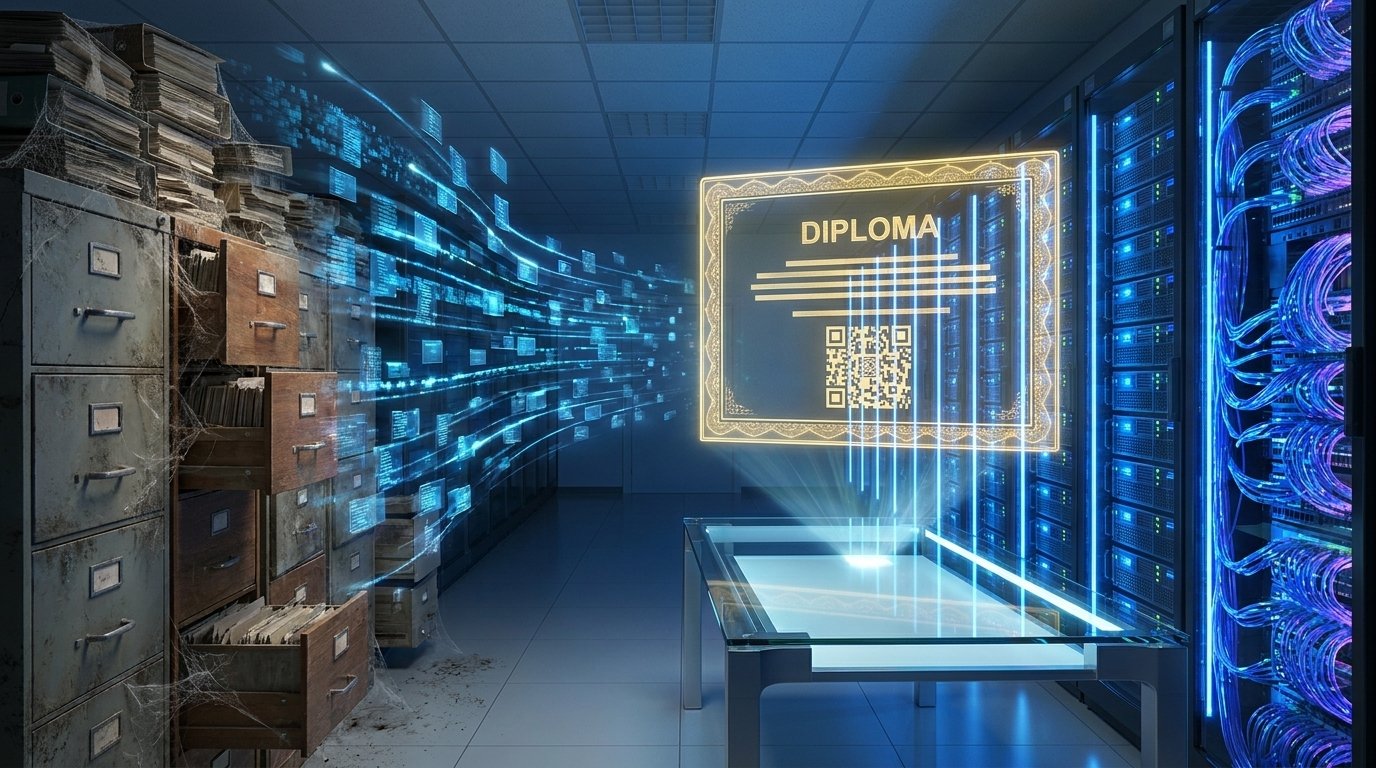
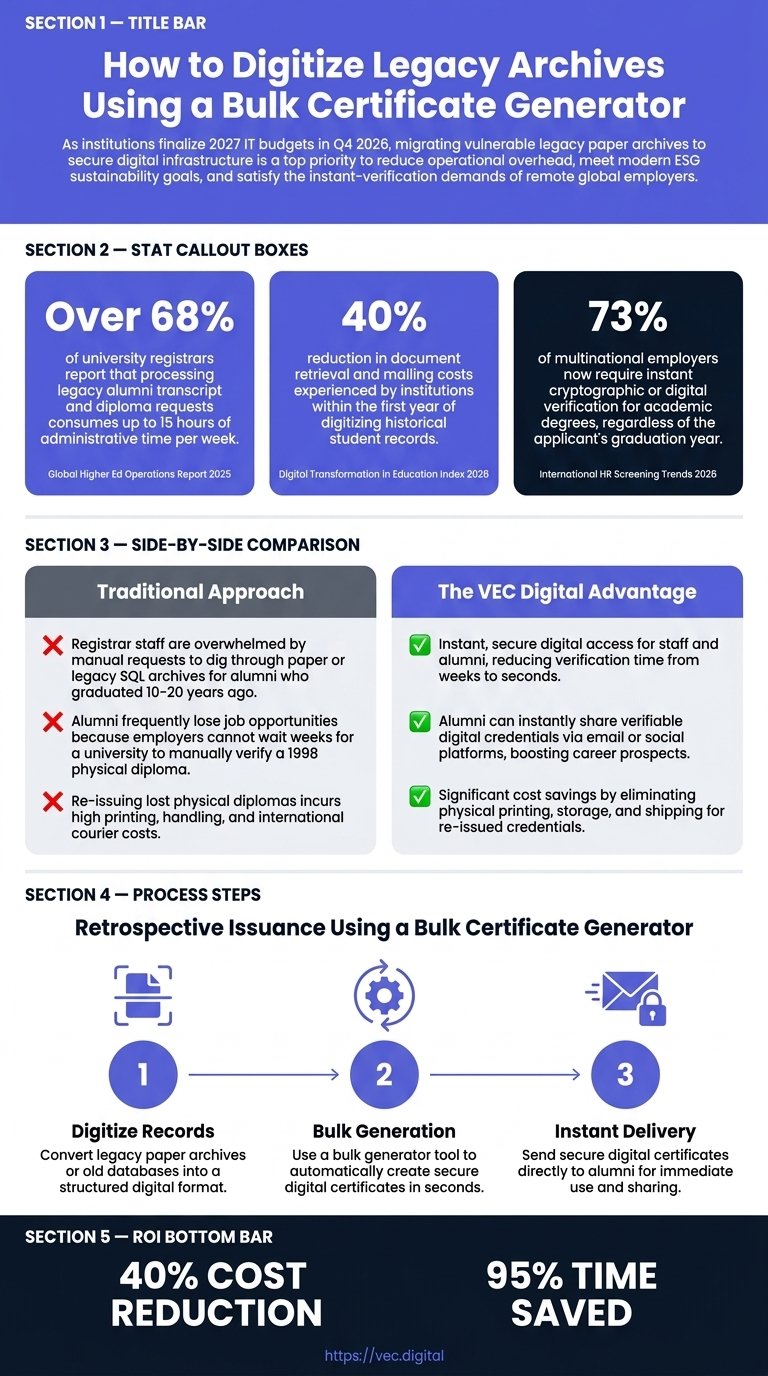
Over 68% of university registrars report that processing legacy alumni transcript and diploma requests consumes up to 15 hours of administrative time per week (Global Higher Ed Operations Report, 2025). As institutions finalize their IT budgets, migrating vulnerable paper archives to a secure bulk certificate generator has become an urgent operational necessity. Relying on physical storage and manual retrieval processes leaves universities exposed to catastrophic data loss and frustrates alumni seeking immediate career advancement in a fast-paced global job market.
Drawing on our extensive expertise in enterprise technology and secure digital infrastructure at VEC Digital, this guide provides a comprehensive roadmap for retrospective credential digitization. You will learn how to map historical databases to modern CSV automated systems, securely backdate verifiable records without triggering system errors, and transform dormant physical archives into instantly accessible digital assets that meet the strict verification demands of modern multinational employers.
Key Takeaways
- A smart **bulk certificate generator** reduces legacy credential recreation time by 99% compared to manual processes.
- Migrating historical data to a **digital diploma platform** cuts document retrieval and mailing costs by 40% in the first year.
- Using a **QR code certificate maker** allows instant validation of decades-old academic records.
- Applying **blockchain certificate verification** to retrospective records ensures absolute immutability and data security.
- Issuing **verifiable digital credentials** for past graduates is the most effective way to globally **prevent degree fraud**.
The Operational Crisis of Legacy Academic Records
The Hidden Cost of Manual Document Retrieval
For decades, academic institutions have relied on physical filing cabinets, microfiche, or early localized SQL databases to store graduate records. Today, registrar staff are overwhelmed by manual requests to dig through these legacy archives for alumni who graduated 10 to 20 years ago. When an alumnus requests a replacement diploma or a verified transcript, administrators must manually locate the file, verify its authenticity, print a new physical copy, and arrange for secure international shipping.
This outdated methodology is highly inefficient and incredibly expensive. Re-issuing lost physical diplomas incurs high printing, handling, and international courier costs that drain departmental budgets. However, institutions digitizing their historical student records experience a 40% reduction in document retrieval and mailing costs within the first year (Digital Transformation in Education Index, 2026). By eliminating the physical handling of documents, universities can reallocate administrative resources toward student success initiatives rather than archival clerical work.
Vulnerabilities in Physical and Legacy Storage
Physical archives are inherently fragile. Paper degradation, localized data loss events such as fires or floods, and server decay affect roughly 1 in 10 legacy academic databases over a 20-year period (Archival Security Council, 2024). When a physical record is destroyed, the proof of an alumnus's academic achievement is often lost forever, creating severe legal and reputational liabilities for the institution.
Even early digital storage methodsâ-such as localized on-premise serversâ-are vulnerable to hardware failure, ransomware attacks, and data corruption. IT Directors struggle to integrate these disparate legacy databases into modern infrastructure without losing critical historical metadata. Transitioning to a secure, decentralized digital infrastructure is the only reliable way to guarantee the long-term preservation of institutional history.
The Impact on Alumni Employability
The delays caused by manual record retrieval have a direct, negative impact on graduate success. In today's hyper-competitive global job market, hiring timelines are remarkably short. Alumni frequently lose job opportunities because employers cannot wait weeks for a university to manually verify a 1998 physical diploma via mail or phone calls.
Currently, 73% of multinational employers now require instant cryptographic or digital verification for academic degrees, regardless of the applicant's graduation year (International HR Screening Trends, 2026). If an institution cannot provide immediate, digital proof of graduation for its older alumni, it inadvertently hinders their career mobility. Modernizing these records is not just an administrative upgrade; it is a vital service to the alumni network.
Retrospective Issuance Using a Bulk Certificate Generator
What is the Best Bulk Certificate Generator for Large Databases?
When tasked with migrating thousands of historical records, IT departments frequently ask: What is the best bulk certificate generator for large databases? The ideal solution is an enterprise-grade automation engine capable of parsing massive CSV datasets without timing out, dropping data, or requiring complex coding from the registrar's office.
A superior generator seamlessly bridges the gap between raw, exported legacy data and visual credential design. It must feature robust mapping capabilities, allowing administrators to align old database column headers (like "Grad_Year" or "Honors_Status") with dynamic text placeholders on a modern digital template. Furthermore, the best systems operate entirely in the cloud, ensuring that the heavy computational lifting of generating thousands of cryptographic hashes occurs instantly and securely.
How Do Universities Digitize Old Student Records?
How do universities digitize old student records efficiently? The process begins with data extraction. IT teams export historical student data from legacy systems (such as old mainframes or early student information systems) into a standardized format, typically a Comma-Separated Values (CSV) file. This file acts as the master ledger for the retrospective issuance project.
Once the data is cleaned and standardized, it is uploaded into the certificate generation platform. The system's automated engine reads each row of the CSV, populates a predefined visual template with the specific alumnus's details, anchors the record to a secure database, and generates a unique digital file. Using bulk automated systems to process CSV data reduces credential generation time by 99% compared to manual legacy PDF recreation (EdTech Automation Insights, 2026).
How to Convert a CSV File Into Bulk Digital Certificates
Understanding how to convert a CSV file into bulk digital certificates is critical for a smooth migration. The automated process involves several precise steps to ensure data integrity:
- Data Cleansing: Ensure all names, dates, and degree titles in the CSV are formatted consistently. Remove any corrupted characters that may have resulted from exporting old database formats.
- Template Preparation: Use a visual drag-and-drop editor to create a digital version of the historical diploma. Insert dynamic variables (e.g., {{Student_Name}}, {{Degree_Earned}}, {{Date_of_Issue}}).
- Field Mapping: During the CSV upload flow, map the columns in your spreadsheet to the corresponding variables on your certificate template.
- Batch Generation: Initiate the automated run. The system will programmatically generate individual, personalized credentials for every row in the CSV simultaneously.
- Automated Dispatch: If alumni email addresses are available in the dataset, the system can automatically deliver the new digital credentials directly to their inboxes.
Mapping Historical Data to a Digital Diploma Platform
Can You Issue Digital Diplomas for Past Graduation Years?
A common concern among academic administrators is: Can you issue digital diplomas for past graduation years? Absolutely. A modern digital diploma platform is designed to handle retrospective issuance seamlessly. The key is structuring the data to reflect the historical reality rather than the current date of digital generation.
When setting up the automated issuance, administrators can define the "Issue Date" parameter to match the original graduation date (e.g., May 15, 2002) rather than the date the digital file is created. This ensures that the digital credential accurately represents the historical achievement while benefiting from modern cryptographic security. This backdating process is fully compliant with academic record-keeping standards, provided the data matches the institution's official archival ledger.
Preserving Metadata During Legacy Migration
One of the greatest challenges IT Directors face is integrating disparate legacy databases without losing critical historical metadata. Older systems often contain granular detailsâ-such as specific departmental honors, thesis titles, or legacy signatory namesâ-that must be preserved in the new digital format.
To preserve this data, advanced digital credential platforms allow for the creation of custom dynamic fields. Instead of forcing historical data into a rigid, modern template, the platform adapts to the data. Administrators can add custom variables to the CSV upload (e.g., {{Legacy_Signatory_Name}}) ensuring that the digital diploma reflects the exact historical context of the original physical document, maintaining complete academic integrity.
Designing With a QR Code Certificate Maker for Older Formats
Digitizing a 25-year-old diploma requires a careful balance between historical aesthetics and modern utility. Using a QR code certificate maker, universities can upload high-resolution scans of historical background artwork, preserving the traditional look and feel of the original paper diploma.
The crucial addition is the embedded QR code. The visual editor allows designers to seamlessly integrate this modern verification tool into the historical layout without disrupting the aesthetic. When an alumnus shares this digitized credential, the QR code serves as a physical-to-digital bridge, allowing anyone who views the document to instantly verify its authenticity against the university's secure database.
Securing the Past With Blockchain Certificate Verification
Does Blockchain Certificate Verification Work for Retrospective Records?
Technologists often ask: Does blockchain certificate verification work for retrospective records? Yes, and it is arguably the most secure method for preserving historical data. When a university digitizes a legacy record, the credentialing engine generates a unique cryptographic hash of the document's data and anchors it to a public, immutable blockchain.
This process does not alter the historical data; rather, it creates a permanent, tamper-proof digital fingerprint of the record as it exists today. Once anchored, the record becomes immune to localized server crashes, ransomware, or accidental deletion. The blockchain serves as an indestructible digital vault, ensuring that the proof of an alumnus's degree will survive independently of the university's internal hardware for generations to come.
How Do Employers Verify University Degrees From 15 Years Ago?
The ultimate goal of digitization is to facilitate frictionless employability. So, how do employers verify university degrees from 15 years ago? In a modernized system, the process takes less than two seconds.
When an alumnus presents their digitized historical credential to a prospective employer, the hiring manager simply scans the embedded QR code with their smartphone or clicks the secure URL link. They are instantly routed to a dedicated verification page hosted by the university's trust infrastructure. This page displays a "Blockchain Verified" security badge alongside the graduate's details, providing the employer with absolute certainty without requiring them to make phone calls, send emails, or pay third-party background screening services.
How Verifiable Digital Credentials Prevent Degree Fraud
Legacy paper documents are incredibly susceptible to forgery. With modern AI tools and high-quality printers, counterfeiters can easily replicate a university's 1995 diploma template. To effectively prevent degree fraud, institutions must transition to verifiable digital credentials.
Because these credentials rely on cryptographic hashing rather than visual inspection, they are mathematically impossible to forge. If a bad actor attempts to alter a digitized legacy diplomaâ-for example, changing a grade or modifying the graduation yearâ-the cryptographic hash will break. When an employer scans the altered document, the system will immediately flag it as invalid. By migrating historical archives into this secure digital framework, universities actively protect their brand reputation from retrospective credential fraud.
Global Compliance and the Paperless Shift
Meeting ESG Goals and Sustainability Mandates
The push to digitize legacy records is not solely driven by operational efficiency; it is also deeply tied to global sustainability initiatives. Maintaining massive physical archives requires significant energy for climate control, physical space, and ongoing paper consumption for re-issuance.
By digitizing historical records, universities directly support the UN Sustainability Goals by radically reducing their carbon footprint. Transitioning to a paperless campus eliminates the ongoing environmental cost of printing, packaging, and internationally couriering replacement diplomas, aligning the institution's operations with modern Environmental, Social, and Governance (ESG) standards.
Regional and International Data Protection
Globally, stringent data protection laws complicate the storage of legacy data. Frameworks like the General Data Protection Regulation (GDPR) in Europe mandate strict rules regarding data privacy, accessibility, and security. In the Middle East, government-led localization initiatives, such as Saudi Vision 2030 and UAE paperless mandates, require institutions to rapidly modernize their historical databases.
Utilizing a decentralized, blockchain-anchored digital diploma platform provides a highly compliant alternative to vulnerable centralized servers. It empowers the end-user (the alumnus) with ownership and control over their own data, while ensuring that the issuing institution meets international standards for data security and immutability.
Secure Your Institution's Historical Legacy Today
Leaving decades of academic history in vulnerable physical archives or outdated local servers is a risk modern institutions can no longer afford. The administrative burden of manual document retrieval drains resources, while slow verification processes actively harm alumni career prospects. By leveraging an automated bulk certificate generator, universities can rapidly map, digitize, and secure their entire historical ledger with zero friction.
At VEC Digital, we provide the comprehensive trust infrastructure required to seamlessly migrate legacy data into the future. Our powerful CSV upload capabilities, intuitive visual design tools, and immutable blockchain anchoring ensure that your institution's history is preserved, protected, and instantly verifiable anywhere in the world.
Ready to transform your dormant paper archives into dynamic, verifiable digital assets? Eliminate the manual workload and protect your university's reputation today. Visit us at https://vec.digital or contact our enterprise integration team directly at support@vec.digital to discuss your legacy data migration strategy.