
How to Issue 10,000+ Records via Bulk Certificate Generator
Published on July 15, 2026

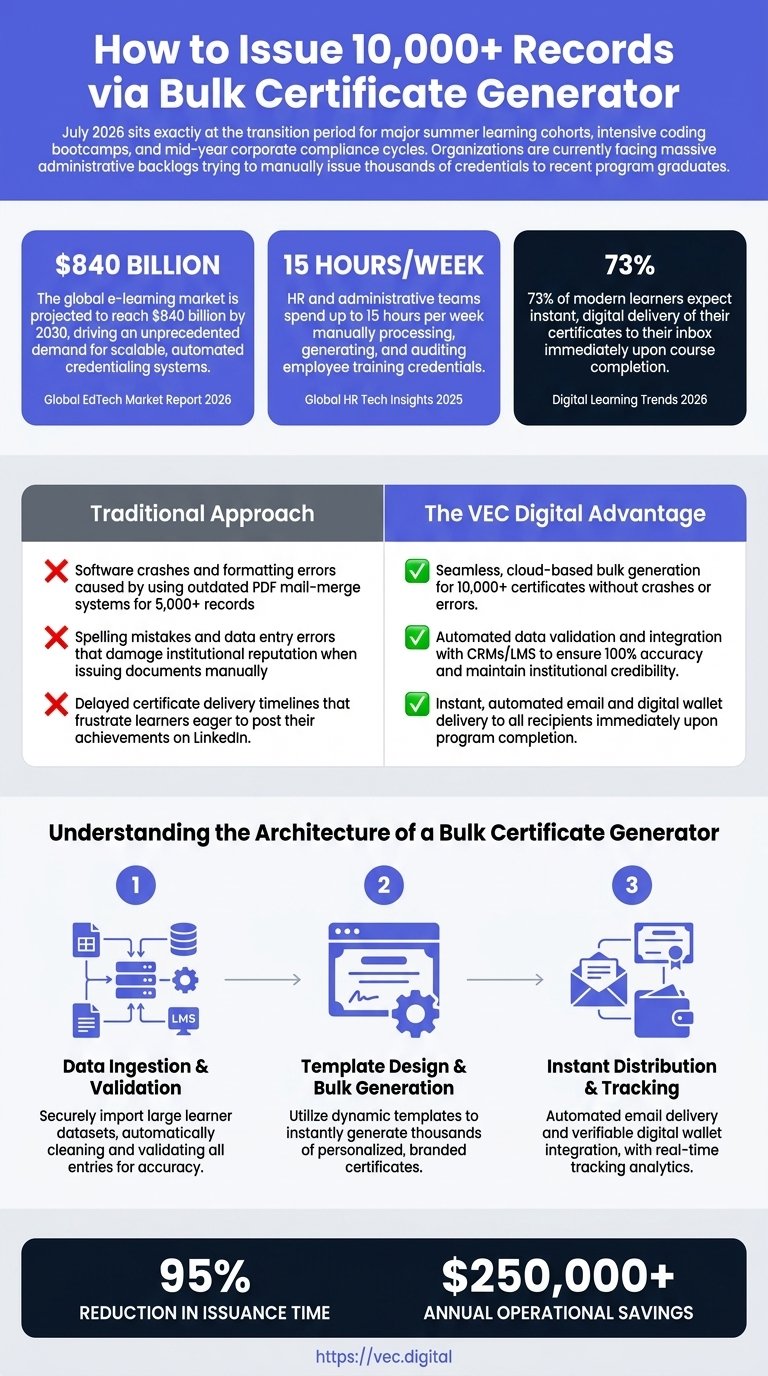
The global e-learning market is projected to reach $840 billion by 2030 (Global EdTech Market Report, 2026), driving an unprecedented demand for scalable credentialing systems. As cohorts expand globally, relying on manual data entry or outdated mail-merge tools creates massive bottlenecks, turning what should be a moment of celebration into an administrative nightmare. Implementing a robust bulk certificate generator is now a critical operational necessity for modern institutions looking to scale efficiently.
In this comprehensive guide, our team at VEC Digital leverages our deep expertise in credentialing technology to demonstrate how automated systems transform data logistics. You will learn how to seamlessly map thousands of records using clean CSV architectures, integrate advanced REST APIs for zero-touch issuance, and automatically embed secure verification parameters into every digital credential.
Key Takeaways
- Bulk certificate generator engines eliminate the software crashes and formatting errors typical of legacy mail-merge systems.
- Clean CSV architectures ensure perfect name mapping and eliminate data entry errors at scale.
- Integrating a robust REST API enables zero-touch automation directly from your LMS or HRIS.
- A QR code certificate maker automatically appends unique verification links to every credential without human intervention.
- Automated verifiable digital credentials drastically reduce the risk of compliance audit failures for corporate L&D teams.
The Hidden Costs of Manual Credential Issuance in Global EdTech
As educational institutions and corporate academies grow, the logistical challenge of issuing credentials multiplies exponentially. Transitioning to a bulk certificate generator is no longer just about aesthetics; it is about resolving severe operational bottlenecks that drain administrative resources.
Overcoming Administrative Backlogs and Delayed Deliveries
In the modern educational landscape, speed and efficiency are paramount. HR and administrative teams spend up to 15 hours per week manually processing, generating, and auditing employee training credentials (Global HR Tech Insights, 2025). This massive time sink prevents staff from focusing on higher-value tasks, such as curriculum development or student engagement. Furthermore, 73% of modern learners expect instant, digital delivery of their certificates to their inbox immediately upon course completion (Digital Learning Trends, 2026). Delayed certificate delivery timelines frustrate learners who are eager to post their achievements on platforms like LinkedIn, ultimately dampening the marketing momentum of your educational programs.
The Risks of Data Entry Errors and Reputation Damage
Manual data entry is inherently flawed. When administrators are tasked with typing or copying thousands of names, dates, and course titles, mistakes are inevitable. Spelling mistakes and data entry errors that damage institutional reputation are common when issuing documents manually. A misspelled name on a final diploma not only invalidates the document for the learner but also reflects poorly on the issuing organization's professionalism. Automated data mapping directly from a source database eliminates human error, ensuring that the exact data provided by the user is the exact data printed on the credential.
The Failure of Legacy Mail-Merge Systems
Historically, organizations relied on basic word processors and spreadsheet software to merge data. However, these tools were never designed for enterprise-scale data publishing. Administrators frequently experience software crashes and formatting errors caused by using outdated PDF mail-merge systems for 5,000+ records. These legacy systems struggle with memory limits, font rendering issues, and file size constraints, often resulting in broken batches and corrupted files. Upgrading to a dedicated digital diploma platform ensures high-capacity processing that handles tens of thousands of records simultaneously without system degradation.
Understanding the Architecture of a Bulk Certificate Generator
Moving away from legacy tools requires an understanding of how modern data logistics operate. A true bulk certificate generator is not merely a design tool; it is a sophisticated data publishing engine that connects raw information to secure, verifiable outputs.
Clean CSV Architectures and Perfect Name Mapping
The foundation of any large-scale issuance event is the CSV (Comma-Separated Values) file. To ensure seamless generation, the system must utilize clean CSV architectures. This involves structuring dynamic placeholders within the certificate template (e.g., {{RecipientName}}, {{CourseTitle}}, {{IssueDate}}) that perfectly map to the corresponding column headers in the uploaded file. Advanced systems automatically parse this data, sanitizing inputs to remove hidden characters or trailing spaces that could disrupt the generation process. This precise mapping is what allows organizations to transform a spreadsheet of 10,000 graduates into 10,000 personalized documents in mere seconds.
How to Generate Thousands of Certificates Automatically from a CSV File
Many administrators ask, "How do I generate thousands of certificates automatically from a CSV file?" The process is engineered for simplicity and scale. First, the user designs a master template using a visual editor, defining where the dynamic text fields will populate. Next, the user uploads their standardized CSV file into the system. The issuance engine then reads the file row by row, injecting the specific data into the template's placeholders. Because this process happens on robust cloud servers rather than a local machine, it bypasses the hardware limitations that cause legacy systems to crash, rapidly rendering high-resolution, personalized credentials ready for immediate dispatch.
Centralized Tracking and Delivery Analytics
One of the most significant pain points of manual issuance is the lack of centralized tracking to know which certificates bounced, failed to deliver, or require re-issuance. Modern automated systems solve this by providing a unified dashboard. Once a batch is processed, the system tracks the email delivery status of every single credential. Administrators can instantly see open rates, bounce logs, and verification metrics. This level of oversight ensures that no learner is left behind and provides a clear audit trail for compliance and administrative records.
API Endpoints and Zero-Touch LMS Certificate Automation
For organizations operating at the highest levels of scale, even CSV uploads can introduce unnecessary manual steps. The ultimate goal is zero-touch automation, achieved by connecting your systems directly to a bulk certificate generator via advanced programming interfaces.
What is the Best Bulk Certificate Generator for LMS Integration?
When evaluating solutions, IT directors frequently ask, "What is the best bulk certificate generator for LMS integration?" The answer lies in the robustness of its REST APIs. The ideal platform offers comprehensive, developer-friendly endpoints that support OAuth 2.0 authentication, webhook events, and real-time status callbacks. It should be capable of processing JSON payloads instantly, meaning that the moment a condition is met within your Learning Management System (LMS), the certificate engine is triggered without any human intervention.
How Do You Automate Certificate Issuance in Canvas or Moodle?
Another common question is, "How do you automate certificate issuance in Canvas or Moodle?" By utilizing webhooks and API endpoints, developers can configure the LMS to send a secure data payload to the credentialing platform the exact second a learner achieves a passing grade or completes a module. This payload contains the learner's name, email, and course details. The certificate engine receives this data, generates the document using the pre-assigned template, and automatically emails it to the learner. Organizations utilizing automated, API-driven credentialing platforms report an 85% reduction in administrative overhead (Enterprise Operations Productivity Index, 2025).
Is There a Way to Generate Certificates Dynamically Using an API?
Yes. "Is there a way to generate certificates dynamically using an API?" is a fundamental query for modern EdTech platforms. Dynamic generation means that not only the text, but also specific visual elements can be altered via API calls. For instance, passing a specific parameter in the API payload could automatically change the signatory signature, update the expiration date, or append a unique QR code. This dynamic flexibility ensures that complex organizations with multiple departments or localized branches can use a single, centralized engine to handle highly varied issuance requirements globally.
Embedding Security: Cryptography and Instant Verification
In an era where digital forgery is increasingly sophisticated, generating a document is only half the battle. A modern bulk certificate generator must also serve as a fortress of trust, embedding cryptographic security into every file.
How Can I Automatically Add Unique QR Codes to Bulk Issued Certificates?
Security-conscious issuers often ask, "How can I automatically add unique QR codes to bulk issued certificates?" A high-end QR code certificate maker handles this natively during the generation process. As the system parses the CSV or API data, it simultaneously generates a unique, cryptographically secure URL for each specific record. It then renders a distinct QR code image and embeds it seamlessly into the designated placeholder on the certificate design. This ensures that every single document out of a batch of 10,000 has its own distinct, trackable verification fingerprint, requiring absolutely zero manual graphic design work.
How Do Employers Verify Digital Certificates Instantly?
The ultimate test of a credential is its utility in the job market. "How do employers verify digital certificates instantly?" With embedded QR codes, the verification process becomes frictionless. An employer or auditor simply scans the QR code on the digital or printed document using any standard smartphone camera. They are instantly routed to a secure, public validation page hosted on the issuing platform. This page displays the immutable details of the achievement—such as the recipient's name, the issue date, and the official signatory—proving authenticity in seconds without the need to download specialized apps or create accounts.
The Role of Verifiable Digital Credentials in Modern Compliance
To truly prevent degree fraud, verifiable digital credentials must be anchored by immutable data structures. Advanced platforms utilize blockchain certificate verification to anchor the cryptographic hash of the certificate to a public ledger. This means that even if the issuing organization's internal servers were compromised, the authenticity of the certificate could still be mathematically proven. This level of tamper-proof security protects the reputation of the issuing university or corporation and provides absolute certainty to third-party reviewers.
Scaling Corporate L&D and Global Compliance Training
While universities face challenges with academic fraud, enterprise organizations face strict regulatory requirements. A bulk certificate generator is equally vital for Corporate Learning and Development (L&D) teams managing global workforces.
Winning Corporate Audits with Automated Employee Training Certificates
Compliance training certificate automation is a major priority for HR directors. Over 60% of compliance audit failures in large organizations are tied directly to fragmented, decentralized, or manually tracked training records (Corporate Compliance Institute, 2025). When an auditor requests proof of OSHA, GDPR, or safety training, organizations cannot afford to dig through disjointed spreadsheets. By automating employee training certificates, HR teams ensure that every completion is instantly generated, securely stored, and readily accessible via a centralized dashboard. This audit-ready posture eliminates panic during regulatory reviews and ensures continuous compliance.
Supporting Global Digital Transformation (UAE Vision 2031 and Beyond)
The shift toward paperless, automated credentialing aligns perfectly with global sustainability and digital transformation initiatives. As the Middle East and Gulf regions accelerate their digital transformation goals (such as UAE's Vision 2031), government-backed upskilling programs and local tech academies are scaling rapidly. These massive cohorts require robust, high-volume automated issuance engines that support localized data security standards while maintaining global verifiability. By adopting cloud-based credentialing technologies, organizations worldwide can reduce their carbon footprint, eliminate the costs of physical printing and shipping, and participate in a modernized, borderless digital economy.
Secure Your Organization’s Credentials Today
Relying on manual data entry and outdated mail-merge tools is no longer a viable strategy for growing educational institutions or enterprise corporations. The risks of data errors, delayed deliveries, and compliance failures are too high. By upgrading to a sophisticated automated issuance engine, your organization can seamlessly process tens of thousands of records, embed unbreakable cryptographic security, and deliver a frictionless verification experience for employers and auditors globally.
At VEC Digital, our platform is engineered to act as the trust infrastructure for your institution. From seamless CSV uploads to zero-touch API integrations, we provide the tools you need to issue with absolute confidence and scale without limits. Secure your organization’s credentials today — design your first template in minutes with no setup fees.
Ready to automate your credentialing? Visit us at https://vec.digital or contact our enterprise team directly at support@vec.digital to transform your issuance operations.