
How to Scale Micro-Credentials With a Digital Certificate Maker
Published on June 4, 2026

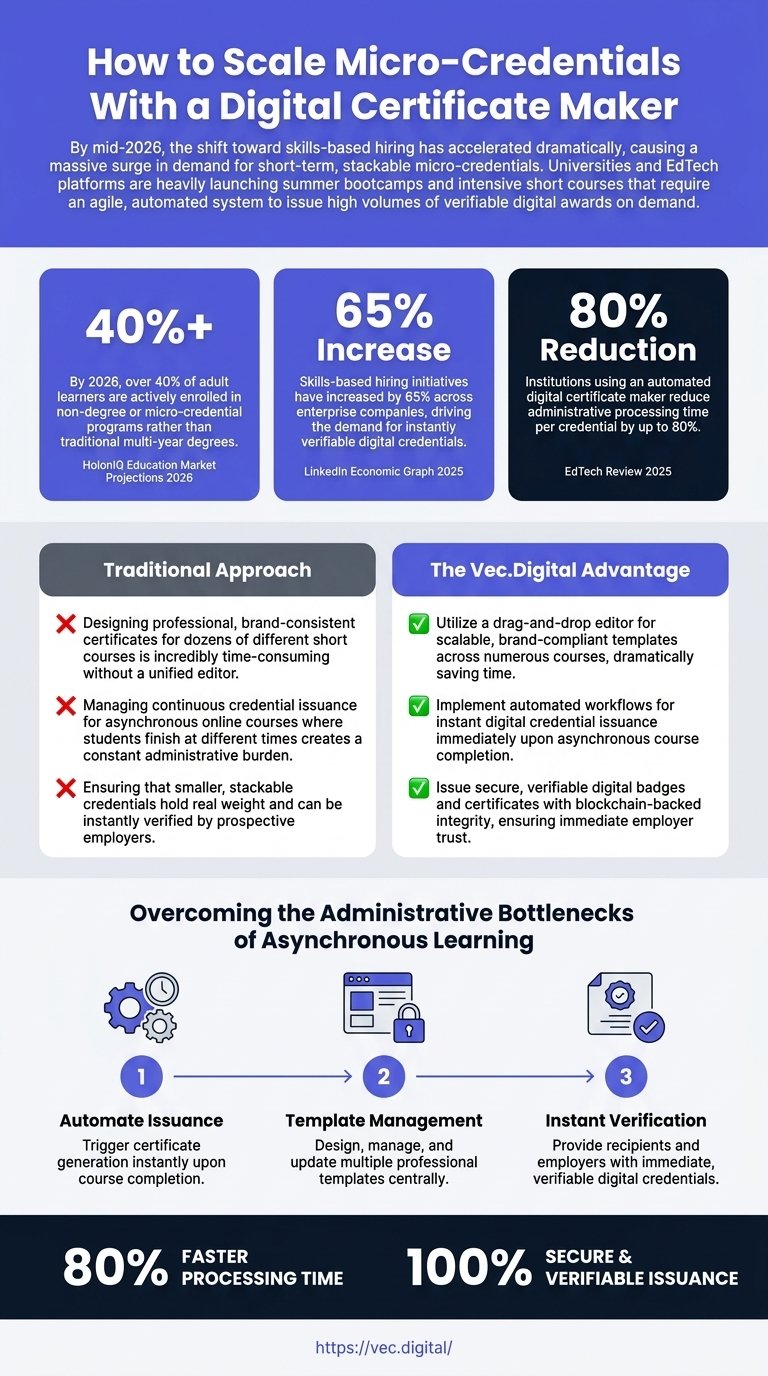
By 2026, over 40% of adult learners are actively enrolled in non-degree or micro-credential programs rather than traditional multi-year degrees, according to HolonIQ Education Market Projections (2026). This staggering statistic signals a massive global shift in how education is consumed and validated. As institutions and online learning platforms race to meet this demand, the administrative burden of issuing thousands of continuous, bite-sized awards has become overwhelming. To thrive in this new landscape, educational leaders need a robust digital certificate maker capable of handling high-frequency, automated credentialing without compromising on security or brand integrity.
In this comprehensive guide, our team at Vec.Digital unpacks the strategic blueprint for designing and automating stackable micro-credentials at a global scale. Leveraging our deep expertise in educational technology and document security, we will show you how to transition away from manual, batch-processed diplomas toward an agile, automated system. You will learn how to embed instant QR code verification, streamline asynchronous issuance, and build a unified tracking infrastructure that empowers learners and satisfies the rigorous demands of modern employers.
Key Takeaways
- Digital certificate maker platforms are essential for automating high-volume credential issuance in modern EdTech environments.
- Implementing verifiable digital credentials eliminates manual processing time by up to 80% for academic administrators.
- Using a bulk certificate generator allows organizations to scale asynchronous learning programs globally without administrative bottlenecks.
- Embedding QR code certificates provides instant, foolproof verification for employers engaged in skills-based hiring.
- Anchoring records with blockchain certificate verification ensures that stackable micro-credentials carry the same trust and immutability as traditional degrees.
The Global Shift Toward Skills-Based Hiring and Micro-Credentials
The traditional educational model, characterized by multi-year degree programs concluding with a single, physical diploma, is undergoing a profound transformation. Driven by rapid technological advancements and changing global workforce requirements, learning is becoming continuous, modular, and highly specialized. This evolution necessitates a complete overhaul of how institutions recognize and record academic achievements.
The Rise of Bite-Sized Learning
Initiatives such as the World Economic Forum's Reskilling Revolution and the European Year of Skills have catalyzed a worldwide movement toward agile, bite-sized learning models. Professionals are no longer leaving the workforce for years at a time to upskill; instead, they are enrolling in intensive summer bootcamps, asynchronous online modules, and specialized short courses. These stackable micro-credentials allow learners to build a customized portfolio of competencies tailored to their specific career trajectories.
However, this shift introduces a significant logistical challenge. A university that previously issued 5,000 diplomas once a year may now need to issue 50,000 micro-credentials on a rolling basis throughout the year. Managing this volume manually is simply impossible. This is where a digital certificate maker becomes not just a convenience, but a critical piece of institutional infrastructure, enabling the automated, continuous recognition of these bite-sized achievements.
Why Traditional Diplomas Are No Longer Enough
The demand for immediate, verifiable proof of skills has never been higher. According to the LinkedIn Economic Graph (2025), skills-based hiring initiatives have increased by 65% across enterprise companies, driving an unprecedented demand for instantly verifiable digital credentials. Employers are increasingly prioritizing specific, demonstrable competencies over broad, generalized degrees.
Traditional paper certificates fail to meet the needs of this modern hiring landscape. They are easily forged, difficult to share on professional networks, and require slow, manual verification processes that frustrate HR departments. Furthermore, physical documents do not align with global sustainability goals aimed at reducing paper waste. The transition to digital, verifiable records is a necessary step for any institution seeking to remain relevant in a skills-first economy.
The Critical Role of a Centralized Issuance System
To successfully navigate this transition, institutions require more than just basic design software. They need a comprehensive system that integrates design, issuance, tracking, and verification into a single, cohesive engine. A modern digital certificate platform serves as the central nervous system for an institution's credentialing strategy, ensuring that every award—whether a massive open online course (MOOC) completion badge or a rigorous corporate compliance record—is generated securely, consistently, and automatically.
Overcoming the Administrative Bottlenecks of Asynchronous Learning
While the pedagogical benefits of asynchronous learning are clear, the administrative realities can be daunting. When students progress at their own pace, completing courses at all hours of the day and night, the traditional batch-processing approach to credentialing completely breaks down.
Solving the Design Fragmentation Problem
One of the most persistent pain points for EdTech platforms and universities is the lack of a unified design process. Designing professional, brand-consistent certificates for dozens of different short courses is incredibly time-consuming without a centralized editor. Often, different departments use disjointed tools, resulting in inconsistent branding, formatting errors, and a general lack of professional polish.
A sophisticated digital certificate maker solves this by providing a unified, drag-and-drop environment where administrators can establish master templates. By utilizing dynamic fields (such as [Recipient Name], [Course Title], and [Completion Date]), a single branded template can be automatically populated with unique data for thousands of different learners across various programs, ensuring absolute brand consistency without manual intervention.
Automating Continuous Certificate Generation
A frequent question from academic registrars is: How can I automate certificate generation for asynchronous learners? Managing continuous credential issuance for asynchronous online courses where students finish at different times creates a constant administrative burden if handled manually. The solution lies in automated system integrations via APIs or webhook triggers connected directly to the Learning Management System (LMS).
When a learner completes their final module or passes their assessment, the LMS communicates instantly with the certificate generation engine. The system automatically populates the dynamic template, generates the secure credential, and emails the digital award directly to the learner—all in a matter of seconds. In fact, institutions using an automated digital certificate maker reduce administrative processing time per credential by up to 80%, according to EdTech Review (2025). This automation frees educators to focus on curriculum development rather than administrative paperwork.
Centralizing Tracking for Stackable Programs
Stackable credentials derive their value from accumulation—a series of foundational micro-credentials that build toward a larger, comprehensive certification. However, a major challenge is the lack of centralized tracking systems to see which learners have completed which tiers of a stackable credential program. Without visibility, it is impossible to guide learners to the next logical step in their educational journey.
Modern platforms address this by offering unified team management dashboards. These centralized hubs provide real-time analytics and tracking, allowing administrators to monitor issuance volumes, track which credentials have been opened or shared, and easily audit compliance records. This level of oversight is particularly crucial as an employee training compliance tracking software solution, where HR departments must prove that specific regulatory training has been completed by all staff members.
Building Trust: How Do You Create Verifiable Micro-Credentials?
The proliferation of online courses has unfortunately been accompanied by a rise in credential fraud. If a micro-credential cannot be trusted, it holds no value for the learner or the employer. Therefore, the core function of any credentialing system must be the establishment of irrefutable authenticity.
What Makes a Digital Certificate Instantly Verifiable?
When institutions ask, What makes a digital certificate instantly verifiable?, the answer lies in cryptographic security and public accessibility. A truly verifiable credential is not just a static PDF; it is a dynamic digital asset linked to a secure, immutable record. The gold standard for this is blockchain certificate verification.
When analyzing blockchain vs traditional certificates, the distinction is clear. Traditional certificates rely on physical signatures and trust in the paper itself. Blockchain-anchored certificates, however, involve hashing the document's data and storing that unique cryptographic signature on a decentralized ledger. If a single pixel or character on the certificate is altered, the hash changes, and the verification fails. This makes secure digital diplomas for universities completely tamper-proof, eradicating the risk of diploma mills and forged records.
How to Add a Verification QR Code to an Online Course Certificate
The most user-friendly method for bridging complex cryptographic security with everyday usability is the QR code. Many educators wonder, How do you add a verification QR code to an online course certificate? The process is entirely automated within a premium digital certificate maker.
During the generation process, the system automatically creates a unique URL for that specific credential and encodes it into a dynamic QR code embedded directly onto the certificate's design. When an employer or auditor scans this code with any standard smartphone camera, they are instantly routed to a dedicated, public verification page. This page displays the issuer's details, the recipient's name, the date of issuance, signatory approvals, and, crucially, a "verified badge" confirming the record's authenticity. This creates online certificates with QR code technology that require no specialized apps or registered accounts to verify.
Ensuring Small Credentials Hold Real-World Weight
Ensuring that smaller, stackable credentials hold real weight and can be instantly verified by prospective employers is vital for the success of any micro-credential program. When an employer can verify a skill in seconds, the perceived value of that micro-credential skyrockets.
Furthermore, learners actively desire this modern format. According to the Educause Learner Survey (2025), 87% of modern learners prefer digital, instantly shareable badges and certificates over physical paper awards. They want credentials they can easily showcase. Understanding how to share digital certificate on LinkedIn and other professional networks seamlessly is a core feature of modern platforms, turning learners into brand ambassadors for the issuing institution.
Implementing an Automated Issuance Engine for EdTech Platforms
Transitioning to a fully automated, verifiable credentialing system requires selecting the right technology partner and implementing scalable processes that align with your organizational goals.
Selecting the Best Certificate Maker for Online Courses
If you are researching, What is the best digital certificate maker for online courses?, you must look beyond basic graphic design tools. The ideal platform must function as a comprehensive HR employee certification platform and academic credentialing engine. Key features to evaluate include:
- 99.98% Uptime Reliability: The system must be available globally, 24/7, to support international asynchronous learners.
- API and LMS Integration: Seamless connectivity with your existing educational infrastructure is non-negotiable for true automation.
- Custom Dynamic Fields: The ability to map complex data points from your database directly onto the certificate layout.
- Signatory Workflows: Built-in approval systems that hold certificates until authorized administrators or deans provide their digital signatures.
Deploying a Bulk Certificate Generator for Bootcamps
For intensive programs like coding bootcamps, hackathons, or corporate training seminars, a bulk certificate generator is indispensable. Event organizers and trainers often face the nightmare of manually personalizing hundreds of awards post-event. By utilizing bulk CSV upload features, administrators can map columns of data (names, scores, completion dates) to the dynamic fields on their template.
With a single click, the system generates, secures, and distributes hundreds or even thousands of personalized, verifiable certificates in minutes. This rapid deployment is essential for maintaining learner engagement and excitement immediately following the completion of a challenging program.
How Universities Are Issuing Stackable Credentials to Adult Learners
Many traditional institutions are actively asking, How are universities issuing stackable credentials to adult learners? The most forward-thinking colleges are creating distinct visual hierarchies for their micro-credentials. A foundational course might yield a standard digital badge, while the completion of a five-course stack triggers the automated issuance of a highly ornate, blockchain-anchored digital diploma.
This tiered approach, managed entirely within a unified digital certificate platform, provides adult learners with continuous motivation. Each verifiable milestone can be immediately added to their resume or LinkedIn profile, providing tangible ROI for their educational investment long before the final degree is awarded.
Strategic Blueprint: Scaling Your Verifiable Digital Credentials
To fully capitalize on the micro-credential revolution, organizations must adopt a strategic, phased approach to scaling their digital issuance infrastructure.
Streamlining the Design Process
Begin by auditing your current credential designs. Consolidate your visual identity into a set of master templates within your digital certificate maker. Ensure that these templates accommodate various text lengths for international names and diverse course titles. Incorporate your organization's official branding, logos, and authorized digital signatures. By front-loading the design work, you ensure that all future automated issuances remain perfectly on-brand.
Integrating with Global LMS Platforms
The next phase involves technical integration. Connect your credentialing engine to your LMS or corporate HR system using REST APIs. Map the data triggers carefully—define exactly what constitutes "completion" (e.g., passing a final exam with a score of 80% or higher) to ensure that credentials are only issued when genuinely earned. This automated pipeline is the key to scaling without increasing administrative headcount.
Measuring the Impact on Learner Engagement
Finally, utilize the analytics provided by your platform to measure success. Track open rates, social media shares, and verification scans. The global micro-credential market is projected to surpass $5.5 billion by the end of 2027, according to MarketsandMarkets (2024). By analyzing how your learners interact with their credentials, you can refine your course offerings, improve marketing strategies, and demonstrate clear value to stakeholders.
Moreover, emphasize the environmental benefits of this transition. Sustainable paperless certificates for NGOs, universities, and corporations align perfectly with UN sustainability goals, reducing the carbon footprint associated with printing, packaging, and shipping physical documents globally.
Secure Your Organization's Credentials Today
The shift toward stackable, asynchronous micro-credentials is not a temporary trend; it is the fundamental future of global education and corporate training. As the volume of issued awards continues to multiply, relying on manual processes and unverified paper documents will severely hinder your organization's growth and reputation. By implementing a sophisticated digital certificate maker, you can automate your entire issuance process, eradicate credential fraud, and provide your learners with the instantly verifiable proof they need to advance their careers.
At Vec.Digital, we provide the ultimate infrastructure for effortless digital certification and verification at scale. Our platform combines intuitive drag-and-drop design with immutable blockchain security and instant QR code verification, empowering you to issue credentials with absolute confidence.
Ready to automate your credentialing process and protect your institution's legacy?
Visit us at https://vec.digital/ or contact our team at support@vec.digital to start issuing verifiable digital credentials today.