
How to Secure Physical Degrees Using a QR Code Certificate Maker
Published on October 5, 2026
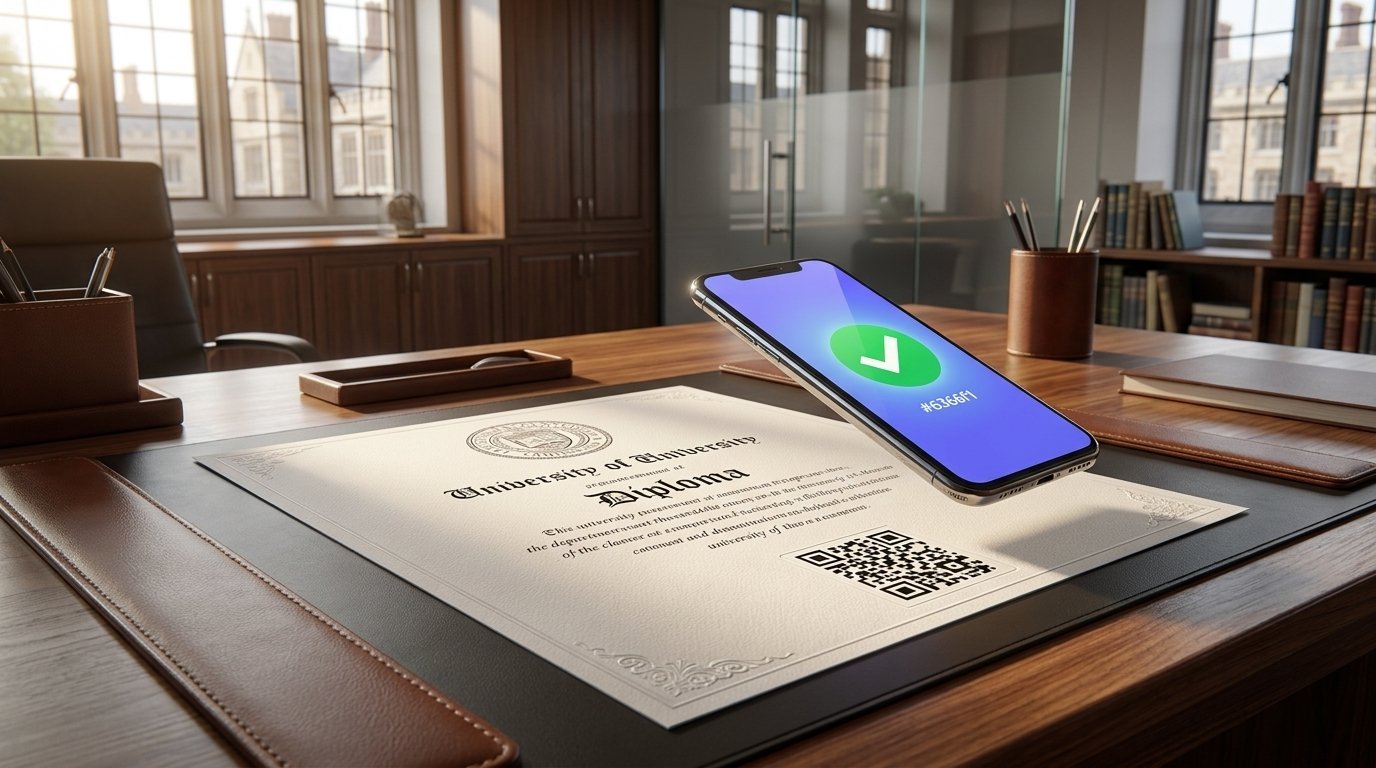
Over the past two years, instances of highly sophisticated, AI-generated fake degrees have risen by 45% globally, leaving traditional paper documents entirely defenseless. By implementing a robust QR code certificate maker, university registrars can bridge the gap between historic commencement traditions and zero-friction cryptographic security. This hybrid approach immediately halts sophisticated diploma forgery without forcing institutions to abandon the ceremonial printed degrees that students and alumni cherish.
In this comprehensive guide, our team at VEC Digital leverages our deep expertise in educational technology to reveal how forward-thinking institutions are modernizing academic records. You will learn how to deploy a hybrid digital-physical credential strategy, drastically reduce the administrative burden of manual audits, and seamlessly integrate verifiable digital credentials into your existing graduation operations.
Key Takeaways
- Hybrid Credentials protect institutional prestige by linking physical paper to an immutable blockchain record.
- A QR code certificate maker eliminates the risk of AI-generated forgery by routing employers to a cryptographic verification page.
- Creating a digital twin diploma satisfies both the student demand for physical graduation artifacts and the corporate need for instant verification.
- Implementing a modern academic verification system reduces manual audit requests from external employers by up to 65%.
- Blockchain certificate verification ensures that even if a physical document is perfectly copied, the underlying data remains secure and tamper-proof.
The Vulnerability of Traditional Paper in a Digital World
For centuries, the physical diploma has stood as the ultimate symbol of academic achievement. However, in an era where high-resolution scanners, advanced graphic design software, and artificial intelligence are readily accessible, the security of standard paper has been completely compromised. Today, institutions must recognize that relying solely on physical security featuresâ-like watermarks, embossed seals, or specialty paperâ-is no longer sufficient to protect their institutional reputation. By integrating a QR code certificate maker into the issuance process, universities can maintain the aesthetic beauty of these documents while fortifying them with modern cryptography.
The global landscape of higher education is facing an unprecedented crisis of authenticity. When a fraudulent degree enters the job market bearing a university's name, it does more than just deceive a single employer; it systematically dilutes the value of every legitimate degree issued by that institution. Addressing this vulnerability requires a fundamental shift in how we view academic records, moving from static pieces of paper to dynamic, securely anchored assets.
The Rising Tide of AI-Generated Degree Forgery
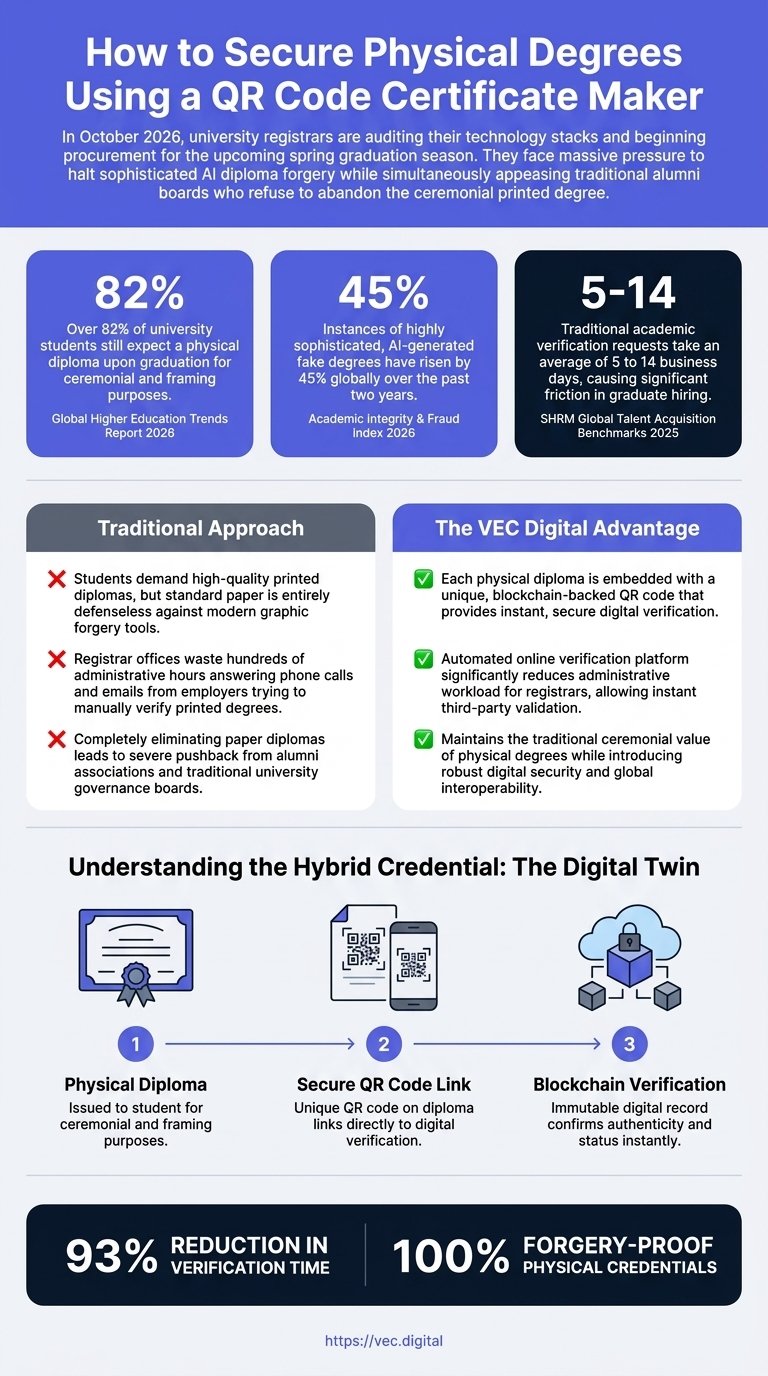
The accessibility of generative AI and advanced image manipulation tools has democratized forgery. According to the Academic Integrity & Fraud Index (2026), instances of highly sophisticated, AI-generated fake degrees have risen by 45% globally over the past two years. Bad actors can now replicate complex typography, match exact institutional color palettes, and even forge the signatures of university chancellors with terrifying accuracy.
This surge in sophisticated credential fraud means that employers can no longer trust a document based solely on its visual appearance. A beautifully printed certificate might look perfectly legitimate in a frame or as a scanned PDF attachment in an email, but without a digital anchor to verify its origins, it remains a high-risk artifact. The challenge for modern registrars is to implement an information security protocol that proactively prevents degree fraud before the forged document is ever presented to an employer.
Why Students Still Demand Physical Diplomas
Despite the glaring security flaws of paper, the demand for physical graduation artifacts remains overwhelmingly strong. According to the Global Higher Education Trends Report (2026), over 82% of university students still expect a physical diploma upon graduation for ceremonial and framing purposes. The physical degree represents years of sacrifice, financial investment, and intellectual rigor. It is a deeply emotional artifact that students proudly display in their homes and future offices.
This sentiment is especially pronounced in regions like the Middle East, parts of Asia, and Latin America, where physical certificates carry profound cultural and professional prestige. A completely paperless approach often alienates traditional alumni associations and university governance boards who fear that modern technology will cheapen the university's historic brand. The solution is not to destroy the tradition, but to evolve it by marrying the physical artifact with a secure digital backbone.
The Administrative Burden of Manual Verification
When physical degrees lack integrated digital verification, the burden of proof falls squarely on the university registrar's office. Traditional academic verification requests take an average of 5 to 14 business days, causing significant friction in graduate hiring, according to the SHRM Global Talent Acquisition Benchmarks (2025). Registrars are forced to waste hundreds of administrative hours answering phone calls, digging through legacy databases, and responding to emails from employers trying to manually verify printed degrees.
This manual system is not only incredibly inefficient but also detrimental to the graduate's career prospects. In a highly competitive global job market, a two-week delay in background screening can cost a candidate a lucrative job offer. By modernizing the verification pipeline, universities can protect their staff from burnout while simultaneously acting as career accelerators for their alumni.
Understanding the Hybrid Credential: The Digital Twin
The concept of a hybrid credential is revolutionizing how institutions manage academic records. Instead of viewing digital and physical formats as mutually exclusive, forward-thinking universities are using a QR code certificate maker to create a symbiotic relationship between the two. This approach ensures that the physical document retains its ceremonial prestige while the digital counterpart provides unbreakable security and instant accessibility.
By adopting this dual-format strategy, universities can satisfy all stakeholders. Traditionalists get their beautifully embossed paper, students get a highly shareable digital asset, and employers get an instant, frictionless way to verify the candidate's claims. This is the essence of building a truly modern credentialing infrastructure that respects the past while embracing the future.
What is a Digital Twin Diploma?
A digital twin diploma is an exact, cryptographically secured digital replica of a physical academic certificate. When a university issues a degree, the digital diploma platform generates a unique, immutable digital record that mirrors the data on the printed document. This digital twin is hosted on a secure server and anchored to a blockchain, ensuring that its dataâ-such as the graduate's name, degree classification, and date of issuanceâ-can never be altered or tampered with.
The physical diploma and its digital twin are permanently linked via a unique identifier, typically embedded within a scannable matrix barcode. When an employer or auditor interacts with the physical document, they are seamlessly guided to the digital twin, which serves as the single source of truth. This completely eliminates the ambiguity of physical forgery, as the digital twin provides irrefutable proof of the document's authenticity.
How Blockchain Certificates Work Alongside Printed University Degrees
The integration of blockchain technology with printed degrees sounds complex, but the execution is remarkably elegant. When a certificate is generated, the underlying data is passed through a cryptographic hash functionâ-a mathematical algorithm that converts the data into a unique, fixed-length string of characters. This hash is then published to a public or consortium blockchain. Because blockchains are decentralized and immutable, this record cannot be retroactively changed by hackers, rogue employees, or even the issuing institution itself.
The printed university degree simply acts as a physical presentation layer for this blockchain record. It displays the human-readable information alongside a unique access point (the QR code). When scanned, the system queries the blockchain to confirm that the hash of the presented data perfectly matches the hash permanently stored on the ledger. If even a single pixel or letter has been altered on the physical document, the hashes will not match, and the verification will instantly fail, exposing the fraud.
Overcoming Stakeholder Skepticism
Transitioning to a secure digital system often requires convincing skeptical stakeholders who fear that modern technology will undermine the institution's legacy. Alumni boards and academic senates frequently push back against the idea of "digitizing" degrees, envisioning a cold, purely electronic future. The key to overcoming this skepticism is reframing the technology not as a replacement, but as an invisible cryptographic shield that protects the physical document.
By demonstrating that the physical graduation ceremony will remain untouched, and that students will still walk across the stage to receive a beautifully printed diploma, registrars can alleviate these fears. The technology operates quietly in the background, serving only to enhance the value of the degree by making it globally verifiable. When stakeholders understand that this hybrid approach actively defends the university's brand against the rising tide of AI forgery, resistance quickly transforms into enthusiastic support.
How to Build a Cryptographic Shield
Implementing a secure credentialing environment requires the right technological infrastructure. The core function of a QR code certificate maker is to seamlessly bind the physical artifact to its digital anchor without introducing friction into the design or printing process. This requires a platform that offers intuitive design capabilities, robust data management, and uncompromising security protocols.
Our comprehensive digital diploma platform at VEC Digital is engineered specifically for this purpose. We provide institutions with the tools to design stunning, high-resolution certificates that natively incorporate secure routing mechanisms. By automating the generation of unique identifiers and cryptographic hashes, we allow registrars to focus on the aesthetics and ceremony of graduation, while our system handles the complex security architecture.
How Do I Add a Secure QR Code to a Printed Certificate?
Adding a secure verification matrix to a printed certificate is a straightforward process when utilizing the right software. Within a visual drag-and-drop template editor, administrators can upload their traditional background artwork, complete with the university's historic crest and signature lines. Dynamic placeholders are then positioned for variable data, such as the recipient's name, major, and graduation date.
The final step is placing the dynamic QR code element onto the canvas. Unlike static codes that point to a generic university homepage, a dedicated certificate engine generates a unique, distinct code for every single graduate in the batch. When the final high-resolution files are exported for the printing press, each document features its own unique cryptographic link. This process requires zero coding or advanced graphic design skills, fitting perfectly into standard pre-press operations.
The Anatomy of a Verifiable Digital Credential
A true verifiable digital credential consists of three distinct layers of trust. The first layer is the visual presentationâ-the aesthetic design that communicates the achievement to a human reader. The second layer is the metadata, which contains the structured, machine-readable information about the issuer, the recipient, and the specific qualifications earned.
The third and most critical layer is the cryptographic proof. This includes the digital signatures of the issuing authorities and the blockchain anchor that guarantees immutability. When all three layers are bound together and accessed via a unique scan point on the physical document, you create an unbreakable chain of trust. This multi-layered anatomy ensures that the credential can be independently verified by third parties without needing to contact the issuing university directly.
Are QR Codes on Physical Certificates Actually Safe From Copying?
A common concern among administrators is whether the matrix barcode itself can be copied or cloned by a forger. The answer lies in understanding how the verification routing works. If a fraudster photocopies a legitimate diploma, they will indeed copy the QR code. However, when an employer scans that copied code, it will route them to the digital twin of the original graduate.
For example, if a forger alters the name on the physical paper from "John Doe" to "Jane Smith" but leaves the original code intact, scanning the code will pull up the official university record for John Doe. The employer will immediately see the discrepancy between the physical paper (Jane Smith) and the immutable digital record (John Doe), instantly exposing the forgery. The code is not a secret password; it is a public signpost pointing to the unalterable truth.
Empowering Employers and Accelerating Graduate Hiring
The ultimate consumer of an academic credential is not the student, but the prospective employer. If the verification process is cumbersome, slow, or expensive, the value of the degree diminishes. By utilizing a high-quality QR code certificate maker, universities can transform their alumni into highly competitive candidates by offering employers a frictionless, instantaneous verification experience.
In today's fast-paced corporate environment, HR departments and background screening agencies demand efficiency. By adopting global standards for verifiable digital credentials, universities directly align themselves with the technological expectations of modern enterprise hiring teams, thereby accelerating the transition from graduation to employment.
How Can Employers Verify if a Paper Diploma is Real?
Historically, verifying a paper diploma required an employer to contact the university registrar, submit a formal request, pay a processing fee, and wait weeks for a response. Today, the process is instantaneous. When presented with a hybrid digital-physical diploma, the employer simply opens the standard camera app on their smartphone and scans the embedded code.
Within seconds, they are routed to a dedicated, secure URL (e.g., /certificate/[uuid]) hosted by the digital diploma platform. This page displays the authoritative data directly from the blockchain, including the recipient's verified name, the exact degree awarded, the date of issuance, and the "Blockchain Verified" security badge. There are no apps to download, no accounts to create, and no fees to pay. It is a zero-friction audit.
Can a Fake Diploma Have a Working QR Code?
Sophisticated forgers will sometimes attempt to create a completely fake diploma and place their own generated QR code on it to simulate authenticity. However, this tactic is easily defeated by the architecture of a proper academic verification system. A forger's code will simply point to a fake website or a spoofed verification page that they control.
Employers are trained to look at the URL domain when the verification page opens. If the official university verification is hosted on a secure, recognized domain (or via a trusted trust infrastructure provider like VEC Digital), a spoofed URL will be immediately obvious. Furthermore, the true blockchain anchor provides a public ledger record that the forger cannot replicate. The cryptographic proof guarantees that the data originated from the authorized institutional wallet, making spoofing mathematically impossible.
Achieving Frictionless Audits with Mobile Scanning
The corporate world has already embraced mobile scanning for operational efficiency. According to the Gartner HR Technology Outlook (2026), mobile QR code scanning for secure document verification has reached 90% adoption among enterprise HR screening teams. By providing credentials that natively support this behavior, universities are speaking the language of modern business.
The impact on university operations is equally profound. Institutions implementing hybrid digital-physical credentials report a 65% reduction in manual audit requests from external employers, according to the EdTech Operations Review (2026). This massive reduction in administrative overhead frees up registrar staff to focus on higher-value student services, rather than acting as a clerical clearinghouse for background checks.
Implementing a Digital Diploma Platform at Scale
Transitioning an entire university's graduation output to a hybrid model may seem daunting, but modern software architecture has eliminated the traditional barriers to entry. Deploying a QR code certificate maker at scale does not require overhauling legacy IT systems or hiring dedicated blockchain developers. Through smart automation and intuitive data handling, institutions can issue thousands of secure credentials in minutes.
A comprehensive digital diploma platform is designed to integrate seamlessly into existing academic calendars and administrative workflows. Whether dealing with a small cohort of specialized medical graduates or a massive commencement ceremony of 10,000 students, the technology scales effortlessly to meet the demand.
Integrating Bulk Generation into Registrar Operations
The most efficient way to handle massive graduations is through an automated bulk issuance process. Registrars can simply export a standard CSV file from their existing Student Information System (SIS) containing the names, degrees, and honors of the graduating class. This file is then uploaded into the secure credentialing engine.
The automated process instantly maps the spreadsheet data to the dynamic placeholders on the approved certificate template. In a matter of minutes, the system generates the unique identifiers, anchors the hashes to the blockchain, dispatches the digital twins via email to the students, and exports the high-resolution, print-ready filesâ-complete with unique scan codesâ-for the physical printing press. What used to take weeks of manual data entry and proofing is now accomplished with a few clicks.
Ensuring Long-Term Blockchain Certificate Verification
Academic degrees are lifelong credentials. A student graduating today may need to verify their degree in thirty years when applying for a senior executive position. Therefore, the underlying technology must offer extreme longevity. Traditional database servers can crash, companies can go out of business, and URLs can break. This is why blockchain certificate verification is the new gold standard.
By anchoring the cryptographic hash of the diploma to a decentralized public ledger, the proof of authenticity exists independently of the issuing university's internal servers and the software vendor's infrastructure. Even if the university's website undergoes a massive overhaul a decade from now, the blockchain record remains permanently intact and publicly verifiable, ensuring that the graduate's achievements are protected for a lifetime.
A Global Standard for Academic Verification Systems
As higher education becomes increasingly globalized, universities need an academic verification system that transcends borders. A graduate from a university in Dubai may apply for a role in London, requiring their credentials to be instantly recognized and trusted by foreign employers who are unfamiliar with the specific issuing institution.
By adopting universally recognized cryptographic standards and frictionless mobile scanning, universities tap into a global trust network. This interoperability is crucial for international student mobility and global workforce integration. It signals to the world that the institution is committed to uncompromising data integrity and modern technological excellence, vastly enhancing its international reputation.
Secure Your Institution's Legacy Today
The physical diploma is a cherished tradition that deserves to be protected, not discarded. By embracing a hybrid digital-physical approach, your institution can eliminate the threat of AI-generated degree fraud, drastically reduce administrative overhead, and provide your graduates with the ultimate competitive advantage in the job market.
It is time to bridge the gap between historic prestige and modern cryptographic security. With our intuitive platform at VEC Digital, you can design, anchor, and issue verifiable digital credentials without writing a single line of code. Build your custom templates, automate your bulk issuance, and secure your university's reputation with unbreakable blockchain technology.
Ready to modernize your graduation operations and protect your academic legacy? Secure your organization's credentials todayâ-design your first template in minutes with no setup fees. Contact our team to learn more about integrating our trust infrastructure into your campus.
Website: https://vec.digital
Email: support@vec.digital