
Hybrid Degrees: Bridging Tradition With a Digital Diploma Platform
Published on August 15, 2026
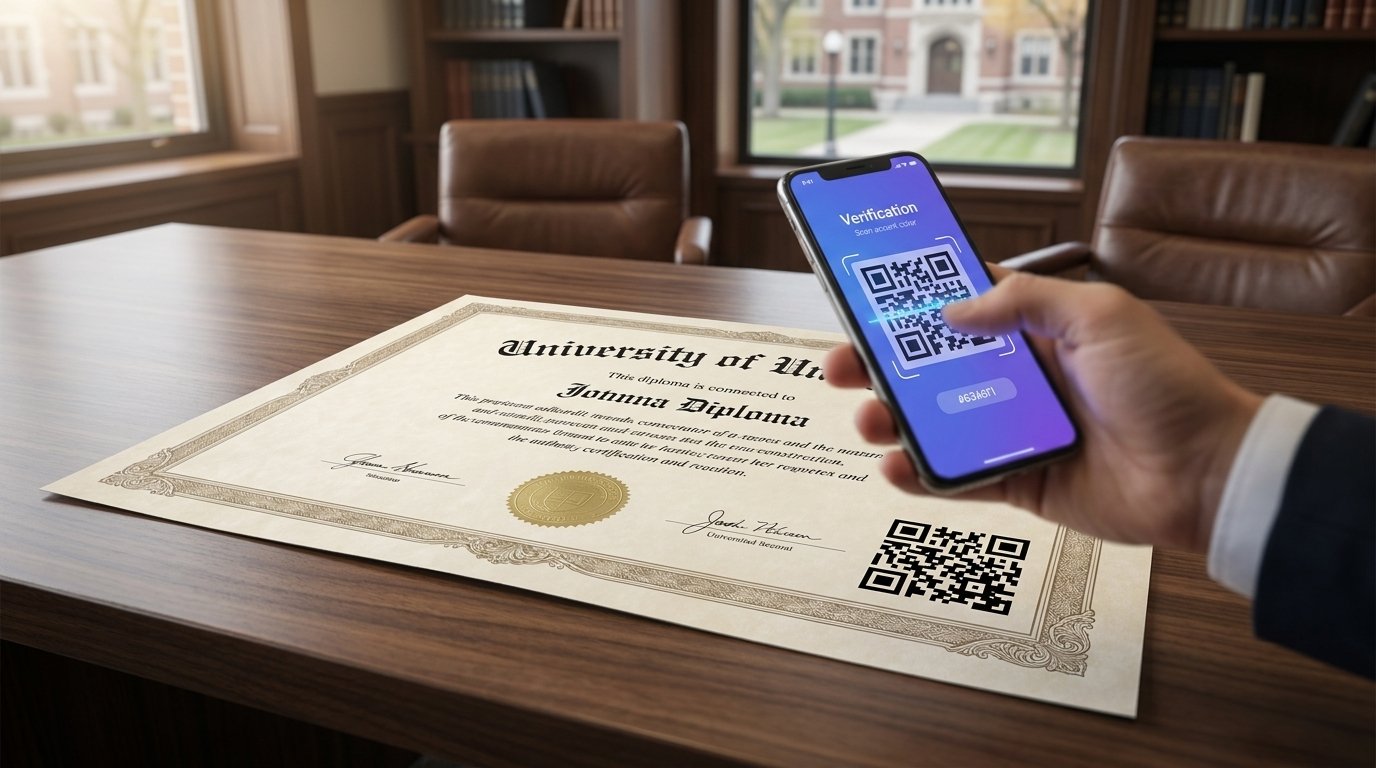
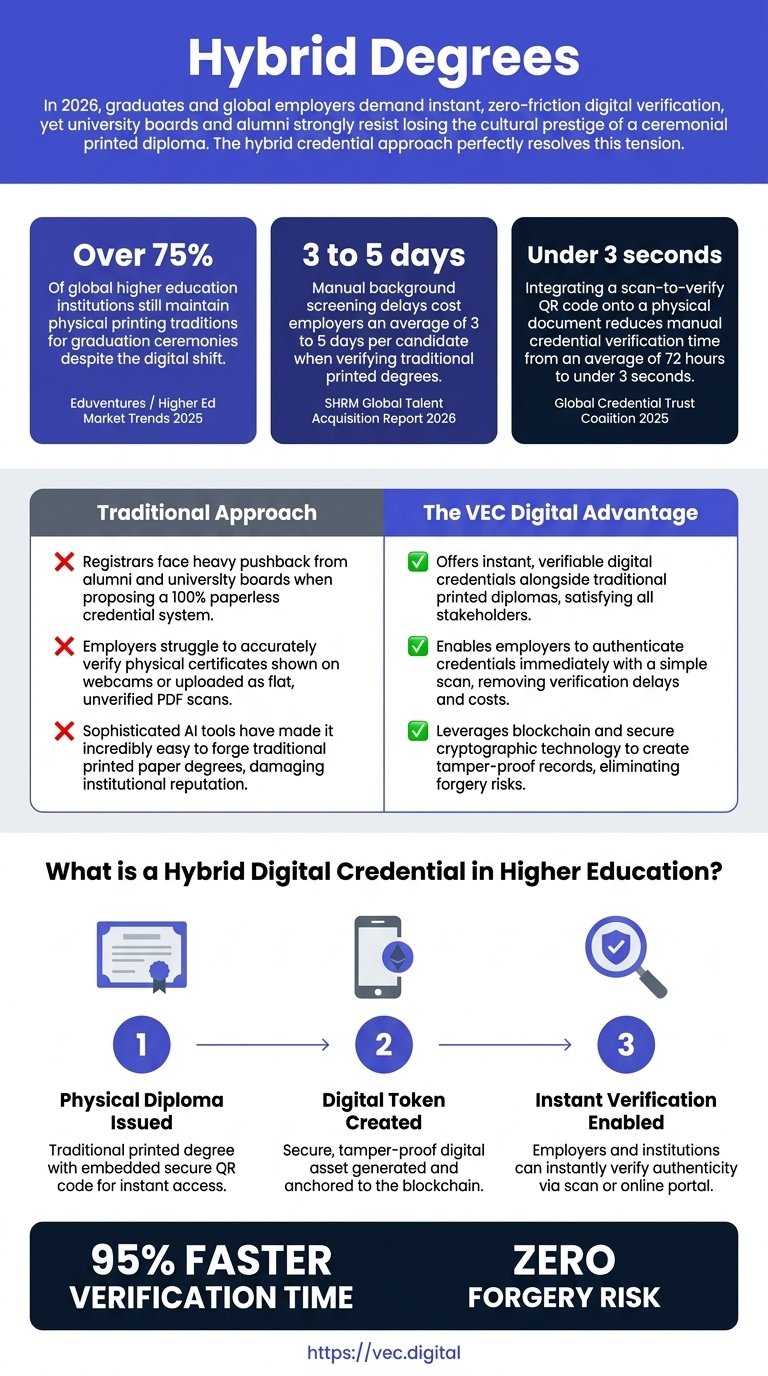
Over 75% of global higher education institutions still maintain physical printing traditions for graduation ceremonies despite the digital shift, according to 2025 data from Eduventures / Higher Ed Market Trends. However, balancing this rich heritage with the urgent global demand for instant, cryptographic security requires a highly modernized approach. By adopting a robust digital diploma platform, university registrars can seamlessly merge the ceremonial prestige of printed parchment with unbreakable blockchain verification.
In this comprehensive guide, our team at VEC Digital explores the mechanics of the hybrid degree strategy for the modern academic landscape. You will learn how to embed verifiable technology into traditional hardcopy designs, discover technological methods to completely prevent degree fraud, and explore how automated credentialing systems can save your institution thousands of administrative hours while satisfying both legacy alumni boards and fast-paced global employers.
Key Takeaways
- Hybrid digital credentials combine the cultural prestige of physical diplomas with the cryptographic security of blockchain technology.
- Implementing a QR code certificate maker reduces manual employer verification times from 72 hours down to under 3 seconds.
- Universities can successfully prevent degree fraud by anchoring physical document hashes to an immutable public ledger.
- Automated batch generation using a bulk certificate generator eliminates the administrative drain of manual transcript mailing.
- Modern verifiable digital credentials empower graduates to share their achievements globally within 24 hours of graduation.
Table of Contents
- The Tension Between Heritage and Modern Security
- What is a Hybrid Digital Credential in Higher Education?
- How to Add a QR Code to a Physical Diploma
- Ensuring Cryptographic Trust: Can a Printed Certificate be Blockchain Verified?
- How Modern Employers Verify Paper Degrees Instantly
- Securing Your Institution's Legacy with VEC Digital
The Tension Between Heritage and Modern Security
For centuries, the physical diploma has served as the ultimate symbol of academic achievement. Yet, in an era defined by rapid digital transformation, universities find themselves caught in a difficult position. They must preserve the cultural weight of graduation ceremonies while simultaneously upgrading their technological infrastructure to meet the strict data verification standards of the modern workforce. A comprehensive digital diploma platform offers the ideal bridge between these two worlds.
The push for modernization is often met with resistance, but the operational realities of legacy systems can no longer be ignored. From the immense administrative burden placed on university registrars to the rising threat of sophisticated forgery, relying exclusively on analog paper records is a profound organizational risk.
The Enduring Cultural Weight of the Physical Diploma
Registrars face heavy pushback from alumni and university boards when proposing a 100% paperless credential system. In many regionsâ-particularly across legacy European institutions, Asia, and the Middle Eastâ-physical diplomas carry immense cultural weight and ceremonial importance. A forced transition to purely digital records is often viewed as culturally misaligned, stripping away the tangible prestige that students work years to achieve.
This is why the aforementioned Eduventures / Higher Ed Market Trends (2025) statistic is so vital: over 75% of global higher education institutions still maintain physical printing traditions. The goal for modern academic leaders is not to destroy this tradition, but to augment it. By integrating advanced technology into the physical document, universities can maintain their elite ceremonial prestige while strictly adhering to the newest global data verification standards.
The Administrative Drain of Legacy Verification
Behind the scenes, the reliance on purely physical documents creates a massive operational bottleneck. Mailing physical transcripts and waiting for manual email verifications drains hundreds of administrative hours each semester. When an alumnus applies for a job overseas, the employer must contact the university's records department, wait for a manual database lookup, and receive a formal confirmation.
This outdated process is highly inefficient. According to the SHRM Global Talent Acquisition Report (2026), manual background screening delays cost employers an average of 3 to 5 days per candidate when verifying traditional printed degrees. This delay not only frustrates global employers but can actively harm a graduate's chances in a competitive, fast-moving job market.
The Rise of AI-Generated Forgery
Perhaps the most urgent catalyst for adopting a modern credentialing system is the escalating threat to institutional integrity. Sophisticated AI tools have made it incredibly easy to forge traditional printed paper degrees, damaging institutional reputation on a global scale. High-resolution printers and AI-driven graphic design software can replicate watermarks, signature strokes, and embossed seals with terrifying accuracy.
The Higher Education Policy Institute (2026) reports that academic credential fraud has risen by over 40% globally, largely driven by these sophisticated AI-generated physical diploma forgeries. To truly prevent degree fraud, institutions must move beyond visual security features (like holograms or specialty paper) and implement cryptographic verification that cannot be replicated by artificial intelligence.
What is a Hybrid Digital Credential in Higher Education?
To resolve the conflict between physical tradition and digital necessity, forward-thinking institutions are adopting a blended methodology. A hybrid credential leverages a digital diploma platform to create a physical document that acts as a secure gateway to an immutable digital record.
This approach satisfies all stakeholders: the alumni board retains the beautiful parchment for framing, the student receives immediate digital proof for their career networking, and the employer gains a frictionless method to verify the document's authenticity in seconds.
Defining the Hybrid Approach: What is a hybrid digital credential in higher education?
A hybrid digital credential in higher education is a physical certificate or diploma that features an embedded, uniquely generated cryptographic linkâ-typically in the form of a scannable QR code. While the document itself is printed on traditional high-quality parchment, the embedded code tethers the physical paper to a secure, cloud-based or blockchain-anchored digital twin.
When scanned, this link directs the user to a dedicated, university-controlled verification page. This page displays the exact, unalterable details of the graduate's achievement, including the date of issuance, the specific degree awarded, and the cryptographic signatures of the university officials. It effectively turns a static piece of paper into a dynamic, interactive data portal.
How can universities transition to digital records without losing printed diplomas?
Transitioning to digital records does not require abandoning the printing press. Universities can transition smoothly by integrating a visual certificate maker into their existing issuance process. Instead of replacing the physical diploma, the university simply updates the design template to include a dedicated zone for a dynamic QR code.
During graduation season, the institution's automated system generates the digital records first. It then exports print-ready files where each student's unique QR code is perfectly mapped onto their specific diploma design. The university can then send these files to their traditional printing partners. The result is a seamless graduation ceremony where students walk across the stage to receive a physical degree that is already cryptographically secured.
Bridging the Gap for Modern Graduates
Today's graduates operate in a digital-first professional landscape. They build their personal brands on global networking platforms and apply for roles across international borders. While they cherish the physical diploma for personal display, they urgently need a digital format for practical career advancement.
According to LinkedIn Talent Solutions / Gen Z Workforce Data (2026), 88% of modern graduates expect to upload verifiable digital proofs of their achievements to professional networks within 24 hours of their ceremony. A hybrid strategy fulfills this expectation perfectly. The moment the university issues the credential through their platform, the student receives an email with their secure digital link, allowing them to share their success globally before the ink on their physical diploma is even dry.
How to Add a QR Code to a Physical Diploma
The operational mechanics of creating a hybrid degree are surprisingly straightforward when utilizing the right technology. By moving away from disjointed legacy software and adopting a centralized digital diploma platform, registrars can automate the entire design and issuance lifecycle without requiring advanced technical skills.
This process empowers institutions to issue thousands of uniquely coded diplomas simultaneously, ensuring that every single graduate receives a secure, personalized document ready for both printing and digital sharing.
The Role of a QR Code Certificate Maker: How do you add a QR code to a physical diploma?
Adding a secure verification link to a physical document is accomplished using a specialized QR code certificate maker. Within a visual drag-and-drop template editor, university administrators can upload their existing, high-resolution background artworkâ-complete with the institution's crest, traditional fonts, and border designs.
Once the background is set, the administrator places dynamic text placeholders (such as {{Student_Name}} and {{Degree_Program}}) onto the canvas. They then drag a dedicated QR code element into a designated corner of the diploma. When the issuance process is triggered, the system automatically generates a unique URL for each specific student, converts that URL into a high-density QR code, and flattens it onto the final print-ready document. There is no need for manual graphic design adjustments for each student.
Designing for Security and Aesthetics
One of the primary concerns from university boards is that adding a barcode or QR code will ruin the classic aesthetic of the diploma. However, modern certificate platforms offer precise alignment guides, custom sizing, and layer management to ensure the code blends seamlessly with the traditional design.
Institutions can scale the QR code to be unobtrusive yet easily scannable by any standard smartphone camera. By treating the QR code as a modern seal of authenticityâ-much like a traditional wax seal or foil stampâ-universities can frame the technological addition as an enhancement of prestige rather than a detraction from it.
Seamless Batch Generation
Handling graduation for a class of 5,000 students requires immense operational efficiency. Manually generating individual QR codes and pasting them into design files is impossible at scale. This is where a bulk certificate generator becomes essential for academic operations.
Registrars can simply upload a standard CSV file containing the graduating cohort's details (names, honors, degree types, and student IDs). The automation engine parses this data, dynamically populates the visual template, generates 5,000 unique QR codes, and produces a batch of high-resolution, print-ready files in minutes. Simultaneously, it dispatches the digital versions to the students' email inboxes, executing a flawless, dual-delivery process.
Ensuring Cryptographic Trust: Can a Printed Certificate be Blockchain Verified?
While a QR code provides frictionless access to a digital record, the underlying security of that record is what truly matters. If the digital database can be hacked or altered, the physical diploma remains vulnerable. To establish absolute trust, leading institutions are turning to decentralized technology, leveraging their digital diploma platform to anchor records immutably.
Blockchain technology fundamentally changes the paradigm of document security. By utilizing public-key cryptography and decentralized ledgers, universities can guarantee that once a degree is issued, it can never be secretly modified, revoked without a trace, or forged by external actors.
Securing Physical Documents on the Blockchain: Can a printed university certificate be blockchain verified?
Yes, a printed university certificate can absolutely be blockchain verified. The process works through cryptographic hashing. When the university issues the credential, the platform takes all the data associated with that specific degree (the student's name, the university's digital signature, the date, and the QR code URL) and runs it through a mathematical algorithm to create a unique string of characters known as a hash.
This hash is then permanently anchored to a public blockchain. When an employer scans the QR code on the physical paper, the verification page automatically checks the current hash of the digital record against the immutable hash stored on the blockchain. If they match perfectly, the system displays a "Blockchain Verified" badge, proving unequivocally that the physical document in the employer's hand is authentic and unaltered.
Are digital diploma platforms secure against AI forgery?
Yes, platforms that utilize blockchain anchoring are entirely immune to AI forgery. While an AI graphic design tool can easily copy a university logo, forge a dean's signature, or replicate the exact visual pattern of a QR code, it cannot rewrite the immutable ledger of a blockchain.
If a fraudster creates a fake physical diploma and generates a fake QR code, scanning that code will lead to a fake websiteâ-but it will lack the cryptographic proof of the university's official blockchain wallet. The verification process relies on underlying mathematical proofs, not visual aesthetics. Therefore, no matter how visually perfect an AI-generated forgery appears on paper, it will instantly fail a cryptographic blockchain certificate verification check.
Global Interoperability and Compliance
The adoption of verifiable digital credentials is accelerating worldwide as governments and international corporations demand stricter compliance. For example, leaders seeking academic degree fraud prevention Middle East are rapidly adopting these cryptographic standards to protect their rapidly expanding educational hubs. Similarly, blockchain certificate solutions UAE have become a benchmark for international tech adoption, proving that legacy prestige and cutting-edge security are highly compatible.
By issuing credentials that adhere to global open standards, universities ensure that their graduates' achievements can be instantly recognized and validated by any employer, anywhere in the world, without relying on proprietary, closed-loop verification software.
How Modern Employers Verify Paper Degrees Instantly
The ultimate test of any credentialing system is how easily it can be utilized by the end-user: the employer. If a verification process is cumbersome, requires account creation, or mandates app downloads, employers will simply bypass it, leading to the same administrative delays that plague legacy systems.
A sophisticated digital diploma platform eliminates this friction entirely. By transforming the physical diploma into an interactive touchpoint, universities empower employers to conduct rigorous background checks in real-time, drastically accelerating the hiring pipeline.
Eliminating the 72-Hour Waiting Period
The transition from manual checks to instant cryptographic validation represents a monumental leap in HR efficiency. According to the Global Credential Trust Coalition (2025), integrating a scan-to-verify QR code onto a physical document reduces manual credential verification time from an average of 72 hours to under 3 seconds.
Instead of drafting an email to a university registrar, waiting for a response, and potentially paying a third-party background screening fee, an HR manager can simply point their smartphone camera at the applicant's diploma. The instantaneous validation accelerates time-to-hire, providing a critical advantage for both the employer and the graduate.
Solving the Webcam and Flat PDF Dilemma
In today's remote-first hiring environment, employers frequently struggle to accurately verify physical certificates shown on webcams or uploaded as flat, unverified PDF scans. A standard PDF can be easily manipulated using basic PDF editing software, and a low-resolution webcam stream makes it impossible to check the physical security features of a printed document.
The hybrid credential completely neutralizes this pain point. If a candidate holds up their diploma on a video call, the employer can simply scan the QR code directly from their computer screen. If the candidate uploads a scan of their physical diploma to an applicant tracking system, the HR software (or the recruiter's smartphone) can read the code from the image file, immediately pulling up the secure, blockchain-verified digital twin.
QR Code Verification for Student Records: How do modern employers verify paper degrees instantly?
Modern employers verify paper degrees instantly by utilizing zero-friction QR code verification for student records. When the employer scans the code, they are routed to a dedicated, secure URL (e.g., /certificate/[uuid]) hosted by the issuing institution's platform.
This page requires no app installations or logins. It presents a clean, professional interface displaying the verified recipient data, the issuing authority's verified digital signature, and the real-time blockchain validation status. This seamless experience builds immediate trust, completely removing the doubt associated with reviewing physical or scanned documents.
Securing Your Institution's Legacy with VEC Digital
The future of academic credentialing does not require the abandonment of physical tradition. By adopting a hybrid degree strategy, universities can honor their rich heritage while equipping their graduates with the cryptographic proof demanded by the modern global economy. From eliminating the administrative nightmare of manual verification to completely neutralizing the threat of AI-generated forgery, the benefits of modernization are undeniable.
At VEC Digital, we provide the comprehensive trust infrastructure required to make this transition effortless. Our platform combines a visual drag-and-drop certificate maker, seamless CSV batch generation, and immutable blockchain anchoring into one frictionless system. We empower institutions to issue with absolute confidence, giving learners the power to own their achievements and employers the certainty to hire without doubt.
Protect your institution's reputation and streamline your credentialing operations today. Discover how easy it is to bridge traditional prestige with modern security by exploring our solutions at https://vec.digital, or reach out to our team directly at support@vec.digital.