
Licensing Boards & Blockchain Certificate Verification: 2026 Guide
Published on October 26, 2026

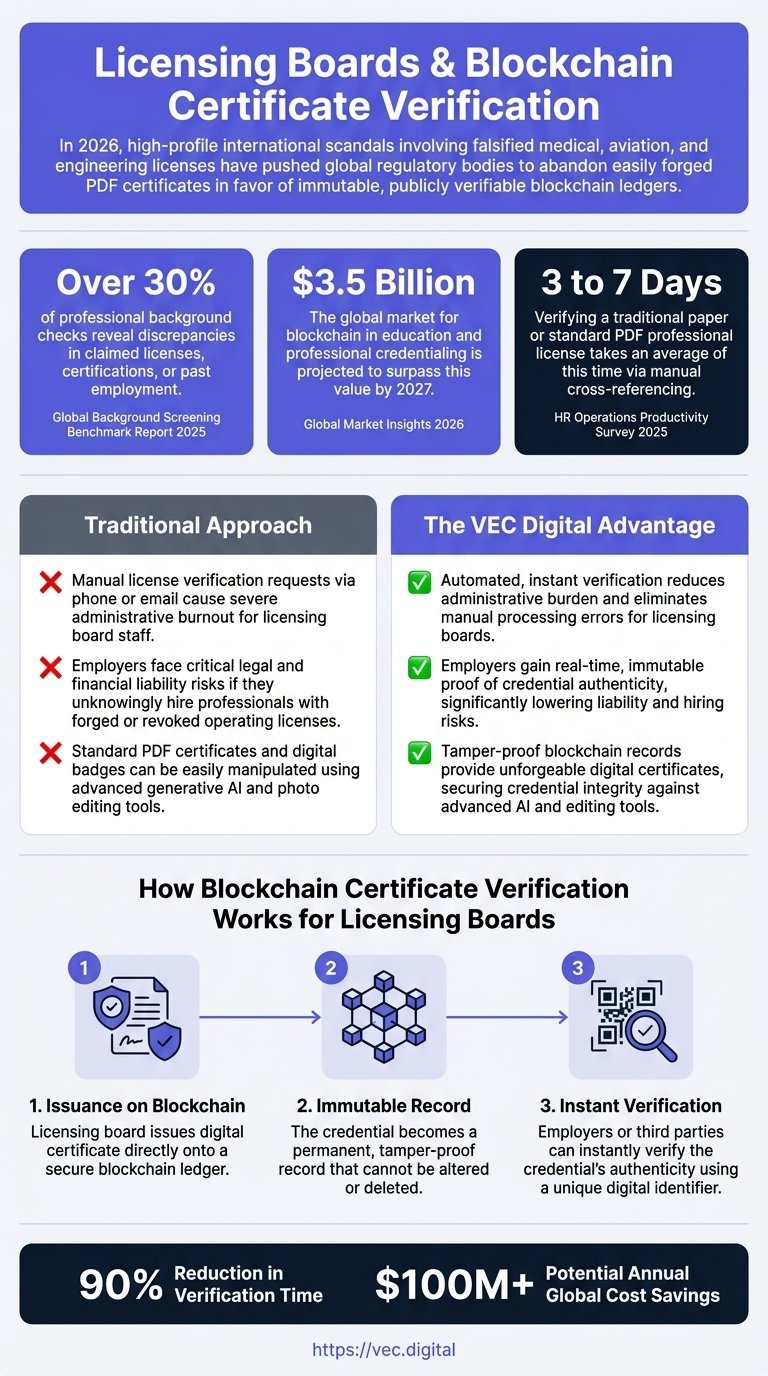
Over 30% of professional background checks reveal discrepancies in claimed licenses, certifications, or past employment, according to the 2025 Global Background Screening Benchmark Report. For professional licensing boards, medical councils, and engineering regulatory bodies, this statistic exposes a critical vulnerability that traditional paper and digital documents can no longer defend against. As the sophistication of credential fraud accelerates worldwide, implementing robust blockchain certificate verification has transitioned from a technological luxury to an absolute mandate for protecting public trust and ensuring occupational integrity.
In this comprehensive guide, you will learn how modern professional associations are overhauling their credentialing infrastructure to eliminate fraud, automate compliance, and streamline cross-border verifications. Drawing on our team's deep expertise in Technology and secure credentialing systems at VEC Digital, we will explore the mechanics of cryptographic verification, strategies for managing dynamic license states, and the global regulatory shifts driving this transformation. By the end of this article, you will have a clear, actionable blueprint for deploying a zero-friction, instantly verifiable digital ecosystem that protects both your organization and the public.
Key Takeaways
- Blockchain certificate verification guarantees absolute authenticity by anchoring professional credentials to an immutable, globally accessible public ledger.
- Transitioning to a secure digital diploma platform eliminates the 3 to 7 business day delay typical of manual background audits.
- Utilizing a QR code certificate maker allows employers and international auditors to conduct zero-friction, instant verifications via smartphone.
- Automated issuance systems drastically reduce administrative burnout while helping regulatory bodies prevent degree fraud and occupational misrepresentation.
- Modern licensing boards use these systems to handle dynamic states, including instant revocations, renewals, and compliance training certificate automation.
The Escalating Crisis in Professional Credentialing
The Hidden Costs of Occupational Fraud
The financial and reputational impacts of credential forgery extend far beyond simple administrative headaches. According to the 2024 ACFE Report to the Nations, organizations lose an estimated 5% of their annual revenue to occupational fraud, often facilitated by individuals leveraging falsified professional credentials to secure high-paying, high-stakes positions. When an unqualified individual practices medicine, signs off on structural engineering plans, or manages corporate finances, the resulting liability can be catastrophic.
For licensing boards, the mandate is clear: the public relies on your seal of approval to guarantee competence. When that seal can be easily replicated by bad actors, the foundational trust in the profession erodes. Blockchain certificate verification provides the cryptographic certainty required to rebuild and maintain this trust, ensuring that every claim of professional competence is backed by undeniable, mathematical proof.
Why Standard PDF Certificates Are Obsolete
Historically, professional associations transitioned from mailed paper certificates to emailed PDF documents, viewing this as a modernization step. However, standard PDF certificates and basic digital badges can now be easily manipulated using advanced generative AI and sophisticated photo editing tools. A bad actor can alter an expiration date, change a name, or fabricate a license number in minutes, creating a document that looks identical to the original.
To effectively prevent degree fraud and license manipulation, regulatory bodies must look beyond the visual layer of a document. The security must be embedded within the data itself. Standard PDFs lack primary-source anchoring; they are merely digital pictures of data. Modern secure credentials, by contrast, are cryptographically hashed, meaning any alteration to the document instantly invalidates its verification signature.
The Administrative Toll of Manual Verifications
The reliance on easily forged documents forces employers into a defensive posture, requiring them to manually verify every license with the issuing board. Verifying a traditional paper or standard PDF professional license takes an average of 3 to 7 business days via manual cross-referencing, according to the 2025 HR Operations Productivity Survey. This delay creates severe bottlenecks in international hiring and hospital staffing.
Furthermore, manual license verification requests via phone or email cause severe administrative burnout for licensing board staff. Highly trained personnel are reduced to operating as data-entry clerks, answering endless emails from background screening agencies. By automating this process through a publicly accessible, secure ledger, boards can reclaim thousands of administrative hours annually.
How Blockchain Certificate Verification Works for Licensing Boards
The Mechanics of Immutable Ledgers
Many administrators ask, "How does blockchain certificate verification work for licensing boards?" The process is rooted in advanced cryptography rather than cryptocurrency. When a licensing board issues a credential, the software generates a unique digital fingerprint of that document, known as a cryptographic hash. This hash is then permanently recorded on a decentralized blockchain network.
Because the blockchain is immutableâ-meaning it cannot be edited, deleted, or altered by any single partyâ-the record of that certificate's issuance is permanent and mathematically secure. When an employer wants to verify the license, the system compares the hash of the presented document against the hash stored on the blockchain. If they match perfectly, the document is 100% authentic. If even a single pixel or character has been altered, the verification fails instantly.
What is the Most Secure Way to Prevent Professional License Fraud?
The most secure method combines cryptographic hashing with zero-friction accessibility. Security systems are only effective if they are actually used. If verifying a license requires an employer to create an account, pay a fee, or wait days for an email response, they may skip the step entirely, exposing themselves to liability.
A comprehensive digital diploma platform solves this by making the verification process invisible to the user but mathematically rigorous on the backend. By decentralizing the proof of issuance, licensing boards remove the single point of failure inherent in legacy databases, ensuring that the verification infrastructure remains online and accessible globally with a 99.98% uptime SLA.
How Do Employers Verify Digital Professional Certificates Instantly?
The physical-to-digital bridge is crucial for real-world application. This is where a QR code certificate maker becomes indispensable. Every secure certificate generated should feature a required, embedded unique QR code. When an auditor, patient, or hiring manager scans this code using any standard smartphone camera, they are instantly routed to a dedicated, secure verification URL.
This process enables zero-friction verification in seconds with no app installs or logins required. The verifier immediately sees a public page displaying the issuer, the recipient, the license status, and a "Blockchain Verified" security badge. This instant, primary-source verification completely eliminates the 3 to 7 day waiting period, radically accelerating global employment timelines.
Managing Dynamic Credential States: Renewals and Revocations
Can Blockchain Credentials Be Revoked or Expired Automatically?
A major content gap in the credentialing industry is the difference between academic degrees and professional licenses. A university degree is static; once earned, it rarely changes. A medical or engineering license, however, is highly dynamic. It requires annual renewals, can be suspended pending an investigation, or can be permanently revoked due to malpractice.
Updating or revoking a compromised license in a legacy database often takes weeks to reflect publicly, creating a dangerous window for unauthorized practice. Modern blockchain certificate verification systems handle dynamic states flawlessly. While the initial issuance record is immutable, the issuer retains cryptographic control over the license's active status. If a board revokes a license, they update the status via their dashboard. The next time an employer scans the QR code, the verification page will instantly display a red "Revoked" or "Suspended" warning, closing the vulnerability window instantly.
Tracking Continuing Education (CE) Credits
Professional associations are heavily burdened by the tracking of Continuing Medical Education (CME) or Continuing Professional Development (CPD) credits. Integrating compliance training certificate automation allows boards to issue verifiable micro-credentials every time a professional completes a required seminar or training module.
These micro-credentials aggregate in the professional's digital locker, providing a transparent, instantly auditable trail of their ongoing education. When renewal season arrives, the board does not need to manually review stacks of paper certificates; the automated system simply verifies that the required cryptographic proofs of education are present on the ledger.
Transitioning from Static to Verifiable Digital Credentials
Moving from static PDFs to verifiable digital credentials requires a shift in operational thinking. It moves an organization from a model of "issuing documents" to a model of "issuing trust." This transition empowers the professional, who now owns a portable, cryptographically secure proof of their hard-earned status that they can share on LinkedIn, embed in their email signature, or present instantly during an international audit.
Global Regulatory Shifts and Legal Compliance
Are Blockchain Verifiable Credentials Legally Compliant for Medical Boards?
A common question among compliance officers is whether these advanced systems comply with stringent data privacy laws like GDPR in Europe, HIPAA in the United States, or equivalent frameworks in the Middle East. The answer lies in the architecture of the hashing process.
When implementing blockchain certificate verification, the actual personally identifiable information (PII) of the professional is never stored on the public blockchain. Only the cryptographic hashâ-an irreversible string of numbers and lettersâ-is anchored to the ledger. The underlying personal data remains securely encrypted on the issuing board's compliant servers. This ensures full compliance with international privacy regulations while still providing public, mathematical proof of authenticity.
The Borderless Mandate: EU, UAE, and Beyond
The push for instant verification is a global phenomenon. Nations across the Middle East (specifically the UAE and Saudi Arabia) and the European Union have recently introduced stringent corporate compliance frameworks requiring instant primary-source verification for healthcare, engineering, and financial professionals. These regions are actively aligning with international standards for digital trust.
This regulatory shift is accelerating the global mandate for borderless verification systems. If an engineer licensed in Germany seeks employment on a major infrastructure project in Dubai, the Dubai employer must verify the license immediately. Legacy systems create unacceptable friction in this global mobility. Blockchain provides a universal, trustless verification layer that works seamlessly across international borders.
Mitigating Employer Liability
Employers face critical legal and financial liability risks if they unknowingly hire professionals with forged or revoked operating licenses. By mandating the use of a secure digital diploma platform, licensing boards actively protect the employers within their jurisdiction. Providing instant, primary-source verification shifts the burden of proof away from the employer and back to the cryptographic system, ensuring that hiring decisions are made based on absolute, verified truth.
Implementing a Modern Digital Credential Platform
How Much Does a Blockchain Credential Verification System Cost to Implement?
Historically, building a custom cryptographic infrastructure required massive capital expenditure, taking months or years of development. Today, the landscape has fundamentally changed. Modern Software-as-a-Service (SaaS) platforms have democratized access to this technology.
Organizations no longer need to hire dedicated blockchain developers. Through flexible, subscription-based models or pay-as-you-go pricing, professional associations can deploy enterprise-grade blockchain certificate verification with zero setup fees and no custom coding required. This allows boards to modernize their infrastructure at a fraction of the cost of maintaining legacy databases.
Automating the Issuance Process
Scalability is a critical requirement for large professional bodies. Utilizing a bulk certificate generator allows organizations to automate the issuance of thousands of licenses simultaneously. Through a simple CSV upload process, administrators can map recipient names, license numbers, and expiration dates to dynamic placeholders within a visual template editor.
For even greater efficiency, boards are leveraging developer-ready REST APIs to connect their internal credentialing engine directly to their existing HRIS, LMS, or membership portals. This enables zero-touch automation, triggering immediate certificate generation and email delivery the exact second a professional passes an exam or pays their renewal fee. To ensure strict administrative governance, organizations can also implement multi-signatory review pipelines, holding certificates in a pending state until designated authorities securely log in and electronically sign off on the batch.
The Future of Professional Licensing
The global market for blockchain in education and professional credentialing is projected to surpass $3.5 billion by 2027, according to a 2026 report by Global Market Insights. Furthermore, nearly 40% of professional associations cite modernizing their digital credentialing infrastructure as a top three operational priority, based on the 2026 Association Management Trends Survey.
These statistics highlight a fundamental industry pivot. The boards that adopt verifiable digital credentials today are positioning themselves as forward-thinking leaders in regulatory compliance. They are reducing their carbon footprint by moving away from paper, eliminating administrative waste, and providing their members with modern, highly valuable digital assets.
Secure Your Organization's Public Trust Today
The reliance on easily manipulated paper and PDF licenses is an unacceptable risk in today's digital economy. Professional licensing boards, medical councils, and regulatory bodies bear the ultimate responsibility for protecting public safety and maintaining the integrity of their respective industries. By adopting an immutable, blockchain-anchored infrastructure, you can completely eliminate credential fraud, automate tedious administrative processes, and provide instant, borderless verification for employers worldwide.At VEC Digital, we provide the comprehensive trust infrastructure required to scale your credentialing operations securely. From our visual template editor and automated bulk issuance systems to our instant QR-code verification and multi-signatory approval pipelines, we empower organizations to issue with absolute confidence.
Secure your organizationâ's credentials today and design your first secure template in minutes with no setup fees. Contact our team to begin your transition to an unbreakable digital ecosystem.
Website: https://vec.digital Email: support@vec.digital