
Prevent Digital Certificate Fraud in 2026: Defeat AI Forgeries
Published on April 22, 2026
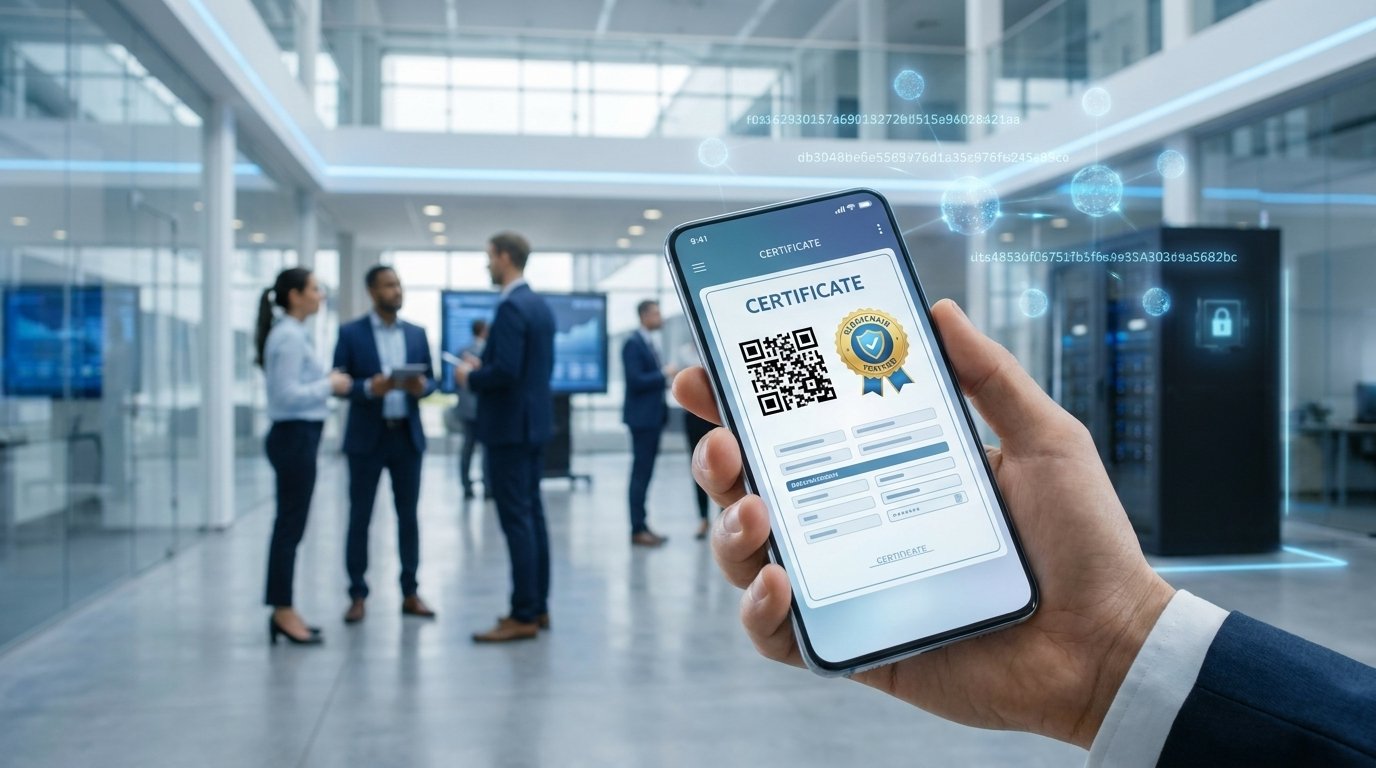
Over 68% of higher education institutions report an increase in highly sophisticated, AI-generated fake degrees and credentials over the past 12 months, according to the 2026 Global Academic Integrity Coalition Report. As automated document editors make visual forgeries virtually undetectable, organizations must urgently rethink how they prevent digital certificate fraud. The era of relying on watermarks, holograms, and secure PDFs has ended, replaced by a critical need for immutable cryptographic truth.
In this comprehensive guide, our team at VEC.Digital will show you how to transition your organization to blockchain-powered credentialing to secure your institutional legacy. You will learn how to eliminate credential fraud entirely, how to issue bulk verifiable certificates in minutes, and how to provide learners globally with instantly accessible, tamper-proof credentials. By understanding the shift from visual security to blockchain verification, your organization can safeguard its reputation, streamline HR compliance, and confidently navigate the future of digital education.
Key Takeaways
- Visual security is obsolete: AI tools can flawlessly forge PDFs, making blockchain credential verification the only reliable defense.
- Financial impact is severe: Hiring an employee with fraudulent credentials costs organizations up to $22,000 per incident in compliance fines and replacement costs.
- Verification speed matters: Transitioning from manual checks to QR code certificate verification reduces verification time from days to under two seconds.
- Global standards are shifting: Frameworks like eIDAS 2.0 and regional mandates in the UAE and APAC are making secure certificate issuance a global regulatory requirement.
- Efficiency meets sustainability: Digital credentials eliminate paper waste while empowering learners with permanent access via a recipient digital locker.
The Global Crisis of AI-Generated Credential Fraud
To successfully prevent digital certificate fraud, organizations must first understand the sophisticated nature of modern forgery. The rapid advancement of generative AI and automated document editors has fundamentally altered the landscape of credentialing. Traditional methods of securing documents are no longer sufficient to protect institutional integrity.
Why Visual Security Fails in 2026
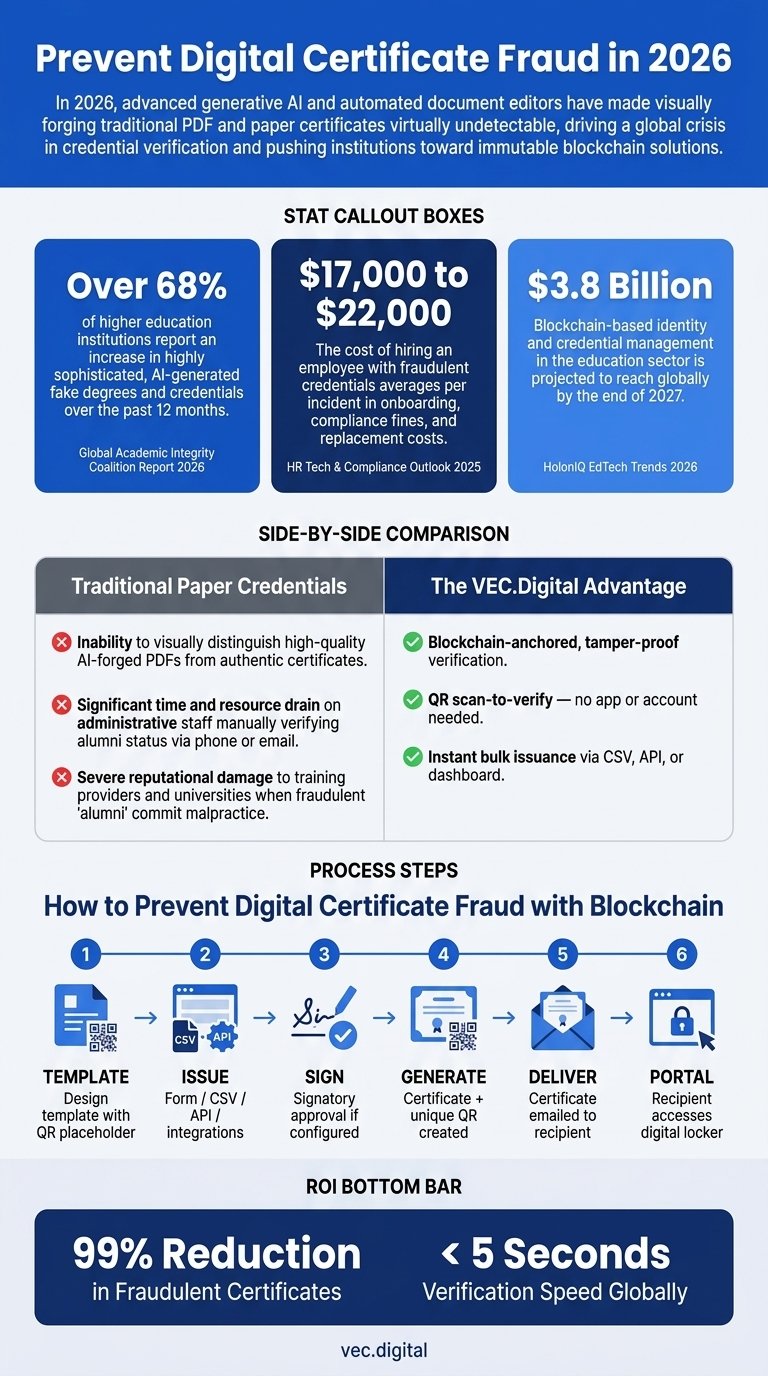
For decades, universities, training providers, and professional associations relied on visual cues to establish the authenticity of a document. Intricate borders, custom watermarks, embossed seals, and password-protected PDF formats were considered the gold standard of secure certificate issuance. However, in 2026, these visual barriers are easily bypassed. Advanced generative AI tools can analyze, replicate, and synthesize visually flawless documents in a matter of seconds. There is now a widespread inability among HR professionals and university registrars to visually distinguish high-quality AI-forged PDFs from authentic certificates.
This technological shift has rendered visual security entirely obsolete. When a bad actor can generate a pixel-perfect replica of a prestigious university degree using a simple text prompt, relying on human eyesight to verify authenticity becomes a dangerous gamble. The focus must shift away from what a document looks like to how the data within it is mathematically anchored and verified. Organizations must adopt systems where the underlying data, rather than the visual representation, proves authenticity.
The Hidden Costs of Fake Credentials
The financial implications of credential fraud are staggering, extending far beyond the initial deception. According to the 2025 HR Tech & Compliance Outlook, the cost of hiring an employee with fraudulent credentials averages $17,000 to $22,000 per incident. This figure encompasses wasted onboarding resources, legal fees, compliance fines, and the inevitable costs of terminating and replacing the fraudulent hire.
Furthermore, there are severe compliance and legal liabilities for HR teams operating in regulated industries such as healthcare, finance, engineering, and aviation. Accidentally hiring uncertified staff in these sectors is not merely an administrative error; it is a critical safety and regulatory failure that can lead to multimillion-dollar lawsuits and the loss of operating licenses. The burden of proof rests heavily on the employer, making robust verification systems a financial imperative.
The Reputational Risks for Global Institutions
Beyond direct financial losses, the reputational damage inflicted by credential fraud can be devastating for the issuing institution. When an individual commits professional malpractice while falsely claiming to be an alumnus of a specific university or training program, the public fallout inevitably impacts the institution's brand. Trust is the foundational currency of any educational or professional credentialing body.
If employers lose faith in an institution's ability to secure its graduation records, the value of that institution's legitimate degrees plummets. This creates a vicious cycle that harms genuine alumni who have worked hard to earn their qualifications. Protecting the brand equity of an institution requires a proactive approach to credential security, ensuring that every issued certificate can be trusted implicitly by any global observer.
How to Prevent Digital Certificate Fraud with Blockchain
The most effective way to prevent digital certificate fraud is to remove human error and visual subjectivity from the verification equation entirely. Blockchain technology provides the mathematical certainty required to establish absolute trust in digital records.
What is Blockchain Credential Verification?
When administrators ask, "How does blockchain verify credentials?" the answer lies in the concept of immutability. A blockchain is a decentralized, distributed digital ledger. When VEC.Digital issues a certificate, the core data of that credential is anchored to this immutable ledger. This means that a permanent, unalterable record of the issuance is created and distributed across a global network of computers.
Because the record is decentralized, there is no single point of failure and no central server that a hacker can compromise to alter the records. When an employer wants to verify the credential, the system checks the presented certificate against the public blockchain ledger. If the record on the blockchain matches the presented document, the certificate is authentic. This process happens in milliseconds, providing an absolute guarantee of origin and integrity.
Cryptographic Hashing Explained for HR and Educators
A significant knowledge gap exists when explaining the technical mechanics of blockchain to non-technical HR managers and educators. The core mechanism that makes this technology work is called "cryptographic hashing." Imagine a cryptographic hash as a unique, complex digital fingerprint for a specific set of data. When a digital certificate is created, all its details—the graduate's name, the course title, the date of issue, and the issuing institution—are passed through a mathematical algorithm.
This algorithm generates a fixed-length string of letters and numbers (the hash). This unique hash is what gets anchored to the blockchain. The crucial aspect of cryptographic hashing is its extreme sensitivity. If a forger uses an AI tool to alter even a single pixel of the certificate's background, or changes a grade from a 'B' to an 'A', the underlying data changes. When that altered data is run through the algorithm again, it produces a completely different hash. Because this new hash does not match the original hash anchored on the blockchain, the verification instantly fails, exposing the forgery.
Can Blockchain Certificates Be Faked or Altered?
A common question from institutional leaders is: "Can blockchain certificates be faked or altered?" The definitive answer is no. While a bad actor can easily download a legitimate digital certificate and use photo-editing software to change the name on the document, they cannot alter the cryptographic hash recorded on the blockchain.
Because the verification process checks the document's current hash against the immutable record on the blockchain, any visual alteration immediately breaks the cryptographic seal. The forged document will fail verification every single time. This is why VEC.Digital certificates proudly display a "blockchain verified" badge on the public verification page—it is a mathematically proven guarantee that the document is exactly as it was when originally issued.
Transitioning from PDFs to Verifiable Credentials
To successfully prevent digital certificate fraud on a global scale, organizations must transition away from static documents and embrace dynamic, instantly verifiable credentials. This transition not only enhances security but radically improves operational efficiency.
How Are Verifiable Credentials Different from PDF Certificates?
It is vital to understand how verifiable credentials are fundamentally different from traditional PDF certificates. A standard PDF is merely a digital picture of a physical document. Even if it is "secured" with a password or a digital signature, it remains a static file that must be manually authenticated by contacting the issuing institution. It contains no inherent, independent proof of its own validity.
In contrast, a verifiable credential is a smart, interactive data container. It carries its own proof of authenticity within its cryptographic architecture. When someone views a verifiable credential, they are not just looking at a picture; they are interacting with a system that can independently cryptographically prove who issued it, who received it, and that it has not been tampered with since the moment of issuance. This self-proving nature is what makes verifiable credentials the global standard for the future of work.
The Role of QR Code Certificate Verification
When users ask, "How do you verify a digital certificate online?" the most efficient answer is through QR code scanning. Every certificate issued through VEC.Digital features a unique, embedded QR code that links directly to a secure, public verification page (e.g., /certificate/[uuid]). This process requires no app downloads, no account creation, and no login credentials from the verifying party.
The efficiency gains of this method are profound. According to 2025 Future of Work Analytics data, manual verification of traditional certificates—which involves HR teams emailing university registrars and waiting for official transcripts—takes an average of 3 to 5 business days per candidate. This is a significant time and resource drain on administrative staff. In stark contrast, blockchain QR verification takes less than 2 seconds. An employer simply scans the code with their smartphone camera and instantly receives mathematical proof of authenticity.
What is the Best Way to Issue QR Code Certificates?
For organizations wondering about the best way to issue QR code certificates securely and at scale, the process must be adaptable to different operational needs. VEC.Digital provides a robust infrastructure with four distinct issuance methods to accommodate any organizational size or technical capability.
Administrators can use the intuitive dashboard form for issuing certificates one-by-one, which is ideal for small training cohorts. For larger institutions, the CSV upload feature allows for the bulk issuance of thousands of certificates simultaneously in just a few clicks. For enterprise-level automation, organizations can utilize the REST API for programmatic issuance or leverage third-party integrations to connect directly with existing Learning Management Systems (LMS) or HR platforms.
Crucially, secure issuance also requires internal governance. VEC.Digital features a multi-signatory workflow that allows up to two signatories per certificate template. When a certificate is generated, it is held in a secure pending state until all assigned signatories have independently reviewed and signed off on the issuance. This prevents unauthorized or rogue issuance from within the organization itself.
Global Standards Shaping Secure Certificate Issuance
The push to prevent digital certificate fraud is not just a technological trend; it is rapidly becoming a global regulatory mandate. Governments and international bodies are recognizing the critical need for secure, interoperable digital identities and credentials.
eIDAS 2.0 and the Shift Toward Digital Identity
In the European Union, the rollout of the eIDAS 2.0 regulation has fundamentally normalized the use of verifiable credentials globally. This regulatory framework establishes strict standards for electronic identification and trust services, mandating that digital credentials must be highly secure, privacy-preserving, and instantly verifiable across borders. Institutions that align their credentialing practices with these high standards position themselves as global leaders in academic and professional integrity.
Cross-Border Verification in UAE, Saudi Arabia, and APAC
Concurrently, major global hiring hubs are implementing stringent verification requirements. In regions such as the United Arab Emirates, Saudi Arabia, and across the Asia-Pacific (APAC), governments and massive enterprise sectors are mandating strict, instantly verifiable digital credential standards for expatriates and cross-border workers. The goal is to entirely eliminate the prevalent shadow market of forged diplomas and fake professional licenses.
For universities and training providers operating internationally, this means that issuing traditional paper certificates or unsecured PDFs is no longer sufficient. Graduates traveling to these regions for employment will face significant hurdles if their credentials cannot be instantly and cryptographically verified by local authorities and employers. Adopting a platform like VEC.Digital ensures that your institution's credentials meet the rigorous demands of the global mobility market.
Sustainability and the Elimination of Paper Waste
Beyond security and compliance, the transition to digital credentials plays a vital role in global sustainability efforts. VEC.Digital actively supports United Nations sustainability goals by helping organizations completely eliminate the paper waste associated with traditional credentialing.
Printing, stamping, packaging, and internationally shipping physical certificates consumes vast amounts of natural resources and generates a significant carbon footprint. By moving to a fully digital, blockchain-anchored issuance model, universities and corporations not only dramatically reduce their administrative and logistical costs but also contribute meaningfully to a greener, more eco-friendly global education sector.
Building a Future-Proof Credentialing Strategy
To comprehensively prevent digital certificate fraud, organizations must adopt a holistic strategy that benefits all stakeholders: the issuing institution, the verifying employer, and the credential recipient.
Empowering Learners with a Digital Locker
A modern credentialing strategy must prioritize the user experience of the learner. VEC.Digital provides every recipient with a secure digital locker—a centralized, personal portal where they gain permanent access to all their earned certificates. This eliminates the common frustration of lost paper degrees or the need to pay exorbitant fees for replacement copies.
Learners can access their digital locker from anywhere in the world, at any time, allowing them to seamlessly share their verified achievements on professional networks, in job applications, or during academic admissions processes. This constant accessibility significantly boosts learner motivation and satisfaction, reflecting positively on the issuing institution.
Meeting Employer Demands for Instant Verification
Employers are actively changing their hiring practices based on the availability of secure digital data. According to the 2026 Talent Acquisition Innovation Survey, an overwhelming 82% of global enterprise employers now prioritize candidates who provide instantly verifiable digital credentials over those who submit traditional paper attachments or unverified PDFs.
By issuing credentials through VEC.Digital, institutions directly enhance the employability of their graduates. When an employer can verify a candidate's qualifications in under two seconds with absolute cryptographic certainty, that candidate moves through the hiring pipeline much faster. Providing this level of verifiable trust is a massive competitive advantage for any educational or training provider.
The $3.8 Billion Future of Blockchain Education Tech
The trajectory of the industry is clear. According to the 2026 HolonIQ EdTech Trends report, blockchain-based identity and credential management in the education sector is projected to reach $3.8 billion globally by the end of 2027. This massive investment underscores the reality that cryptographic verification is not a passing trend, but the foundational infrastructure of the future digital economy.
Institutions that adopt this technology early will set the standard for academic integrity and operational efficiency. VEC.Digital empowers these forward-thinking organizations with a powerful template editor featuring over 1400 Google Fonts, drag-and-drop functionality, multiple sizing options (A2–A5, portrait/landscape), and seamless Canva integration for stunning background designs. This ensures that while the underlying security is mathematically absolute, the visual presentation remains uniquely branded and highly professional.
Secure Your Credentials with VEC.Digital Today
The global crisis of AI-generated credential fraud requires an immediate and decisive response. As visual document security becomes entirely obsolete, organizations must transition to systems anchored in immutable cryptographic truth. By adopting blockchain verification and QR code scanning, you can completely eliminate credential fraud, protect your institution's hard-earned reputation, and save thousands of hours in manual verification tasks.
VEC.Digital is the premier blockchain-powered digital certificate platform designed to enable organizations to create, issue, manage, and verify credentials at scale effortlessly. Our platform is built for global interoperability, ensuring your credentials are trusted instantly, anywhere in the world.
We believe in making robust security accessible to everyone. Your organization can start today with our Free plan—requiring no credit card and zero setup fees. For scaling institutions, our premium paid plans start at just $29.99/month, while individual users can issue certificates for simply $1.00 per credential.
Take the first step toward future-proofing your institutional integrity. Discover how it works and join the thousands of universities and corporations already trusting our platform.
Contact our global team today:
Website: vec.digital
Email: support@vec.digital
WhatsApp: +971521373078