
Preventing Certificate Fraud in 2026: Why Blockchain Credential Verification is the New Standard
Published on May 10, 2026

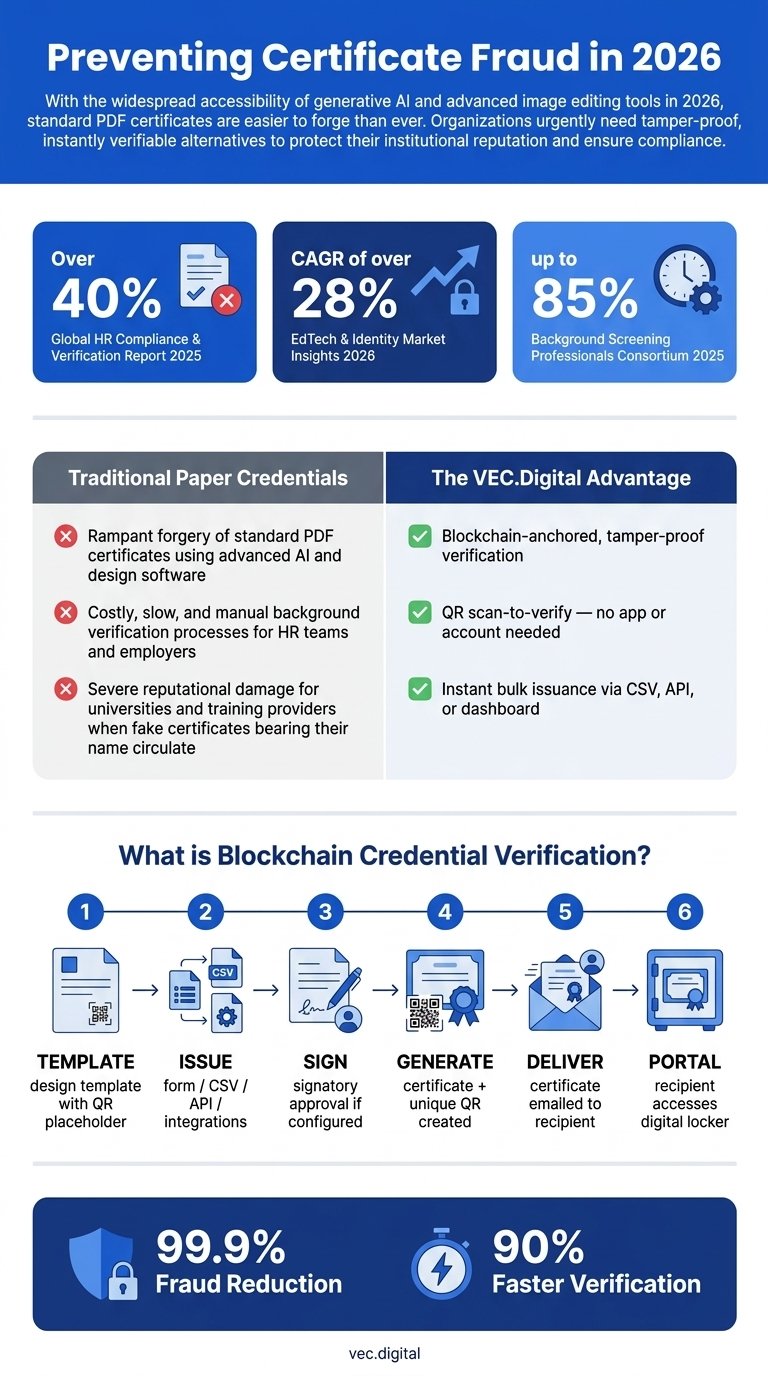
Over 40% of organizations reported encountering embellished or entirely fake credentials during the hiring process over the past 12 months, according to the 2025 Global HR Compliance & Verification Report. As generative AI and advanced image editing tools become universally accessible, standard PDF certificates are easier to forge than ever before, leaving institutions vulnerable to severe reputational damage. To protect their integrity and streamline operations, forward-thinking universities, training providers, and corporate enterprises are rapidly adopting blockchain credential verification to issue tamper-proof, instantly verifiable digital records.
In this comprehensive guide, you will learn how transitioning to secure digital infrastructure can entirely eliminate credential fraud while drastically reducing the administrative burden on your HR and academic teams. Drawing on VEC.Digital’s extensive expertise in blockchain-powered digital credentialing, we will demonstrate how your organization can issue bulk certificates in minutes, provide global learners with permanently accessible digital lockers, and achieve unparalleled compliance confidence. By understanding the practical applications of this technology, you can future-proof your issuance pipeline and safeguard your institutional reputation without requiring in-house technical expertise.
Key Takeaways
- Blockchain credential verification eliminates the risk of forgery associated with traditional PDFs by anchoring records to an immutable ledger.
- Manual background checks are costly and slow, but secure digital certificates can reduce verification times from days to mere seconds.
- Modern platforms enable automated issuance via CSV upload or REST API, empowering non-technical staff to manage credentials at scale.
- QR code certificate verification allows employers and regulatory bodies to instantly authenticate achievements without requiring specialized apps or logins.
- Transitioning to digital credentials significantly advances UN sustainability goals by eliminating paper waste and reducing global carbon footprints.
The Escalating Crisis of Digital Credential Fraud in 2026
The landscape of professional and academic qualification has fundamentally shifted. As the global workforce becomes increasingly mobile, the reliance on digital documentation has skyrocketed. However, this digitization has brought a critical vulnerability to the forefront: the ease with which traditional digital documents can be manipulated. For organizations issuing qualifications, understanding this threat landscape is the first step toward effective prevent digital certificate fraud strategies.
How Generative AI Has Weaponized Standard PDFs
A common question among administrators is: Are PDF certificates secure from forgery? In 2026, the unequivocal answer is no. Historically, a digitally signed PDF offered a reasonable baseline of security. Today, the widespread availability of sophisticated generative AI and advanced graphic design software has democratized forgery. Bad actors can effortlessly alter names, dates, and grades on standard PDF documents, creating pixel-perfect replicas of legitimate credentials.
This rampant forgery of standard PDF certificates creates a massive liability for issuing organizations. When an individual uses a fabricated document to secure employment or gain admission to an advanced academic program, the integrity of the original issuing institution is immediately called into question. The reliance on static, easily editable files is no longer tenable in an era where digital deception can be executed with a few keystrokes.
The Hidden Costs of Manual Background Checks
For HR teams and employers, the downstream effects of unverified PDFs are incredibly costly. When an applicant submits a traditional certificate, the hiring organization must initiate a manual verification process. This often involves contacting the issuing university or training provider via email or phone, waiting for a registrar to locate the physical or digital record, and receiving confirmation.
This bureaucratic friction is a massive drain on resources. According to the 2025 Background Screening Professionals Consortium, manual verification of education and training certifications accounts for up to 85% of the time spent in the background screening process. When employers ask, How do employers check if a certificate is fake?, the answer is usually a slow, expensive, and manual audit. This inefficiency delays hiring timelines, frustrates candidates, and inflates administrative costs for both the employer and the issuing institution.
Protecting Institutional Reputation
Beyond the operational inefficiencies, the most severe consequence of credential fraud is reputational damage. Universities, corporate training centers, and professional associations spend decades building their brand equity. That trust is the very foundation of the value their certificates hold in the job market. When fake certificates bearing their name circulate freely, that trust is rapidly eroded.
If an employer consistently encounters fraudulent documents claiming to be from a specific training provider, they may eventually blacklist that provider entirely, harming legitimate graduates. To combat this, institutions must adopt proactive fake certificate prevention measures that guarantee the authenticity of every document they issue, ensuring that their brand remains synonymous with verified excellence.
What is Blockchain Credential Verification?
To combat the vulnerabilities of static PDFs, the industry has turned to cryptographic solutions. However, the conversation around these solutions has often been bogged down in highly technical jargon. For organizational leaders, the focus must shift from the underlying architecture to the practical business value of blockchain credential verification.
Moving Beyond Cryptographic Jargon
Most existing literature on blockchain technology focuses heavily on complex concepts like distributed nodes, cryptographic hashing, and decentralized autonomous structures. While these elements are the engine under the hood, HR directors, university registrars, and training facility managers do not need to be blockchain developers to utilize the technology.
At VEC.Digital, we believe the focus should be on the outcome: tamper-proof, publicly verifiable credentials. Our platform abstracts the complexity of the blockchain. When an organization issues a credential through our system, the data is anchored to an immutable blockchain ledger automatically. The end result for the user is simply a secure, beautiful digital document that displays a definitive "blockchain verified" badge on its public verification page, providing instant trust without the technical headache.
How Does Blockchain Verify Certificates?
A frequent inquiry from educational administrators is: How does blockchain verify certificates? In simple terms, when a certificate is created, a unique digital fingerprint (a hash) of that specific document's data is generated and permanently recorded on the blockchain.
When an employer or third party wants to verify the document, the system checks the certificate presented against the immutable fingerprint stored on the blockchain. If even a single pixel or character has been altered, the fingerprints will not match, and the verification will fail. This binary, mathematically certain verification process is revolutionary for operational efficiency. According to 2026 Future of Work Tech Trends, blockchain-anchored credentialing can reduce credential verification times from an average of 3-5 days to under 5 seconds.
The Concept of Verifiable Credentials in Education
When educators ask, What are verifiable credentials in education?, they are referring to digital records that are cryptographically secure, privacy-respecting, and machine-readable. These credentials empower the learner to own and share their achievements while allowing any third party to instantly cryptographically verify who issued the credential, to whom it was issued, and that it has not been tampered with since issuance.
The adoption of these standards is accelerating rapidly. The 2026 Global Higher Education Tech Survey reveals that nearly 70% of higher education institutions worldwide are actively transitioning or planning to transition to blockchain-secured digital diplomas by 2027. This shift aligns with global standards, such as the W3C Verifiable Credentials Data Model, which provides a universal framework for expressing these secure digital achievements.
The Operational Advantage: Seamless Workflows for Non-Technical Teams
The true power of blockchain credential verification lies in its implementation. A secure system is only valuable if it can be easily adopted by the administrative staff responsible for day-to-day operations. VEC.Digital is engineered specifically to provide seamless, intuitive workflows for non-technical teams.
Effortless Issuance at Scale
Whether you are a boutique training firm issuing ten certificates a month or a massive global university issuing tens of thousands, the issuance pipeline must be robust and flexible. VEC.Digital offers four distinct issuance methods to accommodate any operational scale:
- Dashboard Form: Ideal for one-by-one issuance, allowing staff to manually input data for bespoke awards.
- CSV Upload: Perfect for bulk issuance. Administrators can upload a simple spreadsheet, and the system will automatically generate and anchor thousands of certificates in minutes.
- REST API: For organizations seeking programmatic control, our API allows seamless integration into existing learning management systems (LMS) or HR platforms.
- Third-Party Integrations: Connect your existing tools directly to the VEC issuance pipeline to automate credentialing based on course completion triggers.
Furthermore, our advanced template editor ensures that security does not come at the cost of aesthetics. With drag-and-drop functionality, over 1400 Google Fonts, support for A2–A5 sizes in both portrait and landscape, and seamless Canva integration for backgrounds, organizations can create stunning, brand-aligned credentials effortlessly.
Multi-Signatory Approvals for Enhanced Security
In many academic and corporate environments, a credential requires authorization from multiple stakeholders—such as a course instructor and a department dean. Traditional paper workflows require physical documents to be routed between offices, risking loss or delay.
VEC.Digital digitizes and secures this process through a robust multi-signatory workflow. A single certificate template can require up to two independent signatories. When a credential is generated, it is held in a pending state until all designated signatories have independently reviewed and digitally signed the document. Only then is the certificate anchored to the blockchain and released to the recipient, ensuring strict internal compliance and oversight.
Lifecycle Management and Revocation
A major pain point with standard PDFs is the lack of centralized, secure lifecycle management. People frequently ask: Can digital certificates be revoked? With traditional files, once a PDF is emailed to a recipient, the issuing body loses all control. If a professional loses their license due to malpractice, or if an academic degree is rescinded, the individual can still present the old PDF as valid.
With VEC.Digital’s secure digital certificates, organizations retain ultimate administrative control. Through our secure management dashboard, administrators can instantly revoke a credential. Because the verification process checks the live blockchain ledger, any revoked certificate will immediately show as invalid upon scanning, completely neutralizing the risk of individuals leveraging rescinded qualifications.
Empowering Recipients with QR Code Certificate Verification
While the administrative benefits of blockchain credential verification are profound, the end-user experience is equally critical. Credentials are meant to be shared, displayed, and utilized by the learner to advance their career. The verification process must therefore be frictionless for both the recipient and the verifying employer.
How to Issue a Certificate with a QR Code
A common operational question is: How to issue a certificate with a QR code? With VEC.Digital, this feature is built directly into the foundational architecture of every credential we generate. You do not need to use third-party QR generators or manually link URLs.
Every certificate issued through our platform automatically features a unique, cryptographically secure QR code. This code links directly to a dedicated, public verification page hosted at a specific URL (e.g., /certificate/[uuid]). When an employer or auditor scans the QR code certificate verification graphic using any standard smartphone camera, they are instantly taken to the live verification page. There is no app to download, no account to create, and no login required to verify the credential. It is instant, frictionless trust.
The Recipient Digital Locker Experience
Modern learners and professionals expect digital convenience. Losing a paper certificate or misplacing a PDF in an old email inbox is a frustrating experience that often results in the individual requesting a costly reprint from the issuing institution.
To solve this, VEC.Digital provides every recipient with a permanent digital locker. This secure portal gives users centralized access to all their earned certificates. They can log in from anywhere in the world, at any time, to view, download, or share their credentials directly to professional networks like LinkedIn. This persistent access not only improves learner satisfaction but also significantly reduces administrative support tickets related to lost documents.
Supporting Global Mobility and Compliance
The global labor market is more interconnected than ever. Regulatory shifts and compliance mandates are driving the need for universally recognized, cross-border credentials. For instance, frameworks like the European Digital Identity (EUDI) Wallet and stricter compliance regulations in regions like the UAE and North America are demanding credentials that can bypass language barriers and slow bureaucratic processing.
By utilizing blockchain anchoring and standardized QR verification, higher education institutions and corporate enterprises can issue credentials that are instantly verifiable anywhere in the world. An employer in Dubai can instantly verify a diploma issued by a university in Toronto with absolute cryptographic certainty, facilitating global talent mobility and ensuring strict adherence to international hiring compliance standards.
Sustainability and the Future of the Verifiable Credentials Market
The transition from physical paper and vulnerable PDFs to verifiable credentials 2026 is not merely a security upgrade; it is a fundamental evolution of the global education and identity infrastructure. This evolution is driving massive market growth and contributing to crucial global sustainability initiatives.
Driving Growth in EdTech and Identity
The demand for secure, instantly verifiable records is reshaping the technology landscape. According to 2026 EdTech & Identity Market Insights, the global verifiable credentials market is projected to grow at a Compound Annual Growth Rate (CAGR) of over 28% through the end of the decade. This explosive growth underscores the urgency with which organizations are abandoning legacy systems.
As this market matures, the expectation from students, employees, and regulatory bodies will shift from preference to mandate. Organizations that fail to adopt secure digital credentialing will find themselves at a severe competitive disadvantage, struggling with administrative bloat and facing increased scrutiny regarding their verification protocols.
Elimating Paper Waste for UN Sustainability Goals
Beyond security and efficiency, the shift to digital credentialing plays a vital role in corporate social responsibility. Traditional credentialing is remarkably resource-intensive. The lifecycle of a paper certificate involves logging trees, chemical processing for high-quality paper stock, printing with specialized inks, and global physical shipping via fossil-fuel-dependent logistics networks.
VEC.Digital is proud to support UN sustainability goals by providing a completely paperless alternative. By adopting our platform, organizations can entirely eliminate the paper waste associated with graduation ceremonies and corporate training completions. Digital certificates drastically reduce an organization's carbon footprint, eliminate printing and physical delivery costs, and contribute to a more eco-friendly, sustainable approach to credential management globally.
Secure Your Organization's Future with VEC.Digital
The era of relying on easily forged PDFs and costly manual background checks is over. As generative AI continues to advance, the threat of credential fraud will only intensify. To protect your institutional reputation, streamline your administrative workflows, and empower your learners globally, adopting blockchain credential verification is the definitive path forward.
VEC.Digital provides the most intuitive, secure, and scalable platform for issuing tamper-proof digital certificates. Whether you need to issue one bespoke award or automate the delivery of thousands of credentials via our REST API, our platform delivers unparalleled reliability with a 99.98% uptime SLA. With features like multi-signatory workflows, instant QR code verification, and a permanent digital locker for recipients, we handle the technical complexity so you can focus on what matters most: recognizing and rewarding achievement.
Transitioning your organization to the future of credentialing is entirely risk-free. VEC.Digital offers a robust free plan to help organizations start immediately—no credit card required and zero setup fees. For scaling institutions, our paid organizational plans start at just $29.99/month, while individuals can verify and secure certificates for just $1.00 per credential.
Don't let outdated technology compromise your organization's integrity. Upgrade your issuance pipeline today and join the thousands of universities and corporations worldwide that trust VEC.Digital.
Contact our global team to get started:
Website: vec.digital
Email: support@vec.digital
WhatsApp: +971521373078