
Preventing Credential Fraud: Blockchain Certificate Verification in 2026
Published on May 11, 2026

Over 2 million fake degrees and certifications are purchased globally every year, according to the Higher Education Degree Datacheck (HEDD) in 2024. As generative AI makes digital document forgery indistinguishable from reality, organizations urgently need robust blockchain certificate verification to protect their reputations and ensure compliance. The days of relying on easily manipulated paper documents or standard static PDFs are officially over.
In this comprehensive guide, our team at VEC.Digital will walk your organization through the transition to secure, tamper-proof credentialing. Drawing on our deep expertise in blockchain-powered digital credentialing, you will learn how to completely eliminate credential fraud, drastically reduce the time your HR teams spend on manual background checks, and implement seamless issuance workflows that provide learners with globally accessible, instantly verifiable digital credentials.
Key Takeaways
- AI-driven document forgery has increased dramatically, necessitating zero-trust verification systems for all issued credentials.
- Blockchain certificate verification anchors credentials immutably, making them mathematically impossible to alter or fake.
- QR code scanning allows employers and HR teams to instantly verify credentials without requiring logins, accounts, or specialized apps.
- Verifiable credentials offer a dynamic, tamper-proof alternative to easily manipulated static PDF certificates, aligning with global compliance standards.
- Automated issuance workflows save organizations thousands of hours in administrative overhead while actively supporting global sustainability goals by eliminating paper waste.
The Escalating Crisis of AI-Assisted Credential Fraud
The Cost of Fake Degrees and Embellished Resumes
The global landscape of professional qualification is facing an unprecedented crisis of trust. According to the HireRight Global Benchmarking Report in 2025, a staggering 85% of HR professionals report encountering embellished or fake credentials on candidate resumes. This widespread deception creates severe operational bottlenecks for hiring teams, who must divert valuable resources away from talent acquisition and into exhaustive, manual verification processes.
When candidates misrepresent their qualifications, the financial and operational impact on hiring organizations can be devastating. Hiring an unqualified individual based on fraudulent credentials leads to decreased productivity, potential workplace safety hazards, and the eventual cost of replacing the bad hire. For multi-national corporations hiring thousands of employees annually, the aggregate cost of these fraudulent claims runs into the millions of dollars.
Furthermore, the burden of proof traditionally falls on the employer. HR departments are forced to contact university registrars, professional training bodies, and previous employers—a process that is notoriously slow and prone to human error. The urgent need for blockchain certificate verification has never been more apparent, as organizations seek automated, trustless methods to validate candidate claims instantaneously.
Why Traditional PDF Certificates Are No Longer Secure
For over a decade, the standard method for issuing digital credentials has been the Portable Document Format (PDF). While convenient, traditional PDFs are fundamentally static documents that offer virtually no inherent security against modern tampering techniques. In 2026, the proliferation of advanced generative AI tools has made forging these traditional PDF certificates faster and more convincing than ever before.
According to Cybersecurity Ventures in 2026, there has been a 40% increase in sophisticated digital document forgery attributed directly to easily accessible AI generation tools. Malicious actors no longer need advanced graphic design skills to alter a name, date, or grade on a digital certificate. AI-driven software can seamlessly match fonts, replicate institutional seals, and generate flawless forged documents in a matter of seconds.
Because traditional PDFs lack a cryptographic anchor to a verifiable source of truth, employers receiving these documents have no immediate way to distinguish an original from an AI-generated fake. This technological vulnerability has rendered legacy digital certificates obsolete for high-stakes credentialing, forcing institutions to adopt more resilient, tamper-proof architectures to protect the integrity of their awards.
The Reputational and Compliance Risks for Issuers
The damage caused by credential fraud extends far beyond the hiring organization; it strikes at the very heart of the issuing institution's brand reputation. When forged certificates are successfully passed off as genuine, the perceived value of the legitimate credential diminishes. For prestigious universities and elite corporate training providers, brand trust is their most valuable asset. If employers can no longer trust the certificates bearing an institution's name, the institution's graduates will inevitably face friction in the job market.
Beyond reputation, there are severe regulatory and compliance risks, particularly for corporations operating in highly regulated industries such as healthcare, aviation, finance, and construction. If employees forge required safety or professional training credentials, the employing organization may face catastrophic legal liabilities, massive regulatory fines, and operational shutdowns. Ensuring that every issued credential is mathematically verifiable is no longer just an IT upgrade; it is a critical compliance mandate.
This is where modern digital credentialing platforms step in. By anchoring credentials to an immutable ledger, organizations can provide absolute cryptographic proof of issuance. This proactive approach not only safeguards the institution's legacy but also ensures that their alumni and certified professionals retain the competitive advantage that comes with holding a genuinely trusted qualification.
What is Blockchain Certificate Verification?
Moving Beyond Technical Jargon: A Business Perspective
When discussing blockchain certificate verification, the conversation is often clouded by complex technical jargon—cryptographic hashes, distributed ledgers, and consensus algorithms. At VEC.Digital, we believe in shifting the focus away from the underlying architecture and entirely onto the seamless user experience and tangible business value. For HR managers, university administrators, and compliance officers, the technology should be invisible; only the outcome matters.
From a business perspective, blockchain verification is simply a highly secure, automated notary service. It provides a tamper-proof, zero-trust verification system that requires no specialized knowledge from either the issuer or the verifier. Your organization issues a certificate through a standard dashboard, and the platform handles the complex cryptography in the background.
This streamlined approach means that institutions can upgrade their credentialing infrastructure without needing to hire blockchain developers or conduct extensive staff training. The focus remains on what truly matters: issuing trustworthy credentials efficiently, preventing fraud, and enhancing the overall experience for your learners and global partners.
How Does Blockchain Verify Certificates?
A common question among educational administrators is: How does blockchain verify certificates? The process is elegantly simple in its execution. When your organization issues a credential through VEC.Digital, the platform takes the unique data of that specific certificate—such as the recipient's name, the course completed, and the date of issuance—and generates a unique digital fingerprint, known as a cryptographic hash.
This unique fingerprint is then permanently anchored onto an immutable blockchain. The blockchain acts as a decentralized, unchangeable public ledger. It does not store the recipient's personal data (ensuring strict data privacy compliance), but rather stores the mathematical proof that the certificate was issued by your authorized organization at a specific moment in time.
When an employer or third party wants to verify the credential, they simply scan the associated QR code or click the verification link. The system instantly recalculates the digital fingerprint of the presented certificate and checks it against the fingerprint anchored on the blockchain. If the fingerprints match perfectly, the certificate is verified as authentic. If even a single pixel or character has been altered by AI or manual tampering, the fingerprints will not match, and the verification will instantly fail.
Can Blockchain Certificates Be Faked?
Another frequently asked question is: Can blockchain certificates be faked? The definitive answer is no, provided the verification protocol is followed. Because the verification relies on cryptographic hashing anchored to an immutable ledger, altering the data retroactively is mathematically impossible.
If a malicious actor attempts to use Photoshop or an advanced AI tool to change the name on a legitimate certificate from "John Doe" to "Jane Smith," the underlying data of the document changes. When the altered document is subjected to the verification process, the newly generated cryptographic hash will be completely different from the original hash stored on the blockchain. The system will immediately flag the document as invalid.
Furthermore, every VEC certificate displays a distinct "blockchain verified" badge on its public certificate verification page. This badge is dynamically generated only when the cryptographic check passes successfully. By removing human subjectivity from the verification process and relying entirely on immutable mathematics, organizations can achieve absolute certainty in the authenticity of their credentials.
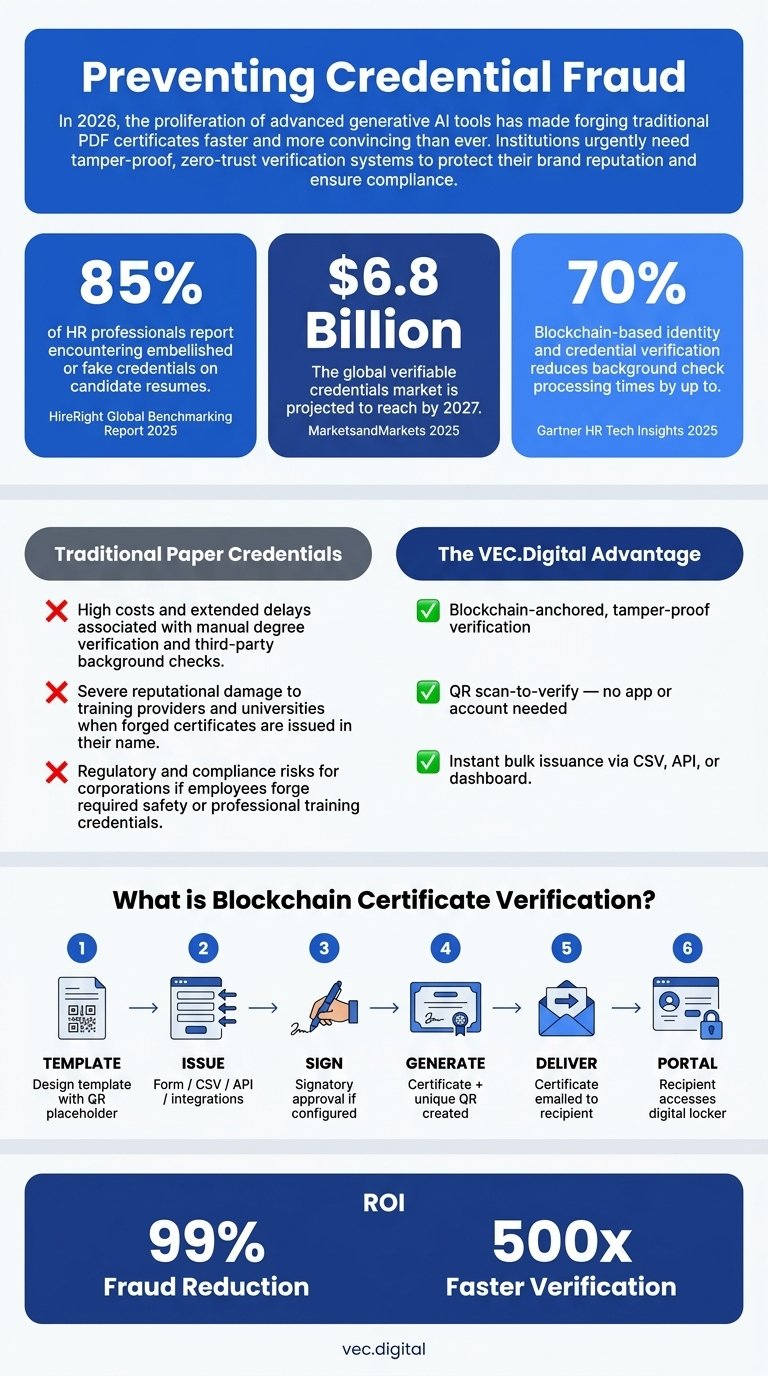
How QR Code Certificate Verification Defeats AI Forgeries
The End of Manual Background Checks
The traditional background check process is a notoriously slow, expensive, and labor-intensive endeavor. HR teams often spend weeks chasing down university registrars and past employers to confirm a single candidate's qualifications. This delay not only frustrates top-tier candidates who may accept competing offers but also drains massive amounts of administrative capital from the hiring organization.
The implementation of blockchain certificate verification fundamentally transforms this workflow. According to Gartner HR Tech Insights in 2025, blockchain-based identity and credential verification reduces background check processing times by up to 70%. By transitioning to an automated, self-verifying credential system, organizations can reclaim thousands of hours previously lost to manual administrative tasks.
This operational efficiency is a game-changer for high-volume hiring environments, such as global enterprises, healthcare networks, and large-scale academic institutions. When credentials carry their own cryptographic proof of authenticity, the need for third-party verification services is largely eliminated, resulting in significant cost savings and vastly accelerated time-to-hire metrics.
How Do Employers Check if a Digital Certificate is Genuine?
To maximize the utility of digital credentials, the verification process must be entirely frictionless for the end-user. How do employers check if a digital certificate is genuine? With VEC.Digital, the process requires absolutely zero technical friction. Every certificate generated on our platform features a unique, embedded QR code.
When an employer, auditor, or compliance officer needs to verify a credential, they simply scan the QR code using any standard smartphone camera or click the unique URL linking to the certificate's dedicated verification page (formatted as /certificate/[uuid]). There is no proprietary app to download, no account to create, and no login required to verify the document.
Upon scanning, the verifier is instantly directed to a secure, VEC-hosted public verification page. This page displays the original, unaltered certificate data alongside the dynamic "blockchain verified" badge. In a matter of seconds, the employer receives cryptographic proof that the credential was issued by the claimed institution, issued to the specific individual, and has not been tampered with since the moment of issuance.
Frictionless Proof for Global Learners
One of the most significant pain points in traditional credentialing is the friction experienced by learners and alumni who struggle to quickly and securely prove their qualifications to potential employers, especially across international borders. Requesting official transcripts or replacement paper certificates can take weeks and often incurs hefty administrative fees.
Digital credentials solve this problem by empowering learners with permanent, on-demand access to their achievements. Because the verification mechanism is embedded directly into the certificate via the QR code and unique URL, learners can seamlessly share their credentials on professional networks like LinkedIn, include them in digital portfolios, or attach them directly to job applications.
This frictionless portability is crucial for the modern, globalized workforce. Whether a learner is applying for a job in Dubai, London, or Singapore, their credentials carry the exact same weight and are verifiable with the exact same speed. By providing learners with easily shareable, instantly verifiable proof of their skills, institutions significantly enhance the value of their educational offerings.
The Difference Between a PDF Certificate and a Verifiable Credential
Static Documents vs. Dynamic Trust
As organizations modernize their tech stacks, a critical question arises: What is the difference between a PDF certificate and a verifiable credential? The distinction lies in the concept of dynamic trust. A standard PDF is a static visual representation of data. It relies entirely on visual trust—the assumption that the logos, signatures, and text have not been manipulated. As we have seen with the rise of AI forgery, visual trust is no longer sufficient.
A verifiable credential, on the other hand, is a dynamic data container. While it may visually resemble a traditional certificate, its true value lies in its underlying metadata and cryptographic signature. This signature provides a permanent, unbreakable link back to the issuing institution's verified identity.
The global market has recognized this fundamental shift. According to MarketsandMarkets in 2025, the global verifiable credentials market is projected to reach $6.8 billion by 2027. This explosive growth reflects a universal acknowledgment across corporate and academic sectors that static documents are a liability, and dynamic, verifiable credentials are the new required standard for establishing digital trust.
Global Regulatory Momentum: eIDAS 2.0 and Beyond
The transition from static PDFs to verifiable credentials is not just driven by technological innovation; it is increasingly being mandated by global regulatory frameworks. The European Union's rollout of the eIDAS 2.0 framework is pushing verifiable credentials into the mainstream, establishing stringent legal standards for digital identity and electronic trust services across member states.
Similarly, the UAE and the wider MENA region are actively mandating blockchain adoption across government and educational sectors through initiatives like the Dubai Blockchain Strategy. This global regulatory momentum makes blockchain certificate verification a required standard rather than an optional tech upgrade in 2026. Organizations that fail to adopt these compliant credentialing frameworks risk being locked out of international partnerships and procurement opportunities.
By adopting a platform like VEC.Digital, organizations ensure that their credentialing workflows remain ahead of the regulatory curve. Our infrastructure is designed to align with these emerging global standards, providing institutions with the confidence that their issued certificates will be recognized and respected across all international jurisdictions.
Sustainability and the Elimination of Paper Waste
Beyond security and compliance, the shift to verifiable digital credentials represents a massive leap forward for corporate sustainability. Historically, educational institutions and corporate training providers have relied heavily on physical paper certificates, which require extensive printing, physical mailing, and eventual re-printing when documents are lost or damaged.
This reliance on physical media contributes significantly to global paper waste and carbon emissions associated with international shipping. By transitioning to fully digital, verifiable credentials, organizations can drastically reduce their carbon footprint. VEC.Digital is deeply committed to supporting UN sustainability goals by providing an eco-friendly credential management system that eliminates the need for paper entirely.
Digital certificates are inherently sustainable. They require no physical resources to produce, no fuel to transport, and they never degrade over time. By championing this digital-first approach, your organization not only improves its operational efficiency and security but also demonstrates a tangible commitment to environmental responsibility to your learners, stakeholders, and the global community.
How to Issue Secure Digital Certificates at Scale
4 Seamless Issuance Methods for Any Organization
For administrators tasked with modernizing their systems, the practical implementation is paramount: How to issue secure digital certificates? At VEC.Digital, we have engineered our platform to integrate seamlessly into any existing organizational workflow, regardless of technical maturity. We offer four distinct issuance methods to accommodate different operational scales.
First, the Dashboard Form allows administrators to issue certificates one-by-one, which is ideal for small, ad-hoc training sessions or specialized awards. Second, the CSV Upload feature enables bulk issuance; administrators can simply upload a spreadsheet containing hundreds or thousands of learner details, and the platform will generate and secure all certificates simultaneously in minutes.
For organizations seeking full automation, our REST API allows for programmatic issuance, triggering certificate generation directly from your internal Learning Management Systems (LMS) or HR platforms upon course completion. Finally, we support robust third-party integrations, allowing you to connect VEC seamlessly with the tools your organization already uses daily. This flexibility ensures that your certificate workflow remains efficient and scalable.
Implementing Multi-Signatory Workflows
In many academic and corporate environments, a certificate requires authorization from multiple stakeholders—such as a course instructor and a department dean, or a compliance officer and a corporate director. Managing physical signatures across different departments or global offices is a logistical nightmare that often delays certificate issuance by weeks.
VEC.Digital solves this bottleneck with our advanced multi-signatory workflow. Our platform allows administrators to configure up to two distinct signatories per certificate template. When an issuance pipeline is triggered, the certificate is generated but securely held in a "pending" state. It is not finalized or anchored to the blockchain until ALL designated signatories have independently reviewed and digitally signed the document.
This automated signatory workflow ensures strict quality control and institutional oversight without the delays associated with physical document routing. Once the final signature is applied, the platform instantly completes the cryptographic anchoring and automatically notifies the recipient that their secure credential is ready to be claimed and shared.
Customizing the Recipient Experience
While security is the foundation of blockchain certificate verification, the visual presentation of the credential remains vital for institutional branding and learner pride. A secure certificate must also be a beautiful one. VEC.Digital provides a powerful, intuitive template editor that empowers organizations to create stunning, brand-aligned credentials without needing professional design software.
Our drag-and-drop template editor features access to over 1,400 Google Fonts, allowing for precise typographic alignment with your brand guidelines. Administrators can design certificates in various standard sizes, from A2 to A5, in both portrait and landscape orientations. Furthermore, our seamless Canva integration allows design teams to import custom, high-resolution backgrounds effortlessly.
This commitment to design flexibility ensures that when a learner shares their verifiable credential on social media or with a prospective employer, the document serves as a premium, visually striking representation of your organization's brand, backed by mathematically unbreakable security.
The Benefits of Using Blockchain in Education and Corporate Training
Protecting Institutional Reputation
When evaluating new technologies, administrators frequently ask: What are the benefits of using blockchain in education? The primary benefit is the absolute protection of institutional reputation. In an era where AI can forge a university degree in seconds, the ability to definitively prove the authenticity of your awards is a critical competitive advantage.
VEC.Digital has built a track record of unwavering reliability in this space. With over 100,000 certificates issued, our platform is actively trusted by more than 500 universities and 10,000 corporations globally. We back this trust with a rigorous 99.98% uptime SLA reliability, ensuring that your verification portals are always online and accessible whenever an employer needs to validate a candidate.
By adopting a platform with this level of proven global scale, educational institutions and corporate training providers send a clear message to the market: they are committed to academic and professional integrity. This commitment increases the perceived value of their programs and ensures their alumni are recognized as verified, high-quality professionals.
Empowering Learners with Digital Lockers
The benefits of blockchain credentialing extend deeply to the learners themselves. Traditional paper certificates are easily lost, destroyed, or degraded over time. When a learner needs to prove their qualifications years after graduation, the process of retrieving a replacement is often frustrating and costly.
VEC.Digital transforms this experience by providing every recipient with a secure, permanent digital locker. This personalized portal grants learners 24/7 access to all their earned certificates from anywhere in the world. Whether they are updating their resume, applying for a visa, or seeking a promotion, their verified credentials are always just a click away.
This centralized digital locker not only improves the learner experience but also keeps your alumni continuously engaged with your institution's ecosystem. By providing them with a modern, highly functional tool to manage their professional achievements, you foster long-term loyalty and brand advocacy.
Ensuring Long-Term Compliance Confidence
For corporate training providers and HR compliance managers, the stakes are incredibly high. Ensuring that every employee has completed mandatory safety, regulatory, or operational training is a legal necessity. If an audit occurs, the organization must be able to produce irrefutable proof of compliance instantly.
Blockchain certificate verification provides this exact level of long-term compliance confidence. Because the cryptographic proof is anchored to an immutable ledger, the verification data will survive indefinitely, regardless of changes to internal IT systems or personnel. Auditors can independently verify the authenticity and timestamp of every training credential without requiring manual intervention from your staff.
This robust, unalterable audit trail dramatically reduces the stress, time, and financial cost associated with regulatory compliance checks. It allows HR and compliance leaders to sleep soundly, knowing their organization's training records are mathematically secured against fraud, tampering, and AI-assisted forgery.
Future-Proof Your Organization with VEC.Digital
As we navigate 2026 and beyond, the threat of AI-generated credential fraud will only continue to accelerate. Organizations that rely on outdated PDF certificates and manual background checks are exposing themselves to severe reputational damage, operational inefficiencies, and significant compliance risks. The transition to secure, verifiable digital credentials is no longer an option; it is an imperative for survival in the modern digital economy.
VEC.Digital provides the ultimate solution for effortless, trustworthy digital credential issuance. By combining immutable blockchain anchoring with frictionless QR code verification, we empower universities, HR managers, and training providers to issue globally recognized credentials that are mathematically impossible to forge. Best of all, our platform handles all the complex cryptography in the background, allowing your team to focus entirely on delivering exceptional educational and professional outcomes.
Ready to protect your brand and eliminate credential fraud? You can start completely free today. Our free plan requires no credit card and no setup fees, allowing you to experience the power of secure credentialing in minutes. For growing organizations, our premium plans start at just $29.99/month, while individuals can secure their credentials for only $1.00 per certificate. Discover how it works or explore our corporate training solutions to see how we can streamline your issuance pipeline.
Contact our team today to secure your credentials:
Website: vec.digital
Email: support@vec.digital
WhatsApp: +971521373078