
Preventing Credential Fraud in 2026: The Ultimate Guide to Secure Digital Diplomas for Universities
Published on May 20, 2026

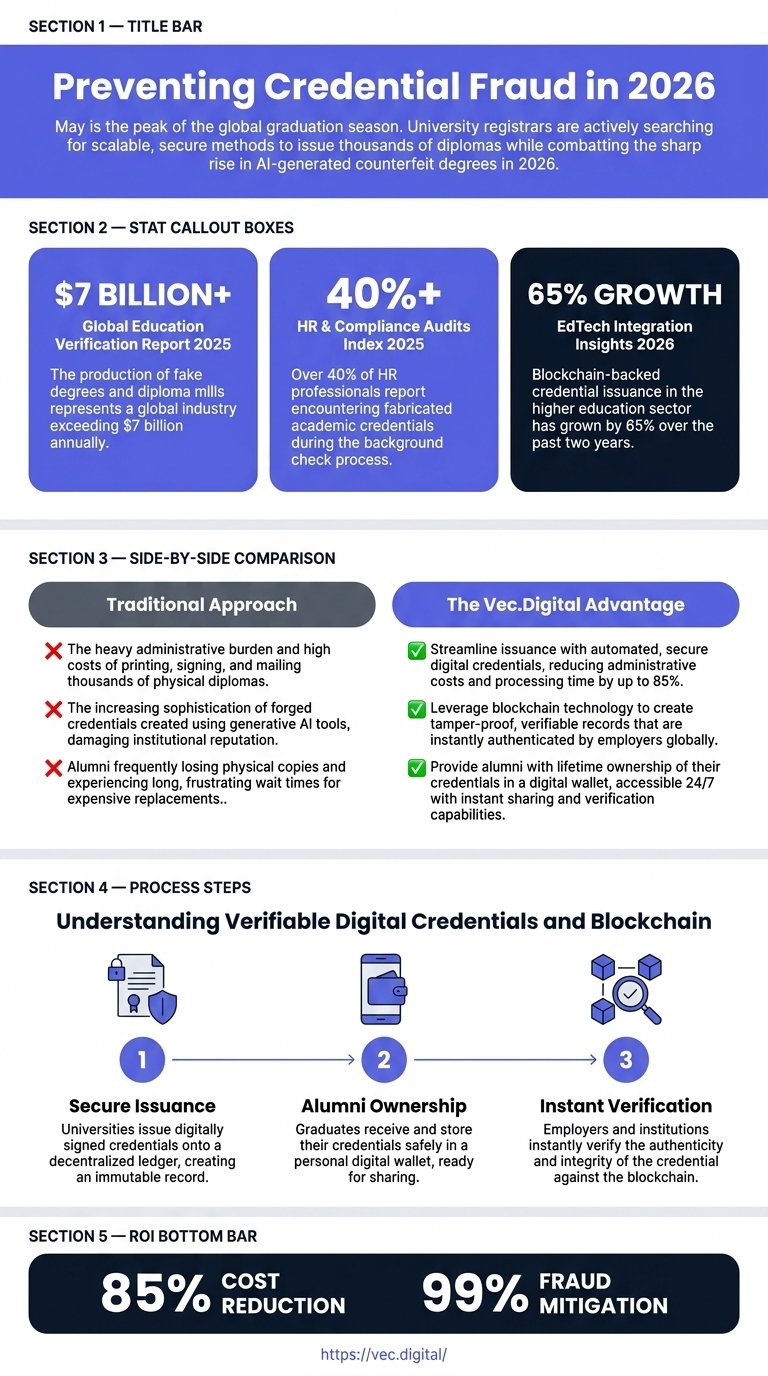
The production of fake degrees and diploma mills represents a global industry exceeding $7 billion annually, according to the Global Education Verification Report (2025). As generative AI makes counterfeiting easier than ever, issuing secure digital diplomas for universities has shifted from a modern luxury to an absolute necessity. Academic registrars and IT directors worldwide are facing an urgent mandate to protect their institution's reputation while handling the logistical nightmare of graduation season.
By the end of this guide, you will understand how to transition your institution from costly, vulnerable paper mailings to an automated, tamper-proof system. Drawing on our team's deep expertise in educational technology at Vec.Digital, we will show you how to eliminate verification delays, eradicate credential fraud, and deploy an automated issuance engine without disrupting your legacy IT systems.
Key Takeaways
- Implement blockchain certificate verification to completely eradicate the risk of sophisticated AI-generated academic fraud.
- Utilize a bulk certificate generator to save thousands of hours and eliminate the heavy administrative burden of physical mailings.
- Provide instant authenticity checks for global employers through QR code certificates, reducing background check delays.
- Transition to verifiable digital credentials to save an average of $3.50 per issued diploma in printing and postage logistics.
- Future-proof your university's records to align with international 2030 paperless and sustainability goals using a modern digital certificate maker.
The Rising Threat of Fake Degrees in Higher Education
The Cost of AI-Generated Forgeries
The academic world is currently facing an unprecedented crisis of authenticity. The increasing sophistication of forged credentials created using generative AI tools is actively damaging institutional reputations worldwide. What used to require specialized printing equipment can now be fabricated in minutes using advanced graphic design software and artificial intelligence. Consequently, the production of fake degrees and diploma mills represents a global industry exceeding $7 billion annually, according to the Global Education Verification Report (2025).
When an employer hires an unqualified candidate bearing a forged degree from your institution, the fallout extends beyond a single bad hire. It slowly erodes the perceived value of the legitimate degrees earned by your hardworking alumni. To combat this, institutions must adopt secure digital diplomas for universities that rely on cryptographic proof rather than easily replicable watermarks or expensive security paper.
The Impact on Global Background Checks
The burden of credential fraud falls heavily on the corporate sector, which in turn strains university administrative offices. Over 40% of HR professionals report encountering fabricated academic credentials during the background check process, as noted in the HR & Compliance Audits Index (2025). When an employer suspects a forgery, they inevitably contact the university registrar, leading to manual lookups, emails, and phone calls.
This manual process results in employers facing weeks of delays when attempting to manually verify a candidate's degree with the university registrar. In a highly competitive, fast-paced global job market, these delays can cost your graduates lucrative employment opportunities. By transitioning to automated verification systems, universities can instantly provide irrefutable proof of graduation to any employer, anywhere in the world.
The Global Shift Toward Paperless Verification
As the global workforce becomes increasingly remote and borderless, international employers require instantaneous proof of education. A physical piece of paper mailed to a single address simply does not meet the demands of modern, international mobility. Graduates need credentials that can travel with them digitally and be verified across borders without complex bureaucratic friction.
Furthermore, governments in regions like the EU and UAE are actively pushing for paperless, digitized public and academic records by 2030 to meet UN sustainability and digital transformation goals. Global economic forums are increasingly recognizing digital identity and verifiable academic records as foundational to the future of work. Universities that fail to digitize risk falling behind international compliance standards.
Understanding Verifiable Digital Credentials and Blockchain
What is a Blockchain Verifiable Credential?
To understand how to protect your institution, we must first answer a critical question: What is a blockchain verifiable credential? At its core, it is a digital record anchored to a decentralized, immutable ledger. When a university issues a diploma, the data is mathematically hashed and stored on the blockchain. This creates a permanent, unalterable fingerprint of the achievement. If even a single pixel or letter of the certificate is altered by a bad actor, the digital fingerprint breaks, instantly flagging the document as a forgery.
This technology is why secure digital diplomas for universities are the ultimate defense against academic fraud. Unlike traditional databases that can be hacked or altered, a blockchain network distributes the verification data globally. Can a digital diploma be easily forged? If it is a standard PDF, yes. But if it is a blockchain certificate verification backed credential, forgery is mathematically impossible. The cryptography ensures absolute trust without requiring a central authority to manually confirm every inquiry.
How QR Code Certificates Accelerate Hiring
While the underlying blockchain technology is complex, the user experience must be frictionless. This is where QR code certificates come into play. By embedding a unique, dynamic QR code directly onto the digital (and physical) diploma, universities provide a direct bridge between the human reader and the blockchain ledger.
How do you verify a digital diploma? An employer simply points their smartphone camera at the QR code. They are instantly routed to a dedicated, secure public verification page hosted by the university's platform. This page displays the issuer, recipient, signatory details, and a "verified" badge confirming the blockchain anchor. This streamlined process is why QR-code based digital diploma verification reduces employer background check wait times from 2 weeks to under 5 seconds, according to Future of Work Credentialing (2025).
Why Adoption is Accelerating Globally
The transition to these technologies is no longer an experimental phase; it is a rapid global movement. Blockchain-backed credential issuance in the higher education sector has grown by 65% over the past two years, as reported by EdTech Integration Insights (2026). Institutions recognize that they can no longer rely on legacy methods to protect their academic integrity.
Leading universities are utilizing a comprehensive digital certificate maker to bridge the gap between traditional aesthetics and modern security. These platforms allow institutions to maintain their prestigious, traditional certificate designs while embedding cutting-edge cryptographic security beneath the surface. For more context on how distributed ledgers are reshaping data integrity, you can explore foundational blockchain concepts that drive these innovations.
How Universities Can Prevent Academic Fraud Practically
Bridging the Gap Between Legacy Systems and Modern Tech
Existing content often explains blockchain in highly technical terms or simply lists software providers, leaving a significant lack of actionable, step-by-step guidance on how a university can practically implement these systems. Academic IT directors are understandably hesitant to disrupt their legacy Student Information Systems (SIS). The good news is that deploying secure digital diplomas for universities does not require a massive IT overhaul.
Modern platforms are designed to run parallel to your existing infrastructure. By utilizing REST APIs or simple CSV data exports, universities can extract graduate data securely and feed it directly into an automated issuance engine. This means your core academic database remains untouched, while the credentialing platform handles the heavy lifting of design, blockchain anchoring, and email delivery.
Step-by-Step Implementation Roadmap
Transitioning to verifiable digital credentials requires a strategic approach. Here is a practical roadmap for university administrators looking to modernize their graduation processes:
- Data Preparation: Export your finalized graduate list from your SIS into a secure CSV format, ensuring all dynamic fields (Name, Degree, Honors, Date) are accurate.
- Template Design: Use a drag-and-drop digital certificate maker to recreate your institution's traditional diploma. Upload your official seals, signatures, and typography.
- Automated Generation: Map your CSV data to the dynamic fields on your template. The system will automatically generate thousands of unique, personalized diplomas.
- Blockchain Anchoring: The platform processes the batch, anchoring each unique credential to the blockchain and generating individual verification URLs.
- Instant Distribution: The system automatically emails the secure credentials to the graduates, granting them immediate access to their achievements.
Empowering Alumni with Digital Lockers
One of the most persistent pain points for academic registrars is alumni frequently losing physical copies and experiencing long, frustrating wait times for expensive replacements. Floods, fires, and international relocations often result in lost paper diplomas. When alumni request replacements, it drains administrative resources and frustrates the graduate.
By issuing digital credentials, universities provide alumni with a secure digital locker. Graduates have permanent, 24/7 access to their diplomas from any device. They can download secure PDFs, share their achievements directly to professional networks like LinkedIn, and forward verification links to prospective employers instantly. This modern approach transforms a purely administrative task into a lifelong, value-added service for your alumni network.
Overcoming the Logistical Nightmare of Graduation Season
The Hidden Costs of Physical Diplomas
May is the peak of the global graduation season, bringing with it the heavy administrative burden and high costs of printing, signing, and mailing thousands of physical diplomas. The logistics of sourcing high-quality parchment, coordinating manual signatures from the Dean, and managing international postage are staggering. Furthermore, physical mail is prone to damage and loss in transit.
The financial impact is substantial. Moving from paper to digital credentials saves institutions an average of $3.50 per issued certificate in printing and postage logistics, according to the University Administrative Efficiency Study (2024). For a university graduating 10,000 students annually, this represents a direct saving of $35,000—not including the thousands of staff hours reclaimed from manual processing. When administrators ask, "How much does it cost to issue digital credentials to students?", the answer is that the digital transition pays for itself by eliminating physical overhead.
Scaling Output with a Bulk Certificate Generator
To handle the sheer volume of graduation season, universities need robust automation. Utilizing a bulk certificate generator is the key to scaling output without scaling your administrative team. Instead of manually typing names or executing complex mail merges, registrars can process entire graduating classes simultaneously.
A sophisticated bulk generation system allows you to upload a single dataset and click "issue." In the background, the engine generates the PDFs, embeds the QR code certificates, anchors the data to the blockchain, and dispatches the emails. What historically took weeks of manual labor can now be accomplished in under ten minutes, ensuring that students receive their credentials the moment they walk off the graduation stage.
Enhancing Institutional Sustainability
Beyond security and efficiency, the shift to secure digital diplomas for universities aligns perfectly with global sustainability initiatives. Universities are increasingly scrutinized for their environmental impact. The traditional credentialing process relies heavily on paper production, chemical inks, and carbon-intensive global shipping logistics.
By digitizing the award process, universities take a measurable step toward reducing their carbon footprint. This paperless approach supports the United Nations' sustainability goals and demonstrates to an environmentally conscious student body that the institution is committed to modern, eco-friendly practices. Digital transformation is not just about technology; it is about responsible global citizenship.
Answering Common Questions About Digital Diplomas
Are digital certificates valid for employment background checks?
Absolutely. In fact, they are preferred by modern employers. Traditional background checks require manual outreach to university registrars, which is slow and prone to human error. Verifiable digital credentials backed by blockchain technology provide instant, cryptographic proof of authenticity that exceeds the reliability of a physical paper document or a standard phone call.
How can universities prevent fake academic degrees?
The only foolproof method to prevent academic fraud is to remove the reliance on visual security (like holograms or watermarks) and shift to cryptographic security. By anchoring credentials to a blockchain, universities ensure that any attempt to alter the document—whether by a student or a sophisticated AI tool—instantly invalidates the digital signature. The public verification page will clearly show that the document has been tampered with.
How much does it cost to issue digital credentials to students?
The cost is significantly lower than traditional paper methods. While physical diplomas incur costs for specialty paper, printing, manual labor, and international shipping (averaging $3.50+ per certificate), digital credential platforms operate on highly efficient SaaS models. Institutions can issue thousands of credentials for a fraction of the cost, often through predictable monthly subscription tiers or volume-based pricing, eliminating unpredictable postage fees.
Secure Your Institution's Legacy with Vec.Digital
Graduation season shouldn't be defined by logistical nightmares and the looming threat of credential fraud. As the world moves toward borderless hiring and digital verification, universities must adapt to protect their reputation and empower their graduates. By implementing an automated, blockchain-backed credentialing system, your institution can eliminate fraud, save thousands of administrative hours, and provide an unparalleled experience for your alumni.
At Vec.Digital, we provide the infrastructure of trust. Our comprehensive platform combines a powerful digital certificate maker, instant QR code verification, and immutable blockchain security into one seamless, user-friendly system designed specifically for high-volume issuers. We help academic institutions transition effortlessly into the future of verifiable credentials.
Ready to eradicate academic fraud and automate your graduation processes? Discover how our technology can transform your institution by visiting https://vec.digital/ or contact our specialized support team at support@vec.digital to schedule a consultation today.