
Preventing Diploma Fraud in 2026: A Guide to Verifiable Digital Credentials
Published on May 21, 2026
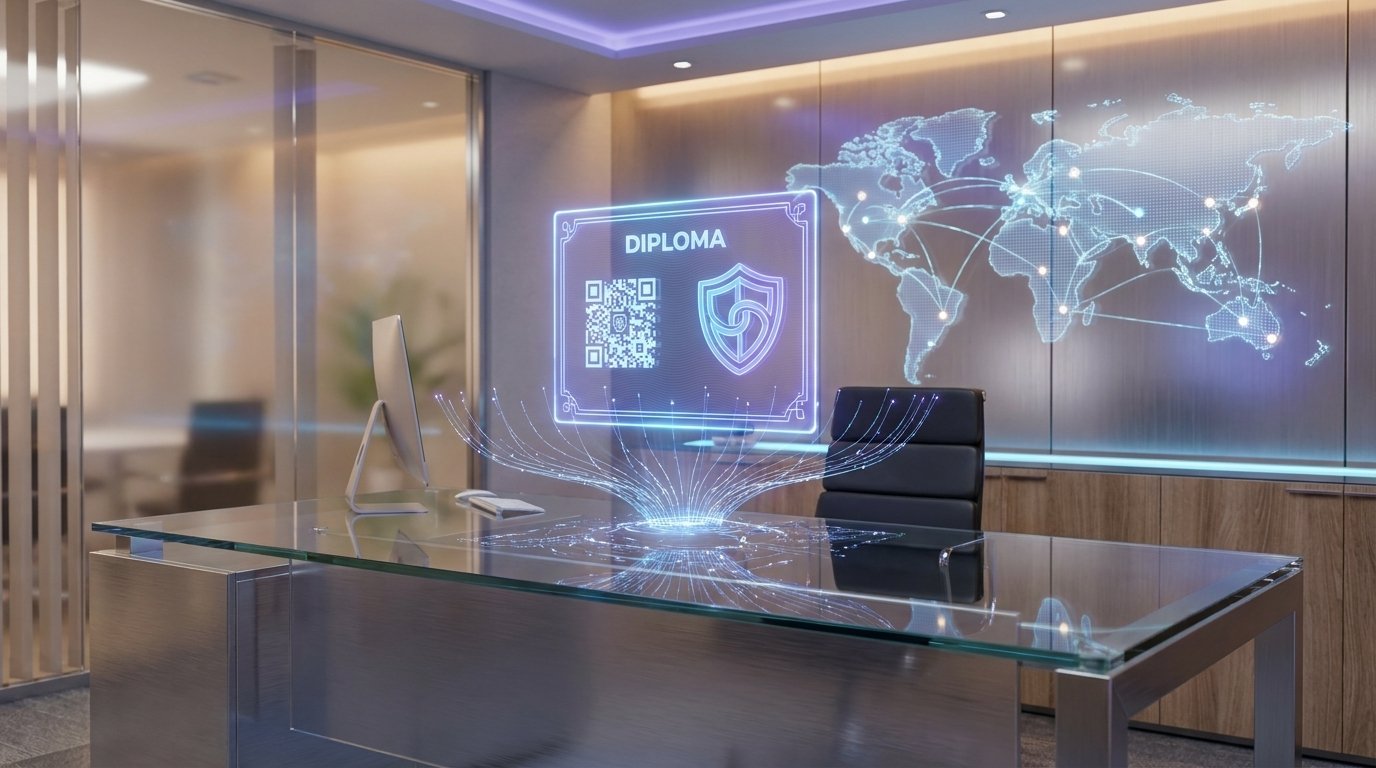
Diploma mills and fake degree operations have grown into a multi-billion dollar global illicit industry, according to the 2025 Higher Education Degree Datacheck (HEDD) Trends Report. As academic institutions face the massive logistical burden of graduation season, the need to implement verifiable digital credentials has never been more urgent. The 2026 landscape demands modern cryptographic security to protect institutional reputation and guarantee graduate authenticity globally.
By reading this comprehensive guide, you will understand how to transition from vulnerable paper records to an automated system that issues tamper-proof academic awards worldwide. Leveraging our deep expertise in Technology at Vec.Digital, we will show you how to eliminate manual verification, drastically reduce administrative costs, and empower your graduates with instantly shareable, universally trusted digital diplomas.
Key Takeaways
- Blockchain certificate verification completely eradicates the risk of sophisticated AI-generated diploma forgery.
- Implementing a digital certificate maker bridges the gap between high-tech cryptographic security and administrative simplicity for non-technical staff.
- QR code certificates enable instant, borderless authentication for global employers without requiring custom apps or accounts.
- Using a bulk certificate generator reduces the administrative hours registrars spend manually processing and verifying alumni records.
- Transitioning to verifiable digital credentials aligns institutions with global sustainability goals by eliminating the massive environmental footprint of paper printing and shipping.
The Global Escalation of Academic Credential Fraud
The Sophistication of Modern Diploma Mills
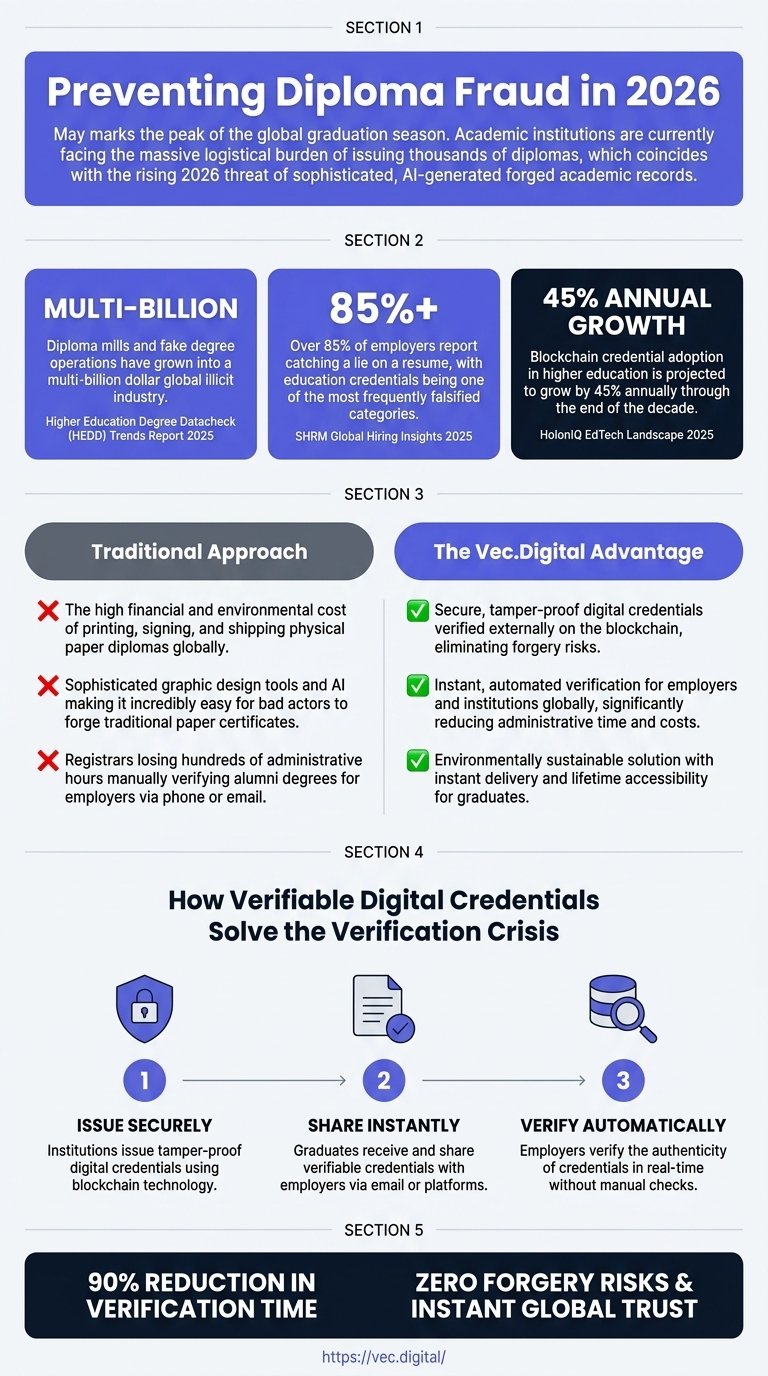
The landscape of academic fraud has shifted dramatically over the past decade. What was once a niche problem has exploded, with the 2025 Higher Education Degree Datacheck (HEDD) Trends Report confirming that diploma mills and fake degree operations have grown into a multi-billion dollar global illicit industry. This alarming growth is largely fueled by the democratization of advanced technology. Sophisticated graphic design tools and artificial intelligence now make it incredibly easy for bad actors to forge traditional paper certificates, perfectly replicating institutional watermarks, embossed stamps, and authorized signatures.
For universities, this means that the traditional methods of securing a diploma—such as specialty paper and holographic stickers—are no longer sufficient deterrents. The modern forger can bypass physical security measures with a few clicks, distributing highly convincing fake degrees across the globe. To combat this, institutions must adopt verifiable digital credentials that rely on immutable mathematics and cryptography rather than physical aesthetics to prove their authenticity.
By shifting the foundation of trust from the physical document to a secure digital ledger, universities can permanently outpace fraudulent operations. When a credential's validity is mathematically anchored, the visual replication of the document becomes entirely irrelevant; the underlying data either verifies successfully or it does not, leaving zero room for sophisticated forgery.
The Impact on Global Hiring and Reputation
The consequences of credential fraud extend far beyond the universities themselves; they severely impact the global hiring ecosystem. Data from the 2025 SHRM Global Hiring Insights reveals that over 85% of employers report catching a lie on a resume, with education credentials being one of the most frequently falsified categories. When employers cannot trust the documents presented to them, the intrinsic value of an institution's degree plummets, causing severe, long-term damage to the university's global reputation.
This lack of trust places an immense burden on academic registrars. Currently, university staff are losing hundreds of administrative hours manually verifying alumni degrees for employers via phone calls, emails, and legacy database lookups. This manual process is not only error-prone but also critically slow, creating friction for graduates who need immediate proof of their qualifications to secure competitive global roles.
As remote global hiring peaks in 2026, employers in regions like North America and Europe are increasingly demanding instant, zero-trust verification of degrees earned in the MENA and APAC regions. The traditional, cross-border manual verification system is simply too sluggish to support the modern, borderless economy. Institutions need an automated system that provides immediate, indisputable proof of academic achievement to any employer, anywhere in the world.
How Verifiable Digital Credentials Solve the Verification Crisis
What Are Verifiable Digital Credentials?
To understand the solution, we must first address a common question: What exactly are verifiable digital credentials? In practical terms, they are secure, tamper-proof digital records that provide irrefutable proof of an individual's achievement or qualification. Unlike a standard PDF or an image of a diploma—which can be easily altered in basic photo-editing software—a verifiable credential contains embedded cryptographic metadata that links directly back to the issuing institution.
A frequent question from students and professionals is: How do verifiable digital credentials work on LinkedIn? The process is remarkably seamless. Because the credential contains standardized metadata, it can be shared to professional networks with a single click. When a graduate adds their verifiable diploma to their LinkedIn profile, it displays as a certified achievement. Any prospective employer clicking on that achievement is instantly routed to a secure, public verification page that confirms the issuer, the recipient, the date of issuance, and the cryptographic integrity of the award.
This level of transparency eliminates the informational gap between the university and the employer. It democratizes the verification process, allowing anyone with the correct link or QR code to independently audit the credential without needing specialized software, thereby restoring absolute trust in the academic ecosystem.
The Role of Blockchain Certificate Verification
The engine powering this profound level of trust is blockchain technology. According to the 2025 HolonIQ EdTech Landscape report, blockchain credential adoption in higher education is projected to grow by 45% annually through the end of the decade. But how does blockchain prevent diploma and certificate fraud? The answer lies in the concept of immutability. When a university issues a diploma, the unique digital footprint (or "hash") of that document is permanently recorded on a decentralized public ledger.
If a bad actor attempts to alter even a single pixel or character of the digital diploma, the digital footprint changes completely, and the blockchain will instantly flag the document as invalid. This blockchain architecture provides an ultimate, unhackable source of truth. It removes the need for employers to contact the university directly, as the blockchain itself mathematically guarantees that the document was issued by the authorized institution and has not been tampered with since the moment of creation.
Another critical question administrators face is: Are digital diplomas legally valid for employment? Absolutely. In fact, they offer a much higher standard of legal and compliance validity than traditional paper. Because blockchain certificate verification provides undeniable cryptographic proof of origin and integrity, these digital records meet and exceed the stringent compliance requirements of enterprise HR departments and international hiring bodies.
Overcoming the Financial and Environmental Costs of Paper
The True Cost of Traditional Paper Diplomas
Beyond security, traditional paper diplomas represent a massive financial drain on academic institutions. The 2024 University Business Administration Review notes that traditional paper diploma processing, printing, and international mailing costs universities an average of $15 to $25 per student. For a large university graduating tens of thousands of students annually, this translates to hundreds of thousands of dollars spent purely on logistics and physical materials.
This high financial cost is compounded by the ongoing burden of replacements. Students frequently lose physical diplomas over time, whether due to relocation, natural disasters, or simple misplacement. When this happens, graduates face lengthy, expensive, and frustrating processes to request official reprints, while university staff must manually process these requests, re-print the documents, and initiate another round of global shipping.
By shifting to a digital-first issuance model, universities can completely eliminate these recurring logistical nightmares. A digital credential cannot be lost in a house fire or damaged in transit. It resides securely in a digital locker, accessible to the graduate 24/7 from anywhere in the world, ensuring that their hard-earned academic records are preserved perfectly for a lifetime.
Meeting UN Sustainability Goals with Digital Alternatives
The transition away from paper is not just a financial imperative; it is a global environmental necessity. Universities worldwide are under increasing pressure to align their operations with the United Nations Sustainable Development Goals (SDGs). The massive environmental footprint of harvesting trees for specialty paper, utilizing chemical inks, and fueling the global air-freight shipping of physical diplomas stands in direct opposition to modern sustainability mandates.
This brings up an important administrative query: How much does it cost an institution to issue a digital diploma? The financial contrast is staggering. Modern platforms offer highly scalable pricing structures that drastically reduce the $15-$25 physical cost. For instance, digital issuance can cost as little as $1.00 per certificate for individual batches, with enterprise subscription models driving the per-student cost down to mere cents.
By adopting cloud-based, paperless certification systems, institutions achieve a dual victory: they drastically reduce their operational overhead while making a tangible, measurable contribution to global environmental sustainability, completely eliminating the carbon emissions associated with global diploma logistics.
Bridging the Gap: From Complex Cryptography to Administrative Simplicity
Empowering Registrars with a Digital Certificate Maker
Historically, the biggest barrier to adopting blockchain technology in higher education has been the overwhelming technical jargon. Academic registrars do not have the time to learn about cryptographic hashing, decentralized nodes, or distributed ledgers. There is a critical need for practical solutions that allow non-technical staff to utilize advanced security without changing their daily operational habits.
This is where an intuitive digital certificate maker becomes essential. A modern platform bridges the gap between high-tech security and administrative simplicity by offering a drag-and-drop design editor. Registrars can visually design their credentials by uploading their university's custom backgrounds, logos, and typography. The system allows institutions to retain 100% of their brand identity while the complex blockchain anchoring happens invisibly in the background.
Furthermore, these design tools include dynamic custom fields and built-in signatory approval systems. Administrators can set up templates where variables like "Student Name," "Degree Major," and "Graduation Date" are automatically populated. If multiple deans need to sign off on a diploma, the automated system securely holds the document until all required digital signatures are collected, ensuring strict internal compliance before the credential is ever published.
Instant Issuance Using a Bulk Certificate Generator
When graduation season arrives, the sheer volume of processing can overwhelm even the most well-staffed administration offices. Registrars frequently ask: What is the best platform for issuing university certificates in bulk? The most effective solutions provide an automated system that can process thousands of records simultaneously without system lag or manual data entry errors.
By utilizing a bulk certificate generator, universities can upload a simple CSV file containing their entire graduating class roster. The issuance engine automatically maps the data to the pre-designed templates, generates the unique QR codes, anchors the records to the blockchain, and securely emails the digital diplomas to the students—all within a matter of minutes.
For enterprise-level institutions, robust REST API integrations allow the certification platform to connect directly to existing Learning Management Systems (LMS) or university CRM software. This seamless data flow means that as soon as a student is marked as "Graduated" in the university's internal database, the automated system triggers the creation and delivery of the verifiable credential instantly, requiring zero manual intervention from the staff.
Enhancing Alumni Engagement and Global Mobility
Instant QR Code Certificates for Borderless Verification
In a truly globalized workforce, a degree earned in one hemisphere must be instantly verifiable in another. A common question from international employers is: How can universities verify digital credentials instantly? The most elegant and universally accessible solution is the implementation of QR code certificates.
Every digital diploma issued through a modern platform features a unique, scannable QR code embedded directly into the design. When an employer, auditor, or immigration official scans this code with any standard smartphone camera, they are immediately routed to a dedicated, secure public verification page. This page displays the issuer's details, the recipient's information, the official signatory data, and a prominent "blockchain verified" badge.
Crucially, this process requires no proprietary apps, no registered accounts, and no complex software installations. It provides foolproof, easily shareable proof of authenticity that completely bypasses slow, cross-border manual verification bureaucracy, enabling seamless global mobility for graduates entering the international job market.
Boosting Digital Alumni Visibility
Beyond security and efficiency, digital credentials act as a powerful marketing and engagement tool for the university itself. According to 2026 Global EdTech Insights, institutions offering instant digital sharing to professional networks see up to a 30% increase in digital alumni engagement.
When students proudly share their verified achievements on platforms like LinkedIn, Facebook, or X (formerly Twitter), they generate organic, highly credible visibility for the university's programs. Each shared certificate acts as a digital billboard, driving prospective students back to the institution's verification pages and official website. By empowering learners to own and showcase their achievements in a digital locker, universities foster a lifelong, interactive relationship with their alumni network that traditional paper diplomas could never achieve.
Secure Your Institution’s Future with Vec.Digital
The transition to secure, verifiable digital credentials is no longer a futuristic concept; it is an immediate operational necessity. By adopting blockchain-backed digital diplomas, universities can eradicate the multi-billion dollar threat of credential fraud, drastically reduce administrative and logistical costs, and meet vital global sustainability goals. Most importantly, they provide their graduates with the indisputable proof of achievement required to thrive in a competitive, borderless global economy.
At Vec.Digital, we specialize in making credential fraud impossible. Our comprehensive platform combines an intuitive drag-and-drop certificate maker, automated bulk issuance via CSV or API, and immutable blockchain verification—all backed by a 99.98% uptime guarantee. We empower academic registrars to issue with confidence, learners to own their achievements, and employers to hire without doubt.
Ready to upgrade your institution's credentialing system and permanently protect your academic reputation? Start issuing verifiable certificates in minutes.
Website: https://vec.digital/
Email: support@vec.digital