
Preventing Diploma Fraud in 2026: The Guide to Secure Digital Diplomas for Universities
Published on May 28, 2026
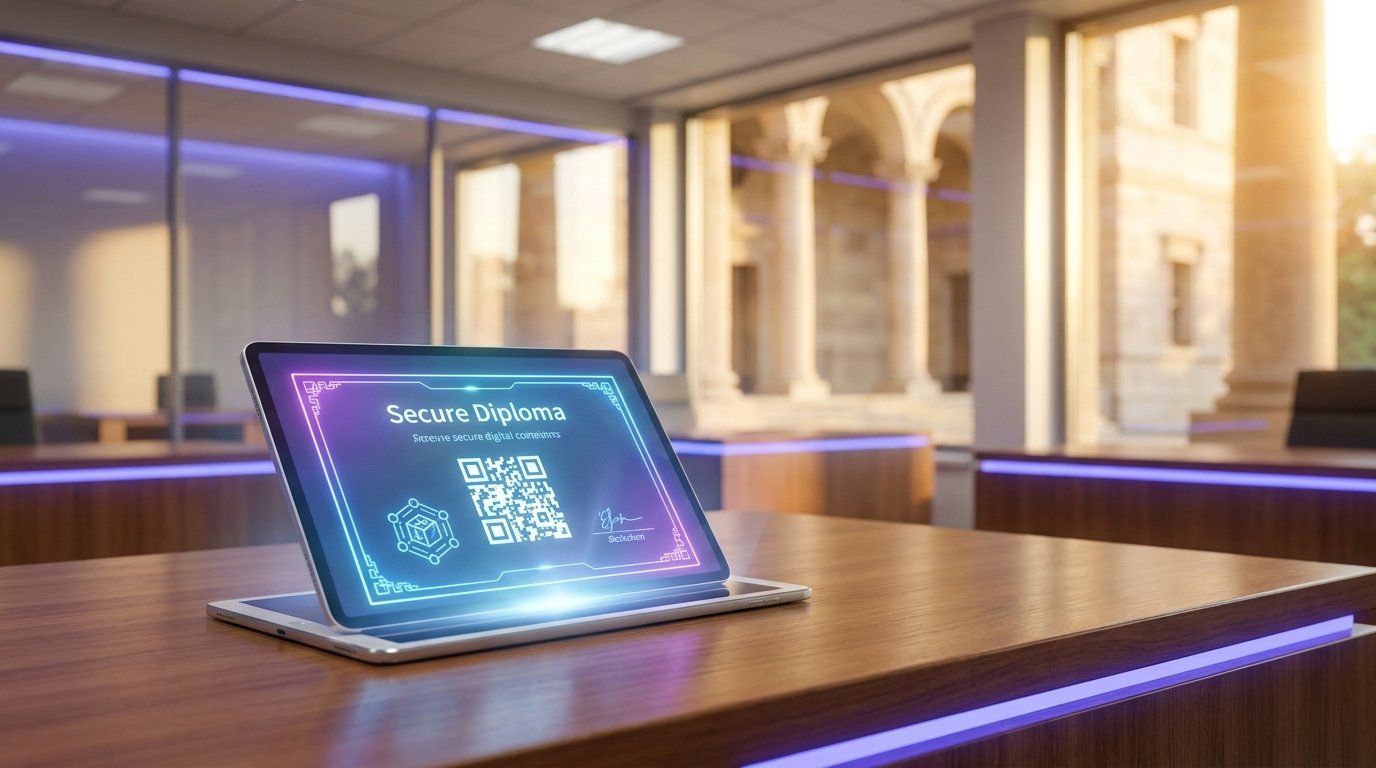
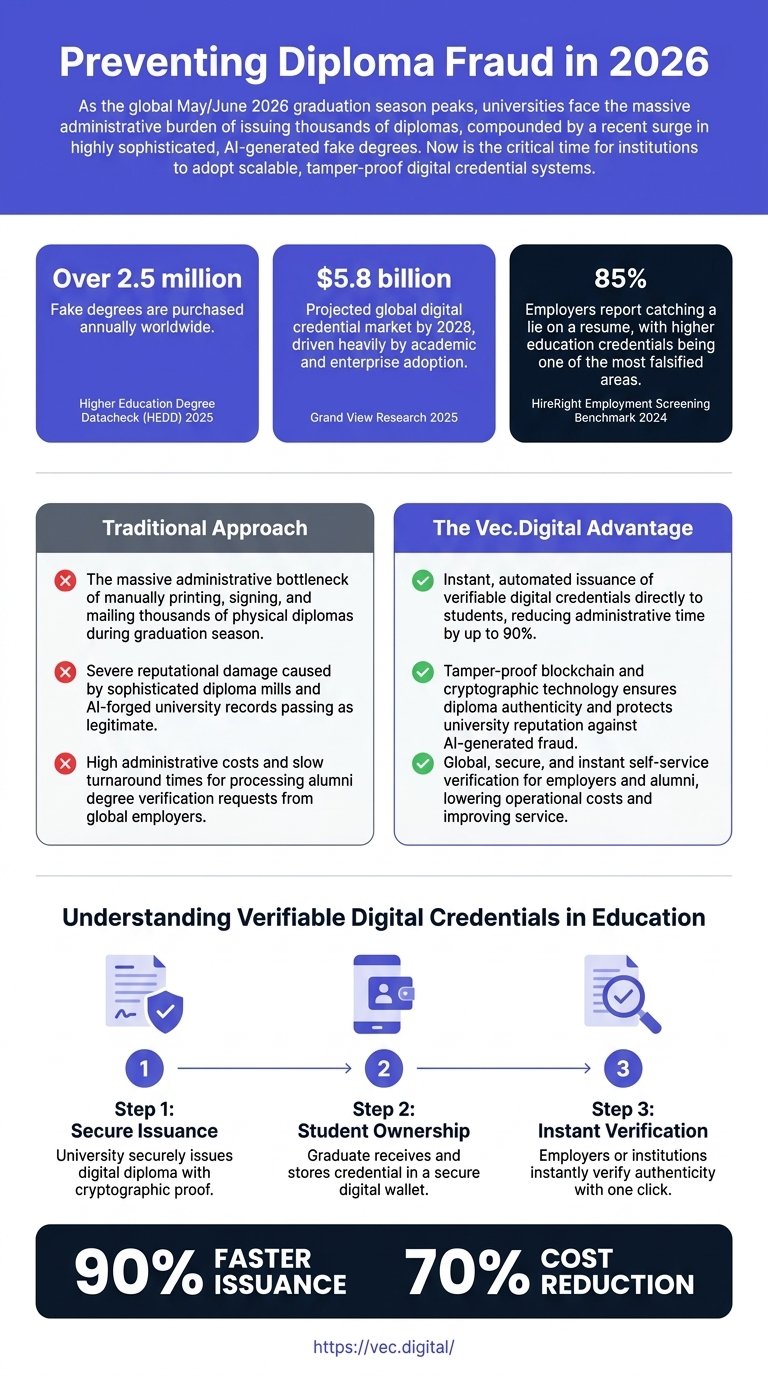
Over 2.5 million fake degrees are purchased annually worldwide according to the Higher Education Degree Datacheck (HEDD) in 2025, creating a monumental crisis of trust for global academic institutions. As highly sophisticated, AI-generated forged records flood the international job market, the mandate to issue secure digital diplomas for universities has shifted from a technological luxury to an absolute necessity. Legacy paper processes and manual verifications are no longer equipped to protect institutional integrity or handle the sheer volume of modern graduation seasons.
In this comprehensive guide, we will explore how academic registrars and IT directors can seamlessly transition to tamper-proof credentialing systems to protect their graduates. Drawing upon our extensive expertise in Technology at Vec.Digital, you will learn how to eradicate diploma fraud, automate large-scale credential issuance, and empower your global alumni network with instantly verifiable achievements.
Key Takeaways
- Implement blockchain certificate verification to permanently eliminate credential forgery and protect institutional reputation.
- Utilize a bulk certificate generator to save thousands of administrative hours during peak graduation seasons.
- Deploy QR code certificates to provide instant, globally accessible proof of education to multinational employers.
- Adopt verifiable digital credentials to drastically reduce employer verification costs and administrative delays.
- Future-proof your academic operations by issuing secure digital diplomas for universities at scale without complex technical overhead.
The Global Escalation of Diploma Fraud in 2026
The urgency to adopt secure digital diplomas for universities has never been more pronounced than in the current global hiring landscape. Diploma mills have evolved from producing obvious, low-quality paper forgeries to generating highly sophisticated digital replicas that easily bypass traditional background checks. This escalation threatens the foundational trust upon which higher education is built, forcing institutions to seek more resilient methods of credentialing.
As the global May/June 2026 graduation season peaks, universities are facing an unprecedented volume of credentials to process. Simultaneously, the tools available to bad actors have become more accessible. Without a cryptographically secure system in place, distinguishing a genuine graduate from a fraudulent applicant becomes a costly and time-consuming endeavor for everyone involved.
How Reputational Damage Impacts Higher Education
Institutional reputation is the most valuable asset a university possesses. When an employer unknowingly hires an unqualified candidate who has submitted a forged degree bearing a university's name, the resulting fallout severely damages the institution's brand equity. According to the HireRight Employment Screening Benchmark in 2024, 85% of employers report catching a lie on a resume, with higher education credentials being one of the most frequently falsified areas.
This widespread falsification dilutes the value of the legitimate degrees earned by hardworking students. If employers cannot trust the authenticity of a university's diplomas, they may begin to devalue candidates from that institution altogether. By transitioning to a secure digital infrastructure, academic institutions proactively defend their prestige and ensure that their alumni retain their competitive edge in the global job market.
The Hidden Costs of Manual Degree Verification
A common question among academic administrators is: How do employers verify university degrees? Historically, this has involved a convoluted process where an employer or a third-party background screening agency contacts the university's registrar office directly via phone, email, or physical mail. The registrar's staff must then manually search archival databases or physical filing cabinets to confirm the student's attendance, major, and graduation date.
This manual process is entirely unsustainable in today's fast-paced, globalized economy. Processing manual degree verifications costs universities an average of $35 to $50 per request in administrative time and resources, according to the EdTech Administrative Coalition in 2025. For a large university receiving thousands of verification requests annually, this translates to a massive financial burden. Furthermore, the slow turnaround time—often taking weeks—frustrates employers and can cost alumni lucrative job opportunities. Modernizing this system is not just about security; it is about operational survival.
Understanding Verifiable Digital Credentials in Education
When defining the architecture of secure digital diplomas for universities, it is crucial to understand the underlying technology that makes them trustworthy. The global digital credential market is projected to reach $5.8 billion by 2028, driven heavily by academic and enterprise adoption, according to Grand View Research in 2025. This rapid growth indicates a fundamental shift in how society recognizes and validates educational achievements.
A digital diploma is no longer just a static PDF sent via email. Static files can be easily manipulated using basic photo-editing software. Instead, modern educational institutions are moving toward dynamic, cryptographically secured assets that carry their proof of authenticity within the file itself, ensuring that any tampering is immediately evident to the verifier.
What is a Verifiable Digital Credential in Education?
Administrators often ask: What is a verifiable digital credential in education? Simply put, it is a digital record of an achievement that is machine-readable, cryptographically signed by the issuing institution, and instantly verifiable by any third party without needing to contact the issuer directly. These credentials contain rich metadata, including the recipient's identity, the specific degree awarded, the date of issuance, and the digital signature of the university's authorized personnel.
Because these credentials rely on public-key cryptography—a cornerstone of modern blockchain technology—they provide absolute certainty regarding the origin and integrity of the document. When a student shares their verifiable credential on a professional network like LinkedIn or directly with a hiring manager, the receiving party can instantly validate that the document was indeed issued by the claimed university and has not been altered since its creation.
Are Digital Diplomas Secure Against AI Forgery?
Another critical question is: Are digital diplomas secure? The answer depends entirely on the technology used to generate them. A standard PDF diploma is highly vulnerable to AI-assisted forgery. However, a verifiable digital credential anchored to a blockchain is virtually impenetrable. Because the security relies on advanced mathematics rather than visual watermarks, even the most sophisticated AI image generators cannot forge the cryptographic signature.
This level of security transforms the diploma from a mere visual representation of an award into a secure data packet. It completely neutralizes the threat of diploma mills, as bad actors cannot replicate the unique private keys held exclusively by the university. By adopting these robust systems, universities provide an unshakeable guarantee of authenticity to the global workforce.
The Mechanics of Blockchain Certificate Verification
At the core of secure digital diplomas for universities lies the immutable ledger of the blockchain. While the underlying technology may seem complex, the application for higher education is straightforward and highly effective. Blockchain certificate verification acts as an incorruptible digital notary, providing a permanent, public timestamp and proof of issuance for every credential generated by the university.
This technology fundamentally shifts the burden of proof away from the university's administrative staff and onto a decentralized, automated system. It ensures that the verification process is always available, 24/7, regardless of the university's operating hours or geographic location.
Can Blockchain Diplomas Be Faked or Altered?
Many IT directors and academic deans naturally ask: Can blockchain diplomas be faked or altered? The definitive answer is no. When a university issues a diploma, the credentialing system generates a unique cryptographic hash—a digital fingerprint—of the diploma's data. This hash is then permanently recorded on the blockchain.
If a fraudster attempts to alter even a single pixel or character on the diploma (for example, changing a GPA from 2.5 to 3.5), the digital fingerprint of the altered document will change completely. When an employer attempts to verify the forged document, the new fingerprint will not match the original fingerprint anchored on the blockchain, and the system will immediately flag the document as invalid. This immutability ensures that the university's records remain pristine and unquestionable forever.
How Do QR Code Certificates Prevent Degree Fraud?
To make this advanced cryptographic security accessible to everyday employers, institutions utilize QR code certificates. How do QR code certificates prevent degree fraud? By serving as a seamless bridge between the physical or digital document and the blockchain verification system. Every secure digital diploma features a unique, dynamically generated QR code embedded directly into the design.
When an employer, auditor, or immigration official scans this QR code using any standard smartphone camera, they are instantly routed to a dedicated, secure public verification page. This page displays the official issuer details, the recipient's information, the authorized signatory data, and a prominent "blockchain verified" badge. This process bypasses the need for specialized apps or registered accounts, democratizing the verification process and making credential fraud immediately detectable in real-time.
Overcoming the Administrative Bottleneck with a Bulk Certificate Generator
Implementing secure digital diplomas for universities does not just solve the security crisis; it completely resolves the massive administrative bottleneck associated with graduation season. For decades, university registrars have endured the grueling process of manually checking student data, printing thousands of physical diplomas on specialty paper, obtaining wet signatures from deans, and coordinating costly physical mail logistics.
This legacy approach is prone to human error, expensive, and incredibly slow. By integrating a professional bulk certificate generator into their administrative systems, universities can automate the entire issuance lifecycle, transforming a process that previously took weeks into one that takes mere minutes.
Transitioning from Paper to Automated Systems
The transition from manual printing to an automated digital system is a massive leap in operational efficiency. A robust digital certificate maker allows university staff to design stunning, brand-compliant diploma templates using intuitive drag-and-drop interfaces. These templates include dynamic fields for student names, degree types, graduation dates, and honors.
Once the template is finalized, administrators can utilize bulk issuance features to process the entire graduating class simultaneously. This eliminates the need for manual data entry, drastically reducing the margin for error. The system automatically populates the dynamic fields, generates the unique QR codes, anchors the data to the blockchain, and securely emails the credentials directly to the students' digital lockers. This level of automation frees up valuable administrative resources, allowing staff to focus on higher-level student services rather than tedious paperwork.
Eliminating the Frustrating Diploma Reissue Process
One of the most persistent pain points for both alumni and university staff is the process of reissuing lost or damaged physical diplomas. Traditionally, an alumnus must submit a formal request, pay a reissue fee, and wait weeks for a replacement document to be printed and mailed. This is particularly frustrating when the alumnus needs immediate proof of graduation for a pending job offer or visa application.
Digital credentials completely eliminate this friction. Because the diploma is stored securely in the cloud and backed by the blockchain, alumni have permanent, instantaneous access to their achievements from anywhere in the world. They can download, share, or print their secure digital diplomas on demand, without ever needing to contact the registrar's office. This self-service model significantly improves alumni satisfaction and entirely removes the administrative burden of processing reissue requests.
How Universities Issue Blockchain Certificates for Students at Scale
The practical implementation of secure digital diplomas for universities is often misunderstood. A significant content gap exists in the industry, with many resources focusing heavily on the theoretical aspects of cryptography while neglecting the day-to-day operational reality for academic administrators. Registrars frequently ask: How do universities issue blockchain certificates for students?
The reality is that modern platforms have abstracted the complex coding away, providing intuitive interfaces that seamlessly connect bulk data management with advanced blockchain anchoring. This allows non-technical staff to execute high-volume, secure issuance without requiring specialized IT knowledge.
Step 1: Designing On-Brand Digital Credentials
The automated process begins within the template editor. Universities can upload their custom background designs, official seals, and high-resolution logos, ensuring that the digital diploma retains the prestige and visual identity of the physical document. Administrators then map out dynamic variables—such as [Student_Name] and [Degree_Program]—and position the mandatory verification QR code.
During this phase, authorized signatories (such as the University President or Academic Dean) are added to the system. The platform securely holds the template until these signatories provide their digital approval, ensuring that internal governance and oversight are strictly maintained before any document is finalized.
Step 2: Utilizing CSV Uploads for Batch Processing
Once the template is approved, the registrar's office exports the final graduation roster from their Student Information System (SIS) into a standard CSV file. This file contains all the necessary variable data for the graduating class. The administrator simply uploads this CSV file into the credentialing platform.
The system's engine instantly parses the data, mapping each row of student information to the corresponding dynamic fields on the approved template. This batch processing capability allows a single administrator to queue thousands of personalized diplomas for issuance in a matter of seconds, bridging the gap between legacy databases and modern credentialing formats.
Step 3: Automated Blockchain Anchoring and Instant Delivery
The final step is where the true technological innovation occurs. Upon triggering the issuance command, the platform automatically generates a unique cryptographic hash for every individual diploma in the batch. These hashes are simultaneously anchored to the blockchain, creating the immutable record of authenticity.
Concurrently, the system generates the unique QR codes and dispatches secure emails to every student on the roster. The students receive a link to view, claim, and share their newly minted, globally verifiable digital diploma. The entire process—from CSV upload to student delivery and blockchain anchoring—happens seamlessly in the background, providing a frictionless experience for both the issuer and the recipient.
The Future of Global Hiring and Cross-Border Verification
The long-term value of secure digital diplomas for universities extends far beyond the campus borders. With remote work and globalized hiring becoming the absolute norm in 2026, employers in North America and Europe are increasingly hiring graduates from universities in Asia, Africa, and Latin America. This cross-border hiring makes traditional, manual degree verification incredibly slow, language-dependent, and difficult.
Digital credentials provide a universal standard of truth that transcends geographical and linguistic barriers. By adopting these systems, universities ensure that their graduates can seamlessly integrate into the international workforce, backed by irrefutable proof of their academic excellence.
Empowering Alumni in a Remote-First World
In a remote-first economy, the ability to instantly prove one's qualifications is a distinct competitive advantage. According to Global EdTech Insights in 2026, institutions utilizing blockchain-anchored credentials reduce credential verification time for employers by up to 98%. This near-instantaneous verification process means that alumni from forward-thinking universities can clear background checks and secure employment offers exponentially faster than peers relying on traditional paper transcripts.
Furthermore, digital credentials are inherently designed for modern professional networking. Alumni can embed their verifiable achievements directly into their LinkedIn profiles, digital portfolios, and email signatures. This visibility not only aids the graduate's career progression but also serves as powerful, organic marketing for the university, showcasing their successful alumni to the broader professional community.
Supporting UN Sustainability Goals Through Paperless Diplomas
Beyond security and efficiency, the shift toward digital credentialing aligns perfectly with global sustainability initiatives. The traditional process of manufacturing specialty diploma paper, printing with chemical inks, and shipping documents globally via air freight carries a significant carbon footprint. By transitioning to a cloud-based, paperless system, universities actively contribute to the United Nations Sustainable Development Goals (SDGs).
Embracing digital transformation in this manner demonstrates a university's commitment to environmental stewardship. It proves to prospective students and global partners that the institution is not only dedicated to academic excellence and technological innovation but also to responsible, sustainable operational practices.
Secure Your University's Legacy with Vec.Digital
The threat of credential fraud is evolving, and academic institutions must evolve their defenses in tandem. Issuing secure digital diplomas for universities is the definitive solution to protecting your institution's hard-earned reputation, eliminating the costly administrative bottlenecks of graduation season, and providing your students with the globally recognized, instantly verifiable credentials they deserve.
At Vec.Digital, we specialize in providing effortless digital certification and verification at scale. Our comprehensive platform combines an intuitive drag-and-drop certificate maker, automated bulk issuance capabilities, and patented blockchain anchoring to make credential fraud impossible. With a 99.98% guaranteed uptime and no complex technical setup required, your institution can transition to modern, paperless credentials seamlessly.
Empower your alumni, satisfy global employers, and secure your academic legacy today. Start issuing verifiable certificates in minutes and experience the future of higher education administration.
Ready to upgrade your credentialing system?
Visit our website: https://vec.digital/
Contact our Happiness Centre: support@vec.digital