
Preventing Diploma Fraud in 2026: The Higher Ed Guide to Verifiable Digital Credentials
Published on May 15, 2026

Over 40% of employers report discovering fabricated educational credentials on applicant resumes during the hiring process, representing a massive global crisis for academic integrity. As graduation season approaches, universities face their highest seasonal risk of forgery and an overwhelming administrative burden, making the transition to verifiable digital credentials more critical than ever. The era of relying solely on easily manipulated paper records is rapidly coming to an end as institutions worldwide seek immutable security.
In this comprehensive guide, you will discover how to modernize your institution's credentialing system without requiring advanced technical expertise. Leveraging our deep expertise in Technology at Vec.Digital, we will show you how to completely eliminate diploma fraud, automate bulk issuance to save thousands of administrative hours, and provide graduates with the instant, globally shareable proof of achievement they demand.
Key Takeaways
- Verifiable digital credentials provide an immutable, mathematically proven record of academic achievement that cannot be forged or altered.
- Implementing blockchain certificate verification reduces manual employer background check times from days to mere seconds.
- Transitioning to secure digital diplomas for universities saves significant institutional capital previously lost to printing and global shipping logistics.
- Issuing QR code certificates empowers employers and border agencies worldwide to authenticate documents instantly without downloading proprietary apps.
- Utilizing a bulk certificate generator automates the registrar's administrative burden, allowing thousands of degrees to be issued with a single CSV upload.
The Global Escalation of Academic Credential Fraud
Understanding the Reputational and Financial Cost
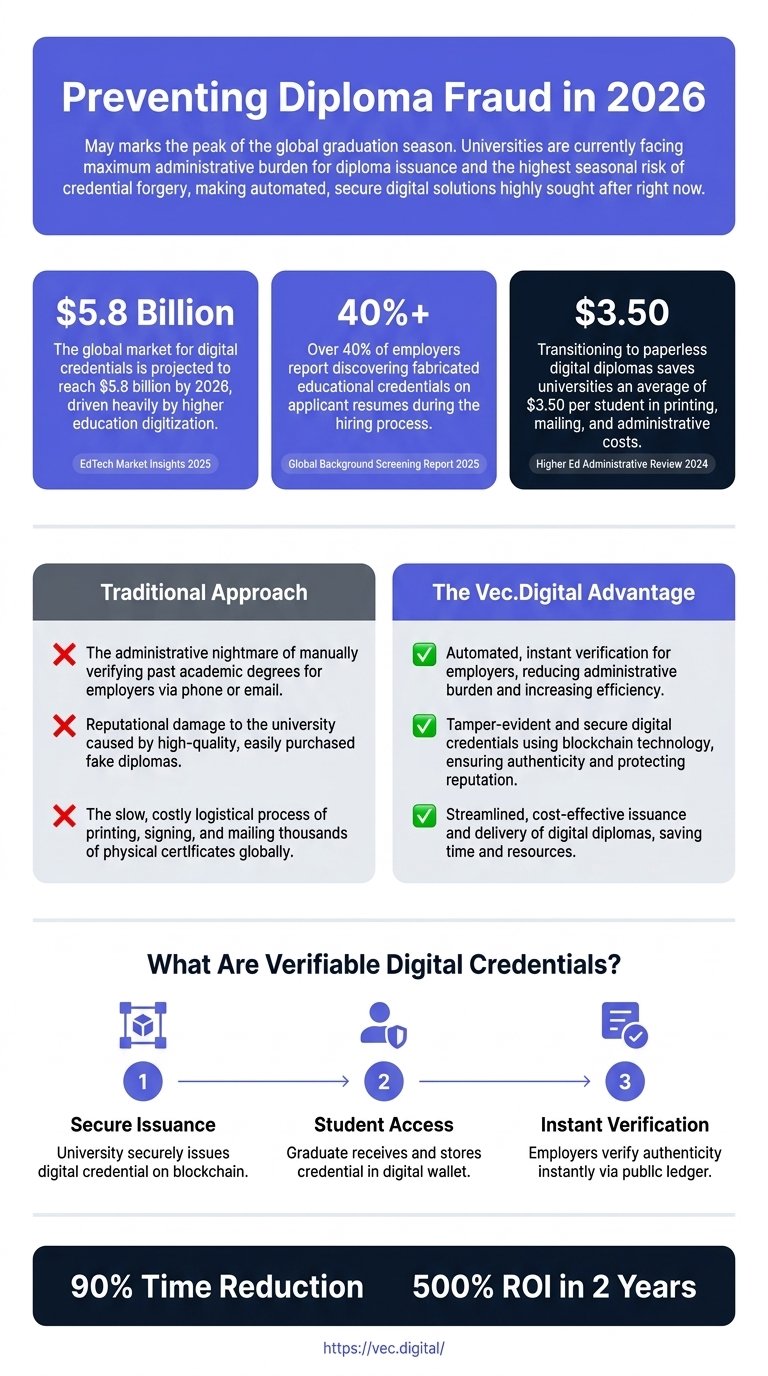
The academic landscape is currently facing an unprecedented wave of credential fabrication. With the proliferation of sophisticated digital editing tools and illicit "diploma mills," bad actors can easily generate highly convincing fake degrees. According to the Global Background Screening Report (2025), over 40% of employers report discovering fabricated educational credentials on applicant resumes during the hiring process. This staggering statistic highlights a systemic vulnerability in how academic achievements are traditionally recorded and verified.
For universities, the consequences of this fraud extend far beyond a single dishonest applicant. When a high-profile corporate scandal or medical malpractice case reveals that an employee held a forged degree from a prestigious university, the resulting media fallout inflicts severe reputational damage on the institution. The public trust that universities spend centuries building can be eroded overnight if employers cannot definitively trust the paper documents bearing the institution's seal.
Furthermore, managing the fallout from these incidents requires immense administrative resources. University legal and compliance teams are frequently forced to investigate claims, issue public statements, and audit their own internal records. By adopting verifiable digital credentials, institutions can proactively shield their legacy from these malicious actors, ensuring that only legitimately earned achievements carry the university's endorsement.
Why Traditional Paper Diplomas Fall Short
For generations, the physical diploma—complete with heavy cardstock, embossed seals, and wet ink signatures—has been the gold standard of academic achievement. However, in today's hyper-connected, globalized workforce, these analog documents are fundamentally incompatible with modern hiring practices. The slow, costly logistical process of printing, signing, and mailing thousands of physical certificates globally creates an immense bottleneck for the registrar's office every graduation season.
Beyond the logistical nightmare, paper diplomas are inherently insecure. An embossed seal can be replicated, and a signature can be forged. When an international employer needs to verify a candidate's background, they cannot rely on a PDF scan of a paper document. This leads to the administrative nightmare of manually verifying past academic degrees for employers via phone or email. Registrars are inundated with verification requests, draining staff time and delaying the hiring process for alumni.
The financial toll of maintaining this legacy system is also substantial. Research from the Higher Ed Administrative Review (2024) indicates that transitioning to paperless digital diplomas saves universities an average of $3.50 per student in printing, mailing, and administrative costs. When multiplied across tens of thousands of graduates annually, the capital wasted on an insecure, outdated medium becomes impossible for forward-thinking academic leaders to justify.
What Are Verifiable Digital Credentials?
Defining the Modern Digital Diploma
When academic administrators ask, "What are verifiable digital credentials?", they are often met with overly technical jargon. In practical terms, a verifiable digital credential is a tamper-proof, cryptographic representation of a traditional document. Unlike a standard PDF or a JPEG image—which can be easily altered in basic photo-editing software—a verifiable credential contains embedded mathematical proofs that guarantee its authenticity, its origin, and its integrity.
These credentials operate on a triad of trust involving the issuer (the university), the holder (the graduate), and the verifier (the employer). When a university issues secure digital diplomas for universities, they use a unique digital signature. If even a single pixel or character of the credential is altered after issuance, the mathematical proof breaks, instantly alerting anyone who views it that the document is invalid. This ensures absolute data integrity without requiring the verifier to contact the university directly.
This digital-first approach transforms the diploma from a static piece of paper into a dynamic, interactive asset. Graduates can store these credentials in secure digital wallets, access them from anywhere in the world, and present them instantly to prospective employers, licensing boards, or immigration authorities, knowing the document will be universally recognized as authentic.
The Role of W3C Standards in Global Education
The transition to digital credentialing is not merely a localized trend; it is a global mandate driven by international standards. The World Wide Web Consortium (W3C), the main international standards organization for the internet, has established the Verifiable Credentials Data Model. This standard ensures that digital credentials are interoperable across different systems, borders, and technologies, much like how HTML ensures websites render correctly on any browser.
With the European Union's push for the European Digital Identity Framework and increasing adoption of the W3C standards globally, institutions worldwide are facing regulatory pressure to modernize. A university in Asia or North America must ensure that its digital diplomas can be seamlessly verified by an employer in Europe without encountering technical friction or requiring proprietary software installations.
By adhering to these global frameworks, universities future-proof their technological investments. It ensures that the digital credentials they issue today will remain valid, accessible, and verifiable decades into the future, regardless of how operating systems or hardware devices evolve over time.
How Blockchain Certificate Verification Works in Practice
Moving Beyond Theoretical Cryptography
A common question among higher education IT directors is, "How does blockchain certificate verification work?" While the underlying cryptography is complex, the practical application is remarkably straightforward for the end user. When a university issues a diploma, the credentialing platform generates a unique cryptographic "hash"—a digital fingerprint—of that specific document. This hash is then permanently anchored to a decentralized blockchain network.
Because blockchains are immutable (meaning data cannot be changed or deleted once recorded), this anchor serves as a permanent, public notary. When an employer wants to verify the document, the system automatically recalculates the hash of the presented diploma and compares it to the hash stored on the blockchain. If they match perfectly, the document is authentic. If they differ in any way, the document is flagged as a forgery.
The efficiency gains from this automated process are staggering. The University Digital Transformation Index (2026) reports that institutions utilizing blockchain certificate verification reduce manual background check response times from an average of 4 days to under 3 seconds. This dramatic reduction not only relieves the registrar's office but also gives graduates a massive competitive advantage in fast-paced job markets.
Can Digital Certificates with QR Codes Be Forged?
As universities adopt modern solutions, a frequent concern arises: "Can digital certificates with QR codes be forged?" The short answer is no, provided the QR code is backed by blockchain anchoring and dynamic verification protocols. A standard QR code is simply a visual representation of a URL. If a fraudster creates a fake certificate, they could theoretically generate a QR code that links to a fake website they control.
However, true QR code certificates issued by enterprise-grade platforms utilize cryptographic signatures. When the QR code is scanned, it does not merely open a webpage; it queries the blockchain to verify the cryptographic hash of the document. The verification page is hosted on the secure, centralized domain of the credentialing platform (such as Vec.Digital), which cannot be spoofed by malicious actors.
Furthermore, the verification page displays the immutable details of the transaction: the exact time of issuance, the verified identity of the issuing institution, and the blockchain transaction ID. This multi-layered security approach makes credential forgery mathematically and practically impossible, providing total peace of mind to both the university and the verifying employer.
How Do Universities Verify Digital Diplomas Instantly?
When asked, "How do universities verify digital diplomas?", the answer lies in the removal of the university from the manual verification loop entirely. In the past, an employer had to call the registrar, submit a formal request, pay a fee, and wait days for a clerk to search through filing cabinets or legacy databases to confirm a student's graduation status.
With a modern credentialing system, the verification process is entirely decentralized and self-serve. The graduate shares their digital diploma—or a link to its dedicated verification page—directly with the employer. The employer simply clicks the link or scans the embedded QR code using any standard smartphone camera. No proprietary apps, accounts, or logins are required.
Within milliseconds, the platform cross-references the document's digital signature against the blockchain ledger and displays a definitive "Verified" badge, alongside the recipient's name, the degree awarded, and the date of issuance. This automated process operates 24/7/365, enabling seamless global hiring without ever triggering a support ticket at the university's administrative offices.
Streamlining the Registrar's Office with Automation
Overcoming the Administrative Nightmare of Manual Verification
The weeks surrounding graduation season are notoriously stressful for university administrative staff. The sheer volume of data entry, quality assurance, printing, signing, and mailing creates a severe operational bottleneck. Human error is inevitable when manually processing thousands of records, leading to misspelled names, incorrect degree classifications, and costly reprints.
By implementing an automated bulk certificate generator, universities can completely overhaul this archaic system. Rather than treating each diploma as an individual, manual task, the registrar's office can connect their Student Information System (SIS) directly to a digital credentialing engine. This allows data to flow seamlessly from the university's database into beautifully designed, brand-compliant digital templates.
This automated process ensures absolute data accuracy. If a student's name is correct in the university database, it will be perfectly replicated on the digital diploma. Furthermore, built-in signatory approval systems allow deans and chancellors to digitally sign thousands of documents with a single secure authorization, eliminating the physical toll of "signing parties" and vastly accelerating the issuance timeline.
How Do I Issue Secure Digital Diplomas in Bulk?
For IT directors and registrars tasked with modernizing their operations, the most pressing operational question is, "How do I issue secure digital diplomas in bulk?" The process is designed to be highly intuitive, requiring no coding or advanced technical knowledge. It begins with the creation of a master template using a drag-and-drop design editor, incorporating the university's official logos, fonts, and dynamic data fields (such as [Student Name] and [Degree Title]).
Once the template is finalized, the registrar simply exports a CSV file from their student database containing the graduating class's details. This CSV is uploaded directly into the credentialing platform. The system's engine instantly maps the columns in the spreadsheet to the dynamic fields on the certificate template.
With a single click, the platform generates thousands of unique, personalized, and blockchain-anchored digital diplomas. The system then automatically dispatches these credentials to the students via secure email links. What previously took weeks of manual labor and logistical coordination is now accomplished in less than five minutes, with zero physical material costs.
Choosing the Best Digital Certificate Maker for Universities
When evaluating technology partners, administrators often search for, "What is the best digital certificate maker for universities?" The ideal platform must bridge the gap between high-end cryptographic security and intuitive, user-friendly design. A solution that requires extensive developer resources to maintain will ultimately fail to gain adoption among administrative staff.
A premier platform must offer a comprehensive, all-in-one ecosystem. This includes a robust visual editor capable of handling high-resolution university branding, dynamic custom fields for complex academic transcripts, and seamless CSV or REST API integrations for high-volume issuance. It must also guarantee high availability; an enterprise-grade Service Level Agreement (SLA) of 99.98% uptime is essential to ensure that alumni can access their credentials during critical job interviews or border crossings.
Furthermore, the right partner will inherently understand the principles of Public Key Cryptography while abstracting that complexity away from the user experience. The registrar should only see a clean, unified dashboard for team management, while the platform handles the complex blockchain anchoring and global W3C compliance silently in the background.
Meeting Student Expectations in a Borderless Digital Economy
Instant LinkedIn Sharing for the Modern Graduate
Today's graduates are digital natives entering a highly competitive, globalized workforce. They expect their university to provide services that align with their digital-first lifestyles. According to the Student Experience Survey (2025), 85% of Gen Z graduates expect to receive a digital, shareable version of their diploma alongside or instead of a physical copy.
A primary pain point for modern alumni is the friction involved in proving their real-world achievements to prospective employers on professional networking platforms. A paper diploma cannot be easily verified on a LinkedIn profile. By issuing verifiable digital credentials, universities empower their graduates to add their achievements directly to their LinkedIn profiles with a single click.
When a graduate shares their verified credential online, it acts as a powerful, organic marketing engine for the university. Every time a connection views the credential, they see the university's branding and a link back to the institution's verification page. This drives brand visibility, enhances the institution's reputation for technological innovation, and visually demonstrates the success of its alumni network to prospective students worldwide.
Cost Savings and Environmental Sustainability
Beyond security and student satisfaction, the shift to digital credentialing aligns perfectly with global sustainability initiatives. The traditional process of manufacturing heavy paper stock, printing with chemical inks, and utilizing international air freight to deliver diplomas leaves a massive carbon footprint. As universities globally commit to the United Nations Sustainable Development Goals (SDGs), eliminating paper waste in administrative processes is a highly visible and effective strategy.
The financial resources previously allocated to physical diploma logistics can be completely reallocated. The $3.50 per student saved on administrative and mailing costs can be redirected toward student services, research funding, or campus improvements. Digital transformation in the registrar's office is not merely a technological upgrade; it is a strategic financial and environmental imperative.
By adopting a paperless, cloud-based certification system, universities demonstrate strong institutional leadership. They prove to their stakeholders, students, and global partners that they are committed to sustainable operations without compromising on the security, prestige, or global accessibility of their academic awards.
Secure Your Institution's Future with Vec.Digital
The threat of academic fraud is escalating, and the demands of modern graduates are clear. Relying on paper-based, manual verification processes exposes your institution to reputational risk and drains critical administrative resources. The global market for digital credentials is projected to reach $5.8 billion by 2026, driven heavily by higher education digitization (EdTech Market Insights, 2025). The time to modernize your credentialing infrastructure is now.
At Vec.Digital, we provide an effortless, all-in-one platform designed to completely eradicate credential fraud while streamlining your administrative operations. Our blockchain-backed security, instant QR code verification, and intuitive bulk issuance capabilities empower universities to issue tamper-proof digital diplomas globally, with absolute confidence and zero technical friction.
Ready to protect your university's legacy and give your graduates the secure, shareable credentials they deserve this graduation season? Transition to a flawless, automated digital credentialing system today.
Contact our team to get started:
Website: https://vec.digital/
Email: support@vec.digital