
Preventing Diploma Fraud in 2026: The Power of Verifiable Digital Credentials
Published on May 24, 2026
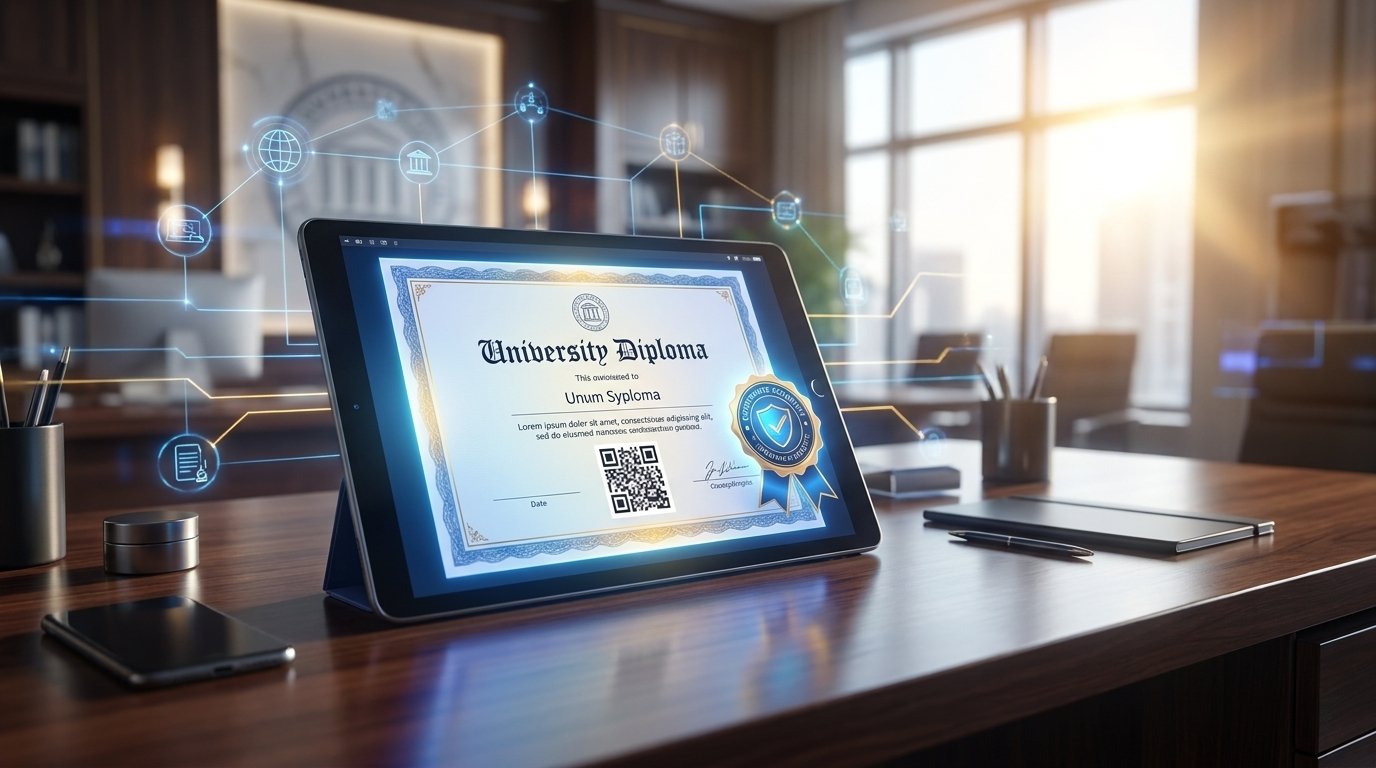
Over 2 million fake degrees are purchased globally every year, a number dangerously accelerated by sophisticated AI forgery tools (Source: Global Education Fraud Reports, 2025). As academic institutions face this unprecedented threat, adopting verifiable digital credentials has become an urgent global necessity. Universities, colleges, and EdTech platforms are finding themselves in a continuous battle to protect their hard-earned reputations from the rampant spread of counterfeit qualifications.
In this comprehensive guide, we leverage our deep technology expertise at Vec.Digital to explore how modern authentication systems are revolutionizing higher education. You will learn how to eradicate diploma fraud using immutable technology, streamline administrative operations through an automated issuance engine, and align your institution with global sustainability goals by embracing a secure, paperless future.
Key Takeaways
- Verifiable digital credentials provide cryptographic proof of authenticity, making academic fraud mathematically impossible.
- Implementing blockchain certificate verification anchors academic records to an immutable ledger, ensuring lifelong global trust.
- Modern QR code certificates allow employers to instantly authenticate qualifications without specialized software or accounts.
- A robust bulk certificate generator eliminates administrative bottlenecks, saving thousands of hours in manual data entry.
- Transitioning to secure digital diplomas for universities supports international mobility and the UN Sustainable Development Goals.
The Escalating Crisis of Academic Fraud in 2026
The Reputational Cost of Fake Degrees
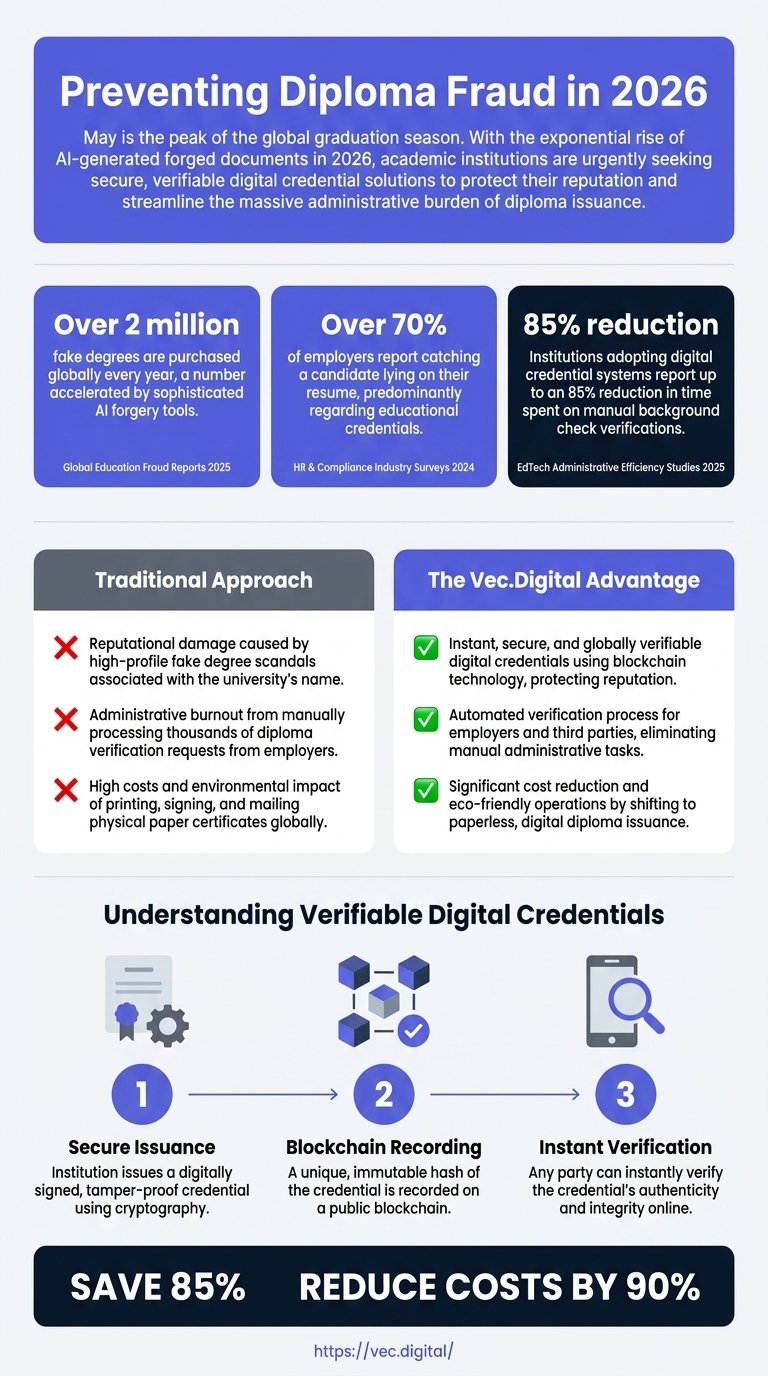
The academic landscape has shifted dramatically, and traditional paper certificates are no longer sufficient to prove an individual's educational background. With the advent of high-resolution scanning, advanced graphic design software, and generative AI, creating a visually perfect replica of a university diploma takes mere minutes. This technological ease has fueled a massive underground market. As noted earlier, over 2 million fake degrees are purchased globally every year, a number accelerated by sophisticated AI forgery tools (Source: Global Education Fraud Reports, 2025).
For a university, the reputational damage caused by high-profile fake degree scandals can be catastrophic. When an individual is found holding a fraudulent degree bearing an institution's name, the public perception of that institution's academic rigor immediately drops. Employers begin to question the validity of all graduates from that university, potentially harming the career prospects of legitimate alumni. This erosion of trust is a critical business risk that higher education leaders must mitigate proactively.
To combat this, forward-thinking institutions are moving away from easily replicable paper documents. They are adopting systems that prioritize cryptographic truth over physical appearance. By securing credentials digitally, universities can ensure that their brand remains synonymous with excellence and integrity, completely neutralizing the threat of counterfeit diploma mills.
The Administrative Burden on Universities
Beyond the reputational risks, legacy credentialing systems place an enormous administrative burden on university staff. Academic registrars and IT directors are intimately familiar with the tedious, manual processes involved in verifying alumni records. When an employer wants to confirm a candidate's background, they typically must contact the university directly, initiating a slow, labor-intensive process of checking physical archives or disjointed databases.
This administrative burnout from manually processing thousands of diploma verification requests from employers drains valuable resources. Staff members are forced to spend countless hours on data entry, email correspondence, and phone calls, diverting their attention from more strategic institutional goals. In an era where efficiency is paramount, relying on human intervention for routine verification is an unsustainable model.
Furthermore, the issuance process itself is fraught with friction. Printing, signing, and mailing physical certificates globally is a logistical nightmare, especially for international students. Delays, lost mail, and the need for costly official reprints create a frustrating experience for graduates who are eager to enter the workforce and prove their qualifications.
Environmental Impact and the Push for Paperless Operations
In addition to security and efficiency concerns, the environmental impact of traditional credentialing cannot be ignored. The high costs and environmental footprint of printing, signing, and mailing physical paper certificates globally run counter to the sustainability pledges made by modern educational institutions. Millions of sheets of specialty paper, chemical inks, and international air freight contribute significantly to a university's carbon footprint.
Simultaneously, academic institutions worldwide are pledging to meet UN Sustainable Development Goals (SDG 12: Responsible Consumption) by transitioning to paperless operations. Making digital diplomas a regulatory and environmental priority is no longer just a trend; it is an international mandate. By digitizing the credentialing process, universities can drastically reduce their ecological impact while simultaneously upgrading their technological infrastructure.
This shift toward sustainability also resonates deeply with the modern student body. Today's learners are highly environmentally conscious and prefer institutions that align with their values. Offering a secure, digital alternative to paper diplomas not only solves logistical headaches but also serves as a powerful testament to a university's commitment to a greener, more responsible future.
Understanding Verifiable Digital Credentials
What is a Verifiable Digital Credential?
One of the most common questions from academic leaders is: What exactly is a verifiable digital credential? Simply put, it is a digital record of achievement that is cryptographically sealed to prove who issued it, who received it, and that it has not been altered since its creation. Unlike a standard PDF or a scanned image of a certificate, a verifiable credential contains embedded metadata and security layers that make its authenticity mathematically provable.
These credentials operate on the principles of decentralized trust. When a university issues a digital diploma, the system generates a unique digital signature. This signature acts as an unforgeable seal of approval. If even a single pixel or character of the document is altered by a malicious actor, the digital signature breaks, immediately flagging the document as invalid.
For learners, these credentials represent a portable, lifelong digital locker of achievements. They can be stored on mobile devices, shared instantly via email, or embedded into professional networking profiles. Because the verification data travels with the document itself, the need for third-party background check agencies is drastically reduced, empowering the student to own and control their academic identity.
How Does Blockchain Prevent Diploma Fraud?
To understand the true power of this technology, we must explore blockchain certificate verification. How does blockchain prevent diploma fraud? A blockchain is essentially a distributed, immutable digital ledger. When a university issues a credential, a unique cryptographic hash (a digital fingerprint) of that certificate is recorded on the blockchain. This record is permanent, transparent, and cannot be deleted or altered by anyone—not even the issuing institution or the platform provider.
When an employer receives the digital diploma, the verification system checks the document's hash against the hash stored on the blockchain. If they match perfectly, the system confirms that the document is authentic and exactly as it was when originally issued. If a fraudster attempts to change the name on the certificate or alter the graduation date, the hash will change, the match will fail, and the document will be exposed as a fake.
This decentralized approach eliminates the single point of failure inherent in traditional databases. Even if a university's internal servers are compromised, the records anchored on the blockchain remain secure and verifiable. This provides an unparalleled level of high-stakes security for crucial documents like academic diplomas and corporate compliance records.
Can Digital Certificates Be Forged or Hacked?
A natural follow-up question from IT directors is: Can digital certificates be forged or hacked? When utilizing standard digital formats like unprotected PDFs or JPEGs, the answer is unfortunately yes. However, when credentials are anchored to a blockchain and secured with advanced cryptographic hashing, forgery becomes mathematically impossible.
The security relies on the immutability of the blockchain itself. To "hack" a blockchain-verified certificate, an attacker would need to simultaneously alter the record across thousands of decentralized nodes worldwide—a feat that requires an impossible amount of computing power. The digital signature embedded in the credential ensures that any tampering, no matter how microscopic, is instantly detected.
Furthermore, enterprise-grade platforms utilize end-to-end encryption to protect the personal data of the recipients. The blockchain only stores the cryptographic hash, not the student's personal information, ensuring full compliance with global data privacy regulations like GDPR. This combination of immutable anchoring and strict data privacy creates a fortress around an institution's academic records.
The Mechanics of Modern Authentication: QR Codes and Blockchain
Why QR Code Certificates Are the New Standard
While blockchain provides the underlying security infrastructure, the user experience of verification must be seamless. This is where QR code certificates come into play. By embedding a unique, dynamic QR code directly onto the digital (and physical) certificate, universities bridge the gap between complex cryptographic security and everyday usability.
The beauty of the QR code lies in its universal accessibility. Anyone with a smartphone camera can act as an auditor. Scanning the code instantly routes the user to a dedicated, secure public verification page. This page displays the issuer's details, the recipient's name, the date of issuance, signatory details, and prominently features a "blockchain verified" badge.
This instant scan-to-verify functionality requires no specialized apps, no registered accounts, and no technical expertise. It democratizes the verification process, allowing HR managers, university admissions officers, and even border control agents to authenticate a document in a matter of seconds. It is the ultimate fusion of high-tech security and frictionless user experience.
How Do Employers Verify Digital University Degrees?
The corporate hiring landscape is demanding faster, more reliable background checks. Over 70% of employers report catching a candidate lying on their resume, predominantly regarding educational credentials (Source: HR & Compliance Industry Surveys, 2024). Consequently, employers are desperate for a solution that bypasses the slow, manual verification channels of the past.
So, how do employers verify digital university degrees? When a candidate submits a verifiable digital credential, the employer simply clicks the embedded verification link or scans the QR code. The automated system instantly queries the blockchain ledger and returns a definitive "Valid" or "Invalid" result in real-time. There is no need to wait days or weeks for a university registrar to respond to an email inquiry.
The impact of this efficiency is staggering. Institutions adopting digital credential systems report up to an 85% reduction in time spent on manual background check verifications (Source: EdTech Administrative Efficiency Studies, 2025). This rapid authentication process accelerates hiring cycles, reduces administrative overhead for both the employer and the university, and ensures that candidates are evaluated based on verified, truthful achievements.
Are QR Code Certificates Safe to Share on LinkedIn?
In today's digital-first professional world, showcasing achievements online is critical for career advancement. Students and alumni frequently ask: Are QR code certificates safe to share on LinkedIn and other social platforms? The answer is a resounding yes, provided the credentials are built on secure, verifiable infrastructure.
Because the certificate's authenticity is tied to the immutable blockchain record rather than the visual image itself, sharing the certificate publicly poses no risk of identity theft or credential hijacking. If a malicious actor downloads the image and attempts to Photoshop their own name onto it, scanning the QR code will still reveal the original, true recipient's name on the secure verification page, instantly exposing the fraud.
This inherent safety empowers graduates to proudly display their achievements to a global audience. When students share their verified credentials on LinkedIn, it not only boosts their personal brand but also acts as powerful, organic marketing for the issuing university. Every shared certificate drives traffic back to the institution's verification portal, reinforcing the university's reputation for innovation and security.
Transitioning to Secure Digital Diplomas for Universities
Overcoming Legacy Systems Without IT Overhead
A significant content gap in the current industry discourse is the practical application of this technology. Existing articles often focus heavily on the theoretical aspects of blockchain but fail to explain how universities can actually deploy these systems. Many academic administrators fear that transitioning to secure digital diplomas for universities will require massive IT overhauls, dedicated development teams, and years of implementation.
The reality is that modern platform solutions are designed specifically to eliminate this technical barrier. By utilizing an intuitive, cloud-based architecture, universities can migrate away from legacy systems without needing to manage the underlying blockchain nodes or cryptographic keys. The technology is abstracted away, presenting administrators with a clean, user-friendly dashboard that operates much like standard design and email software.
This approach empowers non-technical administrative staff to take full control of the credentialing process. With features like drag-and-drop certificate makers and built-in signatory approval systems, cross-functional teams can collaborate seamlessly. The focus shifts from managing IT infrastructure to designing beautiful, on-brand certificates that carry the full weight of blockchain security.
How Do Universities Bulk Issue Digital Diplomas?
Graduation season—particularly the peak in May—presents a monumental logistical challenge. Issuing thousands of diplomas simultaneously requires immense coordination. How do universities bulk issue digital diplomas efficiently? The answer lies in the utilization of a powerful bulk certificate generator.
Modern credentialing engines allow administrators to automate the entire issuance process. By simply uploading a standard CSV file containing student names, course details, and grades, the system dynamically maps this data to custom fields within the certificate template. Alternatively, institutions can use REST API integrations to connect the credentialing platform directly to their existing Learning Management Systems (LMS) or Student Information Systems (SIS).
Once the data is mapped, the automated system generates, anchors to the blockchain, and emails thousands of personalized, verifiable certificates in a matter of minutes. This automated engine completely eradicates the manual data entry that historically plagued registrar offices, ensuring 100% accuracy and instantaneous delivery to students anywhere in the world.
Meeting Global Standards and Cross-Border Mobility
The higher education sector is becoming increasingly globalized. Students frequently study in one country, pursue postgraduate degrees in another, and seek employment globally. This international mobility demands credentials that are universally recognized and easily verifiable across borders. Traditional paper certificates, often requiring expensive and slow apostille or notarization processes, are severe roadblocks to this mobility.
Internationally, initiatives like the European Student Card Initiative and broader UNESCO mobility agreements are demanding cross-border credential portability. Verifiable digital credentials are the perfect technological response to these global mandates. Because the verification page is accessible via the internet and the underlying blockchain is a globally distributed ledger, a degree issued in Dubai can be instantly authenticated by an employer in London or a university in Tokyo.
By adopting these global standards, universities not only future-proof their own operations but also provide a massive value-add to their alumni. Graduates are equipped with a borderless portfolio of achievements that seamlessly integrates into the global digital economy, removing friction from international hiring and academic admissions.
The Future of Global Education Verification
Fostering Lifelong Digital Lockers for Students
As we look toward the future of education, the concept of the "lifelong learner" is taking center stage. Education no longer stops after a four-year degree; it is a continuous journey of upskilling, micro-credentialing, and professional development. To support this paradigm shift, learners need a centralized, secure way to store and present their diverse achievements.
Verifiable digital credentials enable the creation of lifelong digital lockers. Students can accumulate digital diplomas from universities, compliance certificates from corporate HR training, and participation badges from global hackathons, all stored securely in one digital wallet. This consolidated view of a person's capabilities provides a much richer, more accurate representation of their skills than a traditional, static resume.
For educational institutions, participating in this digital ecosystem fosters long-term alumni engagement. When a university issues a digital credential, they establish a permanent digital connection with that student. As the student shares their locker with prospective employers, the university's brand is continuously reinforced as a pioneer in modern, secure education.
Aligning with UN Sustainable Development Goals
The transition to digital credentialing is not solely a technological or security imperative; it is a moral one. The global community is increasingly holding organizations accountable for their environmental impact. As mentioned, the push toward paperless operations aligns directly with the UN Sustainable Development Goals, specifically SDG 12, which advocates for responsible consumption and production.
By permanently eliminating the need for specialty paper, physical transportation, and postal logistics associated with traditional diplomas, universities can make a measurable, immediate impact on their carbon emissions. This commitment to sustainability is a powerful narrative that resonates with stakeholders, prospective students, and international regulatory bodies.
To learn more about the global push for sustainable technology in education, resources from authoritative bodies like the United Nations Sustainable Development Goals and research from Gartner's Education Technology Insights provide excellent context on how digital transformation is shaping the future of global institutions.
Secure Your Institution's Legacy with Vec.Digital
The threat of academic fraud is evolving rapidly, but so are the tools to defeat it. By embracing verifiable digital credentials, your institution can eradicate the risks of counterfeit diplomas, drastically reduce administrative overhead, and provide your students with a secure, globally portable record of their hard-earned achievements.
At Vec.Digital, we provide an effortless, all-in-one platform designed specifically to bring enterprise-grade blockchain security and instant QR verification to your credentialing process. Our intuitive system empowers your team to design, manage, and bulk-issue tamper-proof certificates without requiring complex IT infrastructure or coding knowledge. With a 99.98% uptime guarantee and a commitment to global sustainability, we are here to help you build trust as infrastructure.
Don't let legacy systems compromise your university's reputation. Start issuing verifiable certificates in minutes and secure your organization's credentials today.
Website: https://vec.digital/
Email: support@vec.digital