
Preventing Diploma Fraud in 2026: The University Guide to Blockchain Certificate Verification
Published on May 22, 2026
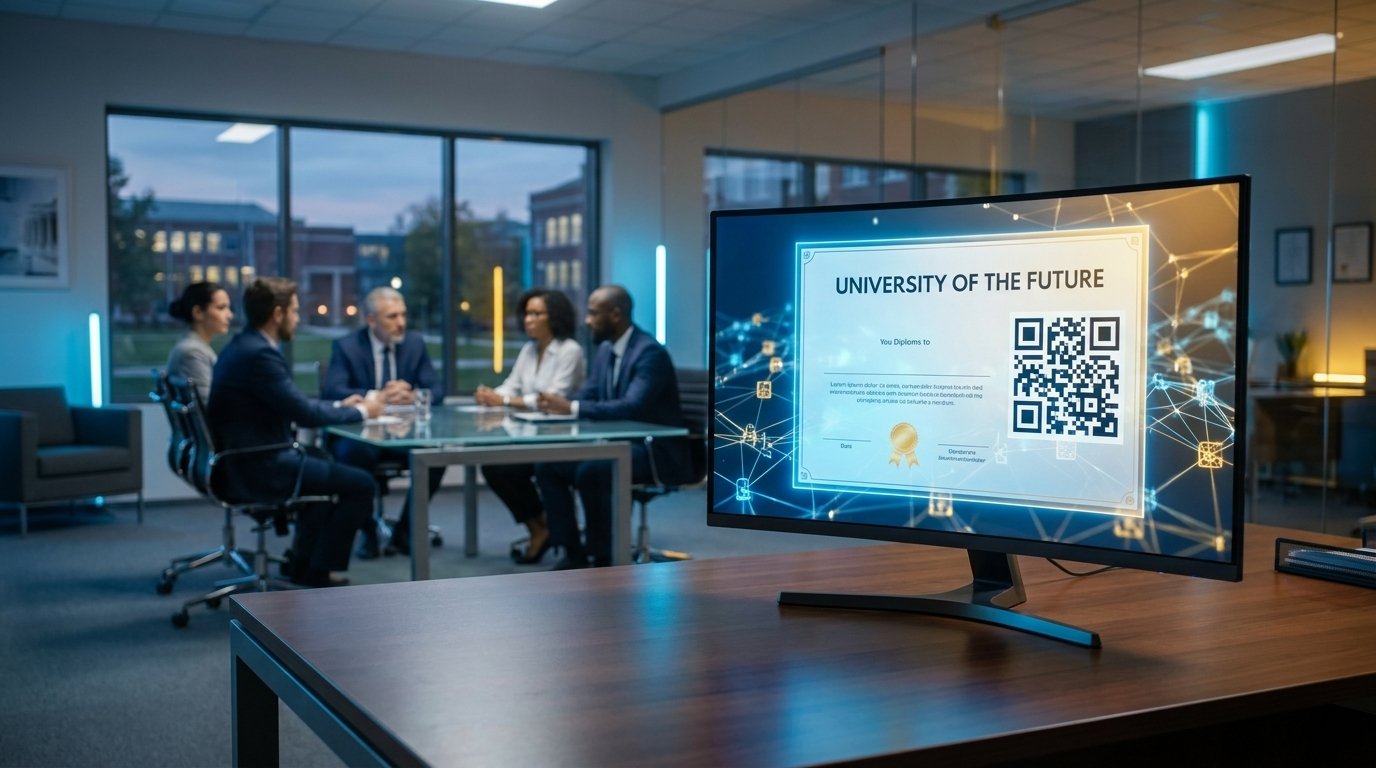
Diploma mills and credential fraud cost employers and academic institutions an estimated $1.2 billion annually worldwide, making the transition to blockchain certificate verification an urgent necessity for universities in 2026. As sophisticated digital forgeries become increasingly difficult to detect with the naked eye, academic registrars and higher education IT leaders are facing unprecedented pressure. May marks the peak of the global university graduation season, and relying on easily manipulated paper documents or standard PDFs is no longer sufficient to protect an institution's legacy. The modern academic landscape demands a cryptographic, immutable solution that provides absolute certainty to both graduates and their future employers.
In this comprehensive guide, our team at Vec.Digital leverages our deep expertise in educational technology to show you exactly how to protect your institution’s reputation. You will learn how to seamlessly deploy secure digital diplomas for universities, automate your mass issuance systems at scale, and empower global employers with instant authentication tools. By bridging the gap between advanced cryptographic security and user-friendly administrative processes, we will provide a clear roadmap for modernizing your credentialing strategy without requiring profound technical expertise.
Key Takeaways
- Blockchain certificate verification ensures absolute immutability against sophisticated digital forgeries, protecting institutional reputation.
- Issuing QR code certificates eliminates manual administrative bottlenecks for HR teams and academic registrars worldwide.
- Adopting verifiable digital credentials saves institutions tens of thousands in operational costs annually by removing printing and mailing logistics.
- A robust digital certificate maker allows seamless integration with existing student information systems for frictionless deployment.
- Using a bulk certificate generator streamlines graduation season, securely delivering thousands of credentials instantly to international students.
The Escalating Crisis of Academic Fraud in 2026
The integrity of global higher education is currently under siege by highly organized credential fraud networks. As the digital tools available to counterfeiters become more advanced, traditional methods of credentialing are failing to keep pace. For academic institutions, the stakes have never been higher. A university's reputation is its most valuable asset, and every forged diploma that enters the workforce dilutes the value of the legitimate degrees earned by hardworking students.
How Diploma Mills and Forgeries Threaten Institutional Reputation
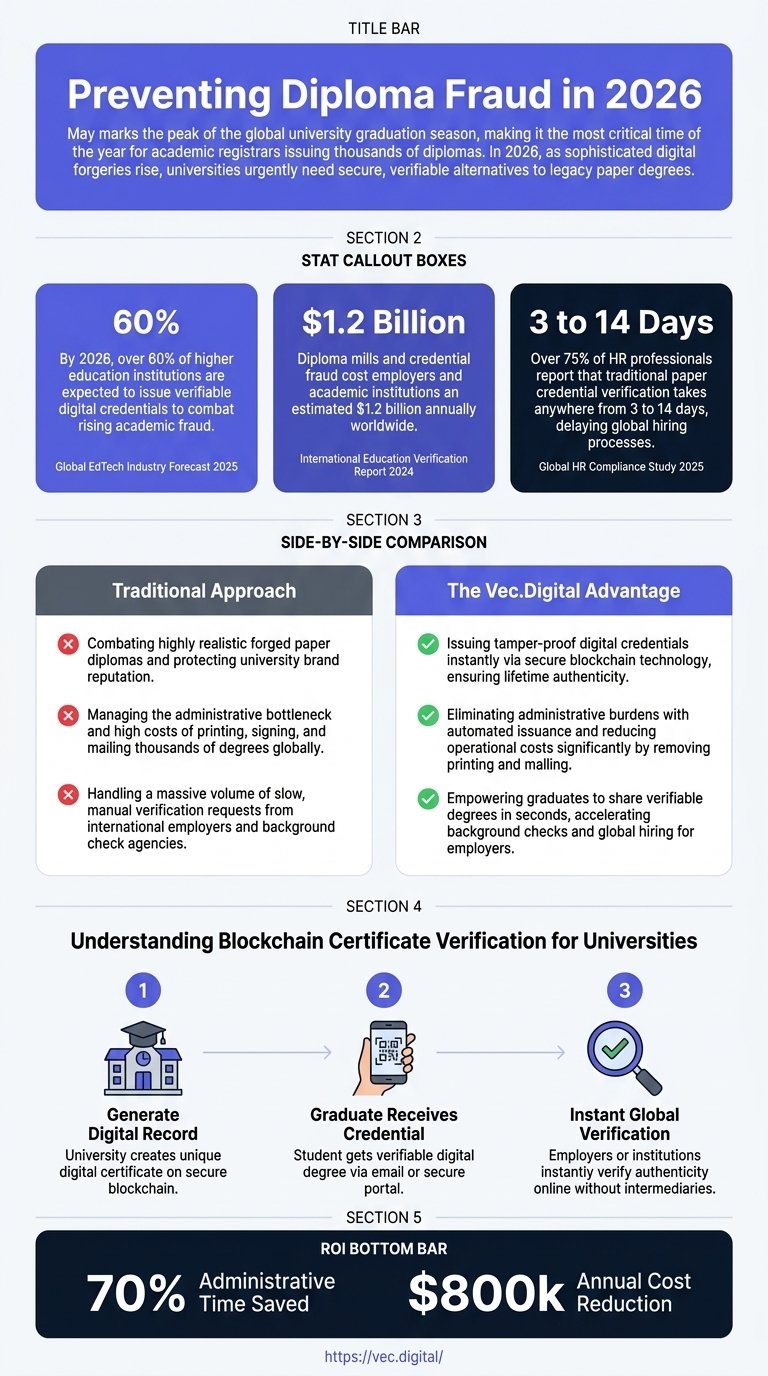
Combating highly realistic forged paper diplomas has become a full-time endeavor for many academic compliance departments. Today's counterfeiters use advanced graphic design software, high-end commercial printers, and even stolen institutional paper stock to create documents that are virtually indistinguishable from the real thing. According to the International Education Verification Report (2024), diploma mills and credential fraud cost employers and academic institutions an estimated $1.2 billion annually worldwide. This staggering financial loss is only part of the equation; the reputational damage suffered by a university when an unqualified individual uses a fake degree to secure a high-stakes position—such as in healthcare, engineering, or finance—can be catastrophic and irreversible.
The problem is exacerbated by the sheer volume of credentials issued globally. With millions of students graduating each year, the surface area for fraud is massive. Institutions are realizing that relying on physical security features like watermarks, embossed seals, or specialty inks is a losing battle. These features can be replicated, and more importantly, they offer no protection when a diploma is scanned and submitted digitally as a PDF—a format that is easily altered using basic editing software. The only definitive solution is a transition to verifiable digital credentials that rely on mathematics and cryptography rather than physical paper.
The Hidden Costs of Legacy Paper Degrees
Beyond the severe security vulnerabilities, managing the administrative bottleneck and high costs of printing, signing, and mailing thousands of degrees globally is an operational nightmare for university registrars. The traditional graduation process involves coordinating with commercial printing vendors, manually verifying student data against printed batches, securing physical signatures from university leadership, and navigating complex international postal logistics to deliver documents to overseas students.
This legacy process is not only slow and prone to human error, but it is also incredibly expensive. The financial burden of maintaining this outdated system drains resources that could be better spent on student services or academic research. Research indicates that transitioning to paperless digital diplomas saves the average university upwards of $40,000 annually in printing, mailing, and administrative overhead, according to the Sustainable Higher Education Index (2025). By digitizing this process, universities can instantly eliminate shipping delays, lost mail, and the continuous need to reprint damaged documents, all while providing a vastly superior experience for the graduating student.
Understanding Blockchain Certificate Verification for Universities
To effectively combat the sophisticated fraud landscape of 2026, academic institutions must look beyond simple digital PDFs and embrace cryptographic security. Blockchain technology, originally known for its financial applications, has proven to be the ultimate infrastructure for establishing digital trust and immutability in education.
How Does Blockchain Certificate Verification Work for Universities?
At its core, blockchain certificate verification works by creating an unalterable digital fingerprint of a student's academic achievement. When a university uses a modern digital credentialing platform to issue a diploma, the system extracts the critical data—such as the student's name, degree earned, graduation date, and institutional details. This data is then processed through a cryptographic algorithm to generate a unique string of characters known as a hash. You can learn more about the underlying mechanics of these algorithms through resources on Public-key cryptography.
This unique hash is then anchored, or recorded, onto a public blockchain network. The blockchain acts as a decentralized, global ledger that cannot be altered, deleted, or manipulated by any single party—not even the university itself or the platform vendor. When an employer or auditor wants to verify the diploma, the system automatically checks the digital document against the hash stored on the blockchain. If even a single pixel or letter on the digital diploma has been changed by a counterfeiter, the hashes will not match, and the verification will instantly fail. This process provides mathematical certainty that the document was issued by the claimed institution and has remained completely intact since the moment of issuance.
Are Digital Diplomas Secure from Hacking and Forgery?
A common question among academic IT directors is: Are digital diplomas secure from hacking and forgery? The answer is a resounding yes, provided they are anchored to a blockchain. Traditional digital diplomas (standard PDFs) are highly vulnerable; they can be easily hacked, edited, or replicated. However, a blockchain-anchored digital credential shifts the security paradigm entirely.
Because the blockchain is decentralized across thousands of independent nodes globally, there is no central database for a hacker to breach. To alter a record on the blockchain, a bad actor would have to simultaneously hack the majority of the computers on the global network—a computational feat that is practically impossible. Furthermore, the actual sensitive student data is not stored publicly on the blockchain; only the cryptographic hash is recorded. This ensures that universities remain fully compliant with stringent global data privacy regulations, such as GDPR and FERPA, while still providing irrefutable, public proof of authenticity. This dual layer of privacy and immutability makes secure digital diplomas for universities the gold standard in academic credentialing.
The Power of QR Code Certificates in Global Hiring
While the underlying blockchain technology provides the necessary security, the practical application of this technology must be user-friendly for it to be effective. The most secure diploma in the world is useless if an HR manager cannot easily verify it. This is where the integration of dynamic QR codes bridges the gap between complex cryptography and frictionless user experience.
How Do Employers Verify Digital University Degrees Online?
Historically, handling a massive volume of slow, manual verification requests from international employers and background check agencies has been a major pain point for university registrars. When a graduate applies for a job, the prospective employer must contact the university's records department via phone or email, await manual lookup in legacy databases, and wait for official confirmation. Over 75% of HR professionals report that traditional paper credential verification takes anywhere from 3 to 14 days, delaying global hiring processes, according to the Global HR Compliance Study (2025).
QR code certificates completely revolutionize this dynamic. When a university issues a digital diploma, a unique, scannable QR code is embedded directly onto the document's design. To verify the degree online, an employer simply scans the code using any standard smartphone camera. They are instantly routed to a dedicated, secure public verification page hosted by the credentialing platform. This page displays the verified issuer details, the recipient's information, the official signatory data, and a prominent "blockchain verified" badge. The entire authentication process takes less than three seconds, requires no special apps, and completely bypasses the university's administrative staff.
Can QR Code Certificates Be Faked or Duplicated?
Skeptics often ask: Can QR code certificates be faked or duplicated? While anyone can generate a generic QR code, the security lies in the destination and the cryptographic linkage. If a fraudster copies a legitimate QR code and places it on a fake diploma with a different name, scanning the code will still direct the employer to the original, legitimate verification page showing the real graduate's name. The discrepancy becomes immediately obvious to the employer.
Furthermore, if a counterfeiter attempts to create their own QR code pointing to a fake website, the URL will not match the official university's verification domain, and the blockchain validation check will fail to produce the cryptographic proof of anchoring. The system is entirely foolproof by design. The impact of this self-service verification model is profound. The adoption of QR code certificates in academic environments has reduced manual administrative verification requests by 85%, according to Digital Credentialing Insights (2026). This allows academic staff to reclaim thousands of hours previously lost to routine administrative tasks.
Implementing a Verifiable Digital Credentials System
Understanding the value of blockchain and QR technology is only the first step. For large-scale academic institutions, the primary challenge often lies in the implementation phase. Universities need systems that can handle massive throughput during peak graduation seasons without causing technical friction or requiring a complete overhaul of their existing IT infrastructure.
Overcoming Administrative Bottlenecks at Scale
Many institutions struggle with lacking an automated system to securely batch-generate and issue tamper-proof certificates at scale. Transitioning from legacy paper issuance to a modern digital system requires a robust engine capable of processing thousands of records simultaneously. This is where a specialized bulk certificate generator becomes indispensable.
Modern platforms allow university administrators to export graduate data from their existing Student Information Systems (SIS) or Learning Management Systems (LMS) into a simple CSV file. This file is then uploaded into the credentialing platform, which automatically maps the data fields—such as Student Name, Degree Program, and Honors—directly onto the approved institutional template. The system then automatically generates the unique QR codes, anchors the batch to the blockchain, and securely emails the digital diplomas to the students in a matter of minutes. For institutions with deeper technical resources, REST API integrations allow this entire process to run automatically in the background, triggering issuance the moment a student's graduation status is approved in the database.
What is the Best Digital Certificate Maker for Higher Education?
When evaluating solutions, academic leaders frequently ask: What is the best digital certificate maker for higher education? The ideal platform must balance enterprise-grade security with intuitive design capabilities. It should offer a drag-and-drop interface that allows the university's marketing or design teams to upload custom background imagery, exact brand colors, and high-resolution institutional logos. The platform must also support complex signatory approval processes, ensuring that a digital diploma is securely held in the system until the Dean or University President digitally signs off on the batch.
Furthermore, the best platforms operate with guaranteed high availability (such as a 99.98% uptime SLA) to ensure that graduates and employers can access and verify credentials 24/7, from any time zone in the world. The momentum toward these comprehensive solutions is accelerating rapidly. By 2026, over 60% of higher education institutions are expected to issue verifiable digital credentials to combat rising academic fraud, according to the Global EdTech Industry Forecast (2025). Institutions that fail to adopt these modern systems risk falling behind in both administrative efficiency and global technological standards.
Why Universities Are Switching to Digital Diplomas Globally
The transition to secure digital credentials is not merely a localized trend; it is a fundamental shift in global educational infrastructure. The forces driving this change extend far beyond basic fraud prevention, touching upon international workforce mobility and global environmental initiatives.
Why Are Universities Switching From Paper to Verifiable Digital Credentials?
With international student mobility at an all-time high in 2026, cross-border degree verification has become a major compliance hurdle. Graduates are increasingly seeking employment or pursuing further education in countries far from where they earned their initial degrees. When these individuals rely on physical paper, proving the authenticity of their achievements across borders involves expensive notarizations, apostilles, and weeks of waiting for international mail.
Verifiable digital credentials eliminate these geographical barriers instantly. A digital diploma issued in Dubai can be instantly authenticated by an employer in London, a university admissions office in Tokyo, or an immigration official in Toronto. Recognizing this incredible efficiency, governmental bodies across the European Union and various Asian educational ministries are heavily pushing for standardized, verifiable digital credentials. These initiatives aim to streamline global hiring, facilitate seamless academic transfers between international institutions, and create a more fluid, frictionless global workforce.
Meeting UN Sustainability Goals and Supporting Student Mobility
In addition to operational efficiency, the shift to paperless certification aligns perfectly with global environmental targets. Universities are massive consumers of paper, ink, and carbon-heavy postal logistics. By eliminating the physical production and worldwide shipping of hundreds of thousands of diplomas annually, institutions can drastically reduce their carbon footprint.
This digital transformation directly supports several Sustainable Development Goals (SDGs) set by the United Nations, particularly those focused on responsible consumption and climate action. For modern universities, adopting an eco-friendly, cloud-based certification system is not just an IT upgrade; it is a demonstrable commitment to sustainability that resonates deeply with the values of the incoming generation of students. It provides a narrative of forward-thinking leadership, showcasing an institution that is actively reducing waste while simultaneously upgrading the security and utility of its academic awards.
Secure Your Institution's Future with Vec.Digital
The era of relying on vulnerable paper documents and easily manipulated PDFs is coming to a close. As academic fraud grows more sophisticated and global employers demand faster, more reliable verification methods, universities must adapt to protect their most valuable asset: their reputation. By embracing blockchain certificate verification and dynamic QR technology, your institution can eradicate credential fraud, eliminate costly administrative bottlenecks, and empower your graduates with modern, instantly verifiable proof of their hard-earned achievements.
At Vec.Digital, we provide the comprehensive infrastructure necessary to make this digital transformation effortless. Our all-in-one platform combines an intuitive digital certificate maker with an automated mass issuance engine and immutable blockchain security. We enable universities, colleges, and enterprise organizations worldwide to design, manage, and authenticate credentials at scale with absolute confidence.
Don't let legacy processes leave your institution vulnerable to fraud and inefficiency. Protect your academic legacy and streamline your graduation operations today.
Start issuing verifiable certificates in minutes.
Visit our website: https://vec.digital/
Contact our Happiness Centre: support@vec.digital