
Preventing Diploma Fraud in 2026: The University Guide to Blockchain Certificate Verification
Published on May 26, 2026
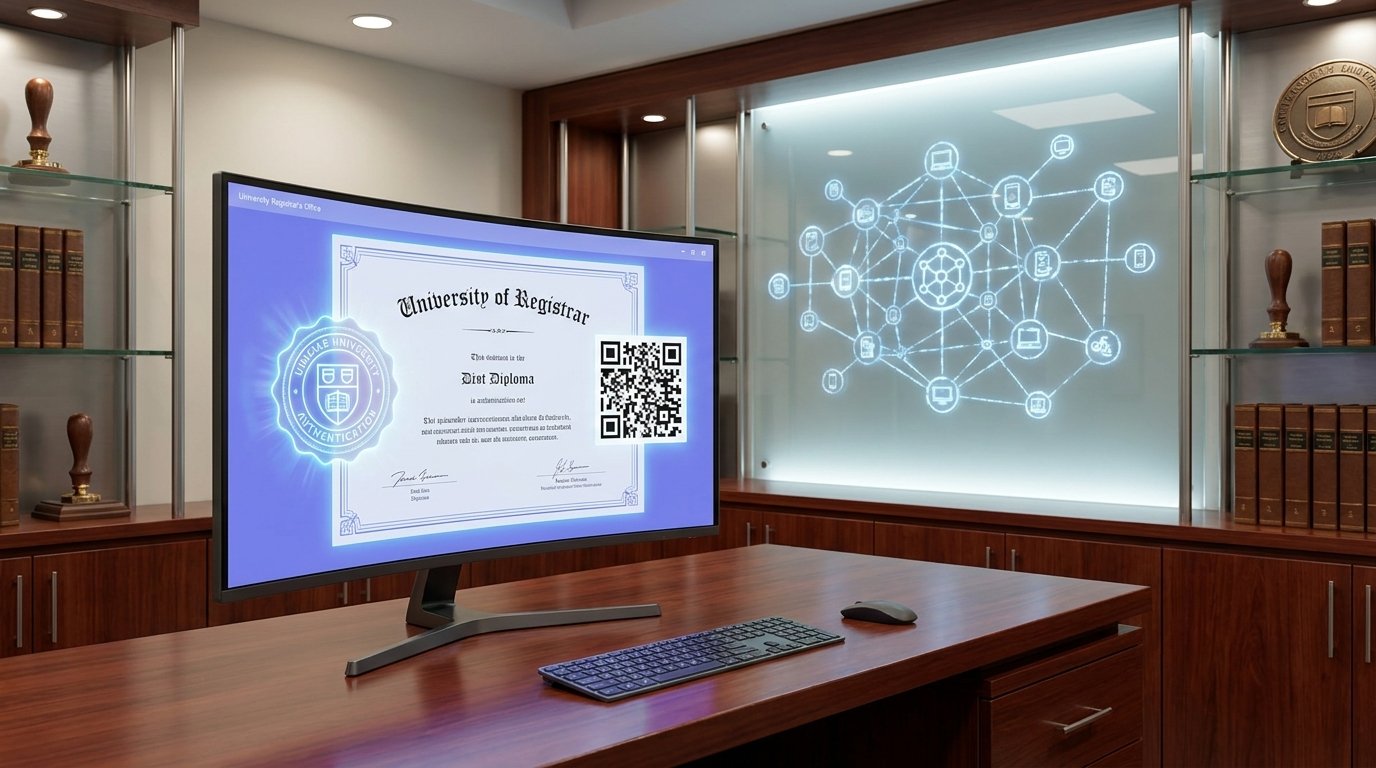
Over 2 million fake degrees are purchased globally each year, fueling a multi-billion dollar illicit industry that threatens the foundational trust of higher education. To combat this escalating crisis, academic institutions are rapidly adopting blockchain certificate verification as an immutable shield against sophisticated academic forgery. Securing your institution's legacy now requires transitioning from easily manipulated paper documents to universally trusted, instantly verifiable digital records.
In this comprehensive guide, we leverage our deep expertise in educational technology at Vec.Digital to provide a practical, non-technical blueprint for modernizing your credentialing systems. You will learn how to seamlessly automate bulk issuance, drastically reduce administrative overhead, and empower global employers to authenticate your graduates' achievements instantly without the need for specialized software.
Key Takeaways
- Blockchain certificate verification completely neutralizes the threat of AI-generated diploma forgery by creating an immutable, tamper-proof digital record.
- Universities can cut administrative costs by up to 70% by transitioning to secure digital diplomas for universities instead of relying on physical printing and shipping.
- Implementing a bulk certificate generator allows academic registrars to issue thousands of credentials instantly via automated CSV uploads.
- QR code certificates empower employers to authenticate academic achievements in seconds, eliminating the traditional 3-to-5-day manual verification delay.
- Adopting verifiable digital credentials aligns institutions with global sustainability mandates by drastically reducing paper waste and carbon footprints.
The Escalating Crisis of Academic Credential Fraud
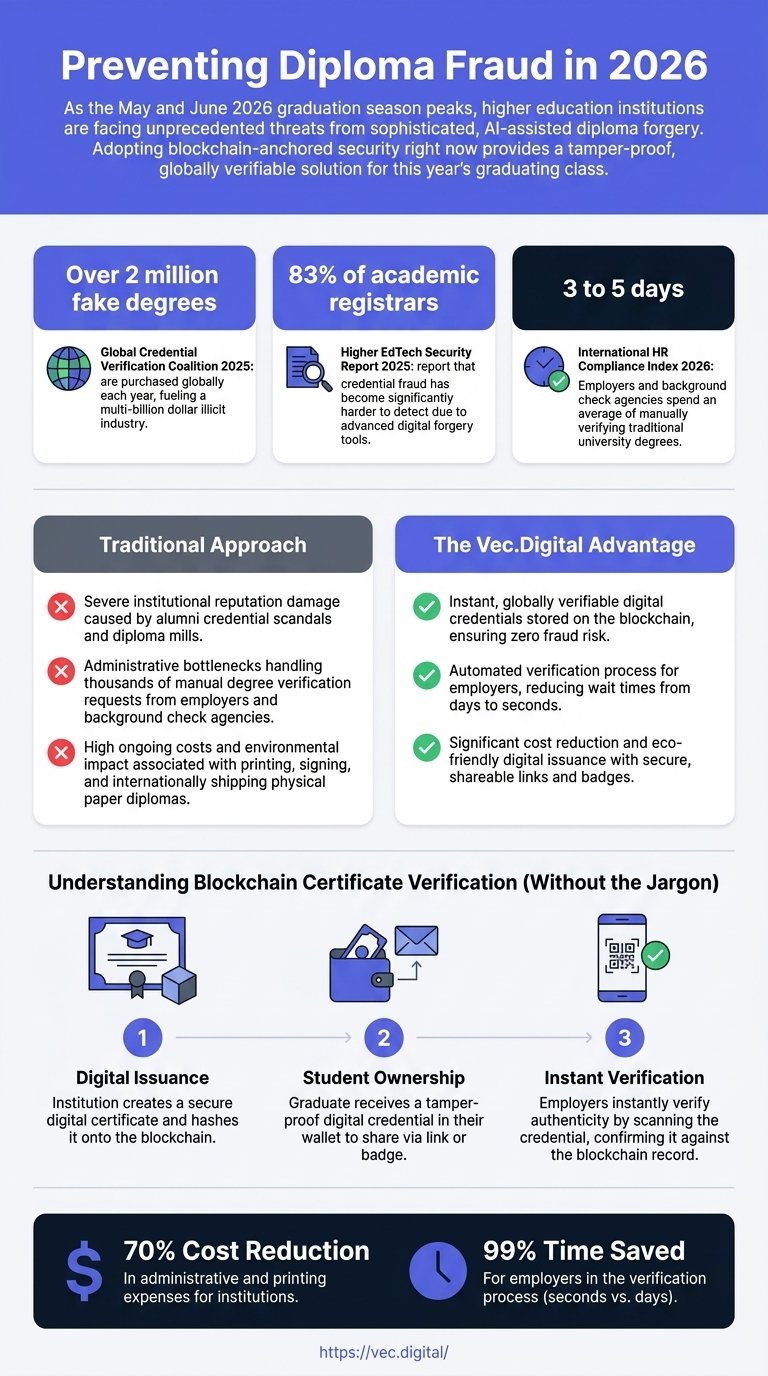
The landscape of higher education is currently facing an unprecedented challenge. As we approach the graduation seasons of the coming years, the sheer volume of counterfeit academic documents is staggering. Over 2 million fake degrees are purchased globally each year, fueling a multi-billion dollar illicit industry, according to the Global Credential Verification Coalition (2025). This black market not only devalues the hard work of legitimate students but also poses severe risks to employers who unknowingly hire unqualified candidates for critical roles.
For universities, the stakes have never been higher. Institutional reputation is the most valuable asset an academic organization possesses. When a high-profile corporate scandal reveals that an executive lied about their degree from a prestigious university, the resulting media fallout inevitably damages the institution's brand equity. To preserve their standing on the global stage, universities must adopt blockchain certificate verification to ensure that every diploma bearing their seal is absolute and irrefutable.
The traditional methods of securing paper diplomas—such as watermarks, embossed seals, and specialized parchment—are no longer sufficient. We are operating in a digital-first global economy where physical documents are frequently scanned, altered, and transmitted as PDFs. The defense mechanisms of the past century cannot withstand the technological threats of today.
How AI is Fueling Sophisticated Diploma Forgeries
The rapid advancement of artificial intelligence and high-fidelity graphic design tools has democratized the ability to create convincing counterfeit documents. In the past, forging a university degree required specialized printing equipment and physical craftsmanship. Today, sophisticated software can replicate complex university seals, replicate authorized signatures, and perfectly match institutional typography in a matter of minutes.
This technological shift has created a nightmare scenario for academic registrars. In fact, 83% of academic registrars report that credential fraud has become significantly harder to detect due to advanced digital forgery tools, as highlighted by the Higher EdTech Security Report (2025). These AI-generated counterfeits are often so precise that they easily bypass standard visual inspections conducted by human resources departments.
As diploma mills and online forgery services become more accessible, the volume of fraudulent documents entering the job market is accelerating. Universities can no longer rely on visual authenticity; they must transition to cryptographic authenticity. By anchoring credentials to an immutable digital ledger, institutions remove the human element from verification, making it mathematically impossible for a forged document to pass as legitimate.
The Hidden Costs of Reputation Damage and Manual Verification
Beyond the existential threat to institutional reputation, the reliance on traditional paper degrees creates massive operational bottlenecks. When an alumnus applies for a job, the prospective employer or their background check agency must verify the candidate's educational background. This process typically involves contacting the university's registrar office via phone or email, submitting formal requests, and waiting for manual database checks.
The inefficiency of this system is staggering. Employers and background check agencies spend an average of 3 to 5 days manually verifying traditional university degrees, according to the International HR Compliance Index (2026). This delay creates friction in the hiring process, frustrating both employers and alumni who may lose out on competitive job offers due to administrative lag.
For the universities themselves, managing thousands of manual verification requests requires dedicated staff, resulting in significant overhead costs. By implementing a modern digital credentialing system, universities can entirely automate the verification process. This shift not only eliminates the administrative burden on registrar offices but also provides a vastly superior experience for alumni entering the global workforce.
Understanding Blockchain Certificate Verification (Without the Jargon)
When academic administrators research solutions for document security, they are often overwhelmed by dense cryptocurrency terminology and abstract cryptographic concepts. However, understanding blockchain certificate verification does not require a degree in computer science. At its core, blockchain is simply a highly secure, decentralized digital ledger that records information in a way that makes it virtually impossible to change, hack, or cheat the system.
Think of it as a digital notary public that is universally recognized and never sleeps. When a university issues a diploma, the automated system generates a unique digital fingerprint (a cryptographic hash) of that specific document. This fingerprint is permanently recorded on the blockchain. If a fraudster attempts to alter even a single pixel or letter on the digital diploma, the fingerprint changes entirely, instantly flagging the document as fraudulent.
This approach provides a practical, non-technical blueprint for academic administrators to secure their graduates' futures. By utilizing this technology, universities can issue secure digital diplomas for universities that carry the same weight and trust as their physical counterparts, but with mathematical proof of authenticity that can be verified by anyone, anywhere in the world.
How Does Blockchain Certificate Verification Work for Universities?
The process of utilizing blockchain for academic credentials is surprisingly straightforward for the end-user. First, the university designs their official diploma using a digital certificate maker, ensuring all institutional branding is perfectly represented. The registrar's office then uploads the graduation data—such as student names, degree types, and graduation dates—into the secure platform.
Upon issuance, the system automatically processes this data. It issues the digital credential to the student while simultaneously anchoring the cryptographic proof of that credential to a public blockchain. The student receives a secure link to their digital locker, where they can view, download, or share their achievement on professional networks like LinkedIn.
When an employer wishes to verify the diploma, they simply click a link or scan a QR code provided by the student. The system checks the document's current digital fingerprint against the immutable record stored on the blockchain. If they match perfectly, the employer sees a "verified" badge, confirming the issuer's identity, the recipient's details, and the exact date of issuance. To learn more about the underlying public-key cryptography that makes this possible, universities can explore global cybersecurity standards.
What is the Most Secure Way to Issue Digital Credentials?
The most secure way to issue digital credentials is through a multi-layered approach that combines access control, cryptographic anchoring, and instant visual authentication. A standalone PDF is inherently insecure, as it can be edited using basic software. Similarly, a simple web page displaying a certificate can be easily spoofed by a fraudster registering a fake domain name that looks similar to the university's official site.
True security requires verifiable digital credentials. This means the credential must be inextricably linked to the issuing institution's verified digital identity. When a university uses a platform like Vec.Digital, every issued certificate is digitally signed by the institution's authorized personnel before being anchored to the blockchain.
Furthermore, the system must support revocation. If a degree is rescinded due to academic misconduct, the university registrar must have the power to instantly revoke the credential's validity. Because the verification page queries the live blockchain status, any employer checking a revoked degree will immediately see that it is no longer valid, closing the loop on credential security.
Can a Blockchain-Anchored Certificate Be Forged or Hacked?
A common question among academic IT directors is whether a blockchain-anchored certificate can be forged or hacked. The definitive answer is no, provided the underlying architecture follows established cryptographic protocols. Because blockchains are decentralized across thousands of global nodes, a hacker would need to simultaneously compromise the majority of the network's computers to alter a single record—a feat that is computationally and economically unfeasible.
If a fraudster attempts to create a fake digital diploma and claims it is from your university, they will not possess your institution's private cryptographic keys. Therefore, their fake document cannot be anchored to your official institutional identity on the blockchain. When an employer attempts to verify the fraudster's document, the system will immediately reject it as unverified.
This level of immutability provides absolute peace of mind. It shifts the burden of trust from the physical document to the underlying mathematics. Universities can confidently issue credentials knowing that their institutional integrity is protected by state-of-the-art security that outpaces even the most sophisticated forgery attempts.
The Practical Blueprint: How to Issue Verifiable Digital Certificates at Scale
Understanding the theory behind credential security is only half the battle; the real challenge for universities lies in operational execution. Transitioning an entire graduating class from paper to digital requires a system that is robust, user-friendly, and capable of handling massive volumes of data without faltering. The goal is not just to increase security, but to streamline the administrative automated process.
Traditional issuance involves coordinating with printing vendors, manually signing thousands of documents, stuffing envelopes, and managing international postage. This legacy approach is fraught with human error, delays, and exorbitant costs. By adopting a modern platform, universities can condense a process that used to take weeks into a matter of minutes.
A comprehensive bulk certificate generator is the engine that drives this transformation. It allows cross-functional teams within the university—from the registrar's office to academic deans—to collaborate securely in a unified workspace. By defining specific roles and permissions, institutions can ensure that only authorized personnel have the power to approve and publish official academic records.
Automating the Issuance Process with a Bulk Certificate Generator
The administrative burden of a graduation season can overwhelm even the most well-staffed university departments. Utilizing a bulk certificate generator completely revolutionizes this automated process. Instead of manually entering data for thousands of students, administrators can securely upload a single CSV file containing all recipient details, degree classifications, and graduation honors.
The system's dynamic fields automatically map the data from the CSV to the corresponding placeholders on the certificate template. This ensures perfect accuracy and personalization for every single graduate, eliminating the risk of spelling errors or mismatched degree titles that frequently plague manual data entry.
Once the data is uploaded and mapped, the automated system handles the rest. It generates the high-resolution digital documents, anchors them to the blockchain, and automatically dispatches secure delivery emails to the students. What once required a dedicated team working overtime for weeks can now be accomplished by a single administrator in under ten minutes.
Designing Secure Digital Diplomas for Universities
A digital diploma must carry the same gravitas and visual prestige as a traditional parchment document. It is a representation of years of hard work and academic dedication. Therefore, the design capabilities of your credentialing platform are just as important as its security features. Universities must retain complete control over their brand identity.
Using an intuitive digital certificate maker, institutions can upload their custom background designs, official high-resolution logos, and authorized signatory graphics. The platform should support hundreds of professional fonts to perfectly match the university's established typographic standards. The drag-and-drop interface allows administrators to position dynamic text fields, signatory blocks, and the mandatory verification components with pixel-perfect precision.
Crucially, the design process seamlessly integrates the security elements. The platform automatically embeds the unique verification QR code and the blockchain authentication badge into the layout. This ensures that the final product is not only visually stunning but fundamentally secure, offering a flawless blend of tradition and modern technology.
How to Issue Verifiable Digital Certificates
For academic registrars wondering exactly how to issue verifiable digital certificates, the procedure is designed to be entirely frictionless. The journey begins in the template builder, where the visual foundation of the diploma is established and approved by university leadership. Once the template is locked, it becomes the standardized format for that specific degree program.
Next, the data integration phase occurs. For smaller cohorts, administrators can use manual web forms to issue credentials individually. For large graduating classes, the CSV bulk upload is the standard method. Enterprise-level universities can even utilize REST API integrations to connect the credentialing platform directly to their existing Student Information Systems (SIS) or Learning Management Systems (LMS), enabling fully automated, programmatic issuance upon course completion.
Finally, the signatory workflow ensures academic compliance. The system can hold the generated certificates securely until the required academic deans or the university president digitally signs and approves the batch. Once approved, the credentials are instantly published to the blockchain and delivered to the eager graduates, ready to be showcased to the world.
Empowering Employers with QR Code Certificates and Instant Authentication
The ultimate value of an academic degree lies in its recognition by the global job market. If a digital diploma is difficult for an employer to verify, it loses its utility, regardless of how secure the underlying technology might be. The solution to this challenge is the integration of instant, universally accessible verification mechanisms directly onto the credential itself.
This is where QR code certificates revolutionize the hiring process. By bridging the gap between the visual document and the digital verification ledger, QR codes provide a frictionless experience for human resources professionals. They remove the need for proprietary software, account registrations, or complex verification portals.
When universities prioritize the employer's experience, they inherently boost the value of their alumni's degrees. A credential that can be trusted instantly is far more valuable in a fast-paced corporate hiring environment than one that requires weeks of manual background checks and administrative back-and-forth.
How Do QR Code Certificates Prevent Diploma Fraud?
The mechanics of how QR code certificates prevent diploma fraud are elegantly simple yet cryptographically robust. Every single certificate generated by the platform features a completely unique, dynamic QR code embedded directly into its design. This code cannot be copied and pasted onto a fake document because it acts as a direct, encrypted gateway to that specific credential's immutable blockchain record.
If a fraudster attempts to create a fake diploma and places a random QR code on it, scanning that code will either lead to a dead link or a completely different, legitimate record that clearly does not match the fraudster's details. The visual information on the document must perfectly align with the data hosted on the secure public verification page.
This system completely neutralizes visual forgery. Even if a counterfeiter perfectly replicates the university's seal, the signature of the dean, and the exact typography, they cannot replicate the cryptographic truth hidden within the QR code. The moment the code is scanned, the fraud is instantly exposed.
How Can You Check if a University Degree is Fake?
For hiring managers and compliance officers, knowing how to check if a university degree is fake has traditionally been a complex, multi-step process. With verifiable digital credentials, this automated process is reduced to a single action: scanning the QR code with any standard smartphone camera or clicking the unique verification URL provided by the candidate.
Upon scanning, the verifier is immediately routed to a dedicated, secure public verification page hosted by the credentialing platform. This page displays the irrefutable details of the achievement: the issuing university's verified identity, the recipient's full name, the specific degree awarded, the date of issuance, and the status of the authorized signatories.
Most importantly, the verification page queries the blockchain in real-time. It prominently displays a "blockchain verified" badge, confirming that the digital fingerprint of the document remains mathematically intact and that the credential has not been revoked by the university. If the page does not load, or if the details do not match the candidate's resume exactly, the employer knows instantly that the document is illegitimate.
Are Digital Diplomas Legally Recognized by Employers?
A frequent concern among students is whether digital diplomas are legally recognized by employers. The global corporate landscape has overwhelmingly embraced digital transformation, and verifiable digital credentials are now considered the gold standard for HR compliance and background checks. In many ways, they are trusted more than physical paper because their authenticity can be mathematically proven.
Major multinational corporations, government agencies, and international background check firms actively prefer digital credentials. They significantly reduce the liability and costs associated with hiring fraud. By providing instant, irrefutable proof of education, digital diplomas accelerate the onboarding process, allowing candidates to secure their positions faster.
Furthermore, institutions offering instantly verifiable digital records see a 15% increase in alumni satisfaction due to easier job application processes, according to the Digital Learner Experience Survey (2025). When universities provide their graduates with modern tools to prove their worth, the graduates experience less friction in their career advancement, reflecting positively on the institution.
Global Mobility and the Push for Sustainable Paperless Credentials
The transition to digital credentialing is not solely driven by security concerns; it is also a vital component of a broader global movement towards sustainability and international workforce mobility. As the world becomes increasingly interconnected, the limitations of physical paper documents become glaringly apparent. A paper diploma issued in one country can be incredibly difficult, expensive, and slow to verify in another.
The global push for digital transformation in education has accelerated rapidly. Initiatives like the European Digital Identity Framework are actively encouraging universities to adopt paperless, borderless, and instantly verifiable academic credentials. These frameworks recognize that the future of work requires a seamless, secure flow of trusted information across international borders.
By adopting a modern credentialing system, universities position themselves at the forefront of this global shift. They demonstrate to their international student body and global academic partners that they are forward-thinking, environmentally responsible, and dedicated to providing credentials that hold universal value.
Aligning with UN Sustainability Goals
The environmental impact of traditional academic credentialing is immense. The process requires cutting down trees for specialized parchment, utilizing toxic printing inks, and relying on global aviation and postal networks to ship heavy cardboard tubes around the world. This legacy model is fundamentally incompatible with modern environmental standards.
Transitioning to verifiable digital credentials aligns universities with the UN sustainability mandates, specifically goals related to responsible consumption and climate action. By eliminating the need for physical printing and international shipping, academic institutions can drastically reduce their carbon footprints and demonstrate real-world environmental stewardship.
The financial benefits of this sustainable shift are equally compelling. Transitioning to verifiable digital credentials reduces university administrative issuance and mailing costs by up to 70%, as documented by the Journal of University Administration (2024). These massive cost savings can be reallocated toward core academic programs, student services, or further technological innovations.
Facilitating International Workforce Mobility
In today's globalized economy, graduates frequently seek employment across international borders. A student may earn their degree in the United Kingdom, apply for a corporate role in the United Arab Emirates, and require background verification from an agency based in the United States. Traditional paper diplomas create massive friction in this scenario, often requiring expensive notarization and physical international mailing.
Verifiable digital credentials eliminate these borders entirely. Because the blockchain is a globally accessible, decentralized network, an employer in Dubai can verify a diploma issued by a university in London instantly, with absolute certainty. The digital locker format allows graduates to carry their entire academic history in their pocket, accessible from any smartphone.
Furthermore, the ability to instantly share these verified credentials on professional networks like LinkedIn allows graduates to showcase their achievements to a global audience of recruiters. This seamless international mobility is exactly what modern students demand from their educational investments, making digital credentialing a powerful competitive advantage for forward-thinking universities.
Secure Your Institution’s Legacy with Vec.Digital
The era of easily forged, expensive, and environmentally damaging paper diplomas is rapidly coming to an end. As sophisticated AI tools make traditional counterfeits harder to detect, universities must take decisive action to protect their institutional reputation and empower their graduates. By embracing blockchain certificate verification, academic organizations can eradicate credential fraud, streamline their administrative operations, and provide a superior, globally recognized experience for their alumni.
At Vec.Digital, our comprehensive platform is engineered to make this transition effortless. We provide the robust tools you need to design stunning academic awards, automate bulk issuance, and anchor every document to an immutable ledger with our guaranteed 99.98% uptime SLA. Do not leave your institution's legacy vulnerable to the rising tide of academic fraud.
Ready to modernize your university's credentialing system and issue universally trusted digital diplomas? Partner with our team of experts today.
Website: https://vec.digital/
Email: support@vec.digital