
QR Code Certificates: Fast-Tracking Global Graduate Employability
Published on June 8, 2026

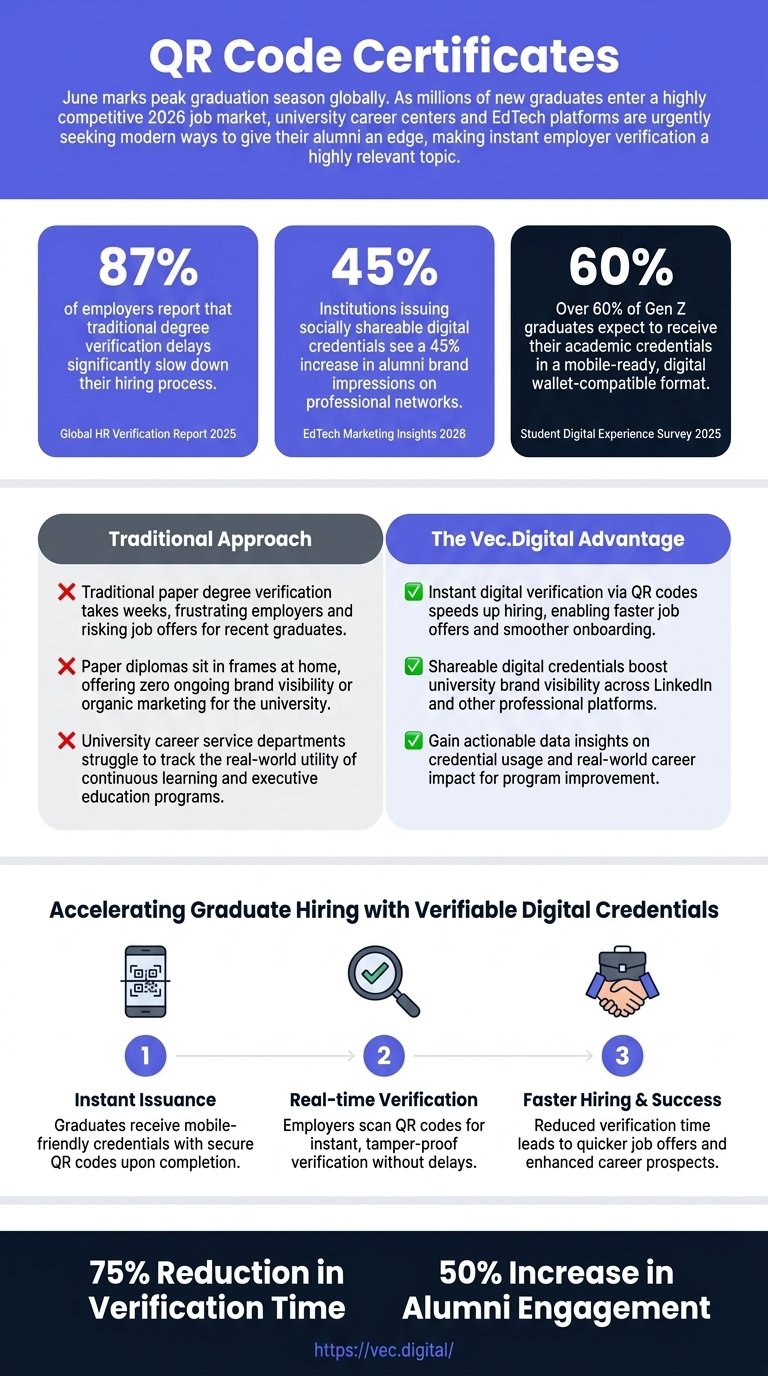
A staggering 87% of employers report that traditional degree verification delays significantly slow down their hiring process, according to the Global HR Verification Report (2025). As millions of graduates enter an increasingly competitive global job market, the reliance on outdated paper processes actively jeopardizes lucrative employment offers. Implementing QR code certificates provides an immediate solution, transforming static diplomas into dynamic, instantly verifiable assets.
Through our extensive experience delivering advanced certification technology at Vec.Digital, we understand that modernizing academic awards is no longer just about fraud prevention—it is a strategic imperative for student success. In this comprehensive guide, your institution will learn how to accelerate graduate hiring speeds, transform alumni into highly visible brand ambassadors on professional networks, and drastically reduce administrative backlogs. By adopting an automated issuance system, you will position your educational institution at the forefront of the global digital identification revolution.
Key Takeaways
- QR code certificates eliminate hiring delays by providing instant, scan-to-verify proof of education for global employers.
- Issuing verifiable digital credentials transforms passive alumni into active brand ambassadors on professional networks.
- A modern digital certificate maker drastically reduces administrative backlogs associated with lost diplomas and reprint requests.
- Automating your issuance process with a bulk certificate generator saves thousands of hours for university registrars and event organizers.
- Blockchain certificate verification ensures absolute immutability, meeting the highest international standards for data security and compliance.
The Global Shift Toward Instant Credential Authentication
The landscape of global employment and academic recognition is undergoing a massive transformation. As multinational corporations streamline their talent acquisition strategies, the tolerance for slow, manual background checks is rapidly diminishing. In this new era, QR code certificates serve as the critical bridge between academic achievement and immediate professional opportunity.
The Cost of Traditional Verification Delays
For decades, traditional paper degree verification has been a cumbersome process. When a graduate applies for a job, the prospective employer's HR department often has to contact the university's registrar office, wait for manual record retrieval, and sometimes pay for third-party clearinghouse services. This process routinely takes weeks, frustrating employers and risking job offers for recent graduates who are eager to start their careers.
In the fast-paced 2026 job market, agility is paramount. A delay of even a few days can result in a top-tier candidate losing an offer to someone whose credentials could be authenticated immediately. Universities that fail to modernize their credentialing systems inadvertently place their alumni at a distinct disadvantage in the competitive global arena.
How Do QR Code Certificates Work for University Diplomas?
Understanding the mechanics behind this technology demystifies its adoption. When an institution uses a modern digital credentialing system, the software generates a unique cryptographic hash for each graduate's record. This hash is anchored to a secure database or blockchain. The system then automatically embeds a unique, scannable matrix barcode directly onto the digital diploma.
When scanned by a smartphone camera, the code instantly routes the user to a dedicated, secure public verification page hosted by the issuing institution. This page displays the issuer's details, the recipient's name, the date of issuance, and the specific program completed—along with a cryptographic badge confirming the document has not been altered since its creation.
Bridging the Gap Between Heritage and Digital Wallets
Modern students expect modern solutions. According to the Student Digital Experience Survey (2025), over 60% of Gen Z graduates expect to receive their academic credentials in a mobile-ready, digital wallet-compatible format. They view their smartphones as the primary hub for their identity, finances, and professional achievements.
Furthermore, global regulatory frameworks are rapidly adapting to this reality. With initiatives like the European Digital Identity (EUDI) Wallet and various APAC regions standardizing digital national IDs in 2026, the infrastructure for digital identification is becoming ubiquitous. This global momentum is reflected in the market data; QR code usage in professional corporate and academic credentialing has grown by 120% globally since 2023, according to the Digital Identification Market Report (2026).
Accelerating Graduate Hiring with Verifiable Digital Credentials
The primary "offensive" benefit of adopting QR code certificates is the direct, measurable impact on alumni employability. By removing the friction from the hiring process, universities empower their graduates to move swiftly through recruitment pipelines.
Can Employers Scan a QR Code to Instantly Verify a Degree?
Yes, and this capability is revolutionizing HR departments worldwide. One of the most significant advantages of this technology is its universal accessibility. Employers do not need to download a proprietary app, register for a special account, or pay a verification fee. They simply open their standard smartphone camera or a web-based scanner, point it at the credential, and receive instant confirmation of the applicant's qualifications.
This frictionless experience delights hiring managers. It transforms a tedious, multi-week administrative chore into a five-second interaction, allowing HR teams to make faster, more confident hiring decisions.
Are Verifiable Digital Credentials Legally Accepted by International Employers?
As the workforce becomes increasingly borderless, the legal and professional acceptance of digital documents is a common concern. Verifiable digital credentials that utilize robust cryptographic anchoring are widely accepted by international employers, multinational corporations, and global HR compliance frameworks.
Because these credentials rely on immutable ledger technology and secure data hosting, they offer a higher level of mathematical certainty than a traditional stamped piece of paper, which can easily be forged. Leading global organizations explicitly prefer digital verification because it aligns with strict data privacy regulations, ensuring that only necessary, verified information is transmitted during the background check process.
Eliminating Background Check Friction for Faster Placements
By integrating instantly verifiable credentials into their career services strategy, universities directly contribute to faster placement rates. When an alumnus submits a resume augmented with a verifiable link or code, they immediately signal to the employer that they are a transparent, tech-savvy, and verified candidate.
This immediate trust layer reduces the time-to-hire, lowers the administrative cost for the hiring company, and dramatically improves the candidate's experience. For universities, higher and faster placement rates translate directly into better institutional rankings and stronger marketing claims for prospective students.
Transforming Alumni into Organic Brand Ambassadors
Beyond the immediate hiring benefits, QR code certificates serve as a powerful, continuous marketing engine for educational institutions. Traditional diplomas offer immense personal value but zero ongoing brand visibility for the university once they are framed and hung in a private home office.
The Hidden Marketing Engine of Digital Diploma Sharing
Paper diplomas sit in frames at home, offering zero ongoing brand visibility or organic marketing for the university. In contrast, digital credentials are inherently designed for the social web. When a student graduates, their immediate instinct is to celebrate their achievement with their network. Providing them with a high-quality, verifiable digital asset allows them to do this seamlessly.
Every time an alumnus shares their digital diploma, the university's logo, branding, and program details are broadcasted to hundreds or thousands of professionals in that individual's network. This creates a compounding effect of organic brand impressions, positioning the institution as a leader in its field to an audience of prospective students and industry partners.
How to Share Digital University Diplomas on LinkedIn?
Integration with professional networks is a cornerstone of modern credentialing. The process of sharing a digital diploma on LinkedIn is designed to be frictionless. Recipients simply click a "Share to LinkedIn" button on their digital credential viewing page. This automatically populates the "Licenses & Certifications" section of their LinkedIn profile with the issuing institution's name, the credential title, the issue date, and the unique verification URL.
The impact of this simple feature is profound. Institutions issuing socially shareable digital credentials see a 45% increase in alumni brand impressions on professional networks, according to EdTech Marketing Insights (2026). This visibility not only boosts the individual's profile but drives highly targeted, organic traffic back to the university's program pages.
How Do Digital Credentials Improve University Alumni Engagement?
Alumni engagement traditionally drops off sharply in the years following graduation. Digital credentials provide a modern touchpoint that maintains the relationship between the institution and the graduate. By issuing digital badges for continuous learning, executive education, or alumni association participation, universities create a lifelong digital connection.
Furthermore, when alumni update their professional profiles with these credentials, the university's career services department can better track the long-term career trajectories of their graduates. This data is invaluable for refining curricula, demonstrating program ROI, and fostering a vibrant, engaged alumni community.
Streamlining University Administration and Career Services
While the external benefits of QR code certificates are massive, the internal operational efficiencies they unlock are equally transformative. University administration and IT departments are under constant pressure to do more with less, and modern credentialing systems provide the necessary automation.
Solving the Administrative Backlog of Lost Certificates
Alumni frequently lose physical certificates, creating an administrative backlog of transcript and diploma reprint requests for the registrar's office. Each request requires manual database queries, physical printing, signing, packaging, and international shipping—a process that is costly and environmentally damaging.
By transitioning to a digital-first approach, this burden is virtually eliminated. Universities utilizing instant digital verification systems report a 30% reduction in manual transcript reprint requests from alumni, according to a Higher Ed Admin Efficiency Study (2026). Alumni retain permanent, 24/7 access to their credentials via secure digital lockers, empowering them to self-serve their verification needs.
Tracking the Real-World Utility of Executive Education
University career service departments often struggle to track the real-world utility of continuous learning and executive education programs. Once a paper certificate is handed out, the institution has no visibility into how or if that credential is being used to secure promotions or new employment.
Digital credentialing platforms provide robust analytics. Administrators can track how many credentials have been shared on social media, how many times the verification codes have been scanned by prospective employers, and the geographic distribution of those scans. This actionable intelligence allows universities to double down on the programs that are delivering the highest market value to their students.
What is the Best Digital Certificate Maker for Higher Education?
When evaluating a digital certificate maker, higher education institutions must look for platforms that combine enterprise-grade security with intuitive design capabilities. The best solutions offer a comprehensive suite of tools: a drag-and-drop design editor, support for custom dynamic fields, and built-in signatory approval processes.
At Vec.Digital, we provide an all-in-one platform tailored for high-volume issuers. Our system allows universities to upload custom background designs, retaining 100% of their brand identity, while automating the heavy lifting of data merging and cryptographic anchoring. This ensures that every certificate issued is both visually stunning and mathematically secure.
Implementing a Secure Credential Verification System
Transitioning from legacy paper processes to a modern automated engine requires a strategic approach. The implementation of QR code certificates must prioritize security, scalability, and the end-user experience.
Designing for Mobile-First Generations
The design of the digital credential must account for the fact that it will primarily be viewed on mobile devices. While the traditional landscape orientation of a paper diploma remains standard, the accompanying digital verification page must be fully responsive. It should clearly display the university's branding, the specific achievements of the learner, and the crucial verification status in a clean, accessible mobile interface.
Institutions must ensure that the digital assets they create are compatible with emerging digital wallet standards, ensuring that as graduates move across borders, their credentials remain universally accessible and legible.
The Role of Blockchain in Guaranteeing Immutability
To truly replace the perceived authority of a physical registrar's stamp, digital credentials must leverage advanced cryptographic security. This is where blockchain anchoring becomes essential. By recording a one-way cryptographic hash of the certificate data on a public, decentralized ledger, the institution creates an immutable record of truth.
If a bad actor attempts to alter the name or date on a digital diploma, the hash of the altered document will no longer match the hash anchored on the blockchain. When an employer scans the code, the system will instantly flag the document as invalid. This makes credential fraud mathematically impossible and protects the foundational reputation of the university.
Setting Up Your Automated Issuance Engine
Efficiency at scale is achieved through automation. Modern platforms allow universities to move away from manual data entry and embrace streamlined administrative systems. By utilizing a bulk certificate generator, institutions can upload large CSV files containing thousands of graduate records, mapping dynamic fields like 'Recipient Name', 'Degree Program', and 'Honors' directly onto their approved templates.
For more advanced enterprise integrations, REST API access allows the credentialing platform to communicate directly with the university's existing Learning Management Systems (LMS) or Student Information Systems (SIS). This means that the moment a student's final grade is approved in the SIS, the secure digital diploma can be automatically generated, anchored, and delivered to the student's inbox without a single manual click from the registrar's team.
Empower Your Graduates with Vec.Digital
The transition to verifiable digital credentials is no longer a futuristic concept; it is an immediate requirement for universities that want to maximize their graduates' success in the 2026 global job market. By eliminating the friction of traditional background checks, institutions can significantly accelerate hiring speeds, while simultaneously transforming their alumni into powerful, organic brand ambassadors.
At Vec.Digital, we specialize in providing the technology infrastructure necessary to make credential fraud impossible while making bulk issuance effortless. Our platform combines intuitive design tools, automated bulk generation, and immutable blockchain security to deliver credentials that employers trust and graduates are proud to share. Do not let outdated paper processes hold your alumni back.
Ready to modernize your institution's credentialing strategy?
Visit our website: https://vec.digital/
Contact our team: support@vec.digital