
QR Code Certificates: Scaling University Learner Records
Published on July 8, 2026

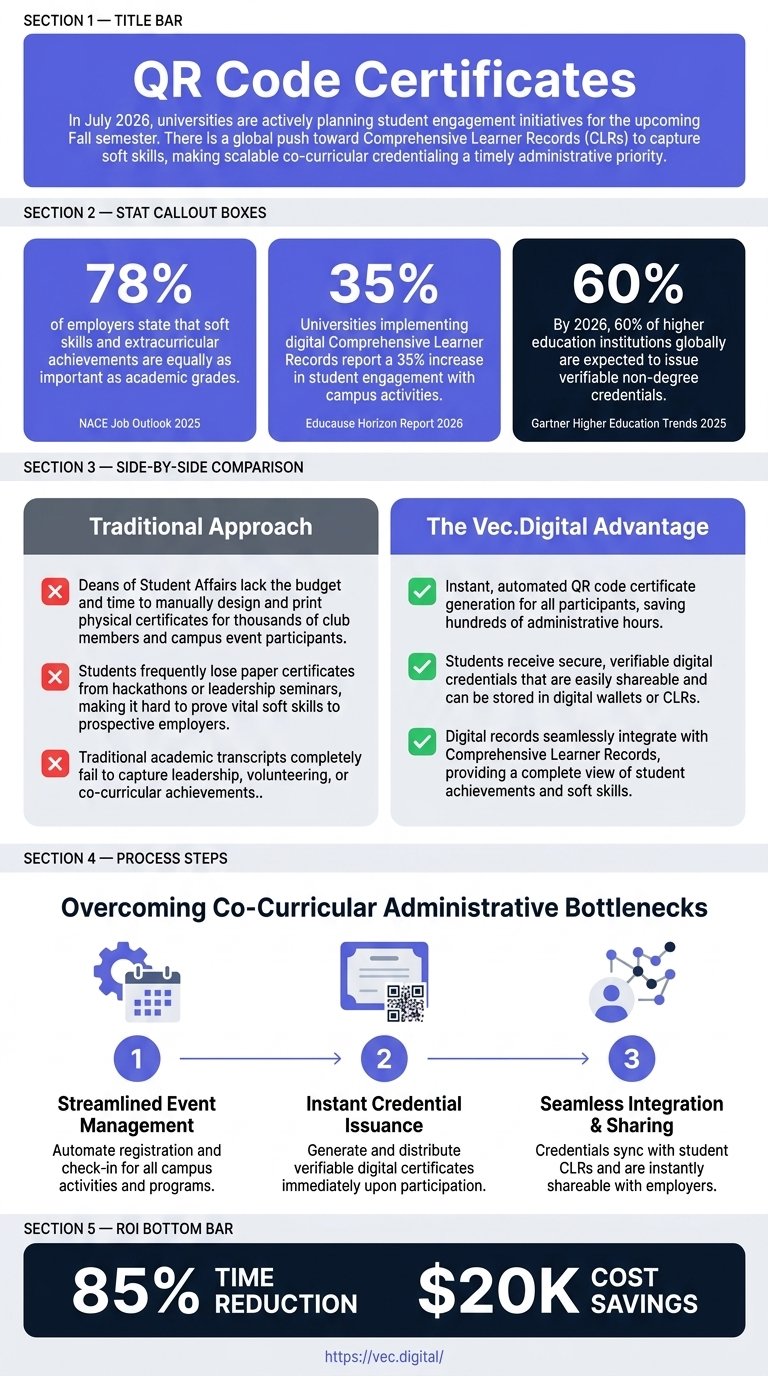
78% of employers state that soft skills and extracurricular achievements are equally as important as academic grades (NACE Job Outlook, 2025). Despite this demand, traditional academic transcripts completely fail to capture leadership, volunteering, or co-curricular achievements, leaving institutions struggling to validate these vital experiences. Implementing QR code certificates offers a modern, scalable solution to digitize and authenticate every aspect of student campus life.
In this comprehensive guide, our technology experts at Vec.Digital explore how global institutions are revolutionizing their credentialing systems. You will discover how to eliminate administrative bottlenecks, seamlessly digitize co-curricular records, and significantly boost student engagement using an automated issuance engine. By standardizing non-degree awards, your institution can empower learners with verifiable proof of their real-world capabilities.
Key Takeaways
- Comprehensive learner records are replacing traditional transcripts by capturing essential soft skills and extracurricular participation.
- Automated bulk certificate generator tools reduce administrative issuance time by up to 80% per semester.
- Dynamic QR code certificates eliminate CV inflation by providing employers with instant, app-free verification of student achievements.
- Implementing a professional digital certificate maker allows campus clubs and societies to issue on-brand, secure awards effortlessly.
- Digitizing co-curricular records directly correlates with a measurable increase in student engagement tracking and campus participation.
The Shift Toward Comprehensive Learner Records (CLR)
For decades, the university transcript has been the undisputed gold standard of academic achievement. However, as the global job market evolves, employers are increasingly looking beyond mere letter grades. They are searching for adaptable problem solvers, proven leaders, and effective communicators. This paradigm shift has catalyzed the development of the Comprehensive Learner Record (CLR), a holistic digital portfolio that captures a student's entire educational journey, both inside and outside the lecture hall. To support this evolution, universities are rapidly adopting QR code certificates to document everything from hackathon victories to student government leadership.
Most higher education credential resources focus entirely on protecting formal degree diplomas from fraud. While securing a bachelor's or master's degree is undeniably critical, there is a significant knowledge gap in how to efficiently manage, issue, and verify the thousands of non-degree, co-curricular certificates that make up a modern CLR. These extracurricular awards are the building blocks of a student's professional narrative, yet they are often relegated to easily lost pieces of paper or unverified lines on a resume. By digitizing these awards, institutions can provide a complete, verifiable picture of student competency.
What is a Comprehensive Learner Record (CLR)?
A Comprehensive Learner Record is an official, secure digital document that encompasses all of a student's learning experiences, achievements, and competencies. Unlike a traditional transcript, which only lists course names and grades, a CLR provides detailed context about the skills acquired during a student's tenure at the institution. This includes internships, laboratory research, community service, peer mentoring, and participation in academic societies. By utilizing a secure digital credential system, universities can ensure that every entry in the CLR is backed by cryptographic proof.
The implementation of CLRs is not just a regional trend; it is a global movement. Frameworks like the European Digital Credentials for Learning (EDC) and the US-based CLR standard are pushing institutions worldwide to document learning outside the traditional classroom. Furthermore, Asian and Middle Eastern universities are rapidly adopting paperless campus initiatives, making digitized student life credentials a worldwide administrative priority. As these standards converge, the ability to issue universally recognized, machine-readable credentials will become a baseline requirement for competitive global universities.
The Global Push for Verifiable Digital Credentials
The transition toward holistic student records is accelerating at an unprecedented pace. By 2026, 60% of higher education institutions globally are expected to issue verifiable non-degree credentials (Gartner Higher Education Trends, 2025). This massive adoption rate underscores a fundamental truth: the modern educational experience is highly decentralized. Learning happens in makerspaces, during weekend coding bootcamps, and through volunteer initiatives. Capturing these moments requires a technology infrastructure that is agile, secure, and infinitely scalable.
Institutions that fail to adopt verifiable digital credentials risk leaving their graduates at a distinct disadvantage in the global talent pool. When an employer reviews a resume, they need immediate, irrefutable proof that the candidate actually possesses the skills they claim. Traditional paper certificates cannot provide this assurance. By anchoring co-curricular achievements to a secure digital infrastructure, universities empower their students to present a verified, tamper-proof portfolio that stands up to the most rigorous background checks, thereby elevating the institution's overall reputation for producing high-quality, career-ready graduates.
Overcoming Co-Curricular Administrative Bottlenecks
While the pedagogical benefits of Comprehensive Learner Records are clear, the operational reality of issuing thousands of non-degree awards can be daunting. Deans of Student Affairs and campus event directors often lack the budget, staff, and time to manually design, print, and distribute physical certificates for every club member, seminar attendee, and campus event participant. This administrative bottleneck frequently results in delayed recognition or, worse, achievements going entirely undocumented. Transitioning to QR code certificates fundamentally resolves this operational friction.
The traditional method of credentialing involves graphic designers, specialized printing paper, physical signatures, and complex logistical distribution. This outdated sequence is not only expensive but also highly susceptible to human error. When a student's name is misspelled on a paper certificate, the entire costly process must be repeated. Modernizing this system through automated technology allows administrative staff to redirect their valuable time toward actual student development and campus engagement initiatives, rather than acting as a localized printing press.
Why Paper Awards Are Failing Modern Students
Paper certificates are fundamentally incompatible with the digital realities of the modern workforce. Students frequently lose paper certificates from hackathons or leadership seminars, making it incredibly hard to prove vital soft skills to prospective employers months or years later. Furthermore, a physical piece of paper cannot be natively shared on professional networking platforms like LinkedIn, nor can it be easily attached to an online job application without cumbersome scanning processes.
The environmental impact of paper-based credentialing also contradicts the sustainability goals of most modern institutions. By moving to a cloud-based issuance system, universities align their administrative practices with global sustainability initiatives. More importantly, the data proves that the primary stakeholders—the students themselves—are demanding this digital transformation. According to the Student Voice Survey by Inside Higher Ed (2024), 92% of students prefer digital, easily shareable credentials over paper awards for extracurricular participation. Meeting this expectation is crucial for maintaining high student satisfaction and institutional relevance.
How to Track Student Engagement Using Digital Badges
One of the most significant advantages of digitizing campus awards is the unprecedented visibility it provides into student life. Student engagement tracking becomes a seamless byproduct of the credentialing process. When an institution issues digital badges for attending workshops, leading student organizations, or completing mental health first-aid training, administrators gain real-time data on which programs are thriving and which demographics are actively participating in campus life.
This data-driven approach allows universities to allocate budgets more effectively and identify at-risk students who may be disengaged from the campus community. Furthermore, the efficiency gains are staggering. Institutions using automated certificate systems reduce administrative issuance time by up to 80% per semester (EdTech Impact Review, 2025). This massive reduction in administrative overhead means that tracking student engagement is no longer a labor-intensive chore, but an automated, insightful system that continuously enriches the institution's understanding of its student body.
The Mechanics of QR Code Certificates in Higher Education
At the heart of this digital transformation is the technology that makes verification instantaneous and foolproof. QR code certificates embed a unique, scannable matrix directly onto the digital or printed award. When scanned by any standard smartphone camera, this code routes the user to a dedicated, secure public verification page hosted by the issuing institution. This page displays the recipient's name, the specific achievement, the date of issuance, and the cryptographic proof of authenticity, ensuring that the credential cannot be altered or forged.
This seamless verification mechanism is critical for bridging the trust gap between universities and employers. In the past, verifying a student's claim that they were the president of the debate club or the winner of a regional coding competition required tedious phone calls or emails to faculty advisors—a process most employers simply skip. By embedding a verification portal directly into the credential, universities provide a frictionless auditing experience that instantly validates the student's extracurricular narrative.
What Are the Benefits of QR Code Certificates for University Students?
For students, the benefits of holding QR-verified credentials are transformative. Primarily, it provides them with an irrefutable digital locker of their achievements that they can access from anywhere in the world. Whether they are applying for a highly competitive internship in London or a graduate program in Tokyo, their credentials travel with them, securely hosted and instantly verifiable. This global accessibility eliminates the anxiety of losing critical proof of their hard-earned skills.
Furthermore, QR code verification directly combats the pervasive issue of CV inflation. Because verifying non-degree campus awards is currently difficult for employers, unverified student claims have become unfortunately common. When a student presents a credential equipped with a QR code, they immediately signal to the employer that their achievements are authentic, institution-backed, and completely transparent. This verifiable proof of soft skills—such as teamwork, leadership, and project management—gives them a distinct competitive advantage in crowded applicant pools.
How Can Universities Issue Certificates for Extracurricular Activities?
Issuing these credentials must be an effortless administrative sequence, or campus leaders will simply refuse to adopt the technology. The process begins with standardizing the criteria for non-degree awards across the university. Once the parameters for a hackathon victory or a leadership seminar are defined, administrators can utilize a centralized platform to design the visual asset. Using dynamic data fields, the system automatically populates the recipient's name, the date, and the specific achievement details.
From there, the issuance engine takes over. Instead of manually typing out hundreds of names, event organizers can upload a simple CSV file containing the participant roster. The system processes this data, generates unique QR codes for every individual, anchors the records securely, and automatically emails the digital credentials directly to the students' inboxes. This automated process ensures that awards are delivered within minutes of an event concluding, capitalizing on the peak moment of student excitement and pride.
Implementing a Scalable Digital Certificate Maker
To successfully digitize a university's entire co-curricular ecosystem, the underlying technology must be both powerful and user-friendly. A professional digital certificate maker serves as the creative and operational hub for this initiative. It allows universities to maintain strict brand guidelines—ensuring that every award features the correct institutional logos, colors, and typography—while simultaneously decentralizing the actual issuance process to trusted club presidents, faculty advisors, and event coordinators.
This balance of centralized branding and decentralized operation is crucial for scale. A university might host hundreds of distinct events in a single semester. If every certificate must be designed and approved by a single central marketing office, the system will inevitably collapse under its own weight. By utilizing a platform with role-based access control and pre-approved design templates, institutions empower their campus leaders to recognize student achievements rapidly and securely.
What is the Best Certificate Maker for University Clubs and Societies?
The ideal solution for higher education must go beyond simple graphic design. The best platforms combine an intuitive, drag-and-drop visual editor with enterprise-grade data security. When evaluating tools for campus use, decision-makers should look for systems that offer hundreds of professional templates, support custom background uploads, and feature automated dynamic fields. This ensures that a student engineering society can create a vastly different visual award than the university's fine arts department, while both remain securely verifiable under the institution's overarching digital umbrella.
Moreover, the platform must require zero technical expertise from the end-user. A faculty advisor organizing a weekend volunteer drive should not need to understand cryptographic hashing or database management to issue an award. They simply need to select a template, upload their participant list, and click issue. The underlying technology must silently handle the complex security anchoring and QR code generation, providing a frictionless experience that encourages widespread campus adoption.
Leveraging a Bulk Certificate Generator for Campus Events
For massive campus events—such as freshman orientation, university-wide hackathons, or graduating senior leadership galas—manual data entry is a mathematical impossibility. This is where a bulk certificate generator becomes an indispensable administrative asset. By allowing organizers to process thousands of records simultaneously via CSV upload or direct API integration with the university's existing student information system, the platform eliminates days of tedious administrative labor.
This bulk capability ensures that no student is left behind. Every participant, whether there are fifty or five thousand, receives their personalized, verified credential simultaneously. This speed of delivery is highly correlated with student satisfaction and social sharing. When students receive an award immediately following an event, they are significantly more likely to share that achievement on professional networks, organically boosting the university's brand visibility and demonstrating the vibrant reality of campus life to prospective applicants and alumni donors.
Bridging the Gap Between Campus Life and Employability
Ultimately, the purpose of higher education is to prepare students for successful, impactful careers. The Comprehensive Learner Record is the bridge that connects the vibrant, multifaceted reality of campus life with the rigid, data-driven demands of global employers. By utilizing QR code certificates to document this journey, universities transition from being mere granters of degrees to lifelong partners in their students' professional development.
This technological upgrade has profound implications for institutional success metrics. When students see that their extracurricular efforts are formally recognized and highly valued by employers, their motivation to participate in campus life skyrockets. Universities implementing digital Comprehensive Learner Records report a 35% increase in student engagement with campus activities (Educause Horizon Report, 2026). This data proves that verifiable recognition is a powerful catalyst for building a thriving, active, and deeply connected student body.
How Do You Digitize Co-Curricular Records in Higher Education?
Digitizing co-curricular records requires a strategic, phased approach. Institutions should begin by auditing their existing non-degree awards. Identify the high-value programs—such as leadership institutes, peer tutoring programs, and major academic competitions—and transition these to a secure digital platform first. Establish clear criteria for what constitutes a verifiable achievement, ensuring that every issued credential represents a genuine, measurable acquisition of skill or experience.
Next, integrate the credentialing platform with the university's broader IT ecosystem. Modern higher education technology relies heavily on interconnected systems. By utilizing REST APIs, universities can connect their digital certificate platform directly to their Learning Management Systems (LMS) or student engagement portals. This creates a seamless, automated flow of data where a student's completion of an online compliance module or attendance at a mandatory seminar automatically triggers the issuance of a verified digital badge, requiring zero manual intervention from administrative staff.
Providing Proof of Soft Skills to Global Employers
The final, and perhaps most critical, step in this digital transformation is educating students on how to leverage their new credentials. A Comprehensive Learner Record is only valuable if it is utilized in the job market. Universities must integrate digital credential management into their career services programming. Teach students how to embed their QR-verified awards into their digital resumes, how to showcase them on LinkedIn, and how to articulate the value of these verified soft skills during job interviews.
When an employer scans a student's credential and instantly views the verified details of their leadership in a campus society or their technical prowess in a hackathon, trust is immediately established. This transparent, technologically backed proof of competency is exactly what the modern workforce demands. By providing this infrastructure, universities ensure that their graduates are not just academically proficient, but demonstrably equipped with the diverse skill sets required to lead in the global economy.
Transform Your Campus Credentials with Vec.Digital
The era of relying solely on the traditional academic transcript is over. To accurately reflect the dynamic, multifaceted capabilities of modern students, institutions must embrace the Comprehensive Learner Record. By standardizing and securing co-curricular achievements through automated technology, universities can eliminate administrative bottlenecks, eradicate CV inflation, and provide their graduates with the irrefutable proof of soft skills that global employers demand.
At Vec.Digital, we provide the comprehensive infrastructure required to bring your institution's digital credentials into the future. Our all-in-one platform features a powerful drag-and-drop certificate maker, automated bulk issuance capabilities, and immutable verification technology designed specifically for the demands of high-volume global issuers. Empower your administrative teams, engage your student body, and protect your institutional reputation with our seamless, secure credentialing system.
Ready to scale your university's learner records and eliminate manual credentialing processes? Connect with our technology experts today to start issuing verifiable digital awards with confidence.
Website: https://vec.digital/ Email: support@vec.digital