
Secure Digital Diplomas for Universities in 2026: Preventing Credential Fraud
Published on May 23, 2026

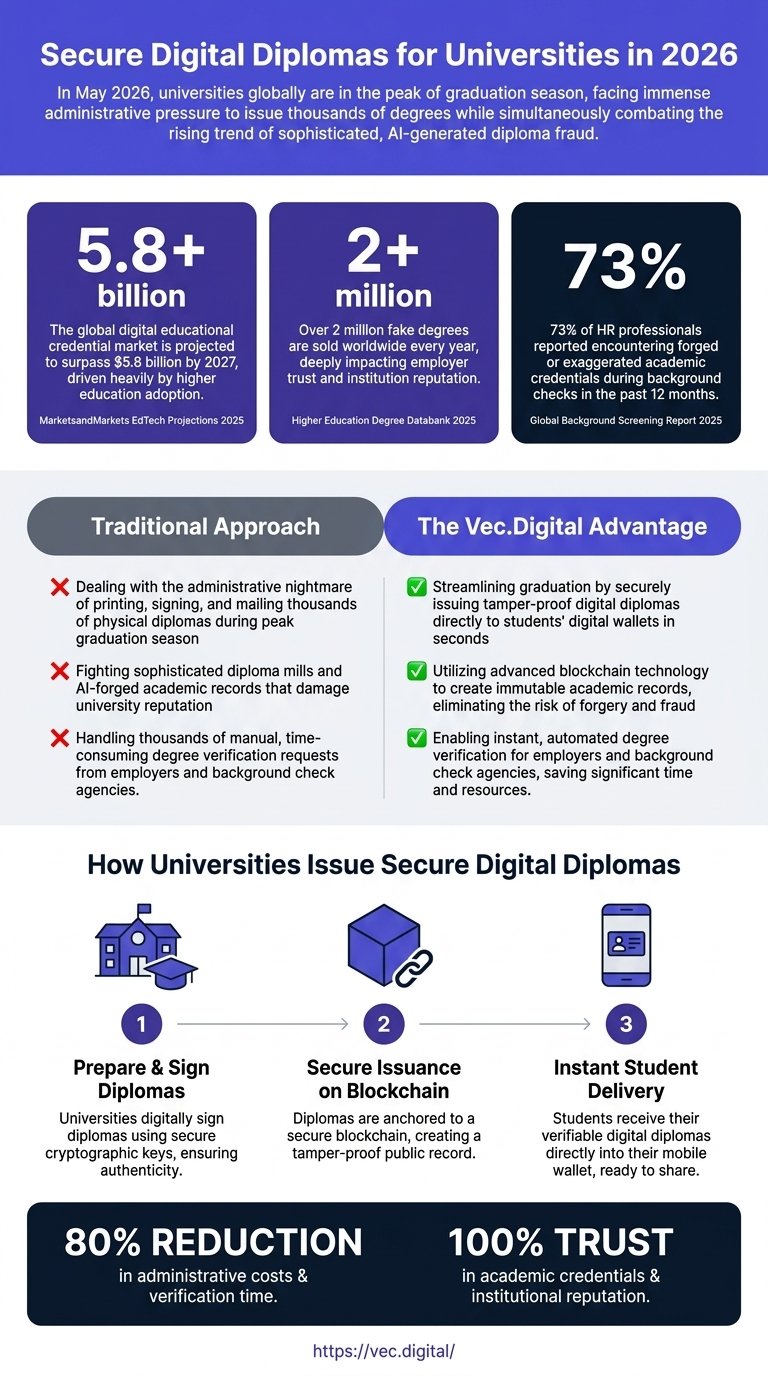
Over 2 million fake degrees are sold worldwide every year, deeply impacting employer trust and institution reputation (Higher Education Degree Databank, 2025). As graduation seasons approach, academic registrars and IT directors face the dual challenge of processing thousands of authentic credentials while simultaneously defending their institution's legacy against an onslaught of sophisticated, AI-generated forgeries. The traditional paper-based methods of the past are no longer sufficient to protect the integrity of higher education. Implementing secure digital diplomas for universities has transitioned from a technological luxury to an absolute administrative necessity.
In this comprehensive guide, we explore how modernizing your credentialing system can permanently eradicate diploma fraud, drastically reduce administrative overhead, and empower your graduates on the global stage. By leveraging advanced automation and cryptography, our team at Vec.Digital helps institutions bridge the gap between legacy paper processes and the future of educational technology. You will learn how to seamlessly integrate blockchain anchoring, utilize instant QR code verification, and deploy scalable issuance systems that save time and secure your university's reputation for decades to come.
Key Takeaways
- Secure digital diplomas for universities eliminate the risk of sophisticated AI-forgeries and diploma mills.
- Implementing blockchain certificate verification guarantees the immutability and global trustworthiness of academic records.
- Embedding QR code certificates allows employers to instantly authenticate degrees without relying on slow manual checks.
- Utilizing a bulk certificate generator reduces administrative issuance time by up to 85% during peak graduation seasons.
- Adopting verifiable digital credentials aligns institutions with global compliance standards and international student mobility initiatives.
The Rising Threat of Credential Fraud in Higher Education
The landscape of academic fraud has evolved rapidly. Today, creating secure digital diplomas for universities is the primary defense against a highly organized, technologically advanced counterfeiting industry. Traditional paper diplomas, with their embossed seals and specialized parchment, are no longer the impenetrable barriers they once were. High-resolution scanners, advanced graphic design software, and artificial intelligence have democratized forgery, allowing illicit actors to replicate complex academic documents with alarming accuracy.
This reality forces institutions to confront the administrative nightmare of fighting sophisticated diploma mills and AI-forged academic records that directly damage university reputation. When a counterfeit degree enters the job market bearing an institution's name, the fallout extends beyond the individual fraudster. It slowly erodes the perceived value of every legitimate degree issued by that university, ultimately harming the career prospects of honest, hard-working alumni.
The Cost of Diploma Mills and AI-Forged Academic Records
Diploma mills operate as highly lucrative global enterprises, exploiting the gap between traditional credentialing and modern verification needs. These illicit organizations do not simply print fake papers; they often create elaborate, fabricated verification websites designed to mimic legitimate university portals. The sheer scale of this problem is staggering. As noted earlier, the Higher Education Degree Databank (2025) reports that over 2 million fake degrees are sold worldwide every year. This massive influx of fraudulent documents creates an environment of skepticism and distrust in the global hiring market.
Furthermore, the advent of generative AI has allowed fraudsters to bypass basic digital security measures. A standard PDF diploma, even one that is password-protected, can be easily manipulated or entirely recreated using modern tools. Academic institutions must recognize that static digital files are just as vulnerable as physical paper. To truly combat this threat, universities must adopt dynamic, cryptographically secure systems that render forgery mathematically impossible.
How Forgeries Impact Employer Trust and University Reputation
The burden of credential fraud falls heavily on the corporate sector, which in turn impacts how universities are perceived. According to the Global Background Screening Report (2025), a staggering 73% of HR professionals reported encountering forged or exaggerated academic credentials during background checks in the past 12 months. When employers repeatedly encounter fake degrees from a specific region or institution, they may begin to view all candidates from those sources with undue suspicion.
This loss of trust has real-world consequences. A university's prestige is intrinsically linked to the employability of its graduates. If a corporate compliance officer cannot trust the validity of an applicant's academic background, the candidate may be passed over for a role, regardless of their actual qualifications. Protecting the institution's brand means ensuring that every employer can verify the authenticity of a degree with absolute certainty and zero friction.
The Administrative Burden of Manual Degree Verification
Beyond the reputational damage, credential fraud creates a massive operational bottleneck for academic registrars. Universities are currently handling thousands of manual, time-consuming degree verification requests from employers, background check agencies, and foreign governments. Each request typically requires a staff member to access legacy databases, manually cross-reference student records, and draft official confirmation letters.
This manual process is not only expensive but also painfully slow, often taking weeks to complete. In a fast-paced global economy, a delayed verification can cost a graduate a lucrative job offer or a crucial visa approval. By transitioning to automated, self-verifying credentials, universities can eliminate this administrative burden entirely, allowing their staff to focus on higher-value student services rather than acting as full-time human authenticators.
How Universities Issue Secure Digital Diplomas
One of the most common questions academic leaders ask is: How do universities issue digital diplomas securely? The answer lies in moving away from easily manipulated file formats and embracing immutable cryptographic technologies. To deploy secure digital diplomas for universities, institutions must adopt a comprehensive digital certificate maker that integrates directly with their existing student information systems while anchoring the final output to a secure ledger.
The process begins with the secure extraction of graduate data. Using an automated API connection or a secure CSV upload, the university transfers the verified student names, degree classifications, and graduation dates into the credentialing system. The system then populates professionally designed templates, applies the necessary digital signatures from the Dean or Chancellor, and generates a unique cryptographic hash for each individual document before it is distributed to the student's digital locker.
Moving Beyond Basic PDF Generation
For years, many institutions mistakenly believed that emailing a PDF to a student constituted a "digital diploma." However, a standard PDF offers no inherent security. It can be opened in any vector graphics editor, where names, dates, and grades can be altered without leaving a visible trace. To solve this, a modern digital certificate maker must offer more than just visual design capabilities; it must provide a structural security layer.
Modern platforms utilize advanced encryption to ensure that the document itself cannot be altered post-issuance. If even a single pixel or character is changed by a malicious actor, the cryptographic signature is broken, and the document immediately flags as invalid during any verification attempt. This shift from visual representation to cryptographic proof is the foundation of modern academic credentialing.
What is a Blockchain Verifiable Credential in Education?
When discussing academic security, people frequently ask: What is a blockchain verifiable credential in education? In simple terms, it is a digital record of achievement that is anchored to a decentralized, public ledger. When a university issues a degree, the credentialing platform generates a unique mathematical fingerprint (a hash) of that specific document and records it on the blockchain. Because the blockchain is immutable—meaning it cannot be altered, deleted, or hacked by any single entity—that record serves as permanent, indisputable proof of the degree's origin and authenticity.
The adoption of this technology is accelerating rapidly. The Digital Credentials Consortium (2026) reports that institution adoption of blockchain-based verifiable credentials grew by 42% globally in the last two academic years. This surge is driven by the realization that blockchain provides a "trustless" environment. Employers do not need to trust the student, nor do they need to contact the university; they only need to trust the mathematics of the blockchain to confirm the document is legitimate.
Are Digital Certificates Safe from Forgery?
Another critical question is: Are digital certificates safe from forgery? The answer is unequivocally yes, provided they are built on the right technological framework. When a credential is appropriately anchored and digitally signed, it becomes mathematically impossible to forge. If a fraudster attempts to create a fake diploma that looks identical to a legitimate one, the underlying cryptographic hash will not match the official record on the blockchain.
Furthermore, if a university needs to revoke a degree—due to academic misconduct or administrative error—they can update the credential's status on the ledger. Any subsequent verification attempt will instantly show that the document has been revoked, providing real-time accuracy that physical paper could never achieve.
The Power of Blockchain Certificate Verification and QR Codes
To maximize the value of secure digital diplomas for universities, the verification process must be as frictionless as the issuance process. This is where the combination of blockchain certificate verification and dynamic QR codes becomes revolutionary. While the blockchain provides the underlying security, the QR code acts as the accessible, user-friendly bridge that allows anyone, anywhere in the world, to authenticate the document in seconds.
This seamless integration solves one of the most persistent challenges in global hiring: cross-border verification. When an employer in Singapore needs to verify a degree issued by a university in London, they no longer need to navigate time zones, language barriers, or complex international postal systems. The entire process is reduced to a simple scan from a smartphone camera.
How Do Employers Verify Digital Degrees Instantly?
Registrars frequently field the question: How do employers verify digital degrees instantly? The process is designed to require zero technical expertise from the verifier. When a graduate shares their digital diploma—whether as a downloaded file, a link on their LinkedIn profile, or a printed copy—the employer simply clicks the secure link or scans the embedded QR code.
This action instantly routes the employer to a dedicated, university-branded public verification page. This page displays the recipient's details, the degree awarded, the issue date, and the verified signatory details. Most importantly, the page runs a real-time check against the blockchain ledger, displaying a prominent "Verified" badge if the cryptographic hash matches. No accounts, no apps, and no waiting periods are required.
Can a QR Code Be Used to Verify a University Certificate?
Yes, and it is rapidly becoming the global standard. Can a QR code be used to verify a university certificate? Absolutely. QR code certificates bridge the physical and digital worlds perfectly. Even if a student chooses to print their digital diploma to frame and hang on a wall, the QR code remains functional. An auditor or employer can walk up to the physical piece of paper, scan the code with their mobile device, and instantly view the immutable digital record.
This dynamic functionality ensures that the security travels with the document, regardless of its format. It completely neutralizes the threat of high-quality physical forgeries, because a fake printed diploma will either have a dead QR code or a code that links to an unverified, easily debunked external site rather than the official blockchain ledger.
Facilitating Global Student Mobility
The push for secure, verifiable records is not happening in a vacuum. It is part of a broader global movement toward standardized digital academic records. Initiatives like the Bologna Process in Europe and various mandates by APAC education ministries are actively pushing for cross-border student mobility. These international frameworks require academic credentials to be instantly verifiable across different jurisdictions to facilitate employment and further education.
By adopting blockchain verification, universities ensure their graduates are never hindered by bureaucratic red tape when moving abroad. A verifiable digital credential acts as a universal academic passport, recognized and trusted by international employers and foreign academic institutions alike, thereby significantly enhancing the global value of the university's degree programs.
Streamlining Graduation with a Bulk Certificate Generator
While security is paramount, operational efficiency is equally critical for university administrators. Issuing secure digital diplomas for universities at scale requires robust automation. During peak graduation season in May and June, registrars face the monumental task of processing thousands of records simultaneously. A powerful bulk certificate generator is the engine that drives this transformation, turning a multi-week ordeal into a task that takes mere minutes.
The transition from manual processing to automated issuance is one of the most impactful digital transformations an institution can undertake. It frees up valuable administrative resources, reduces human error, and ensures that students receive their hard-earned credentials the moment their graduation is finalized.
Eliminating the Nightmare of Printing, Signing, and Mailing
For decades, universities have suffered through the administrative nightmare of printing, signing, and mailing thousands of physical diplomas. This process involves coordinating with specialized printing vendors, organizing massive signing sessions for university officials, and navigating the logistics and high costs of international shipping. Furthermore, physical mail is prone to delays, damage, and loss.
By utilizing an automated system, universities bypass these physical bottlenecks entirely. EdTech Transformation Insights (2026) found that universities utilizing automated bulk digital certificate generators reduce their administrative issuance time by up to 85% compared to paper processing. This massive reduction in labor and material costs allows institutions to reallocate budgets toward student success initiatives rather than postal fees.
What is the Best Bulk Certificate Generator for Higher Education?
When evaluating technology partners, IT directors often ask: What is the best bulk certificate generator for higher education? The ideal solution must combine high-volume processing capabilities with enterprise-grade security. It should allow administrators to upload a simple CSV file containing thousands of student records, map those records to custom dynamic fields within a branded template, and issue the credentials simultaneously with a single click.
Furthermore, the best platforms offer REST API capabilities, allowing the credentialing system to integrate directly with the university's Learning Management System (LMS) or Student Information System (SIS). This ensures that data flows securely and automatically from the registrar's database directly to the blockchain, eliminating manual data entry and the associated risk of typographical errors.
Empowering Graduates with Instantly Shareable Records
Another major pain point for institutions is dealing with alumni who have lost their paper diplomas and require costly, slow replacement processes to prove their qualifications. Traditional replacement requests can take weeks to fulfill and often require the alumni to pay hefty administrative fees.
Digital credentials solve this problem permanently. Graduates receive a secure digital locker where their achievements are stored indefinitely. They can never "lose" a blockchain-anchored diploma. Furthermore, these credentials are designed for the modern professional landscape. With built-in social sharing features, graduates can instantly post their verified achievements to platforms like LinkedIn, providing immediate, verifiable proof of their skills to prospective employers worldwide.
A Practical Guide to Transitioning Your Institution
Transitioning to secure digital diplomas for universities may seem like a daunting technological leap, but with the right strategy, it is a smooth and highly rewarding process. The goal is not to disrupt existing operations, but to augment them with modern verifiable digital credentials. By following a structured approach, academic leaders can secure stakeholder buy-in, implement the technology seamlessly, and begin reaping the benefits of automated, secure issuance.
The global digital educational credential market is projected to surpass $5.8 billion by 2027, driven heavily by higher education adoption (MarketsandMarkets EdTech Projections, 2025). Institutions that act now will position themselves as forward-thinking leaders in academic integrity, while those that delay risk falling behind in a rapidly standardizing global landscape.
Assessing Your Current Issuance System
The first step in the transition is a thorough assessment of your current credentialing operations. Identify the specific bottlenecks in your graduation workflow. How much time and money is spent on printing and postage? How many labor hours are dedicated to answering manual verification requests from background check agencies? Documenting these pain points will help you build a compelling business case for digital transformation.
Next, evaluate your data infrastructure. Ensure that your student information systems can reliably export clean, accurate graduate data via CSV or API. The success of a digital issuance program relies heavily on the accuracy of the data being fed into the system. Clean data ensures that every digital diploma generated is perfectly accurate and ready for immediate blockchain anchoring.
Implementing an Automated Process for Verifiable Digital Credentials
Once your data is prepared, the next phase is implementation. Partner with a specialized digital credentialing platform that understands the unique needs of higher education. Begin by utilizing the platform's design tools to recreate your traditional paper diploma in a digital format. High-quality platforms allow you to upload your institution's specific fonts, logos, and high-resolution background imagery to ensure the digital version carries the exact same prestige and visual weight as the physical parchment.
After the templates are finalized, establish your signatory approval engine. Modern platforms allow you to set up secure, multi-step approval processes where Deans and Registrars can review and digitally sign off on batches of credentials before they are published. Once approved, the system takes over, anchoring the documents to the blockchain, generating the unique QR codes, and automatically emailing the secure access links directly to the graduating students.
Meeting Global Compliance and Sustainability Goals
Beyond security and efficiency, transitioning to digital credentials aligns your university with critical global sustainability initiatives. The environmental impact of printing, packaging, and globally shipping thousands of heavy parchment documents every semester is substantial. By moving to a paperless issuance system, universities drastically reduce their carbon footprint, actively supporting the United Nations Sustainable Development Goals.
This commitment to sustainability, combined with the adoption of cutting-edge cryptographic security, sends a powerful message to prospective students, alumni, and global partners. It demonstrates that your institution is not only dedicated to academic excellence but is also a responsible, innovative leader in the modern digital economy.
Secure Your Institution's Legacy with Vec.Digital
The era of vulnerable paper certificates and easily forged PDFs is coming to an end. As the global job market demands faster, more reliable proof of academic achievement, universities must rise to the occasion. By adopting secure digital diplomas backed by blockchain technology and instant QR verification, your institution can permanently eliminate credential fraud, drastically reduce administrative workloads, and provide your graduates with the modern, shareable assets they need to succeed.
At Vec.Digital, we specialize in providing effortless, high-volume digital certification and verification at scale. Our comprehensive platform empowers academic registrars to design stunning credentials, automate bulk issuance, and secure every document on an immutable ledger—all with zero technical friction. Protect your university's reputation and empower your students with credentials that the world can trust.
Ready to modernize your graduation process? Discover how our platform can transform your credentialing operations today.
Website: https://vec.digital/
Email: support@vec.digital